10 Practical Ways to Reduce Agent Burnout in Call Centers

14 mins read

Posted on Aug 14, 2026

Saravana Kumar
SEO


Saravana Kumar
SEO






It’s easy to hit call targets on paper while wearing out your representatives. Handling angry callers and repeating basic answers all day, with no time to reset, will burn out even your best staff.
That’s why call center agent burnout is more than an employee wellbeing concern. When fatigue builds, performance can suffer, absenteeism can rise, and experienced agents may leave. The cost then extends to the business through recruitment, training, and the time needed to get new agents up to speed.
The problem is widespread. ICMI reports that only 54% contact-center agents in its 2024 research stayed for more than 2 years, showing how difficult retention can be in the industry.
Burnout doesn’t have a single cause, so there’s no single fix. Better workload planning, smarter routing, protected breaks, useful technology, supportive coaching, and consistent recognition can all help.

Key Takeaways
 Agent burnout usually stems from sustained workload, repetitive tasks, emotional pressure, insufficient recovery time, and a lack of support.
- Cut repetitive workload by letting your IVR and routing rules handle routine questions automatically.
- Use call analytics to set realistic targets that show actual call workload and the wrap-up time.
- Protect breaks and recovery time, especially during high-volume periods.
- Reduce after-call work with AI call summaries and transcription.
- Give agents useful performance visibility and real-time support via Whisper and Barge-In for difficult calls that need intervention.
- Rotate demanding call types where possible and recognize improvement - not just top performers.
- Use exit interviews and operational data to detect recurring patterns of burnout.
- Technology can lessen operational pressure, but management practices still play a major role in preventing burnout.
Understanding What Causes Call Center Agent Burnout
Before choosing a solution, managers need to understand what’s actually putting pressure on agents. Four common causes stand out:
- Volume pressure: Back-to-back calls leave little time to recover between conversations.
- Emotional exhaustion: Handling upset calls all day can wear down an agent's patience and focus.
- Lack of control: Bad routing rules and strict scripts leave agents feeling stuck when helping callers.
- Invisible effort: Concentrating exclusively on missed targets makes agents feel like their routine contributions do not matter.
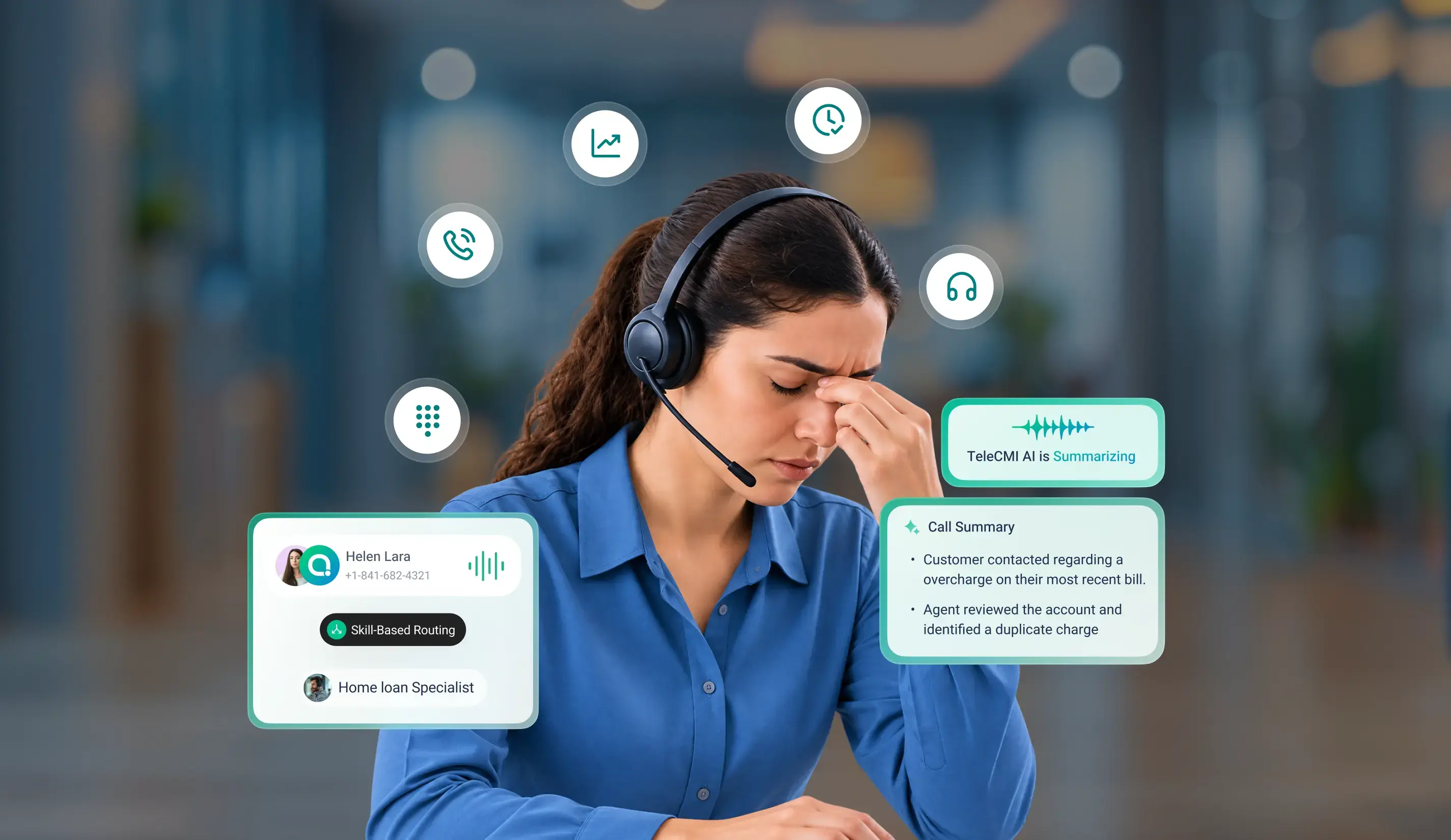
- Smart IVR handles routine questions: skill routing prevents unnecessary transfers; analytics clarify real workloads; and AI handles tedious call logging.
Other causes need management action, including realistic targets, protected breaks, recognition, coaching, and staffing. These together form practical call center burnout solutions.
Way 1: Use IVR to Reduce Unnecessary Call Volume on Agents
Your agents shouldn't spend their day answering basic questions about store hours or simple account updates.
A clean IVR system lets callers resolve routine tasks on their own or routes them directly to the right department. The key is keeping the menu simple. Long, confusing IVR flows can create more frustration rather than reduce workload.
For example, callers can select billing, technical support, or another common request and follow a relevant flow. TeleCMI supports Multi-Level IVR, call lines, customized greetings, and call routing. Its IVR capabilities can be used to structure calls around departments and business requirements rather than sending every caller directly to an available agent.
The goal isn't to replace agents. It's to save their time for conversations that need human support.

According to Zendesk, 4 in 10 agents say customers become angry when they can't complete tasks on their own - a problem a well-designed self-service IVR can help prevent.
Way 2: Implement Skill-Based Call Routing
A customer who reaches the wrong agent often creates more work for everyone.
A billing question handled by someone without billing expertise may lead to a transfer. A technical issue sent to a general support agent may require escalation. A language-specific request may need another handoff.
Skill-based routing reduces some of this difficulty by matching calls to agents based on their skills or the interaction's requirements.
For example:
- Billing queries can go to billing-trained agents.
- Technical issues can reach technical support.
- Priority customers can be routed to an appropriate senior team.
- Language requirements can be matched with agents capable of handling them.
TeleCMI supports skill-based routing, as well as routing based on factors such as shifts and caller ID.
This matters for agent burnout prevention because agents spend more time on conversations they're trained and prepared to resolve. It can also reduce avoidable transfers and escalations, which are frustrating for both agents and customers.
Way 3: Set Realistic Call Volume Targets Based on Data
A daily call target might seem reasonable in a manager's meeting, yet feel impossible on the floor.
Call count alone doesn't tell you how much work an agent is handling. A five-minute routine call and a 25-minute escalation shouldn't carry the same operational weight simply because each counts as one call.
When setting targets, you should look at:
- Average handle time
- After-call work
- Call complexity
- Queue volume
- Peak periods
- Agent availability
- Break and non-call time
Most managers already gather this operational data. ICMI research shows that statistics such as average handle time, abandonment rate, quality, and speed of answer remain among the most consistently measured across contact centers.
The useful step is to connect those numbers to workload rather than using a single metric to define performance.
TeleCMI's live dashboard provides visibility into call flows, agent occupancy, SLAs, and KPIs, while its call analytics helps managers identify call patterns and performance tendencies.
That doesn't mean analytics will automatically tell you the perfect number of calls an agent should be handling. Managers still have to interpret the data alongside call complexity, staffing levels, and team feedback.
Way 4: Build Structured Breaks Into the Schedule
If you keep pulling agents off from breaks whenever call volume increases, it will drain agents faster. So it is good to maintain strict break schedules by staggering them around periods of high volume. This gives representatives a short buffer period to reset after resolving difficult, high-stress calls.
Repeatedly pushing back break times is an operational red flag. It may point to volume forecasting or a capacity issue that needs immediate attention.
Managing break schedules is ultimately up to leadership. Technology gives you the visibility and scheduling tools to make it easier, but software alone won't automatically stop your team from burning out.
The benefit goes beyond wellbeing. According to HubSpot, happy employees are 13% more productive, which may contribute to better customer outcomes, faster resolutions, and lower operating costs.
Way 5: Use AI Call Summaries to Reduce After-Call Work
After-call work is often underestimated. When a conversation ends, agents must manually update the CRM. They log the customer's stated problem, record how it was solved, and add context notes - doing that after every call eats away at an agent's shift.
This is one area where AI can remove repetitive work without removing the human part of customer service.
TeleCMI's Automated Call Summary generates AI-powered summaries that detail key points, tasks, and context. Its platform also supports call transcription and automatic call logging.
The practical benefit is simple. Instead of reconstructing a conversation from memory and typing everything manually, an agent can review an automatically generated summary, thereby spending less time documenting routine information.
TeleCMI also supports CRM integrations, helping teams connect their calling workflows with the systems they already use to manage customer information. That can create a little more space between calls. And when agents are handling conversations throughout the day, reducing repetitive administrative work is an effective way to prevent agent burnout.
Reduce Repetitive Work for Your Agents
Use IVR, smart call routing, AI summaries, and real-time call monitoring to make everyday agent workflows easier
Way 6: Give Agents Visibility Into Their Own Performance
Performance monitoring and performance visibility aren't the same thing.
If metrics are only seen by a manager when an agent misses a target, performance data can feel like surveillance. If agents can understand how they're performing and where they're improving, the same data can become a coaching tool.
Useful visibility can include call counts, missed calls, average call duration, performance statistics, quality information, or customer sentiment, where available.
Agents should be informed about analytics such as calls attended, missed calls, callback-list activity, and average call duration.
Managers can see broader analytics, AI Reports, sentiment analysis, and agent performance analytics to identify trends and coaching opportunities.
The important part is how the data is used.
"Your numbers are down" doesn't give an agent much to work with.
"Your average handle time improved this month, but technical escalations are still higher than the team average - let's look at those calls together" is actionable.
The second approach gives the agent something they can work on rather than another number to worry about.
Way 7: Implement Real-Time Call Coaching Instead of Retrospective Review
Traditional quality reviews are useful, but they happen after the difficult conversation has already ended.
Live support solves a different problem. TeleCMI's call-monitoring capabilities permit supervisors to listen to active calls, while Call Whispering lets a supervisor speak privately to the agent without the customer hearing the coach. Call Barging allows the supervisor to join the live conversation when intervention is required.
Consider an agent dealing with an unusually difficult escalation. Instead of leaving a supervisor to manage the situation alone, a supervisor can listen in and guide Whisper. If the situation genuinely requires direct intervention, Barge-In provides another option.
That doesn't mean live coaching automatically improves retention. The value is more immediate: the agent has support when the pressure is highest.
Used properly, this also changes supervisors' roles. Monitoring isn't only about finding mistakes after the fact. It can be about helping agents handle difficult situations as they happen. Real-time coaching improves performance while helping you keep experienced agents
Research from Forrester highlights that employees with supportive, coaching-focused managers are 1.7 times more likely to stay with their company for the long haul.
Way 8: Rotate Call Types to Reduce Emotional Monotony
Not every team can rotate work in the same way, but it's worth looking at whether the same agents are repeatedly assigned the same difficult call types.
One group may handle complaints all day. Another may take collections calls. Another may deal almost exclusively with escalations. Over time, that concentration can create a disparate workload from a team handling a wider mix of interactions.
Where operations allow it, managers can rotate:
- Different inbound call categories
- Outbound follow-ups
- Escalation responsibilities
- Departments or skill groups
- More complex and routine interactions
Routing configuration can help distribute work, but the rotation itself is a management decision. TeleCMI supports skill-based and other routing methods that can be configured to match group capabilities and business rules.
The aim is fairer distribution of demanding work - not forcing every agent to handle every type of call.
Way 9: Recognize and Reward Consistently - Not Just for Outlier Performance
Acknowledgement often goes to the person at the top of the leaderboard. That leaves a lot of good work unnoticed. A better recognition program can include improvement, consistency, customer feedback, call quality, teamwork, and the ability to handle difficult situations well.
For example, instead of saying "Great work this week," a manager can point to a specific improvement: "Your call quality scores improved this month, and your escalation rate has come down." TeleCMI's analytics and artificial intelligence-powered capabilities can provide supporting information such as performance statistics, sentiment, and call quality.
The data shouldn't replace managerial judgment. A sentiment score doesn't tell the whole story, and neither does a call count.
But specific evidence can make recognition more credible. It also makes it easier to recognize progress from agents who aren't always the highest-ranked performers. That's an important part of call center burnout solutions: making sure performance management isn't only about identifying what's wrong.
Way 10: Make Exit Interview Data From Previous Burnout-Related Departures Actionable
Exit interviews are often treated as the final step after an employee has already decided to leave.They can be much more useful than that.
Categorize the reasons people give for leaving and look for patterns. Are burnout-related departures concentrated in one shift? Is a particular call type mentioned repeatedly? Are agents leaving after a specific period? Does one team have significantly higher attrition than another?
Also, comparing the exit interview feedback with operational data is highly recommended.
If a team reports workload problems and the same team has consistently high occupancy, long queues, frequent overtime, or unusually high escalation volumes, you have more than an anecdotal complaint. You have an operational pattern worth investigating.
This is why agent burnout prevention shouldn't be treated as a one-time initiative. Review employee feedback, operational data, absenteeism, attrition, and workload patterns regularly. Then change the things you can actually control.
Bottom Line
You can't buy your way out of burnout with a new software subscription. Non-stop queues, lack of downtime, and heavy admin work will drain even your best reps over time. Solutions like TeleCMI help reduce agent burnout that call center managers face by simplifying workflows and providing live coaching. But management has to lead the change. Focus on removing daily headaches for your agents and use their input to create a sustainable environment.
Build a More Sustainable Call Center
Give your agents smarter routing, real-time support, AI-powered call summaries, and the tools they need to handle conversations more effectively
Frequently asked questions (FAQ)
Saravana Kumar

I’m passionate about exploring and sharing insights on modern cloud communication technologies. At TeleCMI, I focus on helping readers understand the evolving world of cloud telephony and IVR solutions in a simple yet in-depth way. My goal is to deliver genuine value by turning complex telecom concepts into clear, actionable knowledge that builds trust and drives innovation.