What is a Softphone? How to choose the right one for Business

9 mins read

Posted on May 22, 2024

Vignesh N
SEO


Vignesh N
SEO






There are many ways to make and receive phone calls in the digital age. These days, most people carry around a smartphone that allows them to make and receive phone calls on the go. However, desk phones are still widely used in businesses everywhere. Also, some users prefer landline telephones over mobile devices for various reasons: perhaps they find landline phones to be more reliable or have an auditory or visual impairment that makes using a mobile device difficult.
In such cases, businesses may need to provide employees with an alternative way of making and receiving phone calls from their offices. A softphone is an application that enables users to remain connected to their business partner via Voice-Over-Internet Protocol (VoIP).
What is a Softphone?
A softphone is a software application that allows users to make and receive VoIP calls on devices like desktops, laptops, and smartphones and smartphones. With a strong focus on application security or appsec, these tools not only enable voice. Beyond voice calls, softphones support messaging, file sharing, and video conferencing, making them versatile communication tools for modern businesses.
How Does a Softphone Work?
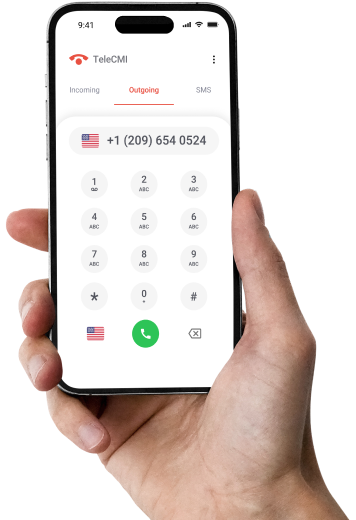
Softphones use Voice-over-Internet Protocol (VoIP) technology to route calls through an internet connection instead of traditional phone lines. They operate via applications installed on devices, connecting users globally with stable internet access.
Ready to transform your Business Communication?
Try TeleCMI's softphone for feature-rich VoIP solutions & crystal-clear smart calling.
Types of Softphone
Softphones are software applications that enable users to make and receive phone calls using VoIP technology on various devices. These applications come in different types based on their platform, functionality, and integration capabilities. Below are the primary types of softphones:
1. Desktop Softphones
These are software applications designed to run on desktop or laptop computers.
Key Features:
- High-definition (HD) audio and video calling.
- Integration with CRM and other business tools.
- Support for advanced features like call recording, call transfer, and conferencing.
Best For: Businesses with employees working from offices or fixed locations.
2. Mobile Softphones
Apps built specifically for smartphones and tablets, compatible with iOS and Android devices.
Key Features:
- Call on-the-go using Wi-Fi or mobile data.
- SMS, voicemail, and video conferencing support.
- Intuitive mobile-friendly user interfaces.
Best For: Remote teams, field agents, and employees who need mobility.
3. Web-Based Softphones
Browser-based applications that do not require installation.
Key Features:
- Accessible via any device with an internet browser.
- No installation or updates required.
- Lightweight and easy to use.
Best For: Quick access without installing software or for temporary usage.
4. Unified Communications Softphones
Softphones integrated into Unified Communications (UC) platforms.
Key Features:
- Combines VoIP, video conferencing, instant messaging, and file sharing.
- Seamless integration with team collaboration tools.
- Centralized management for IT administrators.
Best For: Enterprises requiring all-in-one communication solutions.
5. Standalone Softphones
Description: Dedicated VoIP applications that work independently, without being tied to specific hardware or services.
Key Features:
- Works with multiple VoIP service providers.
- Standard calling features like hold, mute, and transfer.
- Best For: Small businesses or individuals who want flexibility with VoIP providers.
6. VoIP Provider-Specific Softphones
Proprietary softphones developed by VoIP service providers.
Key Features:
- Optimized for the provider’s services.
- Exclusive features like enhanced call routing, virtual numbers, ivr numbers and analytics.
Best For: Customers using a specific VoIP provider, such as TeleCMI, which offers a feature-rich softphone application.
7. Open-Source Softphones
Softphones built on open-source platforms, allowing customization and flexibility.
Key Features:
- Highly customizable and adaptable to specific needs.
- Support for various VoIP protocols (SIP, H.323).
Best For: Tech-savvy businesses and developers needing tailored communication solutions.
Features of Softphone
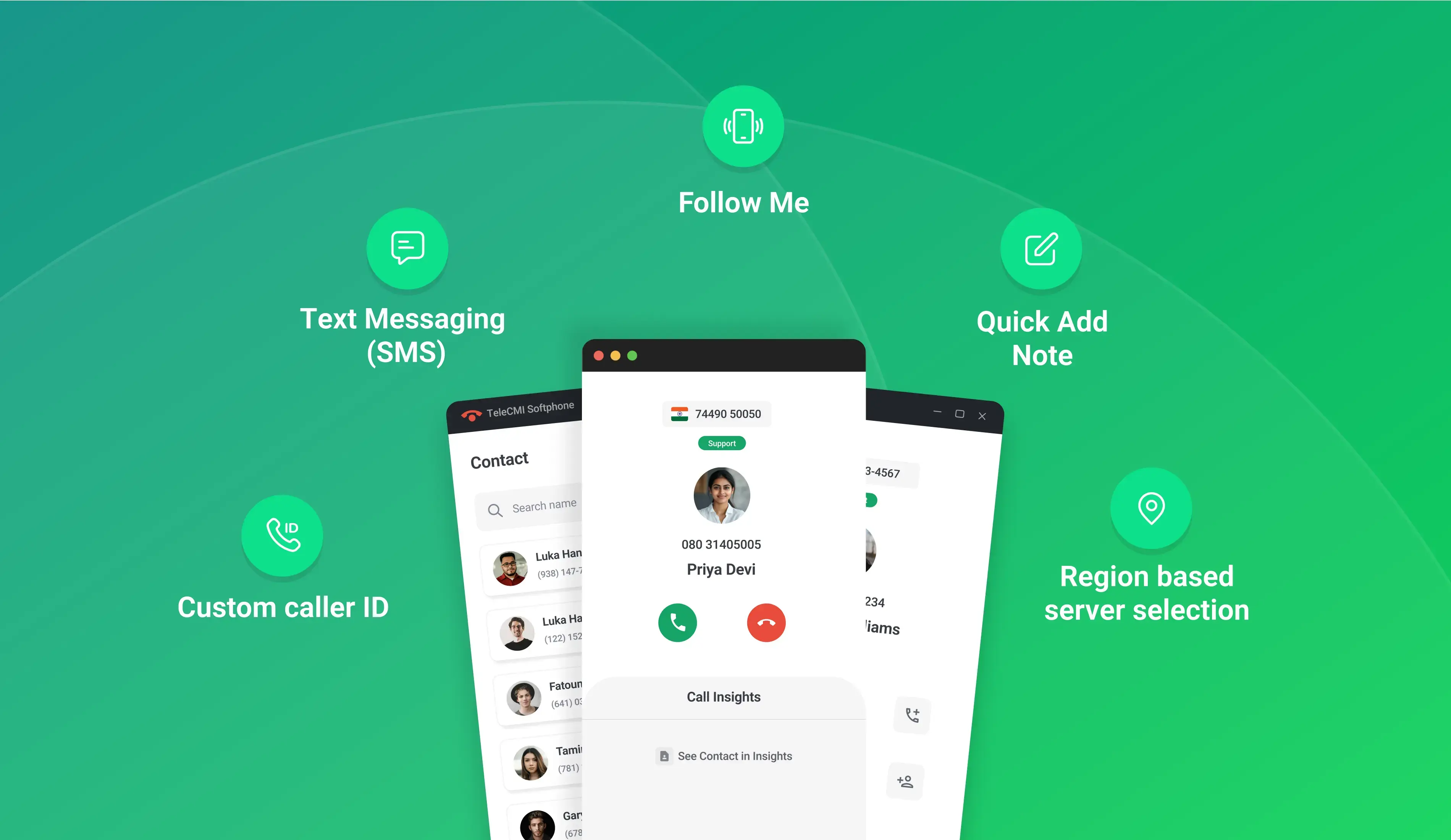
Usually, the features of a Softphone App outweigh those of traditional phone systems, which is why businesses prefer them. With a softphone, you can connect desk phones, laptops, and even smartphones to boost your business productivity.
Custom caller ID: TeleCMI's Caller ID feature allows you to use a local number when making business calls in order to increase the call pick-up rate. For example, when calling UK numbers, use a UK caller ID. This helps you to appear more familiar to your target customers and allows you to reach a larger global market while having a local presence.
Text Messaging (SMS): Text messaging, or SMS (short message service), is a great way to reach your customers and promote your brand. Using a softphone, you can send text messages over a data line, known as "cloud SMS," including post-call survey messages. This way, you can reach more people and promote your products or services to a wider audience.
Follow Me: The "Follow Me" feature is most helpful for remote teams and field workers who need to receive calls on their mobile phones instead of the softphone app when they're in an area with no internet access so they can communicate with their coworkers without compromising the quality of their work.
Region based server selection: The quality of your business calls will have a direct impact on your bottom line. That's why it's important to choose a VoIP Service Provider that offers servers in different countries. This way, you can always choose the server that is closest to your current location for the best possible call quality. For example, if you are making a call from India to the USA or another long-distance destination, then choose a service provider that has data centers in those regions. At TeleCMI, we have datacenters in all major continents and allows businesses enjoy clear and uninterrupted voice calls with customers and employees using our VoIP or softphone.
Quick Add Note: This feature would be beneficial for sales reps when they're trying to follow up with potential customers. If they have the softphone app, they can add the user's information to it while they're on the call with them and review it later. This would make data collection a lot more efficient.
Advantages of Using a Softphone in Your Business
There are many advantages of using a softphone for your business. A softphone can be used on any computer or mobile device that has a microphone and speakers, and it doesn’t require any expensive equipment or additional software like on-premise PBX.
The following are some of the advantages of using a softphone for business communications:
You don't need to buy a separate device for making or receiving calls
The call quality is usually excellent
You can use it from any device with a microphone and speakers
Using a softphone means that you can make and receive telephone calls from any device. This means that you’ll be able to make calls from any location, whether you’re at home, in the office, or on the go using stable internet connection.
You can use a softphone to make calls to people who are using a variety of telephone devices: desk phones, mobile phones, VOIP services, and more.
Using a softphone means that you can use the telephone hands-free. That means that you can multitask while you’re on a call and be more productive while you’re on the phone.
6 Tips for Choosing The Best Softphone for Your Business

When choosing a softphone for your business, keep in mind the following: -
Call Quality: Call quality is the most important factor in choosing a softphone provider. Some providers, like TeleCMI, offer a free trial and a money-back guarantee, so you can try it out. Also, most softphone providers have a local number, so you can call them for free.
Cost savings: In order to succeed and maximize profits, every company must use the best money management practices and cost-saving practices. Compared to traditional phones, VoIP phone systems are less expensive and generally available. VoIP Providers like TeleCMI offer a wide range of plans, like pay-as-you-go and budget-friendly ones, to help you save money while enjoying its many benefits.
Look at Reviews and Testimonials: It is not a good idea to ask a potential provider about their own reputation. There are a lot of softphone providers out there, but not all of them have the same features. The best way to choose one is by looking at reviews and testimonials on trusted software product review platforms, like G2 and Trust-pilot, from other users. They will give you an idea of what the provider offers, how easy it is to use, and if it meets your needs.
Functionality: You want to make sure the softphone you choose is up to the task of running your business. It should be integrated with your existing Business Phone System (if you have one), and also be able to handle the call volume coming into your business.
Uninterrupted Support: Choosing the right softphone provider for your business is crucial for your success. You need to make sure that you are getting the best service, because it will have a direct impact on your productivity and efficiency.There are many providers that offer 24/7 support. The way they provide their support will also depend on what you need from them. You should take into account your specific needs before deciding which provider to choose.
Security: Security is the most important factor to consider when choosing a softphone provider. Few providers, like TeleCMI, offer two-layer security and end-to-end encryption to secure your conversations and data. As a result, ensure that your VoIP phone service providers meet those standards.
Conclusion
In this article, we explored what a softphone is and how it works. We also looked at 6 tips for choosing the best softphone for your business, and the advantages of using a softphone in your business. Softphones are software applications you can use to make and receive phone calls. They are similar to internet telephones in that they are software applications that let you communicate with others over the internet, but they can also make and receive regular telephone calls. Whether you prefer to use a softphone or an internet telephone is up to you and your preferences as a user. No matter which one you choose, you’ll be able to communicate with others more effectively and efficiently.
Switch to Smart Calling Today!

Secure Communication
High-Quality Calls
Supports Multitasking
Vignesh N

With deep expertise in cloud telecommunications, I help readers explore the latest trends in VoIP and modern business communication. At TeleCMI, I focus on educating businesses with clear, practical insights, making complex telecom concepts easy to understand. I’m passionate about helping organizations improve efficiency, enhance customer engagement, and adopt smarter communication strategies.