How AI Is Changing Business Phone Systems in 2026

11 mins read

Posted on Jun 01, 2026
.webp)

Saravana Kumar
SEO


Saravana Kumar
SEO





Business phone calls used to follow a predictable script. A customer dials in. A recorded voice lists five menu options. The caller picks the closest one, gets transferred twice, waits on hold, and finally reaches someone who has no context about why they're calling. The rep types up a three-word note afterward. Repeat, 200 times a day.
That model didn't just frustrate customers; it quietly drained every team running it.
AI business phone systems have rewritten that script entirely. Calls now get routed based on what a caller actually says, not which button they pressed. Conversations transcribe themselves in real time. Agents receive live coaching prompts mid-call. CRM records update automatically the moment a call ends. The system learns. It adapts. And it does most of the invisible administrative work that used to fall on people.
The adoption curve reflects it.

According to Salesforce's State of Service report 2024, 86% of decision-makers say AI has already transformed how their teams handle customer communication and that number has climbed 23 points in two years alone.
This article breaks down exactly what a modern AI business phone system looks like in practice, from intelligent call routing and automatic transcription to sentiment analysis, CRM integration, and real-time agent coaching. Whether you're a CEO evaluating infrastructure, a CFO watching cost-per-contact metrics, or a customer success lead who needs the team performing at its best, every section is built around decisions that actually matter in 2026.
What AI Actually Means for a Business Phone System
Let's be direct. "AI" gets slapped onto everything these days — thermostats, email filters, toasters. So what does it actually mean when a business phone system calls itself AI-powered?
Basic VoIP (Voice over Internet Protocol) just moves your phone calls over the internet instead of copper wires. That's it. Cheaper than landlines, sure. But it doesn't think. It doesn't learn. It routes calls the same dumb way on day 1,000 as it did on day 1.
An AI-powered business phone system layers machine learning and natural language processing on top of that infrastructure. The system listens, analyzes, and adapts. It can understand what a caller is saying, not just which button they pressed. It can detect frustration in someone's voice. Log a call into your CRM without anyone touching a keyboard.
Why is 2026 specifically a turning point? Two reasons.
First, the models got dramatically better. Large language models from the past two years can understand context in conversation in ways that 2020 AI simply couldn't. Second, the cost dropped. What used to be enterprise-only technology, sentiment analysis, real-time transcription, and intelligent routing, is now accessible to companies with 10-person support teams.
The AI vs traditional business phone system comparison isn't about features anymore.
AI Call Routing - Stop Losing Customers to Transfer Hell
AI call routing is probably the most immediately impactful feature in a modern AI cloud phone system. Here's the problem it solves.
Traditional IVR (Interactive Voice Response) routing works on decision trees. Press 1 for billing. Press 3 for support. Press 0 to repeat. The caller has to figure out which bucket their problem belongs to. Half the time, they guess wrong. They get transferred. They get transferred again. By the third transfer, they're already composing an angry tweet.
AI call routing flips the model. Instead of making the caller navigate a menu, the system asks a simple open-ended question: "What are you calling about today?" Then it listens. It understands. It routes, intelligently based on what the person actually said, combined with data it already has about them (previous interactions, account type, issue history).
Fewer wrong queues. Fewer transfers. Faster resolution.
Gartner's research on AI in customer service found that intelligent routing alone can reduce average handle time by up to 40% and meaningfully lower repeat-call rates. That's not a marginal improvement. That's the difference between a customer staying or leaving.
For a CFO looking at cost-per-contact metrics, this is where the ROI conversation starts and a VoIP ROI Calculator can help estimate potential savings and returns from switching to a VoIP solution.
Automatic Call Summaries and Transcription
Every call your team handles generates information. Product feedback, objections, complaints, buying signals. Most of it evaporates the second the call ends, buried in a note that says "followed up, will call back."
Automatic transcription and summarization change that entirely.
After every call, the system generates a written summary. Key topics covered. Action items identified. Sentiment of the conversation. All of it, automatically, in seconds.
Think about what that means for a customer success lead managing a team of 15. Instead of listening to 50 calls to understand what's happening on the floor, reading 50 one-paragraph summaries takes 20 minutes. Patterns surface. Coaching opportunities become obvious. Problems that would have stayed hidden for weeks get caught on day two.
Sales teams benefit differently. Every conversation with a prospect gets logged — not with vague notes but with actual structured data. What the prospect mentioned about their budget. The concerns they raised. The timeline they hinted at. All searchable. All there for the next rep who picks up that account.
This isn't about surveillance. It's about not losing institutional knowledge to bad habits and a forgetting curve.
AI-Powered IVR - Natural Language Instead of Button Presses
The old DTMF (Dual-Tone Multi-Frequency) IVR system, the "press 1 for this" machine — was designed around the limits of 1980s telephony. It worked then. It's exhausting now.
Modern callers expect just to say what they need. They've been trained by Siri and Alexa and Google Assistant to speak naturally. When they call your business and hit a rigid menu, the friction is immediate.
AI-powered IVR systems in 2026 understand natural language. A caller says, "I want to update my shipping address on a recent order" - the system parses that, confirms their identity, and handles the update without ever connecting to a human agent. No press-1 theater required.
For routine queries - account balances, order status, appointment confirmations, simple password resets - the AI handles it completely. Self-service without the frustration.
That last part matters more than it sounds. Reducing agent dependency for routine queries doesn't mean replacing agents. It means freeing them for conversations that actually need a human - the complex, emotional, high-stakes ones where empathy matters.
A well-built AI business phone system understands the difference between a call a bot can own and a call that needs escalation. That distinction is everything.
Sentiment Analysis and Real-Time Call Coaching
This one is genuinely remarkable when you see it in action.
During a live call, sentiment analysis monitors tone, word choice, pace, and pause patterns. It detects when a caller is getting frustrated, often before the agent consciously registers it. The system can then surface a prompt to the agent: "Customer appears upset. Consider acknowledging their frustration before continuing."
Real-time coaching. On an active call. Without the customer hearing any of it.
For new agents, this is transformational. The learning curve compresses dramatically when the system is whispering guidance in real time rather than waiting for a post-call debrief. Responses improve. Escalations drop.
McKinsey's research on AI in customer operations noted that businesses deploying real-time agent assistance saw customer satisfaction scores increase by 10–15% within the first quarter of implementation. That's not from replacing agents, it's from making existing agents more effective, immediately.
For a CTO evaluating infrastructure investments, this kind of measurable impact on CSAT metrics is a strong business case. For a CEO thinking about retention, happy customers stay longer. It's that direct.
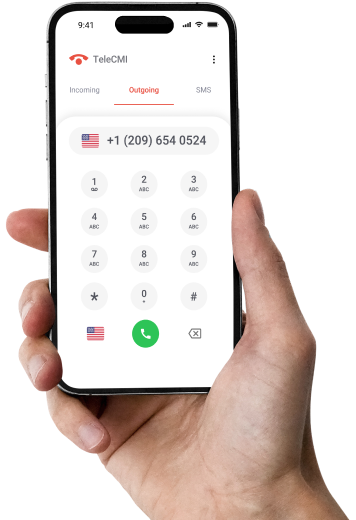
Every customer call contains valuable insights
Use AI-powered call routing, automation, and CRM integration to make every conversation count
AI and CRM Integration - Calls That Log Themselves
Manual data entry after calls is one of the most quietly damaging inefficiencies in any sales or support operation. Reps rush it. Details get missed. By the time someone reviews the notes a week later, they're staring at "spoke to client, seems interested" and have almost nothing to work with.
An AI-powered business phone system that integrates with your CRM changes this at the source.
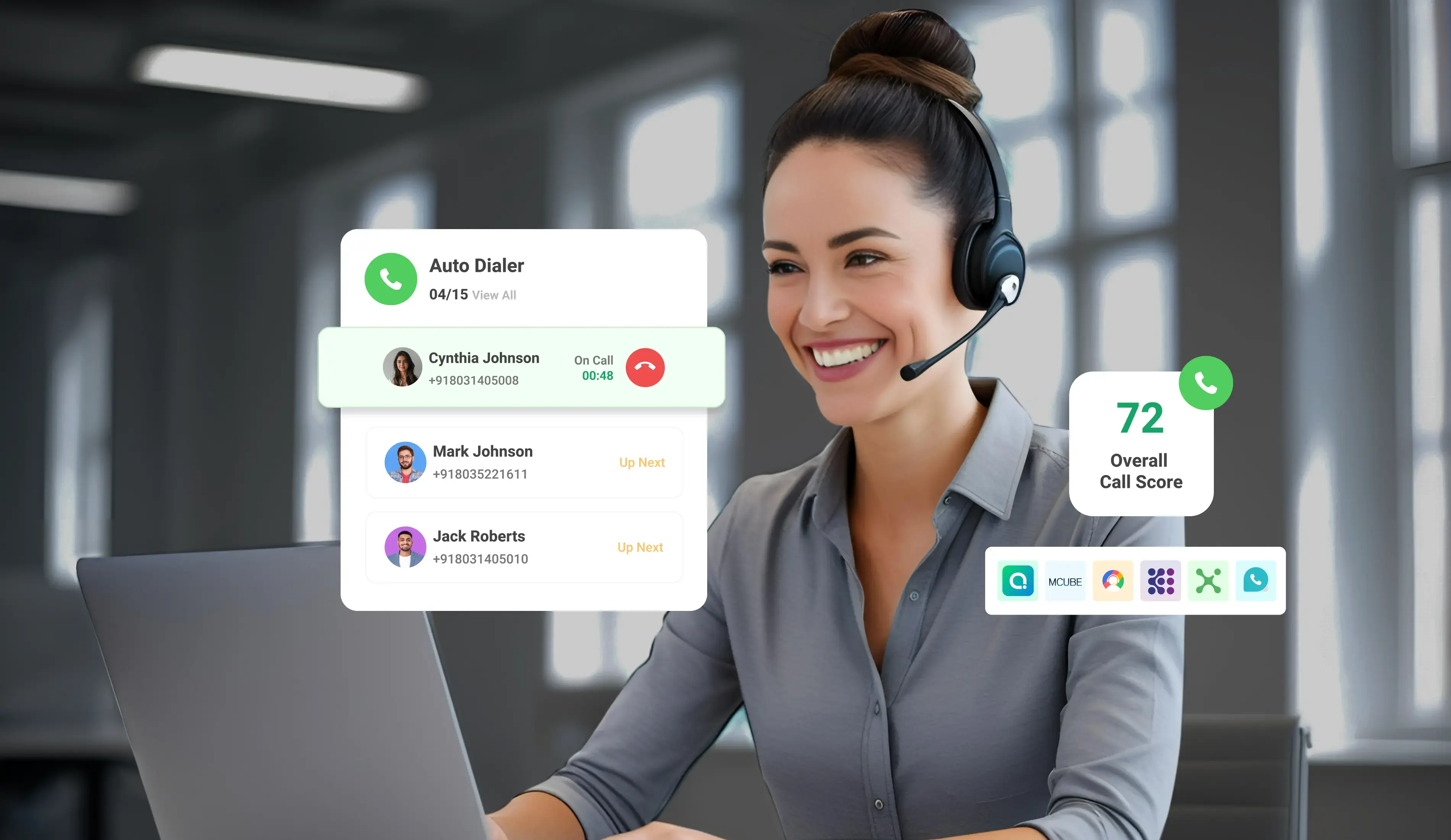
After a call ends, the system auto-tags it - by outcome, by sentiment, by topics discussed. It populates the CRM record automatically. Deal stage updates. Follow-up tasks get created. Contact information gets verified.
Nobody typed any of that. Nobody had to.
For sales teams, this means reps spend more time actually selling and less time doing administrative cleanup. For managers, the pipeline data is finally trustworthy - because it wasn't dependent on someone's motivation to fill in fields at 5:45 PM on a Friday.
The best AI cloud phone systems integrate natively with major CRMs - Salesforce, HubSpot, Zoho, and others. That integration isn't a nice-to-have anymore. It's a prerequisite.
What AI Cannot Replace - The Human Side of Calls
This needs to be said directly because the breathless AI coverage often skips it.
A customer whose father just passed away is trying to sort out an account. A prospect who had a terrible experience with your competitor and needs to be heard, not processed. A long-term client who's considering leaving because they feel invisible.
No sentiment analysis catches everything. No AI coaching prompt covers every nuance of human conversation. There are calls where the most important thing an agent can do is be quiet and listen - not route, not summarize, not coach. Just be present.
AI assists. It does not replace.
The businesses getting the most from AI business phone systems aren't the ones who automated everything possible. They're the ones who figured out which conversations should never be automated and protected those moments.
That's actually a competitive advantage. When most of your competitors are racing toward full automation, a business that uses AI to free up agents for genuinely human conversations stands out.
What to Look for in an AI-Powered Business Phone System in 2026
Before signing any contract, here's what actually matters.
Core AI features to prioritize:
- Intelligent call routing with natural language understanding (not just keyword matching)
- Real-time transcription and post-call summarization
- Sentiment analysis with live agent coaching prompts
- Native CRM integrations that are bidirectional - data flows both ways
- AI-powered IVR that handles self-service without frustrating callers
- Analytics dashboards that surface patterns, not just raw data
Questions to ask any provider:
Does the transcription work in multiple languages? (Critical for distributed teams.) How is customer call data stored and protected? What does the CRM integration actually do - push notes, or truly sync? Can the AI routing learn from outcomes over time, or is it static?
TeleCMI's AI-powered business phone system is built specifically for growing teams who need enterprise-grade intelligence without enterprise-grade complexity. The platform combines smart call routing, live transcription, sentiment analysis, and deep CRM integration, all in a single cloud-based system that works from day one.
The business phone system 2026 standard isn't just about call quality anymore. It's about what the system knows, what it does with that knowledge, and how it makes every person on the team more effective.
Conclusion
The gap between a traditional business phone setup and an AI business phone system is no longer a future-state conversation. It's measurable, it's real, and it's widening right now.
AI call routing reduces misdirected calls. Automatic summaries recover lost knowledge. Sentiment analysis turns raw conversations into coachable moments. CRM integration eliminates the manual overhead that quietly drains team capacity every single day.
The businesses winning in 2026 aren't necessarily the ones with the largest teams. They're the ones where every call counts because the system is designed to make sure nothing slips through.
Ready to see what an AI-powered phone system actually looks like for your business?
Explore AI-powered call automation todayFrequently asked questions (FAQ)
Saravana Kumar

I’m passionate about exploring and sharing insights on modern cloud communication technologies. At TeleCMI, I focus on helping readers understand the evolving world of cloud telephony and IVR solutions in a simple yet in-depth way. My goal is to deliver genuine value by turning complex telecom concepts into clear, actionable knowledge that builds trust and drives innovation.