Best Cloud Phone Systems for Businesses in 2026: Compared & Ranked

6 mins read

Posted on Apr 29, 2026
.webp)

Saravana Kumar
SEO


Saravana Kumar
SEO




We’ve reviewed and evaluated around 25+ business phone systems to create this guide. Through a combination of research, user analysis, and testing, we’ve developed a comprehensive framework to evaluate and compare the top 7 cloud phone systems for business communication in 2026.

Your phone system is no longer a back-office utility. It is a frontline business tool.
Missed customer calls, fixed desk phones, and dispersed teams across multiple cities or even nations may result in only one thing – missed opportunities. Imagine yourself receiving a call from a potential client through your primary phone number; however, the phone call goes unanswered since the extension isn't active. You'll receive the busy signal message, while the caller will end their phone connection. Meanwhile, it's already your competitor who received the call.
We’re in a world where remote work, distributed teams, and 24/7 customer expectations are the new normal. Your phone system is no longer a back-office utility. It is a frontline business tool. Many businesses still rely on outdated systems that were never built for remote work or fast growth.
That’s exactly why firms are shifting to cloud phone systems, whether they're a startup with just two individuals or a multinational company, to communicate no matter where they are. In this guide, we compare and rank the seven best cloud phone systems available in 2026. Also included is a comparative table, strengths and weaknesses of each cloud-based telephone system, pricing structure, and even a decision model for choosing one over the other.

Key Takeaways
 Cloud-based telephone systems allow businesses to manage their call volume effectively while ensuring that no business opportunity is missed.
- Traditional phone systems do not work well for remote teams or growing businesses.
- Cost savings are achieved through eliminating the cost of hardware and using multiple solutions.
- Adding or removing users is as simple as the company evolves.
- It works with multiple CRMs, allowing you to communicate effectively with your clients.
Why Businesses Are Moving to Cloud Phone Systems in 2026?
Businesses are moving to a cloud-based phone system to address a set of practical needs:
Fixing gaps in communication: Calls will be delivered more efficiently, will be available across all devices, and will have many useful functions that will help prevent lost connections and delays.
Decreasing reliance on physical hardware: Enables workers to be productive even when working remotely using one consistent technology.
Adjusting according to changing team size: Using cloud-based phone systems for businesses allows you to increase or decrease users without complicated installation or extra fees for hardware.
Gaining insight into clients and responding promptly: Integrating the cloud phone system with CRM allows the teams to see the context of their customers during calls, making them more efficient and timely.
Disjointed systems elimination: Disjointed systems are not efficient since there is no one platform that facilitates communication and sales collaboration.
Reliable performance without internal costs: Current service providers offer high uptime rates and outsource their infrastructures, thus minimizing costs and maintaining reliable communication systems.
What Is a Cloud Phone System?
A cloud phone system is an online business communication solution that redirects phone calls through the internet rather than using conventional analog telephone connections. There is no need for costly equipment in the office; the phone system exists in the data center of the service provider, accessible through desktop or mobile applications and VoIP phones.

Expert Insight
"Cloud phone systems come with many benefits compared to landline phones and on-premise PBX phones: reduced expenses, flexible pricing plans, mobility, superior call management features, and integration with third-party software.” — GetVoIP Expert Guide, 2026
Quick Comparison: Top Cloud Phone Systems at a Glance
The table below gives you an instant overview of each provider. Ratings and data have been verified across three independent review platforms.
How We Ranked These Providers
Our ratings are derived from real-world experience in testing each of the providers, and are supported by our evaluations from the best independent software review communities. The following six parameters carry the most weight in our evaluations:
Transparency on pricing: Is pricing transparent and clear to understand? Any additional fees associated with every individual function and minute consumed?
Basic functions: Does the software have basic functionality such as call forwarding, IVR, voicemail, and recording support?
CRM support: Does it offer native support and integration for various CRM tools?
Uptime: What level of service guarantee do they provide, backed by SLA? What do real users report about call clarity?
Ease of setup: How quickly can a non-technical team be up and running without IT support?
Customer support: Are live chat, phone, and dedicated account management available , especially for smaller teams?
Choosing the Right Cloud Phone System Starts Here
Compare features, test performance, and see which platform fits your team best.
The 7 Best Cloud Phone Systems for 2026: Ranked & Reviewed
#1 TeleCMI - Best for SMBs & Growing Businesses
.webp)
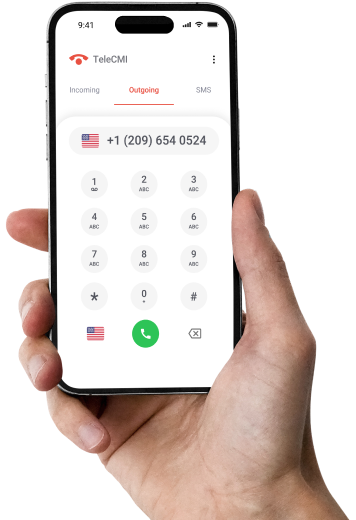
TeleCMI is a rapidly growing cloud-based phone system designed specifically for small and medium-sized businesses that need enterprise-grade features without enterprise-level pricing.
Key Highlights
- Trusted by over 3,500 businesses worldwide.
- 14-day free trial and low per-team entry price.
- Mobile and desktop apps for remote teams.
- 400+ Global calling and advanced analytics.
- 70+ countries virtual, local, and toll-free numbers.
- 99.9% uptime SLA, compliance with standards, and redundancy.
Key Features
- Smart IVR & intelligent call routing
- AI agent and post-call analytics
- Real-time call monitoring & live dashboards
- 170+ CRM integrations (Salesforce, HubSpot, Zoho & more)
- Click-to-call from any CRM record
- Auto call recording with cloud storage
Pricing
Starts at $14.99 user /month in annual billing. 14-day free trial, no credit card required.
Verdict TeleCMI is the #1 pick for startups, SMBs, and any growing business that needs a powerful cloud phone service without enterprise-level pricing. The combination of 170+ integrations, global reach, and a risk-free trial makes it exceptionally hard to beat at this price point.
#2 RingCentral — Best for Enterprise & Large Teams
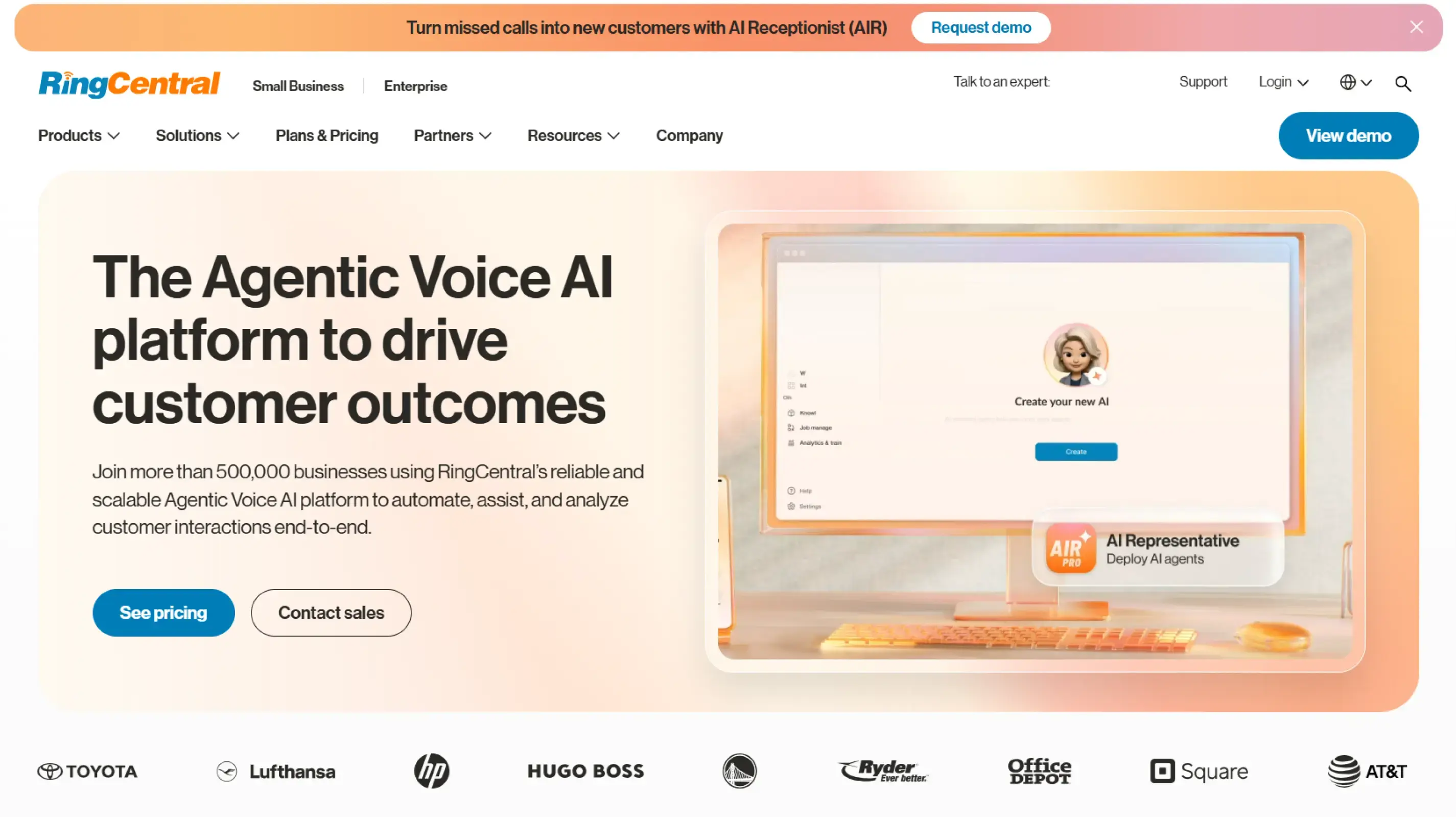
UCaaS solution with the largest number of features available in the market, including voice, video, messaging, and over 300 integrations. This solution includes a drag-and-drop IVR editor that supports up to 250 call menu options.
Key Features
- Video meetings for up to 200 participants
- AI call transcription & summaries (Ultra plan)
- Ring groups with up to 16 numbers
- Customizable analytics dashboard
- 24/7 phone & live chat support
Pricing
- Core: $30/user/mo
- Advanced: $35/user/mo
- Ultra: $45/user/mo
- 14-day free trial available
Verdict RingCentral is best suited for enterprises that need a complete communication suite. For smaller teams, the cost and complexity may outweigh the benefits.
#3 Nextiva
Rated #1 for the highest quality of customer support with inbuilt CRM features, thus minimizing your dependence on third-party applications. It not only focuses on traditional telephony features but also includes analytics for customers’ journey, CRM features, and collaboration tools. Business professionals in service, healthcare, legal, and financial sectors have praised Nextiva for its ease of use during onboarding and prompt support.
Saravana Kumar

I’m passionate about exploring and sharing insights on modern cloud communication technologies. At TeleCMI, I focus on helping readers understand the evolving world of cloud telephony and IVR solutions in a simple yet in-depth way. My goal is to deliver genuine value by turning complex telecom concepts into clear, actionable knowledge that builds trust and drives innovation.