How Cloud Telephony Helps Indian Businesses Make International Calls More Affordably

14 mins read

Posted on Jun 19, 2026

Saravana Kumar
SEO


Saravana Kumar
SEO






You have made all your calls for the week, and you are satisfied with what you have done so far. But then comes the telephone bill. You now realize how expensive the productive quarter just got.
This is a familiar moment for Indian startups, SMBs, and enterprises that regularly deal with international clients. Traditional ISD and carrier-based international calling can cost ₹7–₹20 per minute or more, depending on the destination and plan; without an add-on pack, rates can be significantly higher. For a 10-person team making regular international calls, that adds up fast.
Cloud telephony system, on the other hand, offers voice-over-Internet technology that makes international calling a much more affordable proposition. This guide will walk you through all that cloud telephony can do to reduce the cost of international calls for your India-based company, from how it operates to savings and even plan structuring for call volume. If your business regularly reaches clients or customers in the US, UK, UAE, or anywhere else internationally, this is for you.

Key Takeaways
 International calling through traditional telephony systems is costly, as there are ISD charges as well as per-minute charges.
- Cloud telephony international calling operates using the internet instead of telephone networks, allowing for lower-cost international calls.
- With cloud telephony, Indian businesses can enjoy cost savings of 40% to 70% on international calling.
- Cloud telephony international numbers allow businesses to establish a virtual presence in foreign countries like the US, UK, UAE, and others.
- Businesses making occasional international calls should opt for pay-per-use plans, whereas those making more calls could choose unlimited plans.
- Cloud telephony services have gained popularity across industries including IT services, BPOs, e-commerce, recruitment, and EdTech.
Why International Calling Is Expensive for Indian Businesses on Traditional Plans
Traditional international calling in India runs over the PSTN infrastructure, which was built for local and domestic calls. When you make a call to another country, the telecom company transfers your call via an international gateway network, each step increasing the charges, which are billed to you.
The following is a summary of typical charges for international calling on ordinary service plans in India:
- Base ISD rates vary by operator and destination. For popular markets such as the US, UK, UAE, and Europe, rates generally range from ₹0.50 to ₹9 per minute with ISD packs, while certain destinations and premium routes can cost ₹10–₹20+ per minute.
- Additional ISD packs reduce the cost but require upfront payment, and they often have a validity period of 7 to 28 days, after which any remaining balance expires.
- You pay according to consumption, so regular calls, dialing and redialing, or meetings will raise your monthly telecommunications bill.
- GST and other applicable charges further increase the total amount businesses pay each month.
Now run that math for a team.
Example: A Team of 10 Making Regular Overseas Calls
Consider a software service company that has a group of 10 people who provide service to their clients, who are located in America, Britain, and the UAE. Assume that each one of the people makes international calls for 1 hour every day for 22 days in a month.
- 220 hours of call time every month
- 13,200 minutes of international calls
With traditional carrier plans, effective ISD rates typically range from ₹3 to ₹8 per minute, depending on the country and active ISD packs.
This translates to a monthly telecom expense of:
The above costs do not include GST, connection charges, or any other extra charges that may result in a further increase in total bills. It becomes extremely difficult for business organizations to have regular calls with international clients.
What Is Cloud Telephony and How Does It Change International Calling?
Cloud telephony is a phone system for companies that uses the internet to make calls rather than regular phone lines. Instead of establishing physical connections between two phones through the carrier’s network, this system transforms your voice into digital packets that then travel through broadband just like emails and video calls do.
When combined with Salesforce CTI Integration, cloud telephony enables businesses to handle calls inside Salesforce, automate customer records, and improve agent productivity with real-time caller information.
For international calling, this changes everything about the cost structure:
- No ISD routing charges: The call does not touch the expensive international PSTN gateway at all
- No per-minute shock billing: Most cloud telephony plans use flat-rate or pay-as-you-go pricing that is predictable
- No mandatory add-on packs: International calls are included in the basic plan or a small add-on and not a special emergency recharge.
- No hardware required: Calls happen through a desktop app, mobile app, or web browser using your existing devices
For the callers and receivers of the calls, the experience is the same as making a standard call. The person you dial in New York, London or Dubai will receive the call like any other call. But the difference will be in the billing process.

How it works
Your voice → converted to data packets → travels over the internet → reconnected to the recipient's phone network at the destination country → rings on their device. The "last mile" to the recipient happens locally in their country, which is why international rates are so much lower.
How Much Can Indian Businesses Actually Save With Cloud Telephony?
Cost savings depend on where your customers are located and how frequently your team makes international calls. While cloud telephony often reduces communication expenses, the actual savings vary by country and call volume.
Here are three practical scenarios based on current ISD rates offered by Indian telecom operators and average cloud telephony pricing structures.
Example 1: 10-Person Sales Team Calling US Clients
A SaaS company with ten sales representatives spends around two hours per day speaking with prospects in the United States.
Key takeaway
For US calls, cloud telephony does not always deliver major cost savings because Indian telecom operators already offer highly competitive rates. Businesses usually adopt cloud telephony for features such as:
- IVR and routing
- Virtual international numbers
Example 2: Startup Serving UK Clients
A startup conducting weekly customer and partner calls accumulates approximately 600 minutes per month.
Key takeaway
Companies requiring UK contacts can save up to 25-70% each month on calls made through their provider, based on their call traffic.
Example 3: D2C Brand Supporting Customers in the UAE
A D2C company handling customer support queries from the UAE spends around 800 minutes per month on calls.
Key takeaway
Businesses with customers in the Middle East often experience the most noticeable cost reductions because conventional ISD rates remain relatively high.
Beyond Cost Savings
Although international call charges matter, many companies adopt cloud telephony because it provides capabilities that traditional SIM-based calling cannot easily offer:
- Centralized call management
- AI-powered call summaries
- Automatic call recording
- CRM integrations
- Real-time analytics
- Multi-agent support without additional hardware
For growing teams, these operational efficiencies often create more value than the savings on call charges alone.
Virtual International Numbers: How Indian Businesses Appear Local Globally
One of the most commercially valuable features of cloud telephony for international calling is the virtual number. A phone number with a US, UK, UAE, or any other country's area code that actually rings on your Indian team's devices.
Here is why this matters more than most businesses realize: when you call an international client from a +91 Indian number, many prospects simply will not answer. The caller ID shows an unknown foreign number, and the default reaction is to ignore it.
Trust Factor
Studies show that calls from unknown international numbers are answered roughly 40% less often than calls from local or familiar numbers. According to one widely cited sales benchmark, 94% of calls from unrecognized numbers go to voicemail, up from 80% a decade ago.
With a virtual international number, your caller ID shows a local US area code, a UK landline number, or a UAE number, depending on your target market. The call rings directly on your team's laptop or mobile in India. From the client's perspective, they are receiving a call from a local business.
It helps build confidence even before making any call. The probability that the client would answer the call with 212 or 020 numbers instead of +91 numbers is much greater in America or the UK. This can make a huge difference when considering BPO operations and sales activities.
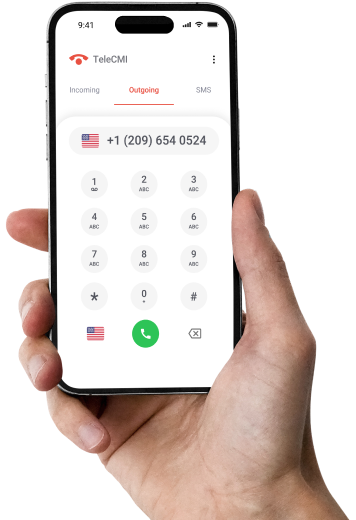
TeleCMI provides virtual numbers in 75+ countries, covering the most important business destinations for Indian businesses.
Get Your Virtual NumberWhich Saves More? Pay-As-You-Go vs Unlimited International Calling Plans
Choosing the right one for your business is straightforward once you know your monthly call volume.
Pay-As-You-Go
You are billed only for the time you spend using the service, at a flat rate per minute. There are no contracts required, no minimum usage to commit to, nor wastage if your international call volumes vary each month.
Best for: Early-stage companies, SMBs with unpredictable international call needs, businesses operating project-based activities, recruiters calling their overseas candidates periodically, or direct-to-consumer enterprises responding to international inquiries that occur on a seasonal basis.
Unlimited International Calling Plans
The monthly fixed fee covers a large number of minutes or truly unlimited international calls to particular countries or regions. The average cost per minute declines as volume increases.
Best for: Outbound Sales organizations making regular calls to US or UK leads each day, Continuous Outbound BPOs and IT Services businesses working for clients based out of the US or UK.
How to Calculate Which Model Fits Your Business
Track your current international call minutes over the last 3 months. If your monthly volume is consistently above 1,000–1,500 minutes, an unlimited or high-volume plan will save you more. If volume is inconsistent or below that threshold, pay-as-you-go is the leaner choice.
Indian Businesses Using Cloud Telephony for International Calls
Various organizations have been using cloud telephony to reach their customers and clients worldwide at a much lower cost than ISD services.
- IT and Software Services: Software companies often conduct daily meetings with clients in the US and UK. By using cloud telephony, teams can maintain clear voice quality and manage customer conversations more efficiently.
- BPO and Call Centers: Agents working in outbound sales and support functions find virtual international numbers as well as internet calling helpful since they don’t require costly international calling via telecom carriers. Functions such as call recording, analytics, and intelligent call routing help increase the efficiency of agents.
- E-Commerce and D2C Brands: Growing brands serving customers overseas can provide affordable customer support without maintaining separate communication infrastructure in each country.
- Recruitment and HR Firms: Recruiters frequently communicate with candidates and clients across the Middle East, Europe, and North America. Cloud telephony helps them stay connected while keeping communication costs under control.
- EdTech Companies: Education providers supporting students and NRI families around the world rely on cloud telephony to maintain seamless communication.
Real Examples from TeleCMI Customers
CodeYoung, an online education platform that connects with students globally, switched to TeleCMI after experiencing call quality issues with its previous provider. After the migration, the company reported clearer voice quality and improved productivity through call-tracking and recording features.
Other Cost-Saving Features That Come with Cloud Telephony
Lower international call rates are only one part of the equation. Cloud telephony also helps businesses reduce operational costs and improve team productivity through built-in features.
IVR Reduces Agent Time
Interactive Voice Response (IVR) system automatically routes callers to the right department or agent. Instead of manually transferring calls, customers are connected to the appropriate team from the start.
This helps businesses:
- Reduce average handling time.
- Minimize unnecessary call transfers.
- Lower the cost per customer interaction.
For support teams handling international inquiries, even saving a minute or two per call can add up significantly over hundreds of conversations each month.
CRM Integration Saves Hours of Manual Work
Without integration, sales and support teams often spend valuable time entering call details manually.
Cloud telephony automatically logs:
- Call duration.
- Customer information.
- Notes and recordings.
- Follow-up activities.
For teams making dozens of international calls every day, this translates into hours of saved effort every month and allows employees to focus on customers rather than data entry.
Mobile Apps Eliminate Carrier ISD Dependence
Employees can make and receive international calls directly from their smartphones using the TeleCMI mobile app.
This means:
- No separate ISD packs.
- No personal phone reimbursements.
- No dependence on carrier international plans.
A single app gives remote and field teams access to business communication from anywhere.
Analytics Help Identify High-Value Markets
Built-in dashboards provide insights into:
- Call volume by country.
- Call duration.
- Answer rates.
- Agent performance.
These insights help businesses understand which international markets are generating meaningful conversations and where to focus resources.
Industry Stat
India’s telecom sector is expected to grow from $48.61 billion in 2024 to $76.16 billion by 2029, reflecting the growing demand for digital and cloud-based communication technologies.
What to Check Before Choosing a Cloud Telephony Provider for International Calling
Cloud telephony service providers may not be equal when it comes to making international calls. Below is a list of some questions that you should ask before signing on:
- Does the provider have virtual numbers in your target countries? Not all providers offer such a service. TeleCMI offers support in more than 75 countries.
- Do they include international calling services as part of their base plan or charge you extra for international calling?
- Do they have a pay-as-you-go plan for when you need less capacity? Avoid providers that force you into a high-volume plan before you have validated your international call volume.
- What is the call quality like on international routes? Ask for a trial call to your specific destination countries before committing.
- Does the provider have local support in India? When something goes wrong, you need support that operates in your time zone and understands the Indian business context.
- What is the contract commitment? Monthly plans give you flexibility to scale or switch. Avoid an annual subscription until you have tested the platform.
TeleCMI offers a free 14-day trial that includes international calling, so you can test call quality, make your first calls to US or UAE numbers, and evaluate the platform in real-world use before spending anything.
Conclusion
International calling need not be a surprise to your monthly budget. The dynamics have entirely changed in cloud telephony, which offers lower per-minute rates, predictable plans, virtual numbers that instill confidence among your international clientele, and other features that reduce your overheads.
For Indian startups, small and medium businesses, and enterprises regularly making calls to the United States, the UK, the UAE, and any other international destination, moving from carrier ISD services to cloud telephony is one of the biggest money-saving moves in 2026.
Frequently asked questions (FAQ)
Saravana Kumar

I’m passionate about exploring and sharing insights on modern cloud communication technologies. At TeleCMI, I focus on helping readers understand the evolving world of cloud telephony and IVR solutions in a simple yet in-depth way. My goal is to deliver genuine value by turning complex telecom concepts into clear, actionable knowledge that builds trust and drives innovation.