Navigating Emotion: A 2026 Guide to Contact Center Sentiment Analysis

9 mins read

Posted on Sep 30, 2024

Vignesh N
SEO


Vignesh N
SEO






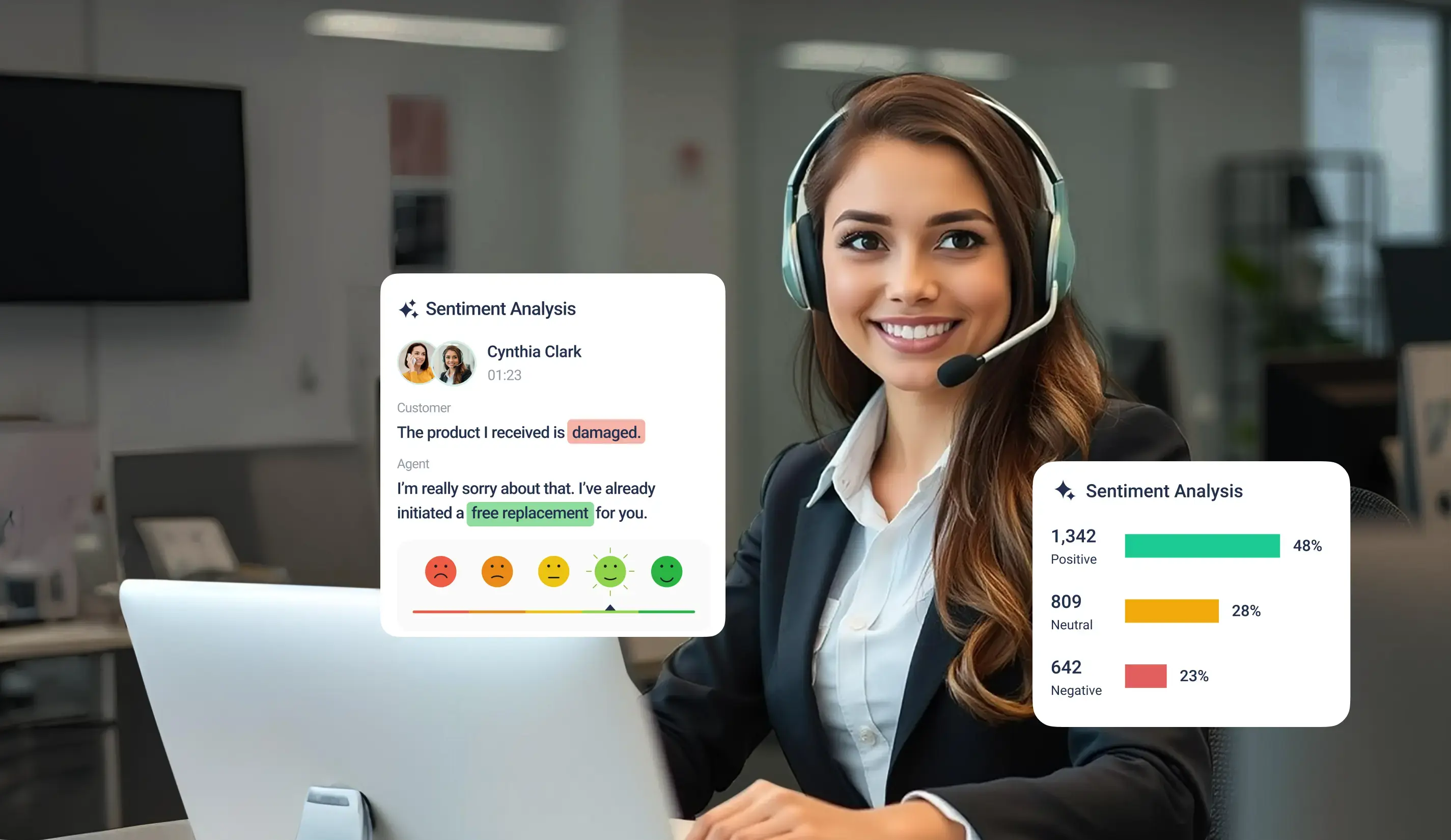
Sentiment amounts to the analysis of text in order to ascertain its positivity, negativity, or neutrality. This is what businesses are doing with customer data from various sources like chats, emails, social media, and reviews to know how their customers are feeling.
The business can improve customer experience and enhance brand reputation through understanding customers’ sentiments, leading to actionable insights.

Key Takeaways:
 Enhanced Agent Performance: Recognize and recompense agents who are performing on top.
- Improved Customer Satisfaction: Explore the depths of customer feelings, enhance and elevate the standard of service delivery.
- Efficient Quality Management: Focused evaluations can make sure that the quality management processes are more efficient.
- Actionable Insights: Utilize emotion exploration as a base for making choices influenced by information.
Understanding the Sentiment Analysis Model for Contact Centers:
Other than checking out what people say about your brand online, sentiment analysis tools are also widely used in inbound call center. They enable us to determine whether customers were happy whenever they talked on the phone, sent a message or an email, or conversed through chats.
Consequently, it is possible to forward such messages to an agent who specializes in facing angry customers.
Furthermore, the sentiment can get calculated for each agent, which helps find out the best practices and ways of improving them.
In conjunction with the other customer experience metrics, including Net Promoter Scores, sentiment analysis models bring in the bigger picture of how consumers perceive their experiences.
What are Sentiment Analysis Techniques:
The most basic sentiment analysis techniques are the ”wordlist” techniques, which employ lists of positive and negative words (e.g. bad=negative, happy=positive) and merely score content by counting how many times each appears. Word listing methods offer a baseline score, but they tend to be weak in themselves.
For example, the sentence “I’m really not satisfied with your new sale prices or happy” has more words that are positive than those that are negative on technicality.
Advances in techniques will result in parsing of sentences by making use of NLP techniques for analyzing the structure and machine-learning models that deal with slang or sarcasm.
The systems that have invented it are able to detect tone of voice, consider the order of words, and separate different parts which drive sentiment in a sentence.
The most precise sentiment scoring for business phone systems comes from building tailored models using your own customer calls and vocabulary with a manually created training dataset, though this process is often time-consuming and costly.
How Does Sentiment Analysis Work in the Contact Center?
There are a number of major steps to take when analyzing sentiments at call centers
.webp)
Data Collection
People collect conversational data relating to channels like phone calls, emails, or live chats.
Text Processing
Analysis necessitates cleaning, tokenizing, and transforming the data into a suitable format.
Sentiment Classification
Text classification is done by machine learning models, which can rate it as positive, negative, or neutral.
Feature Extraction
In order to comprehend the sentiment, linguistic and contextual aspects are drawn out
Sentiment Scoring
A sentiment score is assigned to each interaction.
Aggregation and Analysis
Trends and patterns can be identified through aggregation of sentiment scores.
Trends and patterns can be identified through aggregation of sentiment scores.
With such an approach, you will no longer have to observe calls yourself or check conversation records for customer sentiments towards your company whenever you use a call recording program together with Sentiment Analysis in post-call analytics.
Here are five of the top benefits of Sentiment Analysis:
1. Capture agent effort often overlooked in typical performance metrics
Sometimes they fail to reveal the real competence of your agents even when they are communicated in very simple terms. Conversely, a high number of minutes spent on a single conversation may indicate that an agent is skilled in dealing with intricate problems. In order not to lose out on recognition and lessons learned from them, perform Sentiment Analysis to spot agents who are consistently engaged with calls that have good feelings.
2. Send QM evaluators down the right path
All your listeners cannot listen to each call in order to evaluate quality since they are busy individuals that have no time for this task. In response, Sentiment Analytics has come handy in detecting those agents who handle calls with a negative feeling, thereby making it easier for evaluators to focus on initial points during their assessment work.
3. Supplement post-call surveys to amplify Voice of Customer
Never use survey results to determine your customer experience. Increase your survey and focus group findings by including Sentiment Analysis information, which helps you measure the effectiveness of every relationship.
4. Quickly identify causes
Every day when you look at the KPI reports for your contact center, it is possible to see trends that aren’t so apparent but still exist. An example would be a line graph depicting the customer retention rate versus the amount of negative sounding calls received. To understand why customers are leaving, just listen to those calls that are emotionally hard and diminish retention.
Use Cases for Sentiment Analysis
Here are some sentiment analysis use cases
1. Segment Buyer Groups Based on Opinions
Tracking emotions helps an organization understand which clients are more forensic than others. Generally speaking, it is widely held that eighty percent of client complaints arise from twenty percent of customers.
If this statistic holds up, then one will be able to identify the traits of that group and either rectify similar problems or totally keep away from those patrons. (Naturally enough, this would entail little or no return on investment depending on the degree and kind of sentiments expressed by said individuals.)
2. Plan Product/Service Improvements
When it comes to anything that you sell, customer opinions are like gold mines for data. Upgrading software products or enhancing the design of physical goods or even improving your services can all be based on what customers have to say about them. Sometimes, this information can even create new products or services for the company to market. Teams can strengthen this process by pairing call sentiment with community engagement analytics, which helps identify recurring pain points.
3. Plan Process Improvements
Not all customer sentiments are positive. Nevertheless, negative feedback is not always false. There is a possibility that some of these opinions require organization in a systematic manner, thereby improving your general customer service (or other) process.
How to Implement Sentiment Analysis in Contact Centers?
Incorporating sentiment analysis into contact centers can significantly enhance customer experience by providing insights into customer emotions and reactions during interactions. Here's an outline of the process:
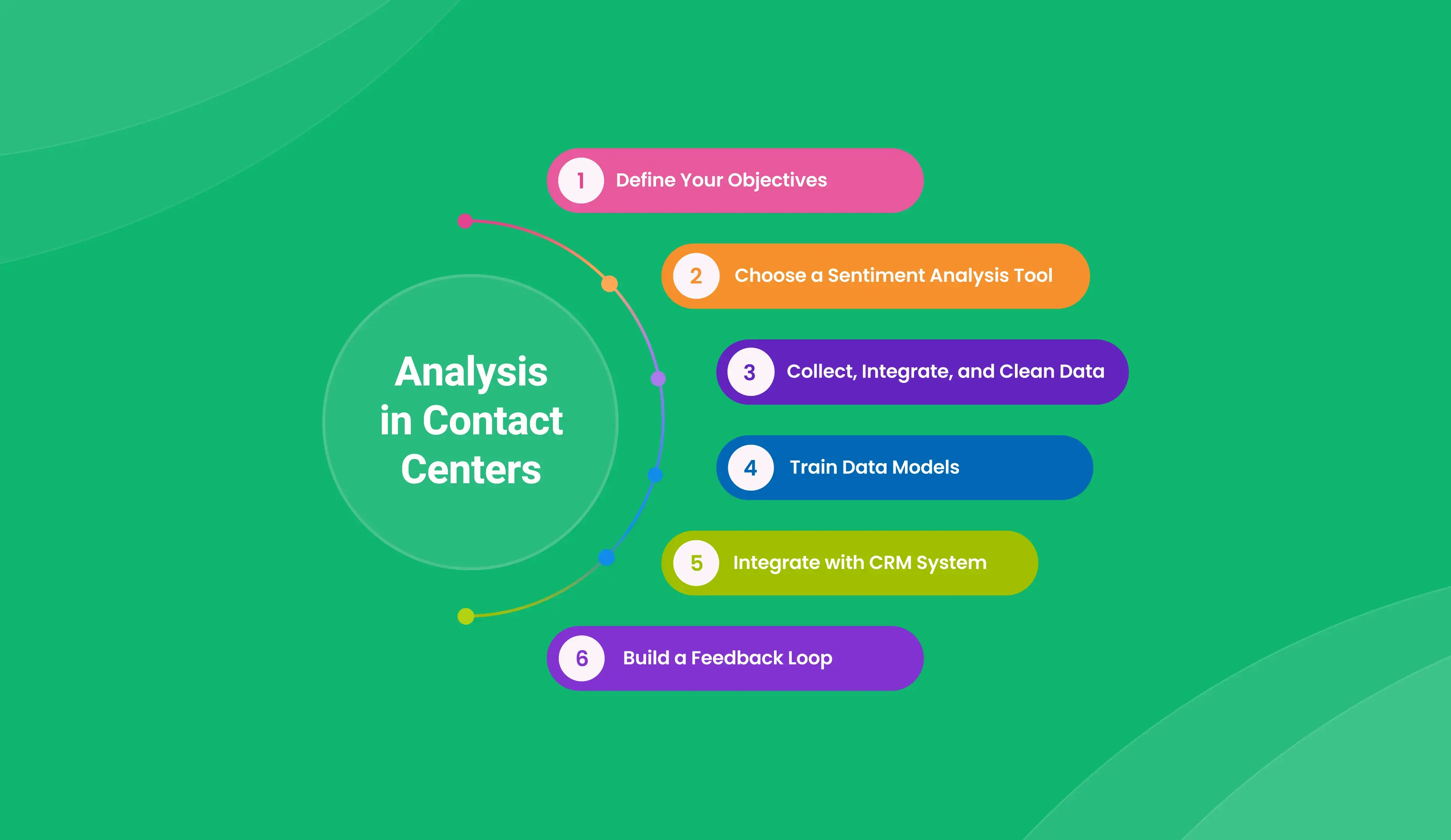
Define Your Objectives
It is essential to outline the goals of performing sentiment analysis clearly.
Choose a Sentiment Analysis Tool or Service
Choose a tool savvy enough for you that is going to match perfectly into what you have been using so far.
Collect, Integrate, and Clean Data
Clean and prepare information obtained using any necessary means for analysis.
Train Data Models
Train your sentiment analysis models using labeled datasets.
Integrate with the CRM System
Make sure that it integrates smoothly with your customer relationship management system.
Build a Feedback Loop
Base your models and processes on feedback and new data to ensure ongoing improvement.
High-end Features Designed to Make Supervisors’ and Agents’ Lives Easier
Here are some important features to improve supervisors and agents work without much burden.
Real-time Assists
Deliver real-time suggestions and guidance to agents during interactions.
Voicemail Drop
Use automated voice mail messages to help you save time and maintain consistency.
Advanced WFM Capabilities
Utilize advanced scheduling and forecasting functions to boost human resource supervision.
How TeleCMI Helps to Measure Contact Center Sentiment Analysis?
TeleCMI is an example of an advanced cloud telephony platform that provides sophisticated sentiment analysis that allows for contact centers.
TeleCMI offering a powerful contact center operation solution through its effective sentiment analysis tools that are used in capturing and analyzing customer’s feelings during their interactions with every agents. With the help of advanced AI, TeleCMI can detect sentiments in phone calls and messages instantly, classifying them into positive, neutral, or negative. This instantaneous feedback enables agents to alter their approach which increases the chances of resolving customer queries or complaints and requirements.
In addition to its real-time analysis, we provide comprehensive sentiment trend reports that assist managers in determining areas needing improvement and making well-informed decisions. The platform leverages sentiment data to assess agent performance, thus facilitating better coaching and training practices.
By seamlessly integrating with zoho crm phone system integrations, it is ensured that sentiment data enhances the complete customer profile & history, which allows for personalized service to every single customer.
The sentiment analysis tools offered by TeleCMI delve into the emotions of customers to assist contact centers in improving the performance of their agents as well as enhancing overall customer satisfaction.
Conclusion
In summary, The feature of sentiment analysis in the cloud contact center is a tactical action that can improve delight in customers and productivity.
As well as thats what the right service provider such as TeleCMI can provide, organizations that manage their businesses well can have excellent customer emotions analytic attributes to give them live insights on how customers feel about a product or a service.
Agents can respond more efficiently, improving service quality while providing managers with valuable data for informed decision-making. When selecting a provider, consider integration capabilities, pricing, and support to ensure it aligns with your needs.
By doing so, you can maximize the effectiveness of sentiment analysis to improve on customer experience and drive profit maximization for your organization.
In just 30 minutes, our experts will show you how TeleCMI can:

Boost agent performance with live emotional feedback
Streamline quality monitoring with AI-driven scoring
Turn every conversation into actionable customer insight
Frequently asked questions (FAQ)
Vignesh N

With deep expertise in cloud telecommunications, I help readers explore the latest trends in VoIP and modern business communication. At TeleCMI, I focus on educating businesses with clear, practical insights, making complex telecom concepts easy to understand. I’m passionate about helping organizations improve efficiency, enhance customer engagement, and adopt smarter communication strategies.