Simplify Call Center Operations: Best Practices for Reducing Average Handle Time (AHT)

5 mins read

Posted on Aug 28, 2024
 for your Call Center and Enhance Efficiency_.webp)

Vignesh N
SEO


Vignesh N
SEO






Long waiting times frustrate customers and result in hanging up calls. This can pave the way for lack of customer satisfaction. It is crucial to maintain minimal handling time and resolve their issues quickly to enhance this factor.
In this blog, let us explore more about the Average Handle Time factor and how it can have a positive impact for business operations.
Average Handle Time (AHT): An Outline
Average Handle Time is a performance metric used in Call centers to measure the average amount of time spent on customer service to resolve the customer query.
This time can include real-time conversations, hold times, transfer times, required follow-up times, etc. It also refers to service customer calls where customers may contact businesses for different reasons.
It is important to reduce AHT to determine the agent's performance, improve customer satisfaction, enhance overall customer service quality, and cut down on operational costs invested by the businesses.
Reduce AHT, Improve Customer Experience with TeleCMI!
Leverage AI, Automation, and Smart Routing to Handle Calls Faster Without Compromising Quality!
How to measure Average Handle Time?
As we have discussed above, AHT corresponds to customer calls. The formula to calculate the Average Handle Time is the total handling time divided by the total number of calls. The total handling time can be talk time, hold time, after-call working time, etc. This AHT can also be evaluated per agent, per department, or the entire team
Average Handle Time (AHT)= (Total Talk Time+ Total Hold Time+ After Call Work)/ Total number of calls.
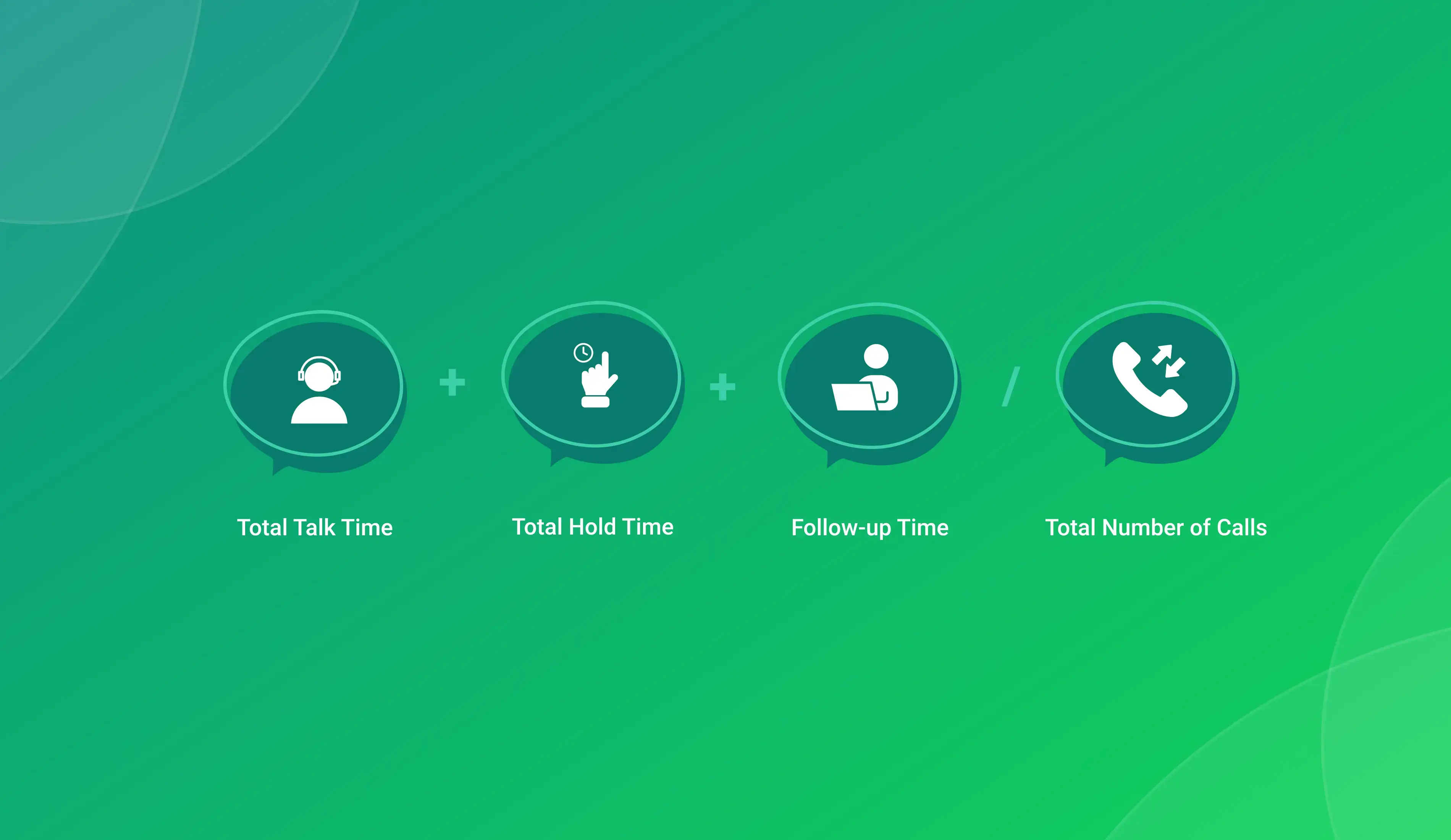
- Talk time refers to the time spent by the call center agent when speaking with the customers.
- Hold time refers to the time a customer spends on hold during the call, which can also include the transfer time.
- After-call work refers to the time spent by the agent on follow-up tasks after completing the calls, such as taking notes, updating the CRM records, logging the call outcome, scheduling follow-ups, etc.
Why AHT is crucial for call centers?
AHT is a significant performance metric for call centers to focus on. With this indicator, businesses can efficiently handle customer queries and maintain improved customer service to retain existing customers and attract new customers.
High AHTs can be termed an inefficient call-routing strategy or result from poorly trained agents. By concentrating on AHT, call centers can work on the customer service processes and determine the areas that need improvement. Based on this, businesses can also arrange for training sessions if required.
5 Simple Tips and Practices to Reduce AHT in a Call Center:
In order to reduce AHT and follow effective customer interaction, here are the significant tips and practices to be followed:
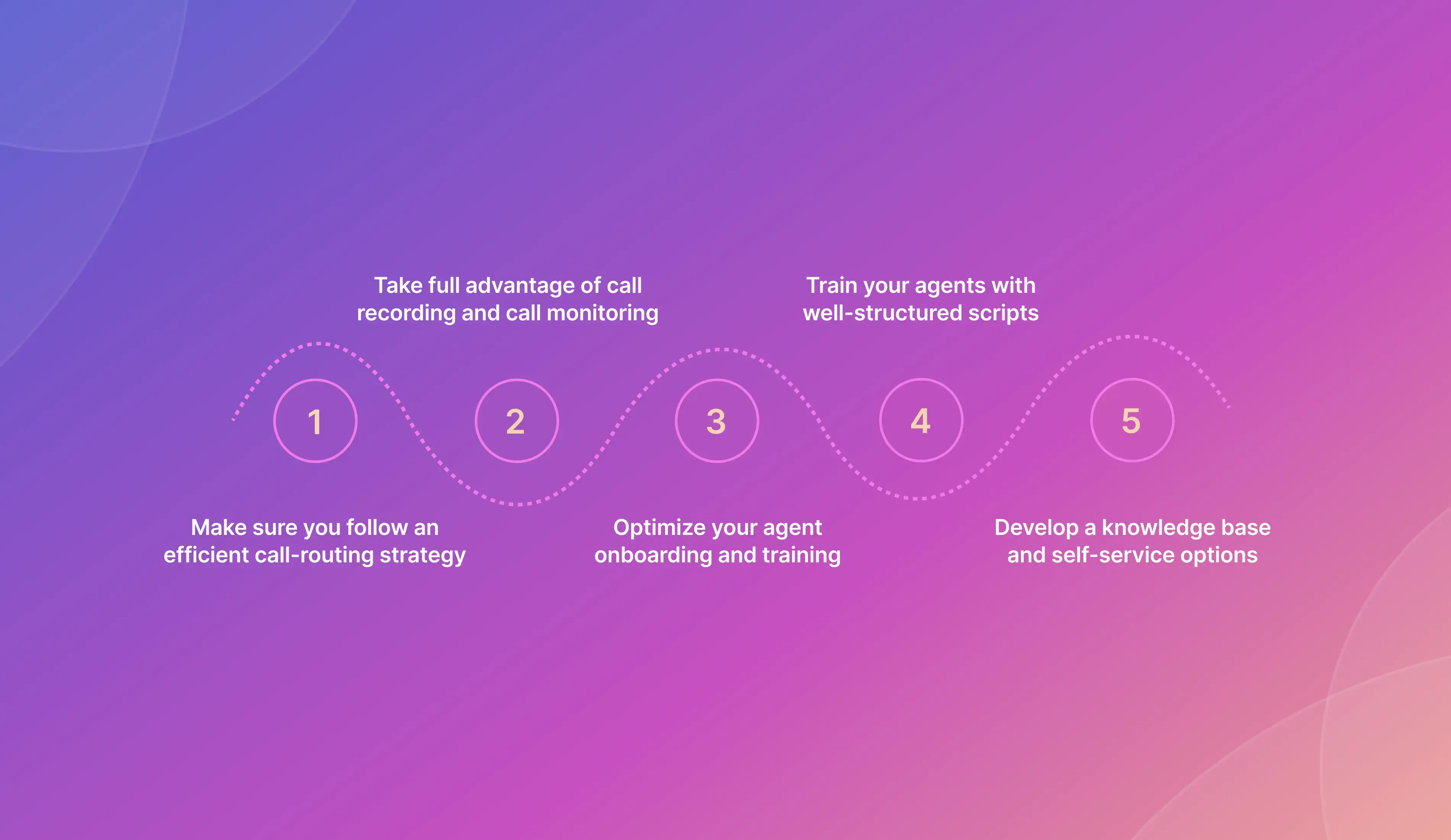
1. Make sure you follow an efficient call-routing strategy
It is crucial that you don’t frustrate your customers. By implementing an exceptional IVR system, businesses can reduce the Average Handle Time (AHT) and enable customers to get responses without the need to speak to agents.
2. Take full advantage of call recording and call monitoring
call recording and call monitoring are a few advanced features that can enhance business phone systems for call centers. Most call centers already have this functionality; with this feature, businesses can keep track of those recordings to monitor agents' performance and explore customer needs. Similarly, the call monitoring feature will also help you track performance.
3. Optimize your agent onboarding and training
By regularly monitoring agent calls with customers, businesses and the supervisor can identify areas for improvement and arrange training sessions when needed. Highly knowledgeable agents can quickly respond to customer queries without maintaining a lengthy AHT. Businesses can also understand customer feedback, which helps to minimize AHT duration.
4. Train your agents with well-structured scripts
It is significant to train the agents with the required scripts, which contain sufficient information to respond to customer queries. With well-structured scripts, agents can respond faster and provide effective answers without a lengthy AHT. However, agents should also be trained to work off the script and offer personalized options to the customer for enhanced experience.
5. Develop a knowledge base and self-service options
To reduce AHT, businesses can introduce self-service options that address the most common and general customer queries. A comprehensive knowledge base can also help agents resolve queries better and can be useful for freshers who need to be trained.
Why Reducing Average Handle Time is Crucial for Call Centers:
Let us explore various benefits of Average Handle Time in the Call Center for businesses
Enhanced customer experience
Customers contact businesses to resolve their queries. This can be their last chance to try something after multiple efforts. Hence, by getting a clear response that can work on their query, customers may feel delighted and can enhance their experience.
Improved contact center performance
With reduced AHT in call centers, businesses can improve contact center performance. Moreover, it can also drive the agent’s performance. When the agent and customer spend less time on the call, we can mean that the query is resolved.
Cost reduction
By lowering AHT, your call center can handle a greater volume of calls. With data analytics and agent performance, you can explore areas for improvement that can further reduce AHT. This can also provide agents with efficient call handling.
Leverage AHT to enhance work operations and customer satisfaction:
AHT can be an excellent solution that can rule out challenges in the call center industry. Businesses which are looking to improve their work operations and enhance customer satisfaction can consider to reduce AHT that can make the process more feasible.
By effectively managing AHT, you can foster happier customers and improve agent retention—both of which are key drivers of call center success and growth. Taking into account the strategies mentioned above, you can significantly reduce AHT, allowing you to focus on other areas of optimization and continuous improvement for your call center.
Ready to Reduce Your Average Handle Time and Boost Efficiency?

Tailored Solutions
Boost Customer Satisfaction
Boost Agent Productivity
Vignesh N

With deep expertise in cloud telecommunications, I help readers explore the latest trends in VoIP and modern business communication. At TeleCMI, I focus on educating businesses with clear, practical insights, making complex telecom concepts easy to understand. I’m passionate about helping organizations improve efficiency, enhance customer engagement, and adopt smarter communication strategies.