Best Call Answering Service Providers for Small Businesses

17 mins read

Posted on Apr 27, 2026


Saravana Kumar
SEO


Saravana Kumar
SEO





Every missed call directly impacts the business revenue.
Missed call = Losing prospects.
Missed call = Lost opportunities.
Missed call = Missed revenue.
Recent studies state that nearly 85% of customers won't call back if their calls are moved to voicemail or unanswered. They often end up choosing the competitor. This highly impacts the SMBs that heavily rely on inbound calls. With limited staff, different work timings, personal SIMs, and high call volumes, these organizations often miss calls, delayed interactions, and delivering a poor customer experience.
Call answering services reduce this risk by effectively handling incoming calls, even during after hours. By leveraging AI agents, structured workflows, multi-level IVR and seamless integration, it provides the flexibility and consistency required to fulfill the growing communication needs of multiple businesses.
Choosing the best call answering platform that fits your business requires multiple evaluation and validation. In this blog, we have simplified the process by comparing the top 5 call answering services for small business with their features, pros, limitations, and pricing.

Key takeaways
Reduces missed opportunities and delays:
Every call is answered and handled properly which reduces missed calls and pickup delays, improving customer trust.
Enhances customer experience:
Fast responses, shorter wait times, and correct routing lead to better interactions and higher customer satisfaction.
Supports scalability:
Helps businesses handle the growing call volumes without increasing internal teams.
What is Call Handling in Business?
Call handling is the process of handling both incoming and outgoing calls in an organization. It answers customer or prospect queries, collaborates with internal teams, and manages the overall business performance. It ensures every call is handled with professionalism, efficiency, and high customer satisfaction.
Response: The process of answering calls, either by a live agent or an automated system. By fastening the responses and reducing wait times, these systems improves customer trust.

According to Forbes
About 35%-40% of sales goes to the agent that responds first, and a 400% decrease if a customer waits for five to ten minutes.
Routing: Directing the call to the right agent, department, or team based on predefined routing rules including working hours, location, caller's priority, agent skillset, and more.
Call Management: Call management refers to the process of structuring and monitoring calls from the moment a customer initiates a call until the interaction is completed. It stores caller details, records conversations, prioritizes important requests, and ensures regular follow-ups for further customer queries.
Why Businesses Use a Virtual Answering Service
Many businesses may lack the budget and staff required to provide an effective answering service, which in turn affects their overall customer reputation. The good news is that there is a solution for this problem: virtual answering services. They help provide consistent support for handling customer calls without adding extra work to internal teams.
The following factors make these solutions commonly used:
Never misses a call:Virtual answering services answers every incoming call, even during busy hours or when internal teams are completely occupied. This helps businesses reduce missed interactions and capture more potential leads.
Mini Case Study:
If a patient calls an hospital to book an appointment, human agents may sometimes be unavailable to attend the call. A virtual agent answers this call immediately, collects patient details, and stores them in the EHR. This removes missed appointments and improves operational efficiency.
24/7 availability:Unlike traditional in-house teams that work for fixed hours, virtual answering systems provide consistent support throughout the day, handling calls even outside of office hours. Customers can reach businesses whenever they want, which improves accessibility and fosters trust.
Enhances customer experience: Virtual agents are faster at responding and more accurate in call routing than live agents, helping create smooth and trustworthy interactions.

According to a report from CMSWire , 82% of customers believe that a company's ability to manage customer service depends on loyalty. Reduced wait times and consistent interactions can lead to increased customer loyalty and satisfaction.
Consistency and Simplicity: By organizing call flows and reducing unnecessary delays, businesses can provide a consistent and streamlined communication experience. A structured call approach offers higher retention rates and better brand perception. Many businesses also use digital tools such as The QR Code Generator (TQRCG) to simplify customer interactions, share information instantly, and create a more seamless communication journey across multiple touchpoints
Cost-effective alternative to in-house teams: Hiring and training an in-house team can raise operational costs by 40-60%. Virtual answering services provide a scalable option, helping businesses reduce communication costs while maintaining service quality.
Overall, virtual answering services offer a flexible and cost-effective way to manage business communication.
Need Reliable Call Answering at Scale? Handle peak hours, after-hours, and busy days without adding staff
See TeleCMI in ActionHow to Choose the Right Answering Service for Small Business
Choosing the right call answering service is essential for small businesses looking to expand and effectively manage customer communication. The ideal solution should reduce missed calls, create space for more potential leads, and support businesses in long-term growth.
Manual vs. AI answering services
Choosing answering services usually depends on the type of customer interaction a business handles. Human agents provide personalized experience, especially in situations where empathy and context matter. AI answering systems provide instant responses, consistent followups, and 24/7 availability at a lower cost. Many organizations choose a hybrid approach that combines both.
Call routing capabilities
Call routing is a notable feature that can directly impact the overall customer experience. A reliable virtual answering service should route calls based on time, department, or customer inputs, which reduces wait times.
CRM integration
In most cases, disconnected systems lead to scattered conversations. Integration with CRM platforms like Zoho, Hubspot or Salesforce helps avoid that by enabling real-time access to customer data, which improves personalization and increase sales productivity.
Scalability
As call volumes continue to increase, systems that were performing well may begin to show their limitations. A good answering service should meet the client's growing needs without requiring major modifications or affecting performance.
Pricing and cost efficiency
Businesses should focus on the value and what they receive in return for their investment. Modern answering services offer flexible pricing, making them more cost-effective and reliable than managing an in-house team.
Best Call Answering Service Providers
Factors like call routing, scalability, AI support, and pricing should be considered while selecting a call answering service. Based on these factors, below are some of the top call answering service providers for small to medium-sized businesses:
TeleCMI
.webp)
TeleCMI is a leading AI-powered unified communications platform (UCaaS) that helps businesses effectively manage customer interactions, across voice and digital channels. It improves inbound customer experience through smart automation, intelligent routing, and analytics, and supports outbound engagement.
Key Features:
- Automation and Routing: Advanced IVRs and intelligent routing quickly connects the call to the right agent.
- Artificial Intelligence: Features like Voice agents, AI coaching, and AI assist reduce the workload of human agents and guide them properly.
- Advanced Call Management Suite: Includes features such as call recording, forwarding, monitoring, conferencing, whispering, barging, and queuing for call control and quality assurance.
- Numbers: Provides local, toll-free, virtual, and international numbers to expand reach and establish stronger connections across various regions.
- Reporting and Analytics Dashboards: Tracks call performance, agent activity, and customer insights with live dashboards and detailed reporting.
- CRM, API Integrations, and Web Extensions: Integrates with 170+ business tools, which allows automated workflows and easy access to calling tools directly from your browser.
- Auto Dialer and Outbound Automation: Enhances agent productivity with predictive/progressive auto dialing and automated followups
Best For:
Businesses that largely depend on inbound customer communication, such as support teams, service providers like e-commerce brands and finance, and growing enterprises.
Pros:
- It is consistently seen as a cost-effective solution, especially for startups and growing businesses
- According to SaaSworthy, users have mentioned TeleCMI as a reliable customer support, which is a major strength
- Helps businesses simplify communication and improve productivity without heavy infrastructure
- A flexible and remote- friendly option that works well for distributed teams and modern business setups
Cons:
- Initial setup may be slightly complex due to the dependence of telecom operators on call termination and connectivity
- Some users report that customization options are limited
- Mobile app is still under development
Client Testimonial: Telecmi's calling solution features like call tracking, intelligent call routing, and unlimited call recording has helped Vision International Educational Consultants (VIEC) to manage large volume of calls and track their team's productivity, increasing efficiency, productivity, and client experience.
AnswerConnect
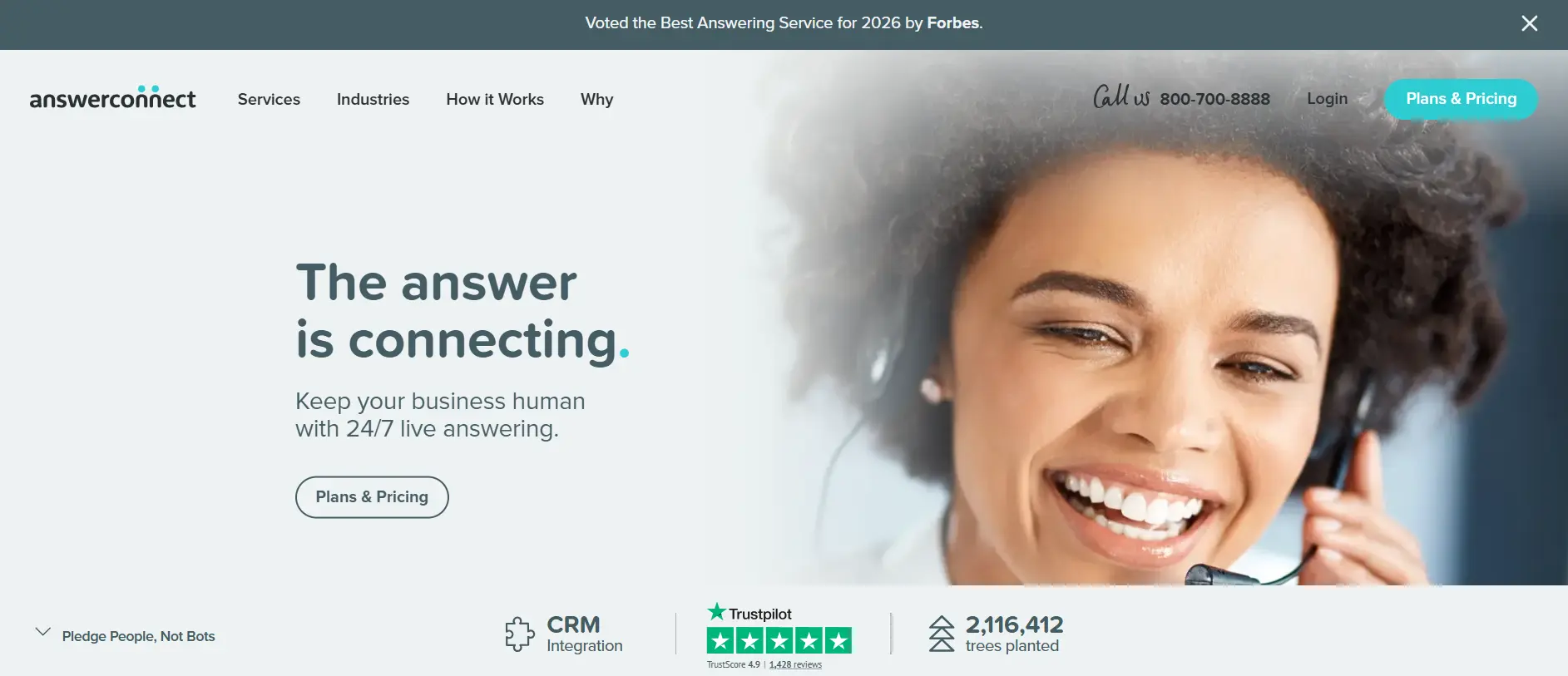
AnswerConnect is a 24/7 virtual receptionist service focused on delivering real-time customer experience through human agents rather than automation or AI-driven communication. It supports professional call handling, appointment scheduling, and efficient lead capture, combining human receptionists with digital tools.
Key Features:
- 24/7 Live Call answering: Trained virtual receptionist answers each call throughout the day, providing a complete human experience and ensuring no missed calls
- Live support for Website visitors: Provides chat support through real humans and engages website visitors, increasing leads.
- Appointment Scheduling and Calendar Management: Receptionists can book, manage, and update appointments easily, helping businesses maintain an organized schedule
- After Hours Answering: Ensures the continuity of businesses outside working hours or during peak hours by human agents.
- CRM integrations and Real-time notifications: Integration with tools like Zapier, and custom webhooks, with instant notifications through SMS, Email, or app.
- Lead Capture Tools: Ensures automated lead capture and customer service through its Active Response tools.
- Urgent Call Handling: Live agents provide 24/7 call handling in case of emergency or critical situations.
Best For:
Service based businesses and SMBs that prefer human-centric approach to handle customer calls, without building an in house team.
Pros:
- Businesses benefit from around-the-clock availability, ensuring no customer call is missed regardless of time or working hours
- Real human interactions create a more personalized, and trustworthy experience compared to automated bots
- Requires minimal setup compared to building an in-house team
- Consistent management of customer inquiries helps businesses capture more leads and convert them effectively
Cons:
- Since calls are handled by humans, each call experience is determined by the individual agent
- Users may report misunderstanding or incorrect information capture by agents
- Compared to AI systems, it is less advanced in automation, customization, and adaptability
ReceptionHQ
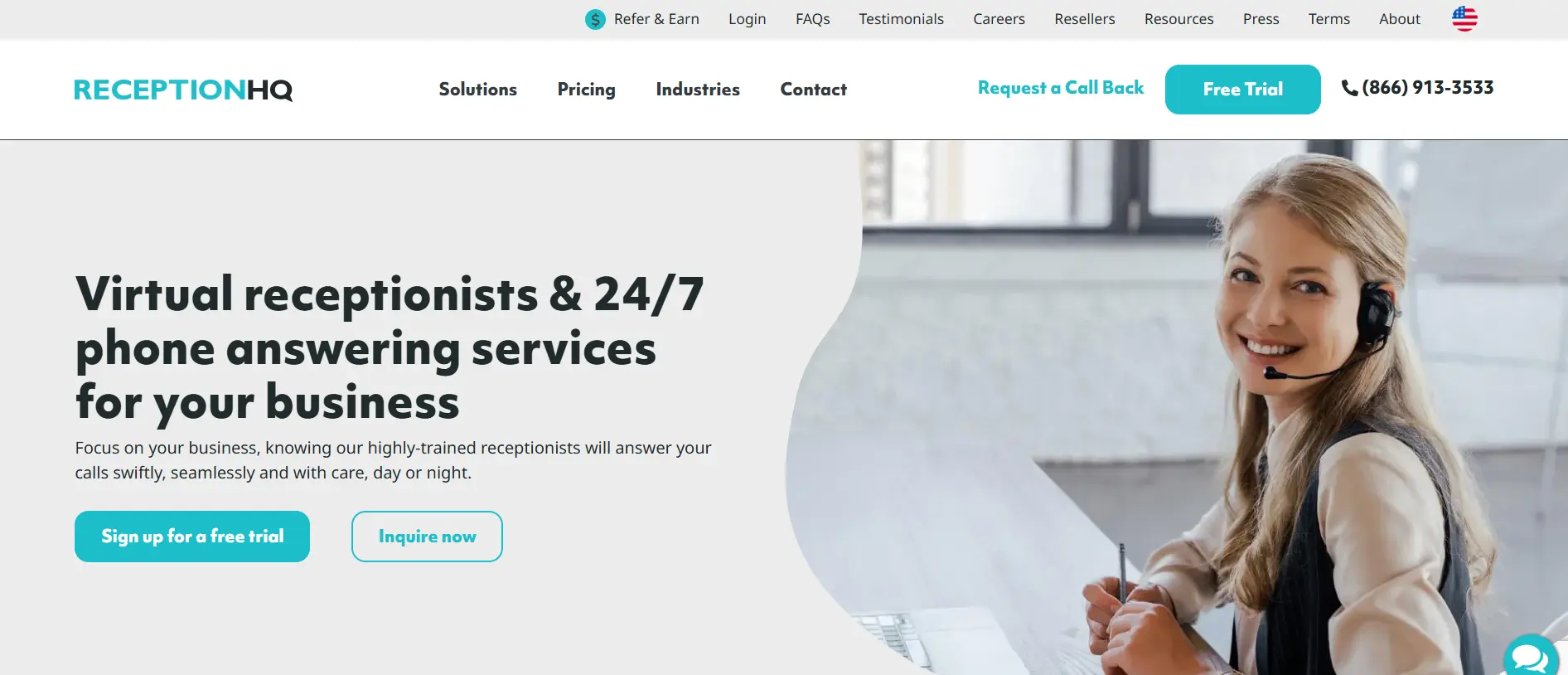
ReceptionHQ is a virtual receptionist service that helps businesses handle incoming calls without hiring in house staff. It uses human agents to provide around-the-clock call answering, personalized greetings, and call transfers, to capture leads, improve customer experience, and avoid missed opportunities.
Key Features:
- 24/7 Live Call Answering: Virtual receptionists are able to answer customer calls even on holidays by turning on after-hours live answering option.
- Bilingual Support: Receptionists assist callers in english and spanish languages
- No lock-in contract: A flexible monthly subscription rather than subscribing for the whole year
- Message Taking and Instant notifications: A message is sent immediately through SMS or email if a call is missed
- Mobile-optimized portal: An online client portal where you can manage inquires or details in mobile phones, besides laptops and desktops
- Toll-free Numbers: Helps businesses enhance their customer support by providing cost-free communication
Best For: Businesses of all sizes that require virtual receptionists to handle professional calls without hiring in-house receptionist staff.
Pros:
- Live trained receptionists ensure every call is answered professionally, resulting in lead acquisition
- Entry price is comparably lower than its competitors, making it ideal for small businesses
- Custom greetings create a customer impression by greeting callers with a customizable welcome message
- Dual pricing option gives flexibility for providers and helps them choose the model that best fits their business
Cons:
- As the number of calls increases, dual pricing can become expensive
- For some plans, call after hours and extended coverage can cost you additional charges
- While it can handle a large number of calls, it is not suited for complex communication systems
Nextiva
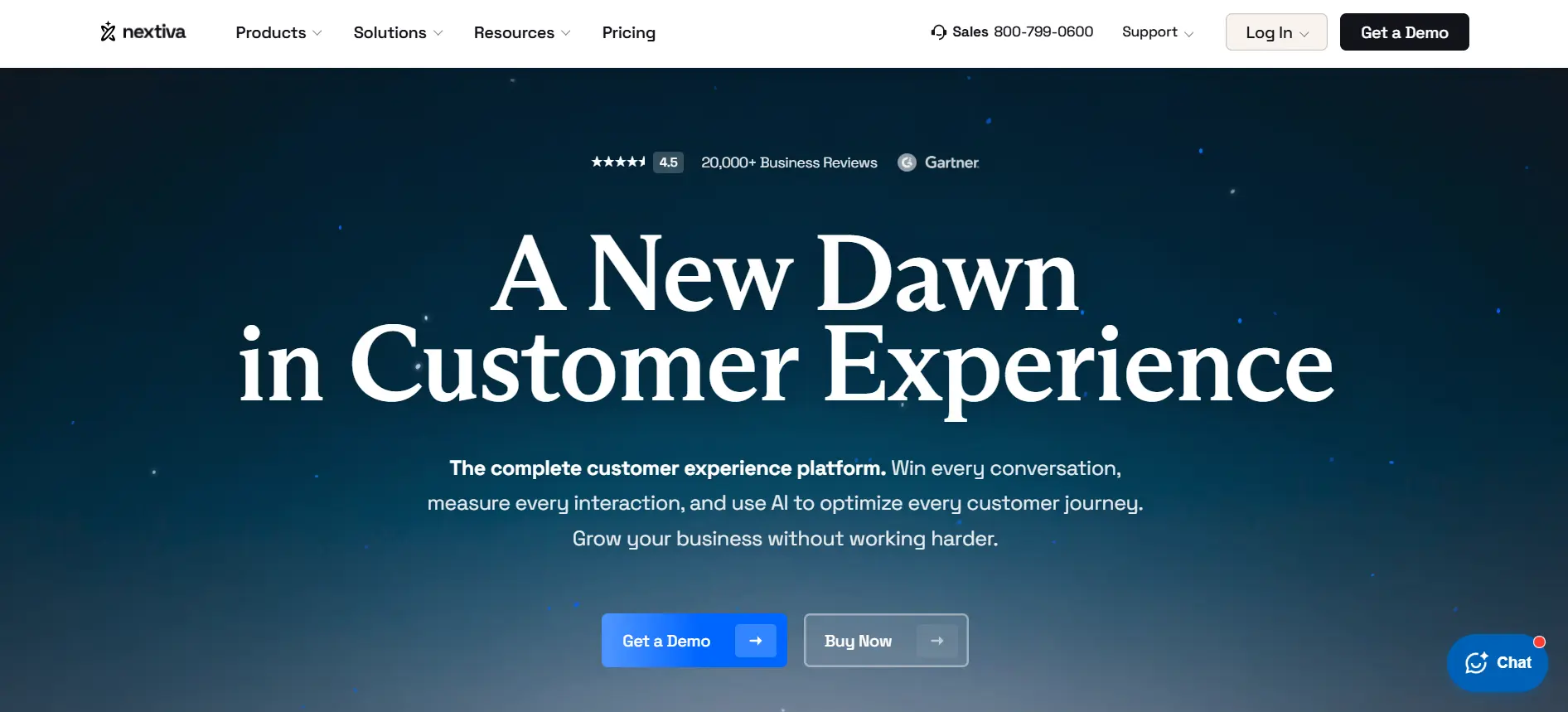
Nextiva is a cloud-based business communications platform that helps businesses manage conversations across voice, chat, email, and social media. More than just a VoIP services provider, it is a complete customer experience platform that combines business calling, messaging, and customer experience tools together.
Key Features:
- AI employee: XBert, an advanced AI feature provides around-the-clock support managing customer interactions. It answers calls, books appointments, resolves other issues and also ensures periodical followups.
- AI assist: Supports human agents by using AI to analyze conversations, guiding them by giving suggestions during calls or chats
- AI Receptionist: A voice-based assistant that uses Natural Language Processing to process a customer call and replies in real-time, enhancing customer experience and reducing delays.
- Smart Escalation: Transfers complex queries to human agents with just the conversation history
- Real-time Insights, Transcripts and Analytics: Calls are recorded, transcribed, and analyzed for tracking performance and improvement
Best For:
SMBs and mid-market enterprises that want automation for customer interactions. It is more suitable for companies prioritizing scalability, AI-driven efficiency, and complete automation over human-led models.
Pros:
- Can handle large volume of calls simultaneously without the interuption of human agents
- Provides immediate responses for queries across its channels without delays
- Goes beyond answering queries like booking or scheduling appointments, and ensuring followups
Cons:
- AI automated performances depends on how well the AI is trained with data
- Internal Teams may need time to adapt to AI-driven workflows
- Works best with Nextiva's ecosystem, limiting flexibility with other solutions
Aircall
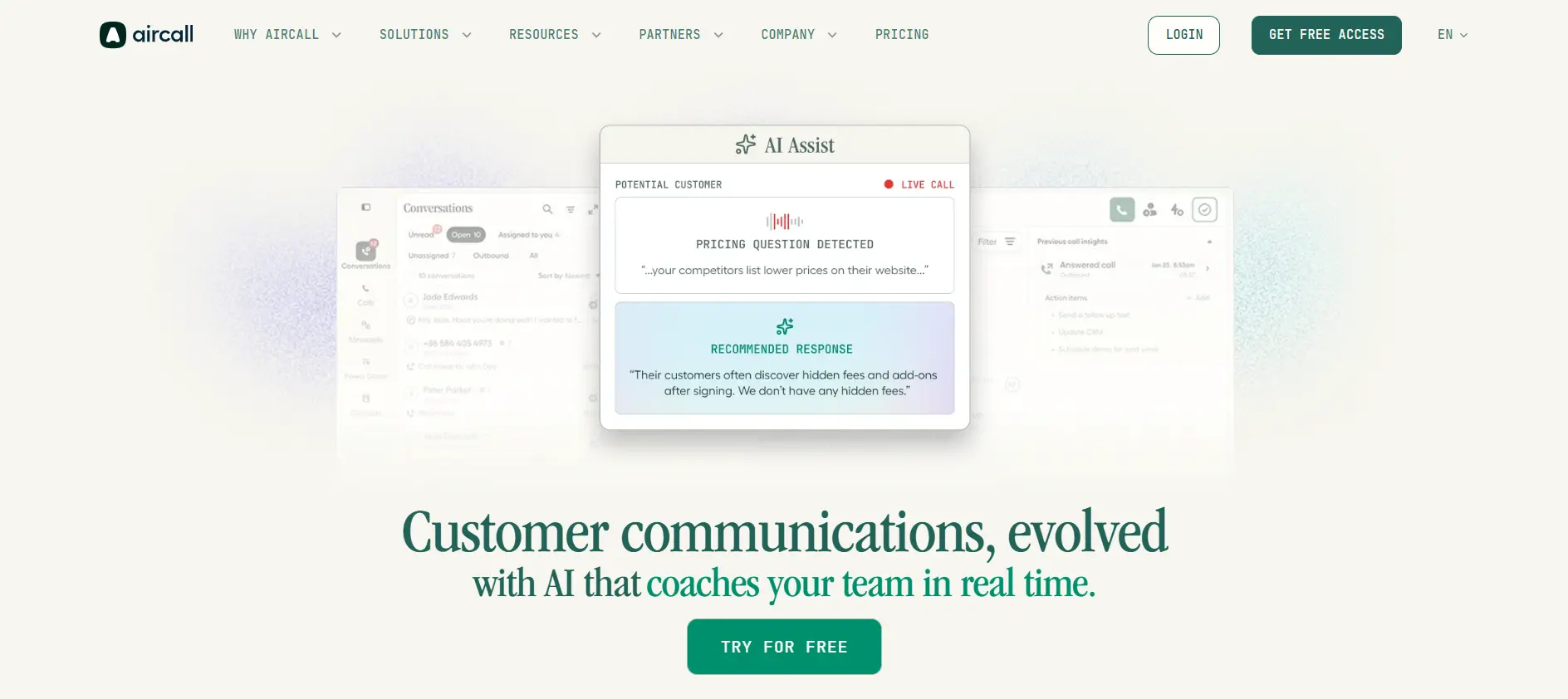
Aircall is a customer communication and intelligence platform designed for sales and support teams that integrates voice, whatsapp, SMS, and social media channels into a single platform. With bi-directional syncing across 100+ essential business apps, it increases productivity, simplifies workflows, and improves customer interactions.
Key Features:
- Power Dialer: Enables agents to call multiple numbers with a single click
- Business Text Messaging: Connects with prospects and customers in a personalized way by sending and receiving SMS and MMS
- Mobile Business Phone App: Stays connected and responds to customers even when a desktop is not available. Mobile notifications allow instant alerts for voicemails, missed calls, and text messages
Shared Call Inbox: A shared call inbox helps users keep track of all calls and prevent conversations from missing and ensures proper followups
Live Monitoring: Enables to track your team's calling activity to improve performance, and optimize staffing
AI Call Summaries: Agents can access AI-generated call summaries to better understand customer queries, and capture customer intent and sentiment
Best For:
Sales and customer support teams that heavily rely on calling workflows and CRM integrations.
Particularly ideal for SMBs and mid-sized companies looking for an easy-to-deploy phone systems with strong integrations
Pros:
- Enables automatic call logging, contact syncing, and workflow automation
- Helps reduce manual workload and increases team's productivity
- International numbers in multiple countries works well for remote teams and global expansion
Cons:
- Costs can become expensive for scaling businesses
- Not suitable for small teams and freelancers
- Lacks advanced contact center capabilities and workforce management
Traditional vs Modern Answering Services
A call answering service includes both human and AI-based agents to attend a call. Though each type has their benefits, knowing the difference between traditional and modern solutions helps businesses choose options that best fit their size, budget, and customer expectations.
Common factors include:
Modern answering services uses advanced algorithms like Natural Language Processing to analyze calls and understand a caller's tone and intent. They are known for their instant response and availability, making them a better option for small and growing businesses to reduce missed calls, delays and enhance customer experience.
Platforms like TeleCMI are shifting towards a smarter, more efficient call handling by combining automation with intelligent routing and AI-driven features. Instead of just relying on human agents, these solutions include advanced features such as skill-based routing, IVR, and AI agents to handle calls smoothly and with minimal delay.
This hybrid approach has multiple benefits like reducing missed calls, operational costs, and improving customer trust, which makes communication more consistent. It also helps growing businesses manage large volumes of calls while maintaining a high-quality customer experience.
Conclusion
Investing in the right call handling or virtual receptionist services helps your business capture every opportunity, boost employee productivity, and improve overall efficiency. For businesses looking for a personalized human touch, traditional call answering can be the ideal choice, while those who want a faster, automated and immediate response can opt for AI call answering.
Modern answering solutions are no longer just a support function; they are a strategic advantage for businesses that want to grow, compete, and deliver exceptional customer experiences.
As AI and automation continue to evolve, call-answering services will become even more intelligent, allowing faster, more personalized, and highly scalable customer communication.
Turn Every Incoming Call Into Opportunity
Improve lead capture and customer support with an intelligent answering platform
Frequently asked questions (FAQ)
Saravana Kumar

I’m passionate about exploring and sharing insights on modern cloud communication technologies. At TeleCMI, I focus on helping readers understand the evolving world of cloud telephony and IVR solutions in a simple yet in-depth way. My goal is to deliver genuine value by turning complex telecom concepts into clear, actionable knowledge that builds trust and drives innovation.