AI Call Summaries: Complete Guide to Automating Call Notes and Reducing After-Call Work

23 mins read

Posted on Jul 02, 2026

Vignesh N
SEO


Vignesh N
SEO





What if your customer support team could handle significantly more calls without hiring a single extra person?
Sounds impossible. But it's happening right now at contact centers across India.
Here's how. It's Monday afternoon in Bengaluru. An agent wraps up a support call. Customer had a problem. Agent fixed it. Conversation took eight minutes.
Normally, this is where the pain starts. Agent opens the ticket system. Types what the customer said. Types what they promised. Types the next steps. Types, types, types. Substantial time to document a short call.
That's the problem. An agent's job isn't to type. It's to help customers. But every single day, they spend significant time typing instead of solving problems.
Take a typical contact center with dozens of agents. Each handles multiple calls daily. The cumulative time spent on documentation adds up quickly. All that time went to paperwork instead of customers waiting on hold.
Then something changed.
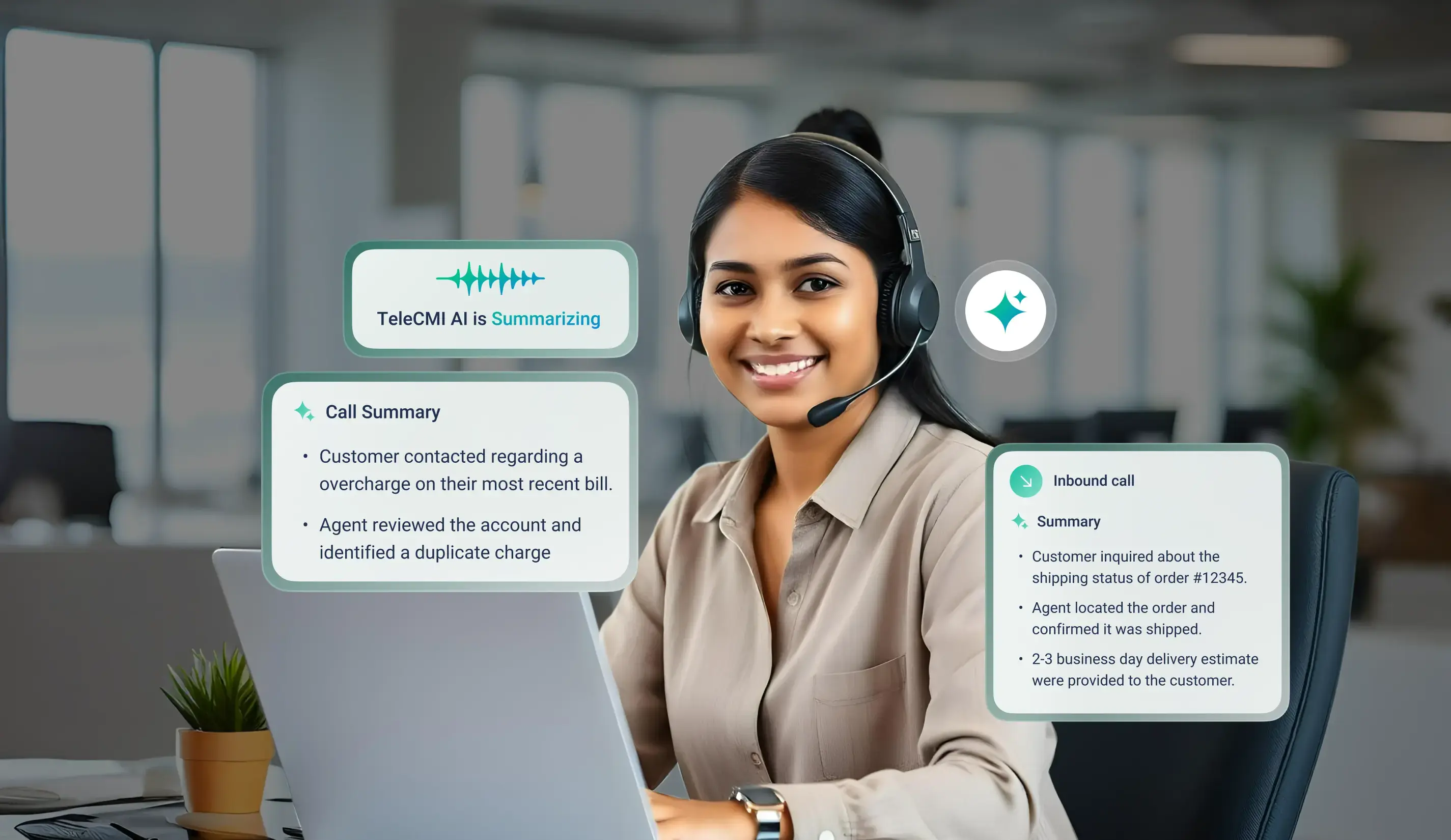
A call ended. Instantly, the system wrote a summary. Issue captured. Discussion noted. What was promised. What comes next. All automatic. The agent never typed a single word. They took the next call immediately.
No more typing about work. Just doing the work.
That's what AI calls summaries do. This guide walks through what they are, how they work, and why they matter for any business handling phone conversations.

Key Takeaways
AI call summaries are instant notes that write themselves. A system listens to a call, figures out what matters, and writes it all down. Agents don't type. Supervisors don't take notes. The summary pops up seconds after the call ends, straight into your CRM or ticket system where people already work.
Here's what companies see after using this: way less time spent on paperwork. Agents finish calls and jump to the next customer. Compliance happens automatically because every call's documented. Repeat calls drop because nothing gets forgotten. Customer satisfaction jumps because follow-ups actually happen when promised.
This works for support teams, sales, big call centers, hospitals, banks, and basically any place where phone calls matter.
What Are AI Call Summaries?
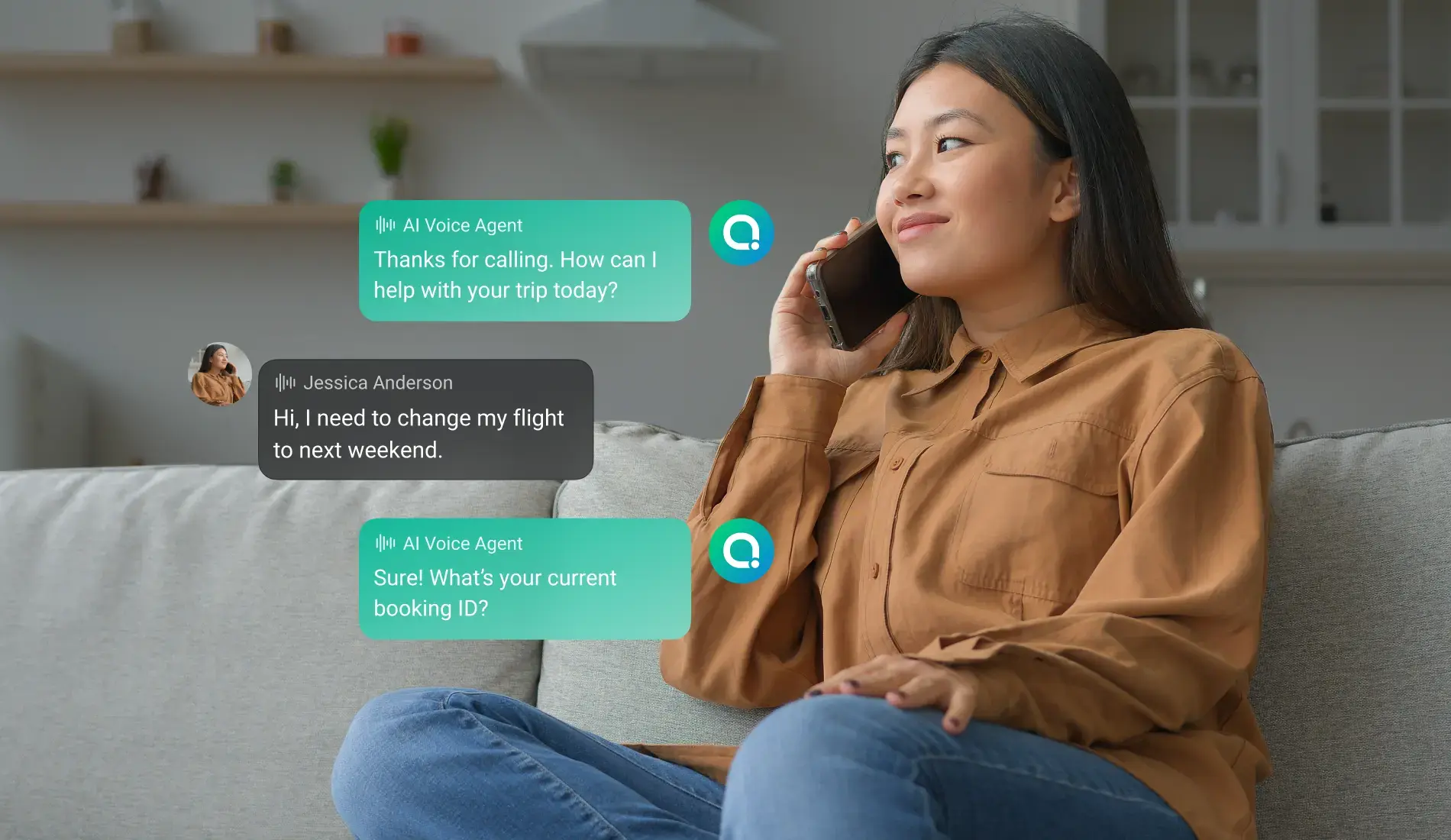
Imagine having someone sit in on every call and take perfect notes. That's basically what AI call summaries do, except it's a machine doing it automatically.
When a call ends, the system listens to the recording. It figures out why the customer called. What the agent and the customer talked about. What got promised. What happens next. Small details too, like names and account numbers and specific complaints. Then it writes all that in clear language that makes sense.
The summary shows up in your CRM or ticket system in seconds. You can read the whole thing in less than a minute. Everything's there. You don't need to listen to the recording.
Nobody has to type notes. No manager sitting around listening to calls and writing things down. No compliance person is trying to track whether all the required steps got documented. The system just does it.
Different systems organize things differently. Some break it into issue, solution, and follow-up. Some write it paragraph style. Some highlight action items separately. The point's the same though. Capture what happened and show it in a way people can actually use it right away.
How AI Call Summaries Work
Call happens. Call records on the phone system. When it ends, the audio goes to the summary engine. The system analyzes it either during the call or right after it finishes.
The technology listens to both voices. It picks up who's talking. Agent and customer, maybe someone else on the line. Then it listens to the whole thing and figures out what actually matters. What problem brought the customer in? What'd the agent suggest? Did the customer seem happy? What got promised for next?
It writes a summary in regular English. Not word for word transcription. Not everything that was said. Just the important stuff organized in a way that makes sense.
The summary pops up wherever agents already work. You open the ticket, and there it is. You don't have to hunt through call recordings. You read the summary, and you get it completely. A manager reviewing the case? Same thing. They see the summary and understand the full picture right away.
Here's the cool part. The system gets smarter. When supervisors fix something or edit a summary, the system learns. It gets better at spotting what matters. The longer you use it, the better the summaries get.
Integration's built in with most modern systems. Summaries automatically fill in CRM fields. They kick off workflows. They create tickets. They load compliance records. No one has to do any of that manually.
Why Traditional Call Notes Are No Longer Enough
This has been how contact centers have worked forever. Call ends. Agent sits and types notes. Or a supervisor listens to calls and takes notes by hand. Both create headaches.
The speed problem first. An agent handles multiple calls daily. After each one, they spend time typing notes. That adds up quickly. Time that could go to helping customers goes to documentation instead. Across a team, this accumulates into significant lost productivity.
Then there's inconsistency. Agent A writes detailed notes. Agent B writes practically nothing. Agent C uses abbreviations nobody remembers six months later. A supervisor reads these notes and has no clue if they're complete. Are they seeing the real story or just a fragment?
Compliance gets messy too. Did the agent mention the required disclosure? Did they get customer consent? Did they follow the script correctly? With manual notes, only a sample of calls get reviewed. The rest have no documentation of whether requirements were met.
And follow-ups get lost. Someone writes, "call customer back on Tuesday." But Tuesday comes and goes. Nobody calls. The note was vague or got buried or someone misread the handwriting. The customer's waiting for a callback that never happens.
AI summaries fix all four problems. Speed jumps because nobody types. Consistency happens because the system does the same thing every time. Compliance's automatic because every call creates a structured record. Follow-ups don't disappear because action items show up clear in the summary.
Benefits of AI Call Summaries
- No More Typing After Calls. Agent finishes a call. Summary's already there automatically. No typing. No note-taking. They're ready for the next customer immediately. One team in Bengaluru went from substantial after-call work to zero. They became available for the next customer faster. Productivity improved significantly as a result.
- Documentation's Actually Complete. Every call gets written up the same way. A compliance officer pulls any call record and sees the same structure every time. Issue, solution, follow-up. Nothing gets lost. Auditors who come in from regulatory bodies find complete, consistent records instead of scattered notes.
- Way Fewer Repeat Calls. Customer calls back. The agent reads what happened last time instantly. They know what was tried, what was promised, and the whole history. They don't start from scratch. Repeat calls decline substantially because customers aren't re-explaining the same problem.
- First Call Resolution Actually Works. Summaries show exactly what you promised. Agent told the customer "we'll call you back tomorrow." The system captured it. Tomorrow? They get called back. The promise is clear and tracked. Nothing gets forgotten.
- Quality Gets Better. Supervisor reads a summary and spots a gap. "This agent didn't ask about account history." Training becomes specific. Not generic. Not vague. Problems are visible, so you can fix them.
- Compliance Gets Automatic. In hospitals or banks or anywhere regulated, summaries create automatic records. What got discussed. What was agreed. What was promised. All documented right away. Regulators see confidence in the system.
- People Actually Like Their Jobs More. Agents hate typing. When they spend their time solving problems instead of writing about problems, they're happier. Turnover improves because the work feels like customer service, not paperwork.
- Decisions Get Better. A manager reads call summaries and spots patterns. "Customers keep asking about this feature. Nobody understands it." Or "this topic shows up regularly in calls. Training's needed." Information's available so you can make real decisions instead of guesses.
Automate Every Call Note with AI-Powered Call Summaries That Eliminate After-Call Work.
Start 14 Days Free TrialKey Information Captured in AI Call Summaries
The system focuses on what actually matters. Here's what it picks up on:
- Why They Called. What brought the customer in? Technical problem. Billing mess. Feature question. Account issue. Service complaint. The summary says it clearly.
- How They Figured It Out. Did the agent and customer talk through it to find the real issue? Or did they jump straight to solutions? The summary shows whether there was actual problem-solving happening.
- What Got Offered. What did the agent do or suggest? Troubleshooting. Password reset. Refund. Handed it off to someone else. Scheduled an appointment. The summary writes it all down.
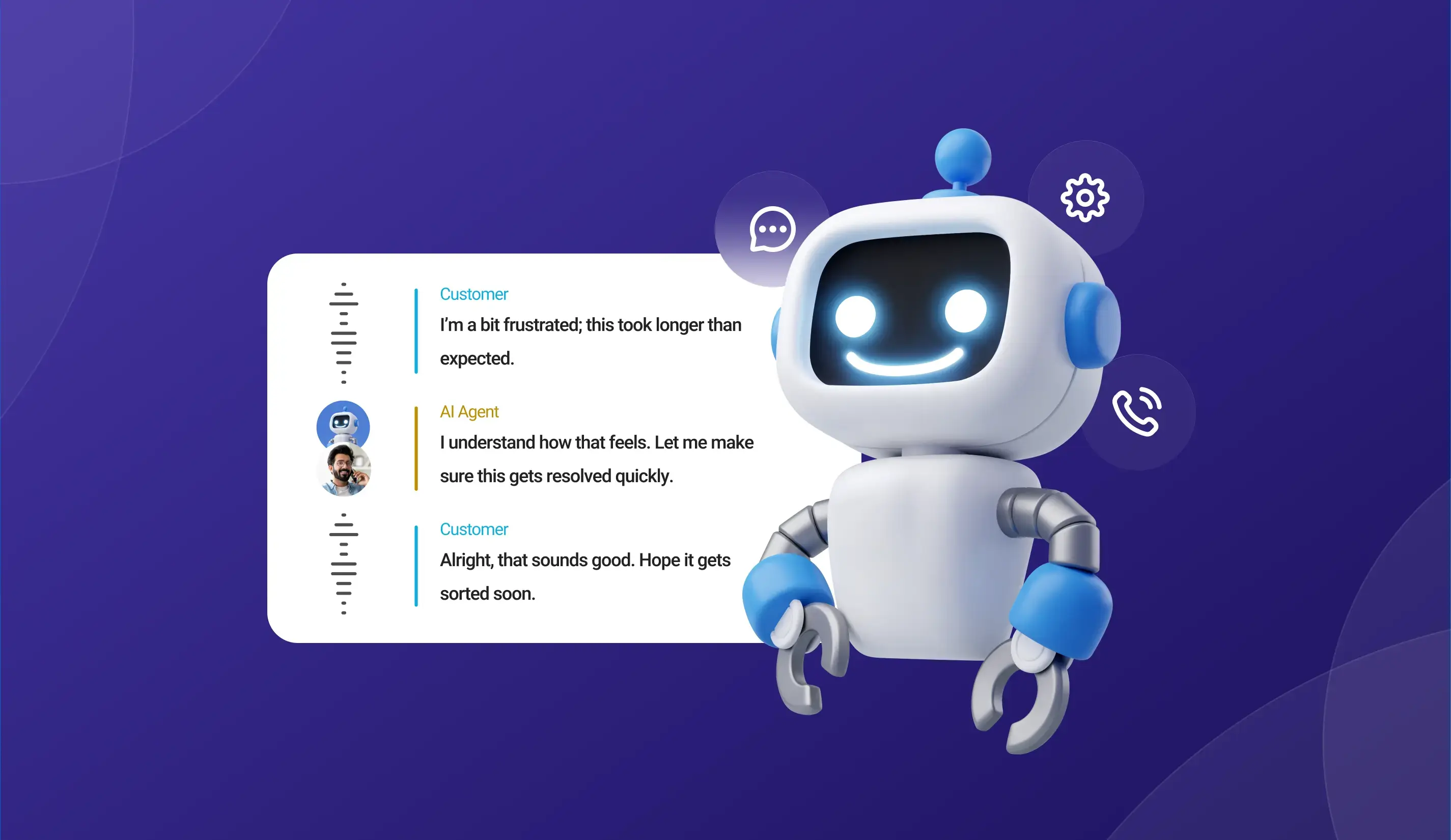
- How the Customer Felt. Was the customer happy with what happened? Did they calm down during the call? Did they actually accept the solution or did they seem grumpy about it? This stuff matters for follow-up.
- What Comes Next. What was supposed to happen after the call? Callback Thursday morning. Hand off to the escalations team. Send docs by email. Confirm appointment. The summary catches all these action items.
- Details That Matter. Customer name. Account number. Error codes they mentioned. Specific things they complained about. The system doesn't miss these.
- Required Stuff. Did the agent mention the required warnings or disclaimers? Did they get approval? Did they follow the script? The system flags whether these compliance things actually happened.
- How Long It Took. Call duration. A 20-minute billing call might mean billing's confusing. A three-minute call probably wasn't complex. Duration tells you something.
The system doesn't write down every word. It gets what the business actually needs. Supervisors reading summaries understand what happened without sitting through
AI Call Summaries for Different Business Teams
Customer Support Teams
Support handles tons of calls. Every single one matters. Every follow-up matters. AI summaries track everything without anyone lifting a finger.
Agent picks up a call. Customer's upset. They got charged six months ago. They tried to dispute it. Never got fixed. Now they're calling back about it. Agent works through the case. The whole time, they're not thinking "I gotta remember all this to type later." They're just listening. Solving. Focused.
Call ends. Summary pops up instantly. "Customer charged six months ago. Dispute in July never resolved. Agent offered a refund. Customer accepted. Refund processed."
A supervisor reading that summary gets it completely. Context's clear. Nothing important got missed. Customer calls back? Next agent reads the summary and knows exactly what happened. They don't start over.
Repeat calls drop like crazy. Customers don't have to re-explain. Resolution's faster because everyone already knows the history.
Sales Teams
Sales reps need to close deals on calls. After the call, they've gotta log what happened. AI summaries handle this.
Rep finishes a call with someone interested. The prospect asked tons of questions. Pricing questions. How implementation works. Support questions. Rep answered everything and sent a proposal. Call ends.
The summary catches what the prospect actually needs to solve, what they asked about, what objections they had, what was in the proposal, what happens next, and when they'll decide.
Sales manager reads the summary. Deal's in the proposal stage. Manager knows what the prospect cared about. Next conversation? Manager can reference those questions. Deal moves faster because nobody forgot anything.
Reps spend less time on paperwork and more time prospecting. Pipeline's transparent because managers see where each deal actually stands.
Call Centers
Big call centers process thousands of calls daily. You need consistency across 100 agents. AI summaries make that happen.
Mumbai call center does 2,000 calls daily. Every agent's call gets summarized the same way. Supervisor pulls any random call, any agent, and finds the same structure. Issue. Solution. Follow-up. That consistency builds trust.
Training gets simpler. Supervisor notices Agent A's summaries are detailed and capture emotion. Agent B's summaries forget details and miss follow-ups. Training focuses on what Agent B needs.
Compliance audits get easier too. Regulator asks for records of 50 random calls. Instead of digging through messy notes or listening to hours of calls, the audit team pulls 50 summaries. Everything's there. Complete. Consistent.
Operations run smoother because nobody's guessing about what happened on calls.
Healthcare Organizations
Healthcare calls are serious. Accuracy matters. Compliance matters. Patient safety depends on documentation being right.
Nurse takes a call. Patient's asking about medication symptoms. They describe what's happening. Nurse asks questions, gathers info, and tells them to call their doctor right now. Call ends.
The summary captures what symptoms the patient had, what the nurse recommended, that they should contact their doctor immediately, and that the patient agreed. This matters if the patient gets worse later. There's a clear record of what got said.
Healthcare has strict compliance rules. Summaries make sure every required piece gets documented. Regulators checking the clinic see complete records for every patient call.
Next provider reading the summary understands the patient's concern completely. Patient care gets better.
Financial Services
Financial advisors handle money conversations. Documentation's critical both legally and ethically.
Advisor gets a call from a client about their investment portfolio. Advisor suggests a strategy that matches what the client can handle financially and what they want. Client agrees. Call ends.
The summary captures the client's financial goals, their risk tolerance, what strategy got recommended, why it fits them, and that they said yes. This protects both people. It shows the recommendation made sense.
Financial services have strict compliance rules. Every call needs proof that recommendations were suitable. Summaries provide that automatically. Regulators see complete documentation of how decisions got made.
Advisors spend time building relationships instead of typing notes. Clients trust advisors more because time's spent listening.
Real-World Example: How AI Call Summaries Reduced Agent Workload
- Before AI Call Summaries
A support team had multiple agents. Each took multiple calls daily. After every call, they had to open the ticket system and type notes.
Typing consumed significant time per call. An agent's shift? A large part went to typing instead of helping customers.
Quality was all over the place. Some agents wrote detailed stuff. Others abbreviated everything. Some noted what comes next. Others didn't. Supervisor reading notes from different people had no idea if they were seeing the whole story or just a piece.
Follow-ups got lost because action items weren't clear. A customer was supposed to get called back. But the note said "call back customer." Nobody knew if that meant Thursday morning or sometime next week. Callbacks happened late. Customers were frustrated.
Repeat calls happened constantly. Customer would call back about the same thing because the first agent's notes didn't write down what actually got promised. The next agent started completely from scratch.
Agents struggled with job satisfaction. Spending shift time on phones plus extensive typing afterward. Turnover was high. Constant training of new people costs money and hurts quality.
- After Implementing AI Call Summaries
Team deployed AI summaries. Calls started getting summarized automatically.
Agent took a call. It ended. Summary showed up in seconds. Agent never typed. They took the next call right away.
After-call typing? Eliminated completely. An agent's available time for customers increased substantially.
Quality jumped dramatically. Every summary had the same structure. Action items were clear. Every promise got documented. Supervisors reading summaries knew the information was complete.
Follow-ups happened reliably. "Callback customer Thursday 10 AM about pricing." Calendar reminder went off. They called. Customers were impressed it actually happened.
Repeat calls declined noticeably. Customers didn't have to re-explain because the agent already knew the history from the summary. First call resolution improved.
Agent satisfaction improved significantly. People liked spending shifts actually solving problems instead of typing. Turnover declined. Training costs decreased. Experienced agents stayed longer.
Leadership noticed the business impact. Fewer repeat calls plus higher productivity meant support costs improved. Customer satisfaction increased. Support transformed from a cost center to a strategic asset.
AI Call Summaries vs Call Transcription: A Quick Comparison
Transcription creates a complete word-for-word record. That works for legal cases or deep case analysis. Summaries give what you need to take action. For daily operations, summaries win. Smart organizations use both. According to Gartner's Contact Center Technology Report, organizations that implement summaries see 25-30 percent improvement in average handling time and 20-25 percent improvement in first-call resolution within six months.
Features to Look for in AI Call Summary Software
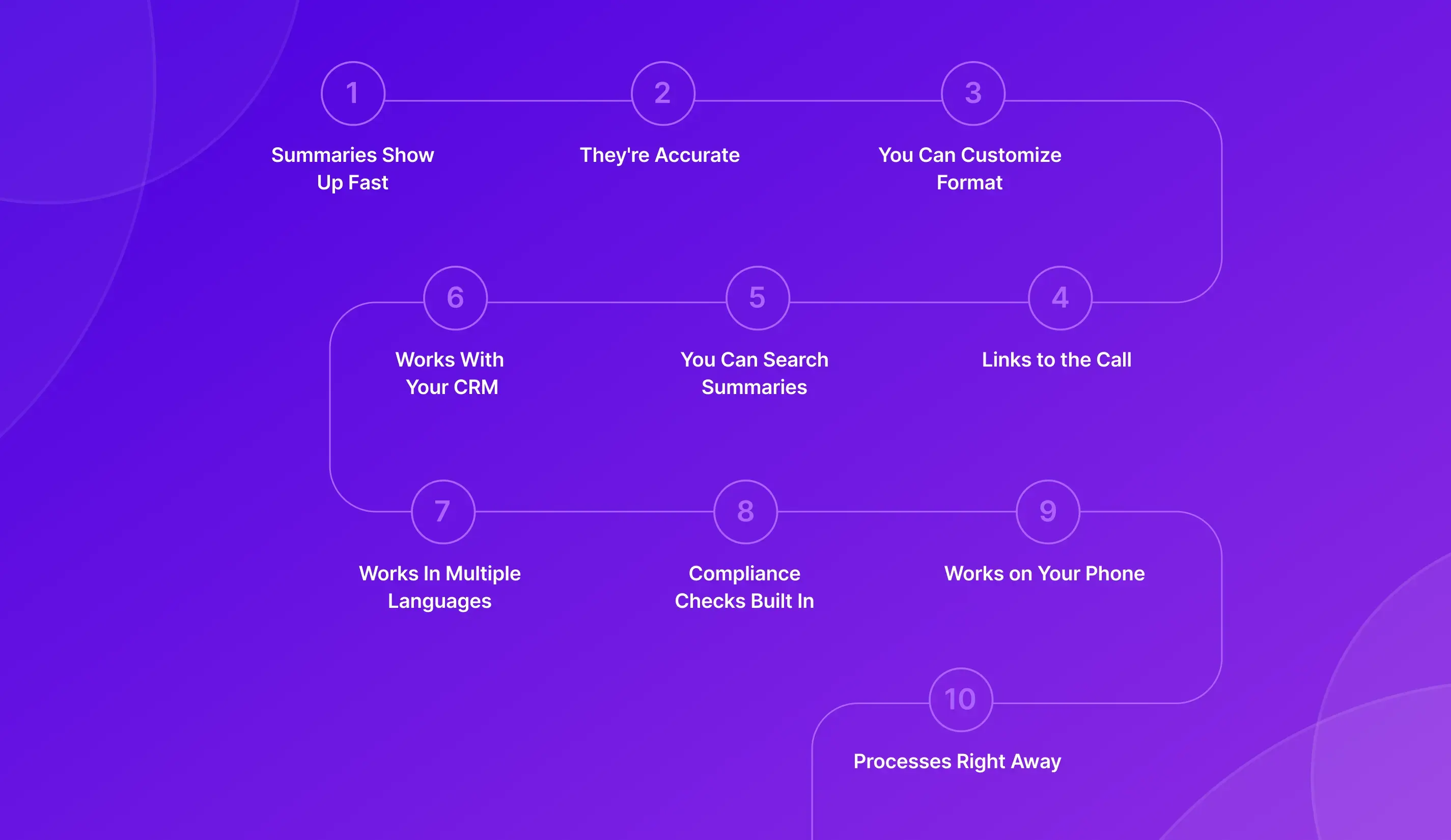
- Summaries Show Up Fast. They should appear in seconds after the call ends, not hours later. If it takes 30 minutes, it's too slow.
- They're Accurate. Summaries need to be right. Missing important details or making stuff up is worse than no summary. Test on your actual calls before you go all in.
- You Can Customize Format. Different teams need different summaries. Support needs issue and resolution. Sales needs decision points and next steps. Software should let you decide what matters.
- Works With Your CRM. The summary has to land where agents already work. If agents have to copy and paste into the CRM, nobody does it. Should be automatic.
- You Can Search Summaries. Managers should search across all summaries. "Show me every call where a customer mentioned the competitor." Being able to search turns summaries into actual knowledge.
- Links to the Call. Summary should link to the recording. "Why was this summary incomplete?" You hit play and listen.
- Works In Multiple Languages. For teams across India, support for Hindi, Tamil, Telugu, Kannada, and Marathi. Makes it accessible to everyone.
- Compliance Checks Built In. In regulated industries, the system should flag whether required stuff got done. "Was consent mentioned? Was the disclosure made?"
- Works on Your Phone. Agents and managers work from different places. Being able to check summaries on a phone matters.
- Processes Right Away. Some systems work during the call. Some work right after. During is better. Info gets captured before anyone forgets.
How AI Call Summaries Improve Customer Experience
Customers never see the summaries. But they feel it.
Customer calls back. They don't have to re-explain everything. Agent reads the summary and picks up where the last conversation ended. Customer feels heard because their history got remembered.
Follow-ups actually happen. They're clear in the summary. Customer was promised a callback Thursday? They get it Thursday. Promised discount? It gets applied because the summary said so. Product replacement? It ships because the damage got documented.
Customers are happier when their problems actually get solved, not just acknowledged. Repeat calls drop. Complaints decrease. Word of mouth improves. Customers tell friends, "these people actually fix it the first time."
Customer satisfaction surveys show measurable improvement after implementing summaries. Teams that properly use the system report noticeably higher satisfaction scores.
According to HubSpot's State of Customer Service, companies that reduce call handling time while improving resolution see customer satisfaction jump an average of 15 to 20 percent.
AI Call Summaries and CRM Integration
Real power comes when summaries feed straight into CRM systems. Summaries don't stay isolated. They become part of the customer record.
Customer calls support. Agent solves it. Summary populates the customer record automatically. Customer calls sales later about renewal. Sales rep sees the support history. They know what the customer dealt with and can show improvements.
Customer's called three times about the same problem. All three summaries are there. Manager realizes this is systemic, not a one-off. They escalate to the product team.
Customer's sentiment is dropping in summaries. First call positive. Second call is neutral. Third call negative. Manager sees it coming and reaches out. Relationship gets saved before the customer leaves.
Data sitting alone means nothing. Data connected to customer records and business outcomes? That's what drives decisions.
AI Call Summaries and Contact Center Operations
Big contact centers need consistency. AI summaries make that happen.
100 agents handle 10 calls daily. That's 1,000 calls summarized the same way. Supervisor pulls any summary and finds the same format, same detail level, and same action items. That consistency builds confidence.
QA gets easier. Instead of listening to random calls, QA scans summaries to spot patterns. "These summaries are missing sentiment." "These don't capture next steps." Training targets real gaps.
Compliance audits move faster. Regulator asks for 100 calls. Center pulls 100 summaries instead of pointing to hundreds of hours of recordings. Compliance verification takes hours instead of weeks.
Workforce management gets better. Managers see which calls take longer, which topics come up most, and which agents need coaching. Staffing decisions actually make sense.
Information's available immediately instead of locked in recordings or handwritten notes.
Best Practices for Implementing AI Call Summaries
- Start Small. Don't deploy everywhere on day one. Pick one support team. Get comfortable. Work out problems. Then expand. Reduces risk and builds confidence.
- Tell People What's Coming. Tell agents exactly how summaries will be used. Reviewed daily or weekly? Will they affect performance ratings? Transparency prevents people from panicking.
- Check Early Summaries Carefully. Review the first week closely. Are they right? Important details getting captured? Action items clear? If something's off, fix it before it spreads.
- Let Agents Review Them. Agents should look at their own summaries and fix errors. "You spelled the name wrong." Or "I mentioned pricing, but you didn't capture it." This improves accuracy over time.
- Daily Review Routine. Supervisors review summaries daily, not monthly. Daily review catches problems early. Also lets supervisors give same-day coaching. "Your summaries were great today. Action items were clear."
- Track the Numbers. Measure before and after. After-call work time. Repeat call rate. First call resolution. Customer satisfaction. Numbers prove value better than stories.
- Make Sure Follow-Ups Actually Happen. Agents need to understand that summaries drive action. If the summary says "callback Thursday," that happens Thursday. Otherwise, the system fails.
- Integrate With Workflows. If action items in summaries don't automatically create tasks or calendar reminders, they don't happen. Integration's critical.
- Let Agents See Their Own Work. Transparency builds buy-in. Agents verify accuracy and improve performance.
- Celebrate When Things Improve. When repeat calls drop or first call resolution improves, acknowledge it. Connect it to summaries. Celebrate the team.
According to McKinsey, organizations that properly implement contact center automation see 25 to 40 percent improvement in key performance metrics within the first year.
The Future of AI Call Summaries
Technology keeps getting better. Systems will get smarter at picking up customer sentiment. Not just from words, but from tone and speaking speed.
Real-time summaries will show up while calls are happening. Supervisors can coach agents during calls, not after. That's powerful.
Predictive systems will flag calls needing immediate follow-up before customers call back angry. A summary will trigger automatic escalation if the sentiment was negative.
Multilingual support will improve across India. Hindi, Tamil, Telugu, Kannada, Marathi, and Bengali summaries will be as accurate as English. Makes the tool accessible to all of India.
Action item automation becomes standard. A summary mentions "send documentation." That task automatically queues. No manual work.
More business phone systems will connect. Summaries feed into accounting, compliance, and product databases. Information flows everywhere it's needed automatically.
The core stays the same. Capture what happened. Document it clearly. Make it actionable immediately.
How TeleCMI Helps Businesses Automate Call Notes with AI Summaries
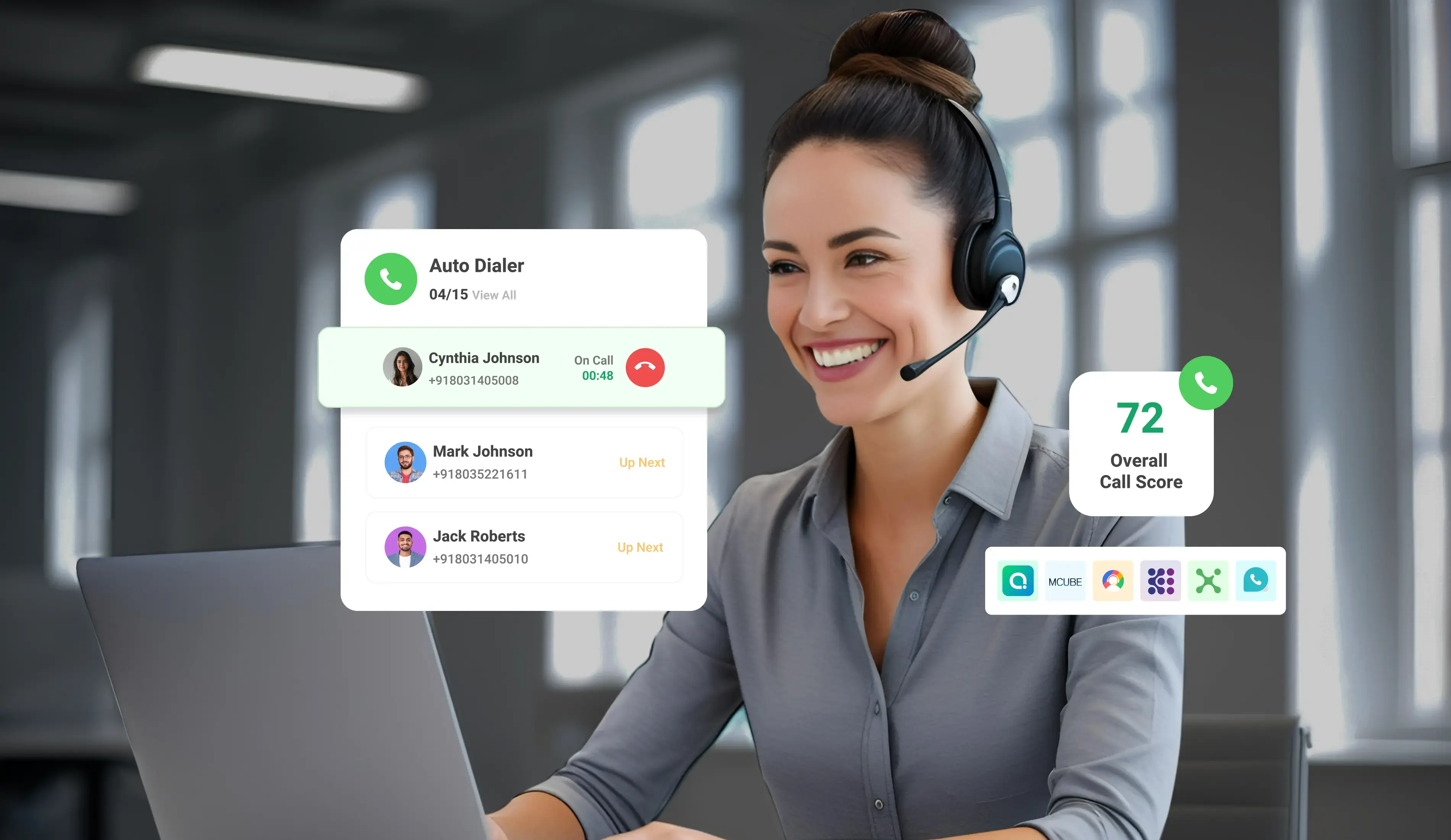
TeleCMI's cloud phone system comes with AI-powered call summaries built for Indian businesses. Every call gets summarized automatically. Summaries show up in seconds and plug straight into Zoho and Salesforce.
The system learns from your team's patterns. Over time, summaries get more accurate because the system understands your business and what matters to you.
Over 3,500 businesses across India use TeleCMI. Customer support teams in Bengaluru, Mumbai, Delhi, and Hyderabad trust the system. Sales teams use summaries to track deals. Call centers use it for consistency across hundreds of agents.
Setup takes 15 minutes. No complicated stuff. Calls start getting summarized immediately. Agents see zero disruption. System runs in the background.
TeleCMI operates across 7 global data centers with 99.99 percent uptime. Summaries are always available. Plugs into 170 plus other business tools. Supports 85 plus countries. For Indian businesses, the platform includes local language support and complies with DPDP Act requirements.
Summaries can be generated in multiple languages. Regulatory bodies get assurance that documentation meets local standards.
Ready to Automate Call Documentation? Experience AI Call Summaries with TeleCMI.

AI-Generated Call Summaries
Reduce After-Call Work
CRM & Helpdesk Sync
Improve Agent Productivity
Frequently asked questions (FAQ)
Vignesh N

With deep expertise in cloud telecommunications, I help readers explore the latest trends in VoIP and modern business communication. At TeleCMI, I focus on educating businesses with clear, practical insights, making complex telecom concepts easy to understand. I’m passionate about helping organizations improve efficiency, enhance customer engagement, and adopt smarter communication strategies.