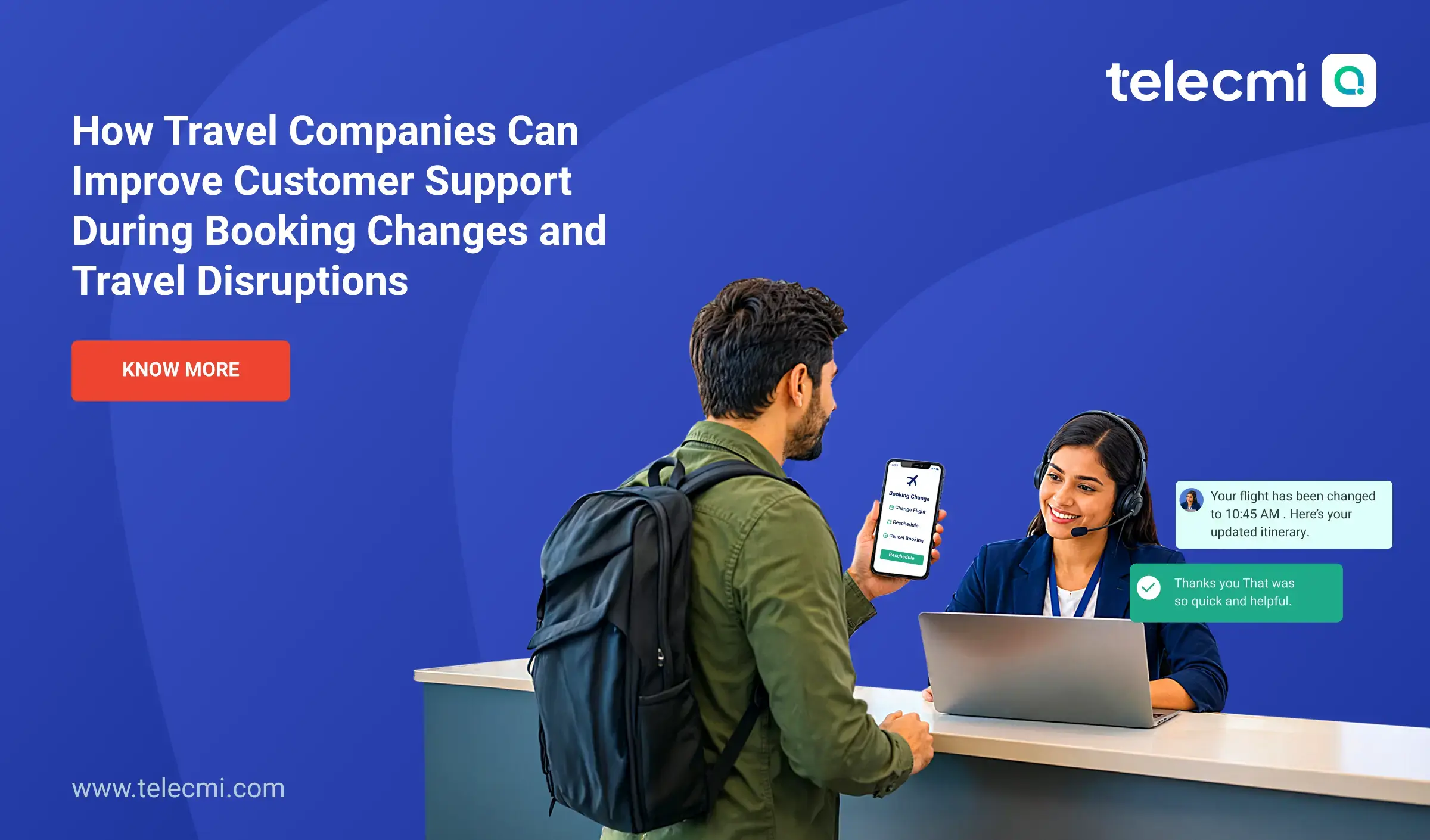
How Travel Companies Can Improve Customer Support During Booking Changes and Travel Disruptions

11 mins read

Posted on May 22, 2024
Kishore Kumar
SEO


Kishore Kumar
SEO






Travel plans can change without warning. Flights get delayed, bookings need to be modified, trips get cancelled, and travelers often need quick answers when they are away from home. For travel agencies, tour operators, airlines, and online travel agencies (OTAs), handling these requests efficiently is an important part of customer service.
Travel companies can improve customer support by responding quickly to urgent requests, simplifying booking changes, keeping travelers informed, and directing inquiries to the right support team. Cloud Call Center Sftware can help organize these conversations and give agents better access to customer information.
The goal is not simply to answer more calls. It is to help travelers understand their options and receive the right assistance at the right time.
Make Every Travel Interaction Better Help travelers get faster support during booking changes and unexpected disruptions with cloud call center software.
BOOK FREE LIVE DEMOWhy Is Customer Support Challenging for Travel Companies?7
Travel customer service involves more than answering questions about destinations and packages. Support teams often deal with time-sensitive requests that can affect a customer's entire trip.
Common challenges include:
Last-minute booking changes: Travelers may need to change travel dates, passenger details, or itineraries.
Flight cancellations and delays: Customers need accurate updates and information about their next steps.
Refund inquiries: Travelers want to know whether a refund has been approved, processed, or delayed.
High seasonal demand: Holiday periods and major travel events can increase the number of customer inquiries.
Different time zones: International travelers may need assistance outside a company's normal business hours.
Repeated explanations: Customers become frustrated when they must explain the same issue to multiple agents.
These challenges become harder to manage when customer details, booking records, and support conversations are spread across different systems.
Travel companies need a clear process for identifying each request, determining its urgency, and guiding the customer toward a resolution.
1. Make Booking Changes Easier for Travelers
Booking changes are a common reason travelers contact customer support. Customers may need to modify departure dates, update passenger information, change hotel arrangements, or adjust an entire itinerary.
A slow response can create additional problems, especially when the requested change depends on availability, supplier approval, or a deadline.
Travel companies can improve the process by:
Collecting the booking reference and basic request details at the beginning of the interaction.
Directing booking-related calls to agents who handle reservations and itinerary changes.
Giving agents access to the relevant customer and booking information.
Explaining available options, applicable fees, and any restrictions clearly.
Confirming the outcome and sending the customer a written update where appropriate.
Example: A traveler calls an agency to move a hotel reservation because a flight has been rescheduled. The agent identifies the booking, checks the relevant arrangements, explains the available options, and confirms the next steps.
A structured process helps reduce unnecessary transfers and gives travelers a clearer understanding of what will happen next.
Operational Failover:
Thirdly, traditional phone systems fail to engage their customers and also lack business operations in multiple ways. They come with limited features, and connecting and responding promptly to customers is challenging. This can result in losing customers and a decline in business operations, too.
2. Respond Quickly to Flight Delays and Cancellations
Flight delays and cancellations can create urgent customer service requests. Travelers may need help understanding rebooking options, connecting flights, hotel arrangements, or the next steps in their journey.
Travel companies should establish a process for identifying disruption-related inquiries and directing them to the appropriate team.
Useful practices include:
- Prioritizing time-sensitive requests according to urgency.
- Providing verified information rather than speculating about travel arrangements.
- Explaining available alternatives and relevant airline or booking-provider policies.
- Keeping customers informed when a resolution requires additional time.
- Recording the issue and agreed next steps so another agent can continue the conversation if necessary.
Cloud call center software can support this process through call routing, queue management, and access to relevant customer records when integrated with the company's systems.
However, the software does not automatically guarantee faster resolutions. Travel businesses still need accurate information, clear escalation rules, and enough trained staff to handle urgent cases.
3. Manage High Call Volumes During Peak Travel Seasons
Travel agencies and tour operators may experience a surge in inquiries during school holidays, summer vacations, festive periods, and major travel disruptions.
When many customers contact support at once, long waiting times can make an already stressful situation worse.
- To manage peak demand more effectively, travel companies can:
- Review historical call volumes to identify busy periods.
- Schedule agents according to expected demand and the complexity of inquiries.
- Use an interactive voice response (IVR) system to identify the reason for a call.
- Route booking, cancellation, refund, and emergency-related inquiries to the appropriate teams.
- Provide callback options where available instead of requiring every customer to remain on hold.
- Monitor queue lengths and waiting times to identify when additional support is needed.
For example, if cancellation inquiries increase after widespread travel disruption, a company can direct those calls to a dedicated team rather than placing every customer in the same queue.
Call analytics can help managers understand when demand increases and which types of inquiries take the longest to resolve. This information supports better staffing decisions for future peak periods.
4. Keep Travelers Informed Before They Need to Call Again
Customers often contact support repeatedly because they do not know what is happening with a booking change, refund, or disruption-related request.
Clear communication can reduce uncertainty and prevent avoidable follow-up calls.
Travel companies should provide:
- Booking confirmations and change confirmations.
- Relevant updates when travel arrangements change.
- Clear explanations of refund status and expected next steps.
- Estimated response times when an issue cannot be resolved immediately.
- Follow-up messages when an agent or supplier needs more time.
Where supported by the company's systems and customer permissions, automated notifications can deliver routine updates through suitable communication channels.
For example, after receiving a refund request, a traveler could receive confirmation that the request has been recorded, followed by another update when its status changes.
Businesses should distinguish between acknowledging a request and confirming that it has been resolved. This prevents customers from receiving misleading assurances.
5. Give Agents the Information They Need to Help Customers
A traveler should not have to repeat every detail each time a call is transferred or a new agent takes over.
When customer information is available across disconnected systems, agents may struggle to understand previous conversations, booking details, or outstanding requests.
Travel companies can improve agent readiness by connecting their support processes with relevant customer relationship management (CRM), booking, and ticketing systems where integrations are available.
Agents should be able to access appropriate information, such as:
- Customer identification and booking references.
- Previous support interactions.
- The current status of an inquiry.
- Actions already taken.
- Outstanding tasks and escalation notes.
The benefit is continuity. An agent who understands the customer's situation can focus on the next step instead of asking the traveler to explain the problem again.
Access to customer data should follow appropriate permissions and privacy requirements. Travel businesses should also train employees to verify customer identity before discussing sensitive booking information.
6. Provide Consistent Support Across Time Zones
International travelers may need assistance outside a travel company's regular office hours. A customer travelling from the United States, for example, may need help from an agency based in another country.
Travel companies can make support more accessible by defining service hours, escalation arrangements, and procedures for urgent requests.
- Depending on their operations, they can consider:
- Extended support hours for important travel periods.
- Clearly communicated emergency contact procedures.
- Call routing based on language, location, or inquiry type where supported.
- Self-service information for routine questions.
- Handover procedures between teams working in different time zones.
Cloud-based communication systems can help distributed teams handle calls without relying on a single physical office. The actual level of availability still depends on staffing, configuration, network access, and the company's service arrangements.
Travel companies should clearly explain when live assistance is available and how customers can get help with urgent issues outside normal business hours.
7. Use Customer Support Data to Identify Recurring Problems
Support conversations can reveal issues that affect the wider travel experience. Repeated questions about baggage rules, refund timelines, booking conditions, or itinerary changes may indicate that customers need clearer information before travelling.
- Travel companies can review support data to identify:
- The most common reasons customers contact support.
- Average waiting times and call handling times.
- Repeat contacts about the same issue.
- Requests that are frequently transferred between teams.
- Periods when inquiry volumes increase.
- Common reasons for unresolved cases.
Call analytics and reporting tools can help organize this information when the relevant data is available.
For instance, if many travelers repeatedly ask about refund eligibility, the company could improve its refund policy explanations on its website and in booking confirmation emails.
The purpose of analytics is not simply to measure agent performance. It is to identify the underlying problems that create unnecessary work for both customers and support teams.
How Can Cloud Call Center Software Help Travel Companies?
It helps travel businesses manage customer calls through a centralized, internet-based system. Depending on the platform and its integrations, it can support call routing, IVR, queue management, customer record access, reporting, and communication workflows.
For travel companies, these capabilities are useful when they are connected to specific customer service needs.
These benefits depend on the software's actual capabilities, the integrations available, and how the business configures its support processes.
Cloud call center software should be treated as part of a broader customer service strategy, not as a replacement for knowledgeable agents, reliable booking information, or clear travel policies.
How to Choose the Right Customer Support Setup for a Travel Business
Before adopting or changing a Cloud Call Center System , travel companies should understand the problems they need to solve.
Consider these questions:
1. What types of inquiries create the most work?
Review whether booking changes, cancellation requests, refund questions, or general travel inquiries account for the largest share of contacts.
2. How are urgent requests identified?
Check whether agents can recognize time-sensitive cases and transfer them to the right team without unnecessary delays.
3. Can agents access the information they need?
Review the connections between the phone system, booking platform, CRM, and ticketing tools.
4. What happens when demand increases?
Assess queue management, staffing arrangements, callback availability, and reporting capabilities.
5. How will performance be measured?
Choose relevant measures, such as waiting time, repeat contacts, resolution time, and customer satisfaction. Establish a baseline before judging whether a new process has improved results.
A practical evaluation should focus on real travel customer service workflows rather than selecting software based only on the number of features advertised.
Frequently Asked Questions
How can travel companies improve customer support?
Travel companies can improve customer support by simplifying booking changes, prioritizing urgent travel disruptions, providing timely updates, training agents, and maintaining clear records of customer interactions.
How can travel agencies manage last-minute booking changes?
Travel agencies should collect booking details early, check available alternatives, explain applicable fees or restrictions, and confirm any changes clearly. Access to relevant booking records can help agents handle requests more efficiently.
How can travel companies handle high call volumes?
They can forecast demand, schedule enough trained agents, categorize inquiries, use call routing and IVR where appropriate, and offer callbacks when available. Reviewing call data helps teams prepare for recurring demand spikes.
Can cloud call center software help with flight cancellations?
It can help organize cancellation-related inquiries through call routing, queue management, and access to customer records when integrated. It does not determine airline policies or guarantee alternative travel arrangements; agents still need accurate information and appropriate escalation procedures.
Why is CRM integration useful for travel customer support?
CRM integration can give agents access to relevant customer information and previous interactions. This helps reduce repeated questions and supports more consistent follow-up, provided the integration is properly configured.
Is cloud call center software suitable for small travel agencies?
It can be suitable for small travel agencies that need organized call handling without maintaining a traditional on-site phone system. The right choice depends on call volume, required integrations, budget, support needs, and the provider's available features.
Ready to delight your travelers? Start your free trial now!

Quick Setup
Handle peak season like a pro
Boost Productivity
Kishore Kumar

SEO Specialist


 for your Call Center and Enhance Efficiency_.webp)