Cloud PBX Uptime and Reliability: What to Look for in an SLA in 2026

17 mins read

Posted on Jun 16, 2026
.webp)

Saravana Kumar
SEO


Saravana Kumar
SEO





Cloud PBX is your business phone system delivered over the internet instead of through on-premise hardware. Employees can make and receive calls from anywhere using a laptop, mobile phone, or desktop application, making it a flexible and scalable communication solution for modern businesses.
Studies show that IT downtime can cost organizations thousands of dollars per hour, depending on company size and operational impact. For businesses that rely on phone-based sales, customer support, or operational coordination, even a short service disruption can lead to missed opportunities, delayed responses, and dissatisfied customers.
This is where a Service Level Agreement (SLA) becomes critical. An SLA is more than a promise of reliability. It is a contractual commitment that defines uptime guarantees, support response times, issue resolution targets, failover policies, and compensation if service levels are not met.
A strong SLA holds the provider accountable when service disruptions occur. A weak SLA leaves your business responsible for the consequences.
What Actually Happens a scenario to understand better
Monday, 9 AM. A mid-sized logistics company in Bangalore gets 300 calls per hour from delivery partners checking dispatch status. Normal Monday.
At 9:15, the cloud PBX dies. Completely. No gradual slowdown. Just black.
Two hours. No calls in or out.
When service comes back at 11:15, the damage is done. Partners calling the landline. Supervisors writing down messages by hand. One delivery sits in the warehouse because the confirmation call never happened. Another driver's waiting for dispatch instructions that never came.
The immediate impact included missed delivery confirmations, delayed dispatches, increased support workload, and frustrated customers. While the exact financial impact varies by business, even a short outage can disrupt operations and lead to lost revenue.
They check the SLA. The provider guarantees 99% uptime. Two hours down? That's 0.03% of the month. Well within their 1% downtime allowance. No compensation. No credits. They own the loss.
The mistake wasn't picking cloud PBX. It was signing an SLA without reading it.
Before we dive into the SLA clauses that actually matter - here’s a question
Does your current or potential provider guarantee 99.9% uptime during YOUR business hours?
What This Guide Covers
This guide explains how to evaluate a Cloud PBX SLA before signing a contract. You'll learn what uptime guarantees actually mean, how failover and redundancy affect reliability, which SLA clauses deserve attention, and the warning signs that indicate a provider may not be able to support business-critical communications.
- A Cloud PBX SLA defines uptime guarantees, support response times, failover commitments, and compensation policies.
- Businesses that rely on inbound or outbound calls should look for at least 99.9% uptime.
- Cloud PBX reliability depends on failover infrastructure, MTTR, support responsiveness, and transparency- not just uptime percentages.
- Always review outage definitions, maintenance exclusions, incident reporting practices, and SLA credit policies before signing.
- A strong SLA protects your business when service disruptions occur; a weak SLA leaves you responsible for the consequences.
Why Does Cloud PBX SLA Matter More Than Other Software SLAs?
Because calls are not asynchronous. Email can wait. File storage can wait. Chat messages can queue up. But a call happening right now either connects or it doesn't. There's no buffer, no retry, no "we'll get back to you."
A cloud PBX SLA is your only legal protection when the system fails. Without it, the provider can go down for hours, refund your monthly fee, and move on. With a proper SLA, they have financial incentive to stay up and compensate you if they don't.
What Is an SLA and Why It Matters for Cloud PBX
A Service Level Agreement is a contract. It says: "If we go down, here's what happens." That's it. No mystique.
What does an SLA actually mean in plain terms? It's a written promise from the provider to you. They're saying: we guarantee X uptime, we'll respond to problems in Y time, and if we fail, you get Z compensation. Nothing vague. Nothing optional. A real SLA has teeth.
Specifically, an SLA commits the provider to:
- A guaranteed uptime percentage (99%, 99.9%, etc.)
- Maximum response time if something breaks
- A timeline for fixing the problem
- Compensation if they miss these targets
- What counts as "downtime" and what doesn't
For cloud PBX, SLAs matter more than they do for almost any other software. Email can wait 4 hours. A project management tool can be down at 2 AM. Calls are real-time. A customer calling right now needs an answer now. If your phone system is down during business hours, you're losing money that exact minute.
Why is cloud PBX reliability different from other cloud apps? Because every minute of downtime is lost revenue, not just lost productivity. A video conferencing tool going down means postponed meetings. A cloud PBX going down means lost customers. The impact is immediate and measurable.
Most cloud PBX providers publish impressive SLA numbers: "99.99% uptime guaranteed." What they don't always tell you is what that actually protects. Does it cover the network? The data centers? Just the software? What about scheduled maintenance? What if only your region goes down, not the whole system?
A weak SLA sounds good until you read footnote 7.

The average cost of IT downtime is estimated at $5,600 per minute for large enterprises - though the figure varies significantly based on company size and industry.
Understanding Uptime Percentages: The Numbers That Matter
What is cloud PBX uptime exactly? It's the percentage of time your business phone system is actually available and working. If a provider guarantees 99.9% uptime, it means they promise the system will be working 99.9% of the year. The remaining 0.1%? That's the time it's allowed to be down.
Uptime percentages look simple. They're not.
99% uptime = 87 hours of downtime per year. That's roughly 3.5 days. For a business that depends on calls, that's catastrophic. But it sounds close to perfect.
99.9% uptime = 8.7 hours of downtime per year. Almost a full business day gone.
99.99% uptime = 52 minutes of downtime per year. Now we're talking about a real commitment.
99.999% uptime = 5 minutes of downtime per year. This is what telecommunications companies, hospitals, and emergency services demand.
Why does the difference between percentages get exponentially harder to achieve? Because as you go higher, every additional decimal requires entirely different infrastructure. Going from 99% to 99.9% might just mean better monitoring. Going from 99.99% to 99.999% requires redundant data centers across geographies, automatic failover, backup power systems, and 24/7 engineering teams. The costs multiply.
The jumps between these percentages don't scale linearly. The difference between 99% and 99.99% is not 0.99%. It's 86 additional hours of lost calls per year. For a company handling 200 calls an hour, that's 17,200 missed conversations.
What should your business demand? That depends on your call volume and whether you have fallback options.
A call center with 1,000+ daily calls should never accept less than 99.9%. A small business with 50 daily calls might tolerate 99%. But the compensation structure matters more than the number itself. (We'll get to that in a moment.)
What Is Included in a Cloud PBX Uptime Guarantee?
What counts as downtime?
Many providers define downtime as a complete system blackout. Not degraded performance. Not slow calls. Not 10% of your calls failing to connect. A total, system-wide collapse. So if your calls technically go through but half of them drop? That's not downtime. You get nothing.
Scheduled maintenance is where it gets worse. Most SLAs just... exclude planned downtime. A provider can guarantee 99.9% uptime and then schedule quarterly updates during your busiest hours. And it doesn't count. Check the fine print: Do they give you notice? Will they actually schedule it during your off-peak times, or just whenever they feel like it?
If you're in India running across time zones, you already know how this plays out. US provider thinks 2 PM PT is safe. That's 2:30 PM IST the next day. Your peak hours. Done.
Geographic exclusionstoo. Some providers calculate uptime by region—so if your Mumbai data center goes down for 8 hours but Singapore's fine, they haven't technically breached anything if they buried some "subject to regional limitations" clause in the contract.
Then there's this: "commercially reasonable efforts." That's vendor-speak for "we'll try our best, no promises." It's not a guarantee. It's a wish. Avoid it.
6 Other SLA Elements Beyond Uptime Percentage
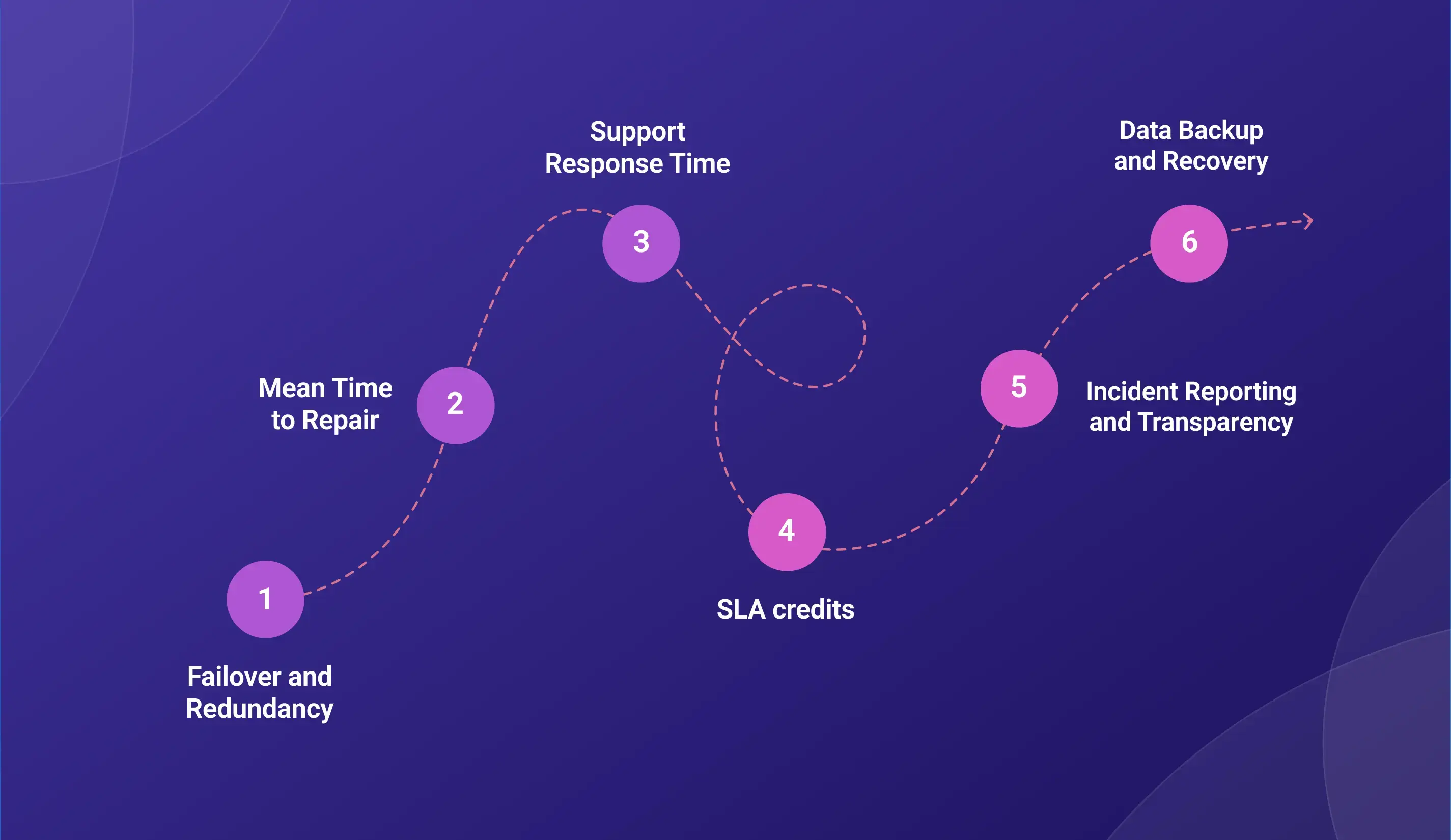
Uptime is just the entry ticket. Here are the clauses that actually protect you.
Failover and redundancy. What is failover in a cloud PBX? It's the system's ability to automatically switch to a backup when the primary fails. When one data center fails, does traffic automatically route to another? How fast? Automatic failover matters more than the uptime number. If the provider has three data centers and can reroute calls instantly, they can claim lower uptime and still serve you better than a competitor with one massive data center and high uptime by luck. For Indian businesses, ask specifically: do they have redundant data centers within India? Failover to Singapore doesn't help if the issue is regional network congestion in India.
Mean Time to Repair (MTTR). What is MTTR? It's the average time it takes to fix a problem after it's detected. MTTR matters because uptime of 99.9% is useless if the MTTR is 12 hours. You get downtime resolved eventually, but your business took the hit. You want MTTR in single digits. Minutes, ideally. Some providers publish MTTR in their SLA. Others hide it. If it's not in the contract, assume it's bad.
Support response time. Does the provider have a 24/7 war room? Or do they take phone calls only between 9 AM and 6 PM on weekdays? A logistics company getting hit during late-night operations won't care about an SLA if the support team is asleep. For India-based businesses, verify the support hours are IST-aligned, not US-aligned.
SLA credits. This is the compensation. Some providers offer credits of 5% of monthly fees if they miss SLA targets. If you pay 50,000 rupees a month and they're down for a full day, the credit is 1,667 rupees. That doesn't match the damage. Better providers offer credits scaled to the severity: 10% for missing by 30 minutes, 25% for missing by hours, and 50% for full outages.
Incident reporting and transparency. A status page tells you what actually happened. Look for providers with public incident histories that show outages over the last 90 days. If the page is blank or vague (like "service interruption resolved"), they're hiding poor performance. Check if they publish post-incident reports explaining what went wrong and how they'll prevent it next time.
Data backup and recovery. If the system goes down, are your call recordings safe ? Call logs? Voicemail files? Some providers keep backups in the same data center, which defeats the purpose. Ask if backups are geographically isolated. For sensitive call recordings in regulated industries, ask if backups meet data residency requirements (stored within India, for instance">call recordings.

Uptime Institute's research on outage costs found that a large share of incidents involving cloud and SaaS providers in recent years could have had their business impact reduced through clearer SLA terms.
Red Flags in a Cloud PBX SLA
Watch for these patterns:
Monthly uptime instead of annual. A provider claiming 99% uptime month-over-month is gaming the stat. Some months you get 99%, others 98%. Average it across 12 months and you're at 98.25%, which is actually terrible. Always demand annual uptime calculations.
No public status page or zero transparency on incident history. If the provider won't show you their last 90 days of outages, they're hiding something.
SLA credits capped at one month of service. If you pay 50,000 rupees monthly and they're down for three days, the cap should be at least 10,000 rupees. One month sounds good until you realize it's the maximum, not the calculation.
Support is only available during business hours. A 24/7 communication tool with 9-to-5 support is a joke.
No clear definition of a qualifying outage. If the SLA says "service is unavailable" without defining unavailable (dropped calls, latency over X ms, call quality below Y score), they can argue any outage doesn't technically qualify.
SLA applies only to the platform, not the network or carrier connectivity. Some providers say, "Our software is 99.99%, but we can't control the phone network." That's fair. But then the SLA is useless to you. If 50% of call failures happen outside the provider's control, don't rely on an SLA that ignores those failures.
Who Should Prioritize Cloud PBX Reliability?
Cloud PBX reliability is especially important for:
- Logistics companies
- Contact centers
- Healthcare providers
- E-commerce businesses
- Real estate firms
- Financial services companies
Not all SLAs protect your business
Ask your provider: What’s your actual uptime over the last 12 months?
How to Evaluate Cloud PBX Reliability Before Signing
Don't trust the marketing sheet. Here's what to do actually.
Ask for historical uptime data. Not the promised number. The actual number over the last 12 months. If they hesitate, they're hiding poor performance.
Check their public status page. Most reputable providers have one. Bookmark it. Look at the last 90 days of incidents. If there are gaps (two months with zero incidents), the data is fake or they're not logging everything. For India-based businesses specifically, check if outages correlate with Indian peak hours (9-11 AM or 3-5 PM IST). If all outages happen during US peak hours, that's a sign infrastructure isn't India-optimized.
Ask where their data centers are located and how many redundant locations they maintain. A provider with one Mumbai data center and one Singapore backup is different from a provider with five global locations. For Indian businesses, prioritize: data center in India (preferably Mumbai or Delhi for latency), redundancy within India or at minimum within Asia. If the backup is in Europe, failover latency kills call quality.
Request a reference from a customer in your industry and call volume range. A startup success story doesn't predict performance for a 500-person logistics company. Ask the reference specifically: "Have you experienced downtime? What was the impact?" Don't ask if they're happy. Ask about failure.
Run a test. Use their free trial during peak hours, not at 11 PM when the network is quiet. For India-specific testing, run calls during 10 AM to 11 AM (peak office hours) and again during 3-5 PM. Test from multiple cities if possible (Bangalore, Delhi, Mumbai). Call quality during low-traffic periods tells you nothing about how they handle your actual load.
Example of What a Strong Cloud PBX SLA Looks Like
TeleCMI guarantees 99.999% annual uptime with automatic failover across multiple geographically distributed data centers in India. Redundant infrastructure and real-time failover mechanisms ensure business continuity, with automatic failover occurring in less than 30 seconds and requiring zero manual intervention.
Response time for critical incidents is 15 minutes (24/7), with escalating response times for high (30 min), medium (1 hour), and low (4 hours) severity issues.
Planned maintenance is scheduled with 30 days advance notice and always during off-peak hours (typically 12:00 AM – 2:00 AM IST). Emergency maintenance for security patches requires 48 hours' notice. Maintenance windows are capped at 4 hours per month and do not count against your uptime guarantee.
TeleCMI publishes a public status page showing real-time system health across all regions, ongoing incident details with severity levels, historical incident data, scheduled maintenance announcements, and monthly uptime percentages. SLA credits are issued automatically for verified outages and scaled to the duration of the breach:
- 99.990% – 99.998% uptime: 5% of monthly fees
- 99.900% – 99.989% uptime: 10% of monthly fees
- 99.000% – 99.899% uptime: 25% of monthly fees
- Below 99.000% uptime: 50% of monthly fees
Credits are applied to your account within 7 business days of month-end and can be used toward future invoices.
What is Cloud PBX Reliability?
Cloud PBX reliability refers to a provider's ability to keep business phone services available with minimal downtime through uptime guarantees, redundancy, failover systems, and rapid issue resolution.
The SLA Is Your Insurance Policy
An SLA isn't bureaucracy. It's the difference between a provider that stands behind their product and one that hopes you won't notice when things break.
What is cloud PBX reliability in practical terms? It's how consistently your phone system stays available and functional. But reliability isn't just about the technical uptime percentage. It includes response time, failover speed, transparency, and compensation when things break. A provider promising 99.99% uptime but taking 12 hours to fix problems isn't reliable. A provider with 99.5% uptime but automatic failover and one-hour response is more reliable.
Before you sign a cloud PBX contract, read the SLA like you're buying liability insurance. Because that's exactly what it is.
See TeleCMI's SLA Before You Compare Any Other Provider
TeleCMI offers 99.999% uptime, automatic failover across India-based data centers
Frequently asked questions (FAQ)
Saravana Kumar

I’m passionate about exploring and sharing insights on modern cloud communication technologies. At TeleCMI, I focus on helping readers understand the evolving world of cloud telephony and IVR solutions in a simple yet in-depth way. My goal is to deliver genuine value by turning complex telecom concepts into clear, actionable knowledge that builds trust and drives innovation.