How Cloud Telephony Supports Large-Scale Outreach During Election Campaigns

7 mins read

Posted on Jan 21, 2026


Saravana Kumar
SEO


Saravana Kumar
SEO






Election campaigns are decided less by ideas alone and more by how effectively those ideas reach voters. Those are built on time, reach, and message. On the final day, it comes down to whether your voice is noise or influence.
Modern political parties are expected to communicate with lakhs or even crores of voters. This places enormous pressure on outreach systems. Messages must go out quickly, stay consistent across regions, and still feel direct enough to hold attention. Traditional methods such as manual calling, fragmented call centres, or isolated volunteer efforts simply do not hold up under this load. This is where communication stops being an advantage and becomes a bottleneck.
Many times, a campaign does not fail because they have poor messaging but because there is no infrastructure to execute it. This is what seems to be one of the most common and least talked-about reasons why a campaign fails.
This blog explores where political communication infrastructure falls short under pressure and how cloud telephony system addresses those weaknesses, introducing order, insight, and management to large-scale polling outreach.

Key Takeaways
 Election campaigns fail at communication more often due to weak execution systems than weak messaging
- Traditional outreach methods break down under scale, time pressure, and regulatory complexity
- Cloud telephony provides a centralised, measurable communication layer built for short, high-intensity campaign cycles
- Voice broadcasting, IVR, and real-time analytics enable campaigns to reach, listen to, and adapt to voters at scale
- Real-time analytics turn outreach activity into actionable insight during the campaign window
The Real Communication Problems Political Campaigns Face
Political campaigns face significant communication problems, mainly driven by the fragmented system, a massive audience, zero visibility, the spread of misinformation and the challenge of engagement. Key communication problem includes:
Scale Without Coordination: Thousands of volunteers making calls to voters, but there might not be coordination, which means there will be a lack of collective oversight. This makes it impossible for the campaign managers to identify which voters have been contacted, which messages have been reached, or which places need a revisit.
Inconsistency in Messaging: Scripts change, local teams improvise, and regional offices interpret guidance differently. Over time, the campaign’s core message becomes diluted. What reaches voters depends more on who called them than on what the campaign intended to say.
Timing: Campaign communication involves strong timing considerations. A reminder or an issue-oriented and voter turnout notification becomes mundane and nearly irrelevant when delivered late. Manual calling, a slow response system, and an inefficient calling centre can cause a campaign not to respond promptly and effectively to changing public opinion or changing events.
Data reliability: Traditional calling methods generate incomplete or delayed records. Feedback from voters is often lost, recorded incorrectly, or never captured at all. Without accurate data, campaigns cannot refine targeting or adjust messaging during the campaign window that matters most.
Compliance Adds Pressure: Regulations around consent, call timing, and opt-outs vary by region and are easy to violate when outreach is decentralised. Even a single unintentional misstep can reveal campaigns to legal risk and public controversy.
Why Traditional Outreach Methods Don’t Scale in Political Campaigns
Traditional outreach method involves complete physical presence and manual effort. Their impact is limited by time, location and human resources.
- Rallies create visibility, but their reach is defined by their physical presence.
- Door-to-door campaigns are personalised but very slow and require manpower.
- Manual calling does not support sudden volume increases, such as last-minute voting reminders and rapid-response messages.
- Reporting is minimal or delayed, making it difficult to track outcomes or refine strategy in manual calling.
- Also, manual calling is expensive to operate at scale, especially when it relies on temporary staff or outsourced call centres.
The campaigns exert significant effort with limited reach, operate with low visibility, and lack the data required to optimise outreach during the campaign.

Efficiency Gap: A single manual caller can typically make 30–50 calls per hour. In contrast, a Cloud Telephony system can trigger 10,000+ concurrent calls in the same 60 minutes.
Why Cloud Telephony Is Built for Election Campaigns
Election campaigns demand communication systems that can handle intensity without losing control.
- It supports high-volume communication over short, defined periods.
- Campaigns can reach large voter segments within days, not weeks, without redesigning their operations.
- Capacity scales with need, allowing outreach to expand during peak phases and settle when pressure eases.
Most importantly, cloud telephony turns outreach into a measurable process. Calls, responses, and outcomes are recorded automatically. Campaign leaders gain visibility into what is happening in real time, enabling them to adjust targeting and messaging before time runs out.
Still relying on volunteers and spreadsheets for voter outreach? See a better system
Start Free TrialCore Cloud Telephony Capabilities Used in Modern Polling
Election campaigns rely on a small set of communication systems that must perform under pressure. A Cloud telephony provider brings these systems together into a unified layer that supports scale, speed, and control.
Voice Broadcasting
Voice broadcasting enables campaigns to communicate at scale without relying on manual effort.
- Provides the same message to lakhs of voters in a matter of minutes
- Pre-recorded calls that can be planned and pinpointed for a region and/or voting list
- Facilitates campaign-critical communication such as leadership messages, activities, and voting notifications
Pro-Tip: Research shows that voice broadcasts featuring the actual voice of a candidate (rather than a professional voice actor) can increase voter trust and engagement rates by up to 25%.
Outbound IVR
- Outbound IVR allows campaigns to gather voter input without deploying large calling teams.
- Structured feedback inputs by keypad and/or voice
- Engages in multi-step interactions using IVR that support languages and geographical locations globally
- Records responses for analysis and comparison
Inbound IVR
Inbound IVR manages incoming voter queries while protecting volunteer capacity.
- Provides self-service information through menu-based call flows
- Routes calls by language or request type to the appropriate team
- Reduces call congestion during peak campaign periods
Analytics and Reporting
Communication activity is transformed into insight through analytics.
- Reports on delivery, response, and engagement metrics per region and timeline
- Pinpoints IVR connection points and high response frequencies
- Supports quick changes in messaging and resource allocation for campaign teams
TeleCMI Supports Election Campaign Operations" class="text-lg sm:text-2xl text-[#2b2e33] font-bold font-heebo pt-10">How TeleCMI Supports Election Campaign Operations
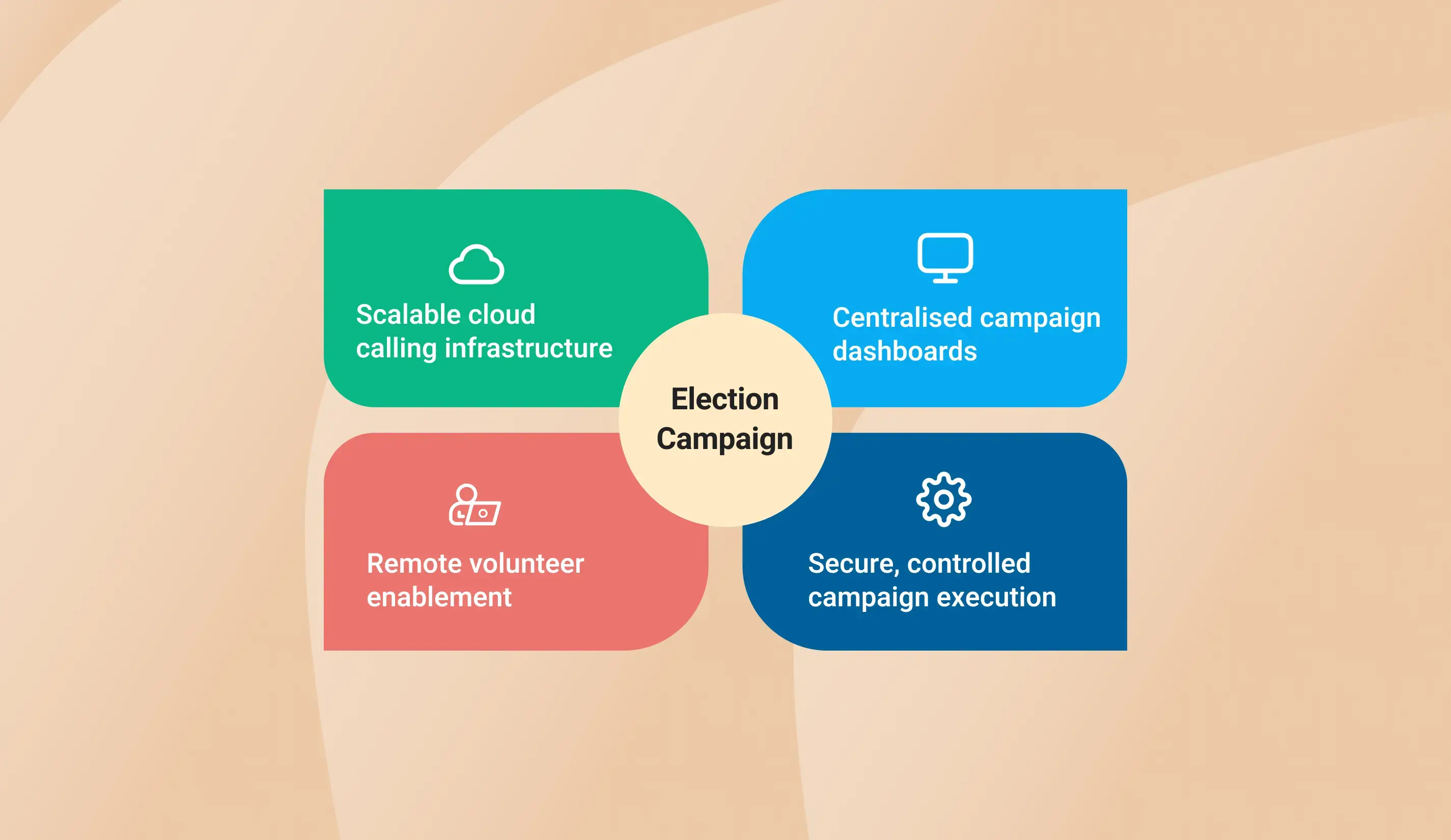
Election campaigns require communication systems that can expand quickly, remain controlled, and function under constant pressure.
- Scalable cloud calling infrastructure: Campaigns can scale outreach up or down based on phase, geography, or urgency, while maintaining call quality and delivery reliability.
- Centralised campaign dashboards: Outreach progress, engagement patterns, and regional performance can be monitored centrally , reducing dependence on delayed or manual reporting.
- Remote volunteer enablement: Volunteers and field teams can participate from any location using internet-based access. This removes the need for physical call centres and allows campaigns to mobilise supporters quickly without losing oversight or coordination.
- Secure, controlled campaign execution: Provides controlled access, role-based permissions, and structured workflows. Scripts, call flows, and data capture remain consistent across teams, reducing risk while ensuring outreach stays aligned with campaign objectives.
Frequently asked questions (FAQ)
Build a campaign communication system that can

Reach lakhs of voters in minutes
Capture real voter feedback
Stay compliant across regions
Saravana Kumar

I’m passionate about exploring and sharing insights on modern cloud communication technologies. At TeleCMI, I focus on helping readers understand the evolving world of cloud telephony and IVR solutions in a simple yet in-depth way. My goal is to deliver genuine value by turning complex telecom concepts into clear, actionable knowledge that builds trust and drives innovation.