Top 5 Contact Center Software for Large Enterprises (Minimum 50+ Agents)

11 mins read

Posted on Jan 13, 2026

Vignesh N
SEO


Vignesh N
SEO






Contact center growth often appears simple. Add agents, expand locations, and handle more calls. In practice, growth changes how the entire operation functions. Visibility narrows, coordination weakens, and decisions rely more on assumptions than data.
These issues surface most clearly once teams reach 50 agents. At that point, the contact center becomes a shared dependency across regions, systems, and teams. Software that worked at a smaller scale begins to limit performance rather than support it.
This guide examines why enterprises require a different class of contact center software and how the right platform shapes operational stability, visibility, and customer experience at scale.

Key Takeaways :
 Contact center software plays a pivotal role when the team size expands to more than 50 agents.
- Simplifying the cognitive load for the agents will directly improve the service quality, while it will also lead to better workforce retention.
- Real-time visibility enables faster, better decisions than those from rigid control or human monitoring.
- The enterprise readiness of a system is reflected by its behavior at failure, spikes, and disruption rather than when it is running smoothly.
- Scalable platforms that do not require constant configuration, retraining, or disruption achieve better performance.
- Vendor maturity levels, support capabilities, and complexity know-how play a bigger role than specific capabilities.
What Defines Contact Center Software for Large Enterprises?

Enterprise growth is uneven; a software should absorb the spike, not react. This section clearly answers the question of what distinguishes enterprise software from tools for small- and medium-sized businesses.
1. Agent Volume and Scalability: Built for handling a very high volume of interactions and agents. It may be 50, 100, or 1000+ agents; the solution will adapt automatically without needing any restructuring of the entire architecture.
2. Multi-Location and Distributed Team Support: Large businesses tend to spread out across different regions and cater to an international customer base. It supports global coverage with uniform routing logic and centralized administration with regional operational control.
3. Enterprise-Grade Security and Compliance: If a company grows, security can emerge as a risk to the business. Enterprise software will support local compliance, MFA, industry regulations, SOC 2 Type II, ISO 27001, PCI DSS, HIPAA, role-based access, and a variety of protocols.
4. Reliability, Uptime, and SLAs: Downtime leads to lost revenue at the enterprise level. Look for 99.99% availability or an inherent redundancy with an automated callback, auto-recovery, active failover, simple SLAs, or escalation processes.
5. CRM, Helpdesk, and System Integrations: Integration enables context to flow smoothly from one point to another. The software should support integration with CRM, help desk tools, and other automation software, and allow for a complete context perspective.
6. Reporting, Analytics & Quality Monitoring: With a good analytics system, the business will be able to change its paradigm from problem-solving to optimization. It will emphasize real-time visibility, trend analyses, quality monitoring, compliance, and auditing reports.
7. Ease of Deployment & Administration: Large enterprises require platforms that can be deployed across different regions without long setup cycles or significant technical dependencies.
How to Choose the Right Contact Center Software for a Large Enterprise
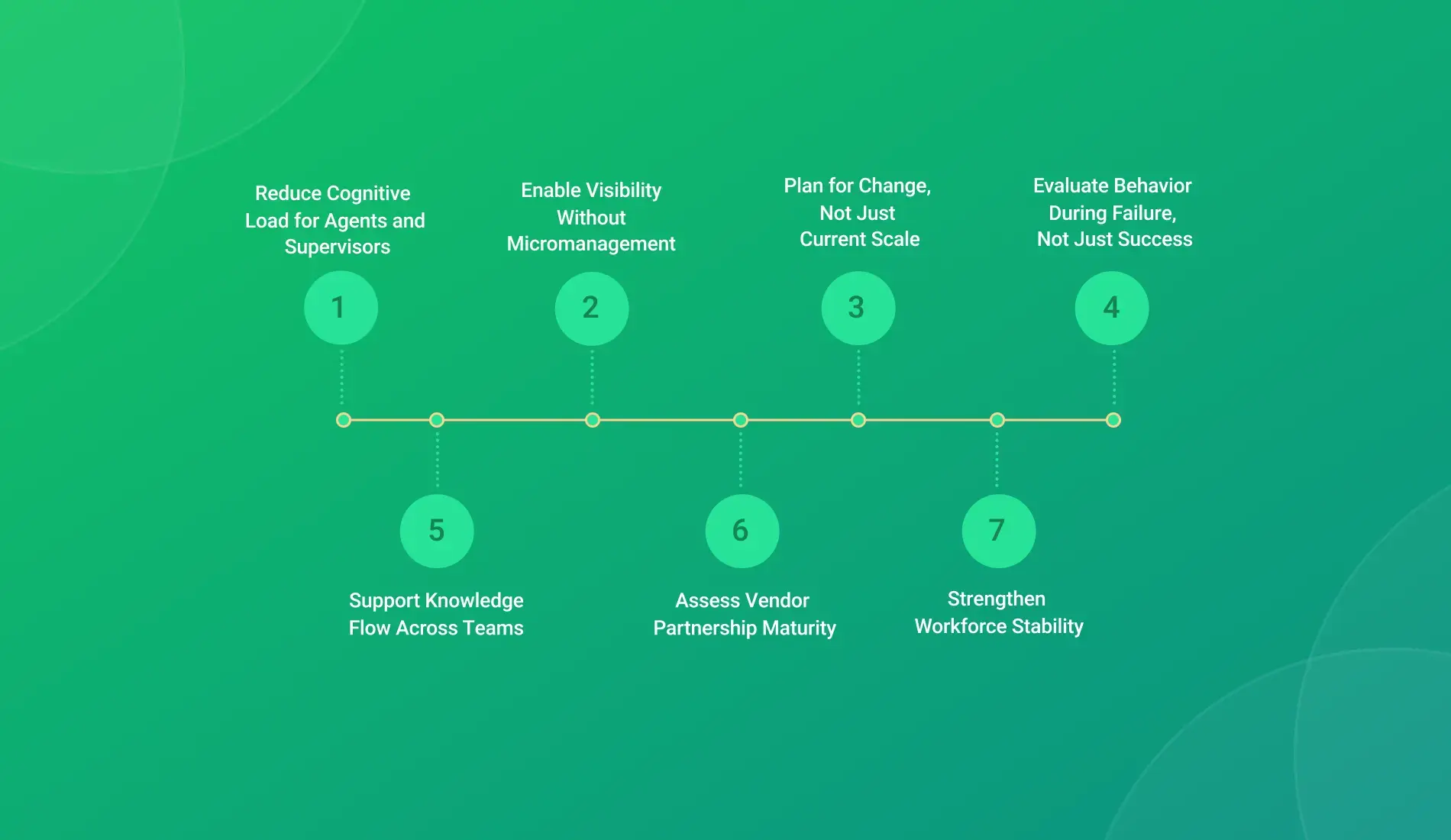
According to recent reports, more than 50% of contact center workers have high levels of burnout because they lack proper tools and an optimal workload. Therefore, when deciding on which to choose, you must definitely consider these aspects:
Factor 1: Reduce Cognitive Load for Agents and Supervisors
- Unified workspace experience for all communication channels
- Well-defined workflows that minimize manual intervention
- Minimal context switching within client interactions
Business benefit
- Lower agent burnout
- Faster onboarding
- More consistent customer handling
Factor 2: Enable Visibility Without Micromanagement
When the leaders are able to know what happened and what is going on without direct meetings and manual spreadsheets, the performance of the teams automatically grows.
- Real-time visibility into operations across teams and regions
- Early warning signals for possible overload or degradation of queue performance
- Understanding Patterns of Performance vs. Dumping Data
Business benefit
- Faster, more confident decisions
- Reactive escalations are reduced.
- Improved trust levels between agents and management
Factor 3: Plan for Change, Not Just Current Scale
Enterprise contact centers are constantly growing across departments and regions. The software should be able to grow with them, without interruptions.
- Easy addition of teams, regions, and channels
- Functional workflows with adaptability for business changes
- Stability in the event of traffic increases or organizational change
Business benefit
- Reduced operational risk
- Faster response to market or customer behavior changes
- Longer platform lifespan
Factor 4: Evaluate Behavior During Failure, Not Just Success
Downtime is inevitable, but what happens next is up to the system.
- Graceful degradation instead of full outages
- Clear system status visibility during incidents
- Easy rerouting and recovery options
Business benefit
- Minimized service disruption
- Stronger business continuity
- Less pressure on frontline teams during crises
Factor 5: Support Knowledge Flow Across Teams
While scaling, sharing details, and transferring knowledge become siloed. Enterprise contact center systems cover this by keeping all data safe, offering context, and integrating software and support to unify learning.
- Centralized access to interaction history and insights
- Visibility into recurring issues and resolutions
- Consistency in handling similar customer scenarios
Business benefit
- Faster resolution times
- More consistent customer experience
- Reduced duplication of effort
Factor 6: Assess Vendor Partnership Maturity
License isn't enough for enterprise-class platforms; it takes a long-term commitment. Compare, explain, and then select before investing in and signing the contract.
- Proven experience with large deployments
- Transparent product roadmap and support structure
- Strong onboarding and escalation processes
Business benefit
- Smoother scaling
- Fewer implementation surprises
- Greater confidence in long-term stability
Factor 7: Strengthen Workforce Stability
Software exerts a tremendous impact upon the emotions of the agents regarding their work, and the performance of the business is well understood without human effort.
- Predictable workflows and system behavior
- Clear feedback loops instead of constant monitoring
- Tools that support agents, not overwhelm them
Business benefit
- Lower attrition
- Higher engagement
- Stronger service consistency
5 Best Contact Center Software for Large Enterprises
Contact centers ensure a smooth, efficient process that increases productivity and helps run your business. However, not all enterprise-level software may meet your business needs, which is why a Software Development Company carefully evaluates enterprise tools based on specific operational requirements. Here is a list of the top 5 contact center software that you may select from:
1. TeleCMI
Best for scalable & cost-efficient enterprise contact centers
.webp)
TeleCMI provides a cloud-first contact center platform that supports growing teams and distributed operations with its unified platform, AI automation tools, and advanced analytics. It is specially designed for rapid development, global reach, and flexible scaling without heavy hardware investment and manpower. Also, their report states that its deployment supports small teams and large enterprises with 500+ agents.
Key Features
- Cloud scalability and fast deployment
- Omnichannel interaction and engagement
- AI-driven routing, automated logics & detailed insights
- CRM & helpdesk tool and APIs, webhooks, and SDK integration
- Multichannel monitoring and better operational control
Security & Compliance Capabilities
- Secured data transmission through encryption, TLS, and IP whitelisting
- Security Assertion Markup Language and 2FA for complete access control
- Support for HIPAA, GDPR, SOC-II readiness, and a few regional regulations
Pros
- Eliminates hardware costs and reduces the total cost of ownership
- Real-time dashboards and performance analytics with live insights
- Voice, SMS, WhatsApp, and CRM interactions unified in one interface
- Support for CRM integrations and SDK/API access for customization
Considerations
- Enterprises with advanced business intelligence need to pair with third-party tools
- Focuses on omnichannel engagement rather than workforce optimization and predictive analytics
- Have occasional limitations in mobile app capabilities or connectivity under specific conditions
Best Fit For
Growing Enterprise Teams with Distributed Agents, seeking core contact center capabilities and teams prioritizing unified communication.
2. Five 9
Best for large, mature contact center operations
.webp)
Five 9 is a reliable contact center system that allows you to engage customers, streamline operations, and offer collaborative intelligence. It has a strong reputation for supporting both inbound service and outbound operations across the globe.
Key Features
- Integrated intelligent virtual agents (IVAs)
- Predictive, power, and preview dialers
- Centralized customer journey
- Automate routing logic
- Seamless integrates with third-party tools
Security & Compliance Capabilities
- Role-based access controls (RBAC) protect sensitive customer information
- Comprehensive logging and audit records, configuration changes, and system events
- Regular security assessments, vulnerability scanning, and patch management
Pros
- Strong omnichannel handling and blended workflows.
- Reliable large-scale deployment track record
- AI incubation, including Agent Assist, generative AI tools, and other
Considerations
- Advanced customization and automation may require IT teams
- Newer automation workflows can have a learning curve
Best For
Enterprises with high outbound and inbound routing demands, mature CX operations, and integration needs across multiple enterprise systems.
3. Avaya
Large-scale contact center with robust integration
Avaya has a robust set of capabilities for handling large and complex businesses with on-premises and cloud-based contact center solutions. It provides excellence in the area of resilience, integration, and advanced real-time speech processing. In addition to this, it has expertise in integration with telephony and enterprise applications.
Key Features
- Hybrid deployment flexibility
- Enterprise-grade voice routing and call control
- Deep integration with legacy PBX and enterprise systems
- Sophisticated call orchestration and IVR capability
- Resilient Architecture for Mission Critical Voice Operations
Pros
- Strong support for complex call routing and telephony continuity
- Capable of handling heavy voice and data interaction volumes in hybrid environments
Considerations
- It may have an outdated user interface compared to more modern cloud-native alternatives.
- Transitioning from on-premise systems is not very easy; hence, cloud services need to be planned and managed.
Best Fit For
Large enterprises with existing Avaya investments, hybrid cloud strategies, or deep integration needs with traditional telephony.
Understand the CX ROI in Real Time
Get a live walkthrough focused on customer journeys, agent workflows, and CX performance metrics
4. Content Guru
Best for omnichannel enterprise customer experience
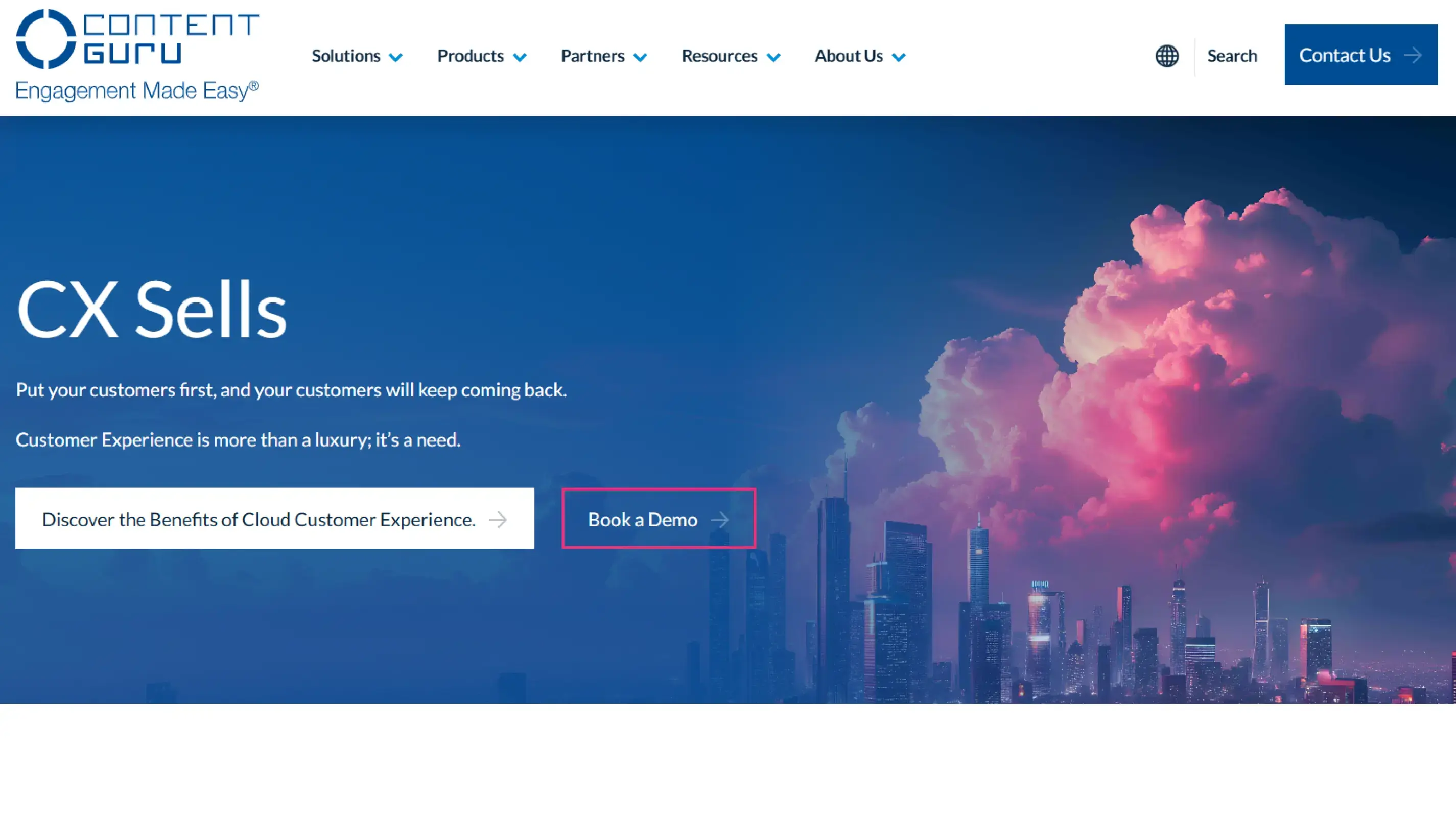
Content Guru is built around the idea of CX continuity on a large scale, with a cloud experience that combines omnichannel routing, AI-powered automation, and high reliability for mission-critical applications. It is for enterprises with high availability needs and a large volume of contacts.
Key Features
- Mission-critical communication and emergency services
- Unify and streamline communication from a single interface
- Highest level of service availability and scalability
- Centralized control with regional execution
- End-to-end customer journey visibility
Pros
- Complex call routing and telephony continuity
- Capable of handling heavy voice and data interaction
- Offering high-performance, flexible AI solutions
Consideration
- Licensing and modular structure can be complex for new organizations
- Some enterprises may require external partners for integration and customization.
Best For
Enterprises seeking a true omnichannel experience coordination with very high reliability and mission-critical service demands.
5. NICE CXone
.webp)
Best for Highly Regulated Enterprises
NICE CXone is a comprehensive cloud contact center platform that unifies omnichannel engagement, workforce augmentation, analytics, and AI across a single suite. It is built to handle customer journeys, automated self-services, and reduce the need for multiple point solutions, and simplifies governance for large deployments.
Key Features
- AI, automation, and augmentation capabilities
- Real-time and historical analytics
- Enterprise-grade integrations and APIs
- Unified CX platform and Workforce optimization
Pros
- Strong omnichannel consistency with unified routing
- Performance monitoring and compliance management
- Scales elastically with enterprise needs without on-premises hardware
Consideration
- A rich feature set needs a steep learning curve and team support
- Complex environments may require dedicated IT resources
Best For
Governance-heavy, regulated enterprises that need visibility, control, and compliance at scale.
Conclusion
Enterprise contact centers operate under constant pressure. Growth, compliance, customer expectations, and workforce stability all converge in one place. The software running these operations quietly shapes outcomes every day.
Choosing the right contact center platform is not about adopting more technology. It is about removing friction, restoring clarity, and building systems that scale with confidence rather than complexity.
Align the platform with your business growth plans

Custom Pricing
Enterprise Deployment
SLAs & Compliance
Frequently asked questions (FAQ)
Vignesh N

With deep expertise in cloud telecommunications, I help readers explore the latest trends in VoIP and modern business communication. At TeleCMI, I focus on educating businesses with clear, practical insights, making complex telecom concepts easy to understand. I’m passionate about helping organizations improve efficiency, enhance customer engagement, and adopt smarter communication strategies.


 for your Call Center and Enhance Efficiency_.webp)