HIPAA-Compliant VoIP: A Complete Guide to Secure Healthcare Communication

14 mins read

Posted on Jun 18, 2026

Vignesh N
SEO


Vignesh N
SEO


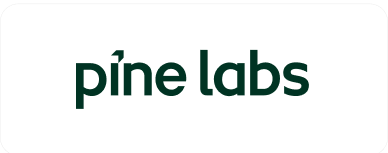



Healthcare organization needs a business phone system that delivers. Calls need to connect reliably. Features need to match your workflows. Pricing needs to make sense. But for healthcare specifically, there's something that sits above all of that. Data protection.
HIPAA compliance isn't optional in healthcare. It's the law. The Healthcare Insurance Portability and Accountability Act (HIPAA) has governed how healthcare organizations handle patient information since 1996. Then came the Health Information Technology for Economic and Clinical Health Act (HITECH) in 2009, strengthening those protections further. Both exist for one reason: to keep patient personal health information (PHI) and electronic protected health information (ePHI) secure from breaches and unauthorized access.
Your phone system plays a critical role here. Patient calls contain sensitive health data. How that data gets handled during those calls matters legally.
This guide covers what actually makes a VoIP system HIPAA-capable, what matters when evaluating providers, and how organizations successfully implement secure healthcare communications.
What is HIPAA-Compliant VoIP?
HIPAA-compliant VoIP is a cloud phone system that protects patient health information through encryption, access controls, audit logs, and Business Associate Agreements (BAAs), helping healthcare organizations meet HIPAA regulations.
It enables hospitals, clinics, and telehealth providers to manage patient calls securely, voicemails, recordings, and virtual consultations while maintaining regulatory compliance.
HIPAA-Compliant VoIP Checklist
- End-to-end encryption
- Business Associate Agreement (BAA)
- Audit logs
- Multi-factor authentication
- Secure call recording
- Role-based access controls

Key Takeaways
Here's what actually matters:
 HIPAA-compliant VoIP encrypts patient calls and stores them securely
- It includes Business Associate Agreements that make vendors legally responsible
- Healthcare organizations need this for regulatory compliance, not optional upgrades
- The right solution protects patient trust and reduces organizational risk
- Implementation should be straightforward
What is HIPAA-Compliant VoIP Phone Service?
HIPAA-compliant VoIP phone system that meets all the legal requirements for handling protected health information. It combines encryption. Access controls. Documented agreements. Activity tracking. So patient conversations stay private and organizations avoid penalties.
Think of it this way. Regular VoIP serves general business. HIPAA VoIP treats every call like it contains sensitive data. Because healthcare calls often do.
Here's what makes it different:
- Calls get encrypted during transmission so conversations can't be intercepted
- Recordings and voicemails stay encrypted when stored
- Activity logs track who accessed what information and when
- Vendors sign Business Associate Agreements accepting legal responsibility
- Access controls ensure only authorized staff hears patient information
- Everything aligns with HIPAA rules from 1996 and updates since
HIPAA-compliant VoIP isn't optional for healthcare. It's foundational.
Protect Patient Data with a HIPAA-Ready VoIP Solution Built for Secure Healthcare Communication.
Start 14 Days Free TrialHow It Differs from Standard VoIP
Standard VoIP handles general business communications effectively. HIPAA VoIP? It's purpose-built for healthcare data protection.
Standard VoIP addresses general business needs. HIPAA VoIP's designed specifically for healthcare and patient data protection.
Why HIPAA Compliance Matters for Healthcare Communication
Healthcare organizations handle sensitive patient information. Every single day. How that information travels and gets stored? That's got legal consequences.
Risks of non-compliance include:
- Financial penalties: $100 to $50,000 per violation. Annual caps hit $50,000
- Patient trust damage. Takes years to rebuild after a breach
- Regulatory shutdown orders from government agencies
- Personal liability for organizational leaders in serious breach scenarios
- Reputational damage affecting patient acquisition and retention
- Ransomware attacks targeting organizations without adequate security
- Legal liability from patients whose information gets exposed
In 2023, healthcare organizations reported over 725 data breaches. More than 33 million patient records exposed. Average breach cost hospitals $10.93 million to address (IBM Cost of a Data Breach Report).
One hospital chain in Mumbai had a breach. Caller IDs and call logs got exposed. Cost them $2.3 million and 18 months of regulatory oversight.
Benefits of HIPAA-compliant VoIP:
- Patient data stays protected during every call
- Patients gain confidence in how their information gets handled
- Compliance audits become straightforward. Not panic situations
- Organizations avoid catastrophic financial penalties
- Systems scale without multiplying compliance risk
- Insurance providers often offer 10-15% discounts for real compliance
- Regulators see documented proof of security measures
- Telehealth and remote consultations become legally sound
- Staff can focus on patient care. Not compliance anxiety
How HIPAA-Compliant VoIP Works
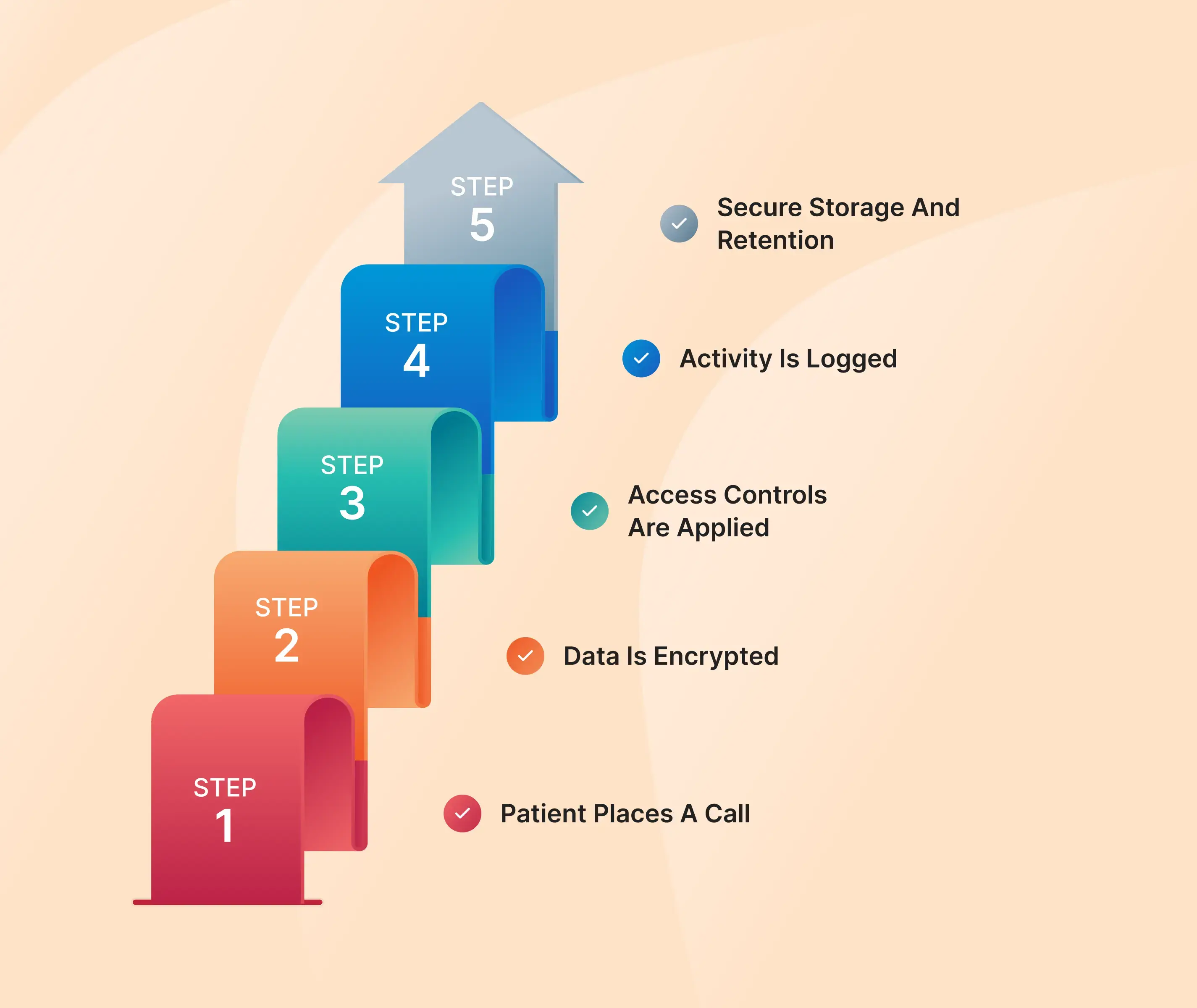
The technical process follows a clear sequence.
Step 1: Patient Places a Call
Patient dials the clinic. Call reaches your HIPAA VoIP gateway. System immediately flags this as a call containing patient data needing protection.
Step 2: Data is Encrypted
Call gets encrypted using TLS protocols. It travels encrypted from the patient's phone through the internet to your clinic. Anyone attempting to intercept it? Gets unreadable data. Not an actual conversation.
Step 3: Access Controls are Applied
Call arrives. Only authorized staff can answer. Multi-factor authentication confirms they're actually who they claim to be. Receptionist answers the live call. Only the doctor can access the recording later.
Step 4: Activity is Logged
Every action gets recorded. Who called. When. Call duration. Who accessed the recording. When they accessed it. From where. This creates an audit trail proving you're controlling patient data access.
Step 5: Secure Storage and Retention
Call recordings stay encrypted on servers. Multiple backups exist across secure locations. When your retention policy says delete? The system securely wipes it. Recovery becomes impossible. No data remnants.
Your staff doesn't think about this process. They answer calls. Everything else? Automatically protected, whether managed internally or through outsourced IT services.
Key Requirements of a HIPAA-Compliant VoIP Phone System
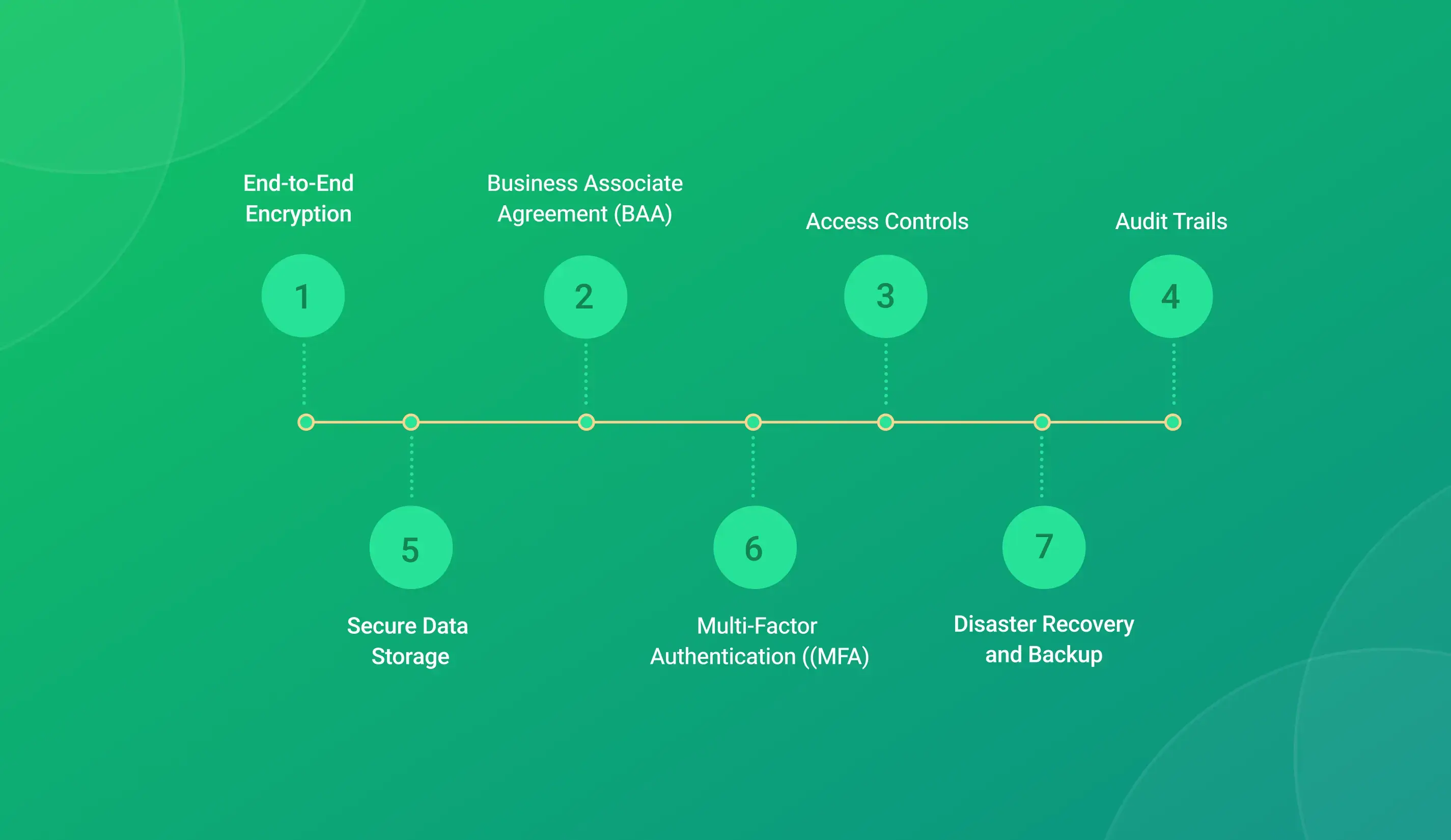
Real HIPAA compliance requires specific components working together.
1. End-to-End Encryption
Every call gets encryption during transmission. Recordings get encrypted in storage. Voicemail transcripts stay encrypted. No exceptions. TLS protocols or equivalent protect data.
2. Business Associate Agreement (BAA)
This is the legal contract between your healthcare organization and the VoIP vendor. Makes the vendor responsible for implementing HIPAA security standards. Without it? You're not compliant. With it? The vendor shares liability if things go wrong.
3. Access Controls
Not everyone in your organization should hear every call recording. Your system needs granular permissions. Front desk hears live calls. Doctors access their patients' recordings. Billing hears nothing about clinical conversations. Finance never accesses patient calls.
4. Audit Trails
Your system must log who accessed patient information, when they accessed it, and from where. Creates accountability. If something goes wrong? You've got proof of exactly who did what.
5. Secure Data Storage
Patient data doesn't live on a single server. It's replicated across secure data centers with encryption at every layer. One facility experiences a power outage? Your patient records are already backed up elsewhere.
6. Multi-Factor Authentication (MFA)
Passwords alone aren't sufficient. MFA means staff need something they know (password) plus something they have (phone, security key) to access the system. Stops unauthorized access even if a password gets compromised.
7. Disaster Recovery and Backup
Natural disasters happen. Power outages happen. Cyberattacks happen. Your HIPAA system needs redundancy. One data center goes down? Another takes over within seconds. Patients can still reach you.
Features to Look for in a HIPAA-Compliant VoIP Provider
When evaluating vendors, ask these specific questions:
- SOC2 Type II certified? Means independent auditors verified security controls work.
- Will you sign a Business Associate Agreement? Non-negotiable.
- How do you handle call recordings? Encrypted at rest and during transmission?
- Can I control how long recordings stay in the system?
- Is multi-factor authentication standard or additional cost?
- Where are your servers located? Can data stay within India or specific regions?
- What happens if your system goes down? Automatic failover?
- Can you provide an audit report showing HIPAA Security Rule compliance?
- Do you log all access to patient data? Can I review those logs?
- What's your breach notification timeline? How quickly do you inform organizations if something goes wrong?
Vendors that answer these clearly? They understand healthcare requirements. Vendors that hesitate? Probably aren't ready for this responsibility.
Industries That Need HIPAA-Compliant VoIP
1. Hospitals
Managing patient communication across multiple departments. Coordinating care between specialists. Handling appointments without exposing medical history. Large organizations need tight control systems.
2. Clinics
Single-location or small-chain clinics. Patient consultations. Lab results. Prescription refills over the phone. Primary care centers need the same protections as larger operations.
3. Telehealth Providers
For services such as PrEP online, remote consultations may represent much of the clinical interaction, making secure communication essential for protecting sensitive patient information. No secure VoIP means no compliant telemedicine. This's one of the fastest-growing use cases.
4. Dental Practices
Yes, dental offices handle protected health information. Appointment reminders discussing treatment plans. Insurance coordination. Patient education about procedures. All require HIPAA compliance.
5. Mental Health Services
Arguably the most sensitive healthcare conversations happen here. Patient mental health details are protected health information needing the strongest possible security.
7. Medical Billing and Insurance Organizations
Medical billing and insurance organizations work between healthcare providers and insurance companies, handling patient data from multiple sources. A secure healthcare call center software solution helps protect sensitive information during patient and provider interactions, as one unsecured call could expose data from dozens of practices.
USE CASE
Telehealth Providers
- Problem: Remote patient communication risks liability and regulatory exposure when using unsecured systems.
- Solution: Secure VoIP calls with end-to-end encryption and secure storage.
- Benefit: Safe virtual consultations. Doctors focus on patient care, not compliance concerns.
Hospitals
- Problem: Large-scale patient communication without control over who hears what clinical conversation.
- Solution: Implement a VoIP solution for hospitals with centralized communication management, role-based access controls, and comprehensive audit trails to ensure secure and compliant healthcare operations.
- Benefit: Compliance achieved. Care coordination improved. Documentation enhanced.
Business Associate Agreement (BAA) for VoIP Providers
A Business Associate Agreement is the legal foundation of HIPAA compliance.
When a healthcare clinic uses a VoIP vendor, that vendor becomes a "Business Associate" under HIPAA law. The BAA is the contract making them legally responsible for protecting patient data.
Without a BAA:
- Vendor has no legal obligation to protect patient information
- Breach happens? The vendor isn't liable; your organization is
- Using an unsecured vendor violates HIPAA regulations
- Regulators can impose penalties regardless of where the failure originated
With a BAA:
- Vendor is legally responsible for security implementation
- Liability is shared if a breach occurs
- Your organization has legal recourse if things go wrong
- Using the vendor is compliant
A real BAA covers:
- Permitted uses of patient data (only for phone service, not data sales or other purposes)
- Required security measures the vendor must implement (encryption, access controls, logging)
- Breach notification timelines (typically 24-48 hours)
- Data handling if your organization leaves or the contract ends
- Requirements for subcontractors (those vendors need BAAs with your vendor too)
A Business Associate Agreement is non-negotiable. It's what makes the vendor legally accountable for your patient data.
How to Choose a HIPAA-Ready VoIP Provider
The evaluation process follows a specific order.
1. Business Associate Agreement
Before anything else, confirm they'll sign a BAA. This's foundational.
2. Third-Party Certifications
SOC2 Type II certification means independent auditors verified security controls actually work. Ask for their latest report. Type II shows controls worked consistently over months, which is what healthcare needs. Type I shows controls exist at a point in time. That's not enough.
3. Encryption Approach
Ask specifically how they encrypt calls during transmission and at rest. "We use encryption" is vague. "We use AES-256 encryption for stored data and TLS 1.2+ for transmission" is specific enough to evaluate.
4. Data Residency
Where are their servers located? If you're in India, can they guarantee your data stays within Indian data centers? Some vendors only offer US-based storage.
5. Audit Trail Capabilities
Log into a demo account. Try accessing a call recording. What audit trail proves you accessed it? Is that level of detail sufficient for a regulatory audit?
6. Disaster Recovery
What's their uptime guarantee? What happens if their data center goes down? Can they failover to another location within minutes?
7. Implementation Support
HIPAA compliance requires more than just the tool. Does the vendor provide training and documentation so your team understands correct usage?
8. Transparent Pricing
HIPAA-compliant VoIP costs more than general business VoIP. Specialized security infrastructure. Compliance certifications. Healthcare-specific features. That's where the cost comes from. Understand what you're paying for. If pricing seems suspiciously cheap? The vendor might be cutting corners on security.
Future Trends in Healthcare Communication
Healthcare communication's evolving beyond voice calls alone.
- Unified Communications Platforms
Doctors'll chat with patients, transition to video calls, record notes. All within one secure platform. All encrypted. All tracked.
- AI-Powered Transcription
Calls will be automatically transcribed and summarized. The AI handling this work'll protect patient data carefully with HIPAA controls built in.
- Electronic Health Record Integration
VoIP systems will connect directly to EHR systems. Patient records auto-populate during calls. Call summaries auto-save to patient charts. Everything stays secure.
- Advanced Privacy-Preserving Analytics
Providers will gain insights into patient communication patterns without violating privacy. Which patients call frequently? What topics come up most? Analyzed with proper protections.
- Blockchain for Audit Trails
Some healthcare organizations are testing blockchain-based audit trails that literally can't be falsified. Provides even stronger proof of compliance.
TeleCMI: A HIPAA-Ready Unified Communications Platform for Healthcare
TeleCMI builds cloud telephony specifically for Indian healthcare organizations.
Their platform understands unique Indian healthcare needs:
- Geographically distributed practices across metros and Tier-2 cities
- Multi-location coordination (Mumbai HQ with Bengaluru clinic with Hyderabad telehealth center)
- Integration with Indian payment and billing systems
- Regional compliance specific to Indian regulations
- Scaling from single-doctor practices to multi-hospital networks
TeleCMI's HIPAA-ready infrastructure includes:
- End-to-end encryption using TLS protocols
- Business Associate Agreements for all healthcare customers
- Role-based access controls ensuring staff only hear relevant calls
- Comprehensive audit logging of all call access
- Geographic data center redundancy for business continuity
- SOC2 Type II compliance certification
- Automatic failover if systems go down
- Integration with existing healthcare software
Organizations start with voice. Add messaging. Layer in video. Everything stays HIPAA-ready from day one.
Final Verdict
Your healthcare organization's phone system isn't just a communication tool. It's a HIPAA compliance tool.
Patient conversations contain sensitive health information. How that information's legally protected? Matters significantly. Penalties for inadequate protection? Severe. Cost of proper implementation? Reasonable.
HIPAA-compliant VoIP isn't optional for healthcare. It's foundational.
Healthcare organizations using general business VoIP systems need to upgrade to HIPAA-compliant solutions to meet regulatory requirements. That transition protects both patients and the organization.
Solutions exist that make this straightforward. Implement one. Get audited. Protect patient data properly.
Ready to Secure Your Healthcare Communications? Discover HIPAA-Ready VoIP Today.

HIPAA-Ready VoIP Platform
99.99% Uptime SLA
End-to-End Encrypted Communications
Trusted by Healthcare Providers
Frequently asked questions (FAQ)
Vignesh N

With deep expertise in cloud telecommunications, I help readers explore the latest trends in VoIP and modern business communication. At TeleCMI, I focus on educating businesses with clear, practical insights, making complex telecom concepts easy to understand. I’m passionate about helping organizations improve efficiency, enhance customer engagement, and adopt smarter communication strategies.