How Cloud Telephony Makes Customer History Accessible Across Agents

8 mins read

Posted on Feb 27, 2026


Saravana Kumar
SEO


Saravana Kumar
SEO






Let's consider a situation.
The customer comes to your business to solve a problem; unfortunately, they have to go through several transfers, who ask for the same information every time.
Do you think the customer is satisfied with the experience?
No, right?
In today's business environment, customers demand seamless interaction, personalized communication, and a consistent experience at every touchpoint. But when several representatives handle customer inquiries, it becomes difficult to retain the history of the previous interactions manually.
Cloud telephony solution helps agents access the customer history. Because all calls, call history, and follow-ups are stored in a single cloud-based contact center, every representative has access to the entire customer context regardless of the representative who handled the previous interaction.

Key Takeaways
 Customer history frequently breaks in traditional systems due to architectural and operational limitations.
- Cloud telephony unifies interactions, including call history, recordings, comments, and follow-ups, in the customer profile, which can be accessible by all agents.
- Integration with CRM allows for instant context with automatic screen pops of client information and current issues.
- Multiple agents can work together without breaking continuity, as everything is synchronized instantly.
- Customer history can be viewed together, allowing for faster resolution and higher satisfaction rates by not having to repeat the same process.
Why Customer History Breaks in Traditional Systems
Customer history frequently breaks in traditional calling systems, including legacy PBX systems, on-premises phone systems, landlines, and PSTN-based setups. These systems were designed decades ago for basic voice calling and fixed office environments.

According to Gartner, by 2025, over 75% of organizations will have migrated from legacy telephony to cloud-based communication platforms, driven by the limitations outlined below.
7 Key Reasons Customer Records Get Lost in Traditional Phone Systems
1. Scattered Records The details and recordings of every call are stored on separate devices, so when a call is transferred, the new agent begins from scratch.
2. Simple Call Routing Calls are routed to whoever is available, not based on the customer’s history, so context is often lost.
3. Manual Recording Agents are forced to record everything by hand, which can result in lost or incomplete information.
4. No Shared Visibility If a customer switches agents, the new agent won’t be able to see the previous interactions associated with a different device or number.
5. Poor CRM Integration Most traditional systems don’t integrate with today’s CRM software, so agents have to record information manually, and callbacks provide no context.
6. Poor Insights Since information is associated with devices, not customers, it’s hard to identify trends and measure performance.
7. Delicate Infrastructure Hardware on site can fail due to outages or simply from age, and to keep it running requires constant human intervention.
The Business Cost of Lost Customer Context

According to CX Network, Poor customer experience could cost businesses as much as $3.8 trillion globally in 2025. Each time the context is missing, the handling time goes up, first-call resolution rates fall, and customer trust declines.
In detail, the loss of context results in the following:
- Customers have to repeat information, leading to frustration and wasted time.
- Average handling times rise as the agent has to build the context from scratch.
- First-call resolution rates fall as there is not enough context available for immediate resolution.
- Inconsistent answers from different agents, damaging brand reputation.
What Customer History Really Means in Voice Communication
Customer history is not just a name or phone number. It is a complete interaction record that allows agents to deliver fast, personalized service. Key components include:
- Call logs (inbound and outbound) with timestamps and durations.
- Conversation outcomes, resolutions, and discussion highlights.
- Call recordings for reference and quality assurance.
- Follow-up status, pending actions, and open tickets.
- A chronological timeline of all agent interactions.
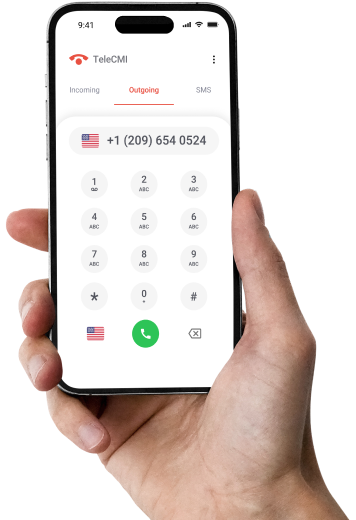
Reduce Repetition. Improve Resolution
When agents see full interaction history instantly, first-call resolution naturally improves
How Cloud Telephony Maintains Customer History
Cloud telephony consolidates all customer interactions in one place, ensuring that every agent is up to speed before they respond. The key functionalities are:
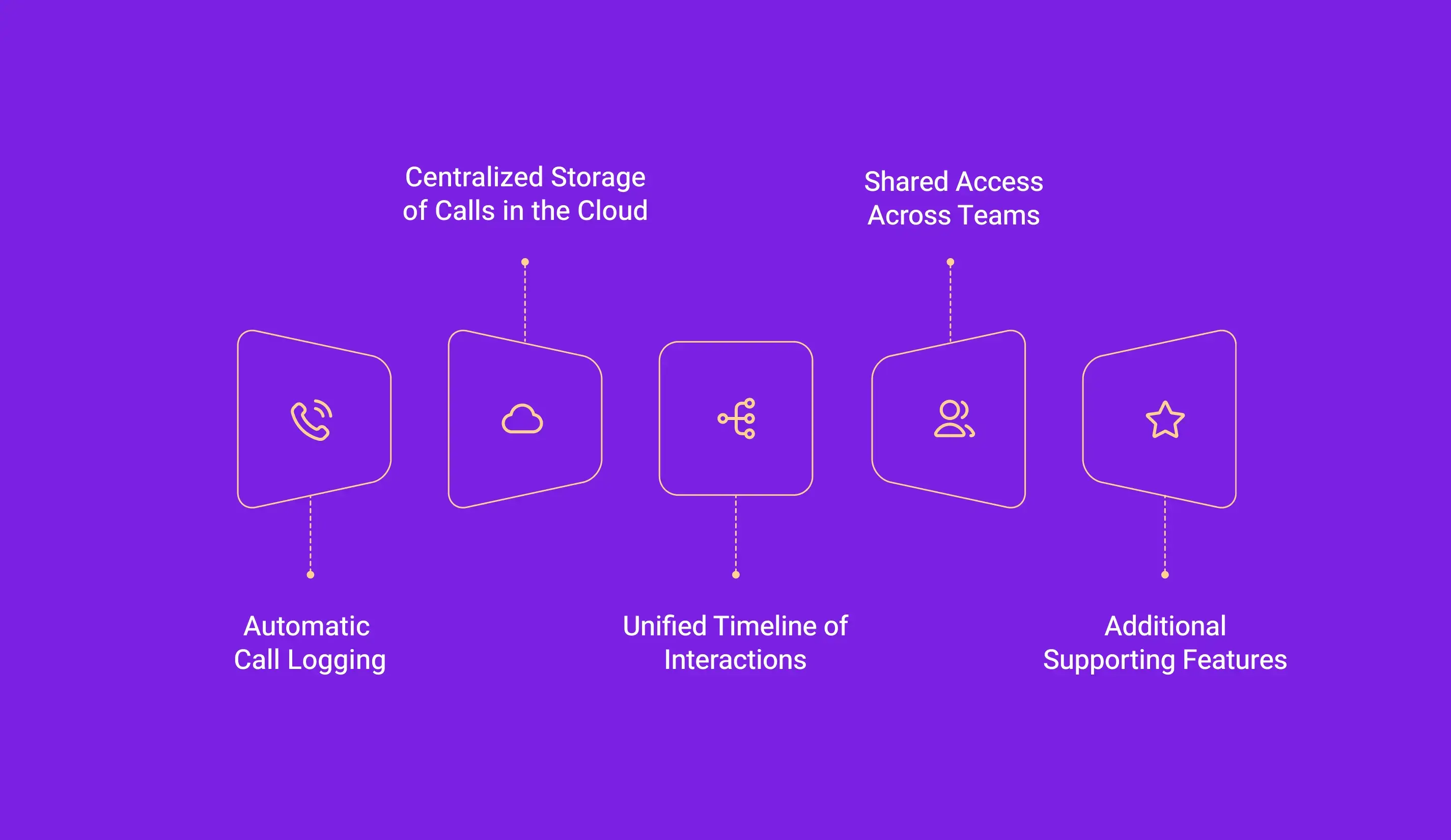
Automatic Call Logging
Calls are automatically associated with a customer ID, recording time, duration, agent, result, and disposition without any manual intervention.
Centralized Cloud Storage
Customer interaction information is stored in cloud databases, not on devices. This ensures that history is available irrespective of the agent’s location and the call they are currently handling.
Unified Interaction Timeline
A common timeline provides agents with a complete history of customer interactions, including calls, comments, and recordings, even before they answer the call.
Smart Call Linking
Calls are automatically associated with the correct customer ID based on caller ID or other criteria, without any manual searching, ensuring that no interaction is missed.
Where possible, customers are directed back to the same agent, creating continuity, reducing repetition, and building the kind of familiarity that improves resolution speed.
Calls are directed to the best-fit agent based on the customer’s issue and history. Transfers preserve full context, so service continuity is never disrupted.
Real-Time Screen Pops
Before a call is even answered, the agent sees the customer’s full interaction history on screen. Harvard Business Review research shows that resolving a customer issue in a single interaction reduces customer service costs by up to 23%. Screen pops are a direct enabler of that outcome.
Omni-channel Unified View
All interactions — calls, chats, emails — are compiled into a single customer record. Teams are automatically synced, ensuring every channel delivers the same level of informed service.
Role-Based Access Control
Agents access only the information relevant to their role. Support teams see issue history; sales teams see purchase behavior while protecting sensitive information.
CRM Integration Strengthens Shared History" class="text-lg sm:text-2xl text-[#2b2e33] font-bold font-heebo pt-10">How CRM Integration Strengthens Shared History
The major advantages of CRM integration are as follows:
- Calls are automatically recorded against the precise customer profile, without any human error.
- Screen pops highlight the history of previous interactions, at the moment the call is connected.
- Persistent history that prevents recurring inquiries and supports consistent service.
- Faster resolution through full context, reducing unnecessary transfers.
- Consistent communication across every agent and touchpoint.

CRM systems deliver an average return of $8.71 per dollar spent, and pairing them with cloud telephony significantly amplifies that value.
Why Shared History Becomes Critical as Teams Scale
As teams expand, the problem of maintaining service quality becomes exponentially more difficult without centralized solutions.
Shared history directly addresses the most common scaling challenges:
- More agents mean a more fragmented context without centralization.
- High employee turnover can erase institutional knowledge unless it is stored systematically.
- Distributed and remote teams cannot coordinate without real-time access to shared records.
- Growth without centralized systems leads to recurring service failures at scale.
How Centralized History Improves Core Service Metrics
First Call Resolution
When agents see the full interaction history, they solve problems in one conversation more often — knowing exactly what has been attempted, what failed, and what the customer wants.
Average Handling Time
Time is lost when agents must reconstruct context from scratch. With a consolidated record, agents spend less time on background discovery and more time on resolution. According to IBM, agents with access to full customer context handle calls up to 40% faster than those working without it.
Repeat Call Rate
When every step of a customer’s history is visible, follow-up calls become targeted rather than repetitive. Partial resolutions — the primary driver of callbacks — are significantly reduced.
Customer Satisfaction
Few things frustrate customers more than having to repeat the same explanation. Zendesk’s Customer Experience Trends Report found that 72% of customers want agents to know who they are and their purchase history without being asked. Centralized history makes that expectation fulfillable.
Agent Productivity and Morale
Agents work more effectively when fully informed. Spending less time on background information means more focus on resolution, reduced stress, and better long-term performance.
Conclusion
Customer experience frequently breaks when context disappears. When conversations live on separate devices, in scattered notes, or in the memory of individual agents, continuity is fragile — and customers feel that break immediately.
Cloud telephony addresses this by consolidating all calls, recordings, notes, and follow-ups into a single accessible system. Regardless of location, shift, or staff turnover, agents can work collaboratively, understand the full context instantly, and respond to customers with confidence.
If your customers are still repeating their story every time they call, it is time to examine the infrastructure behind the experience. Centralizing customer history is not a technical upgrade — it is a service standard.
Upgrade Your Customer Communication Infrastructure

Preserve history across agents
Integrate directly with CRM
Improve service metrics
Frequently asked questions (FAQ)
Saravana Kumar

I’m passionate about exploring and sharing insights on modern cloud communication technologies. At TeleCMI, I focus on helping readers understand the evolving world of cloud telephony and IVR solutions in a simple yet in-depth way. My goal is to deliver genuine value by turning complex telecom concepts into clear, actionable knowledge that builds trust and drives innovation.