PSTN vs VoIP: Which is Best for Global Business Calling?

6 mins read

Posted on May 22, 2024


Vignesh N
SEO


Vignesh N
SEO





Business and communication are inseparable. If you own a business, you must use a communication tool to have full control over your communication transactions, which is essential for the success of your business.
However, the type of communication technology you use is crucial and must satisfy your business communication needs.
The Public Switched Telephone Network (PSTN) has been in use for decades, while Voice over Internet Protocol (VoIP), also known as internet telephony, has been used as an alternative to traditional phone systems for several years.
Both technologies have made significant contributions to improving business communication.
However, since every business has unique requirements, choosing the right communication technology can be challenging.
But don't worry, in this blog, we will help you determine which communication technology is best suited to your business needs. So, read on to find out more!
What is VoIP and How Does it Work?
VoIP (Voice over Internet Protocol) is a technology that allows you to make and receive calls, send SMS, and set video meetings using the internet instead of relying on traditional phone lines.
With VoIP, you only need an internet connection to communicate from any location without the need for a physical landline. This is because VoIP converts your voice into digital data packets that travel over the internet to the receiver's IP, softphone where it is decoded back into voice format.
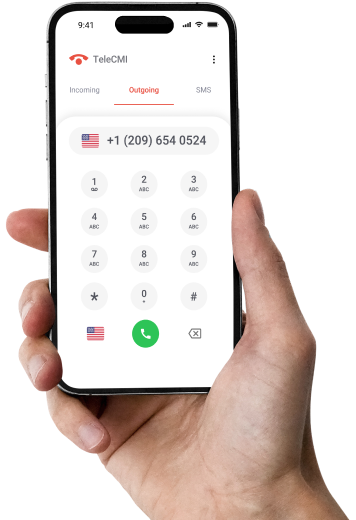
Get Global VoIP Calling Solutions
Reduce your international calling costs with TeleCMI's VoIP Services.
What is PSTN and How Does it Work?
The Public Switched Telephone Network (PSTN) is a widely used standard communication system that has been in use for decades. It is a circuit-switched telephone network that uses underground copper wires, commonly referred to as "landline network systems," to facilitate communication.
PSTN networks work by utilizing various communication technologies, such as telephone lines, fiber optic cables, and switching centers.
When you dial a phone number, the call is transmitted through the network and reaches its destination. This network allows telephones to communicate with each other, making it a reliable means of communication.
Here is a Detailed Comparison of VoIP and PSTN Connectivity
VoIP utilizes the internet for communication, while PSTN relies on traditional landline technology. These two methods of communication are entirely different from each other.
With VoIP, you can make calls using your existing devices like mobile, PCs, computers, and even desk phones as long as you have internet connectivity, whereas PSTN only works with the help of physical landlines.
Flexibility
VoIP Phone Systems offer flexibility and convenience as they allow you to make and receive calls from anywhere in the world as long as you have an internet connection.
Moreover, you can customize your VoIP plan based on your business requirements, adding or removing features as needed. Expanding your Cloud Phone System is also easy when your business grows, with no physical work required.
In contrast, PSTN is limited to the physical location where the landline is installed. Customizing the PSTN, such as adding more lines, can be challenging and may require physical work.
Features
When comparing features, a VoIP business phone system has several advantages, including call queuing, custom caller ID, virtual numbers, advanced call routing, and more, as well as the ability to analyze performance metrics.
These features can greatly improve internal and external communications and help you identify areas that need improvement.
On the other hand, a PSTN system only allows for making and receiving calls.
Cost
Compared to the PSTN, VoIP offers more affordable call charges and requires less maintenance. As a Virtual Phone System, VoIP can be easily set up by purchasing a monthly or yearly plan from providers like TeleCMI, without the need for any physical hardware installation at your premises.
Furthermore, VoIP solutions provide remarkably low rates for both domestic and International VoIP Calls compared to the PSTN, which, as mentioned earlier, uses traditional phone lines.
With VoIP, calls are made over the internet, resulting in significant cost savings for businesses. These cost-effective options make VoIP a more practical and budget-friendly solution for businesses looking to improve their communication infrastructure.
Which Is Better for Businesses in 2026?
Choosing between VoIP and PSTN depends on the size and needs of a business. However, in 2026 most organizations prefer VoIP because it is more flexible, cost-effective, and supports modern communication needs.
Startups
For startups, VoIP is usually the better option. It requires minimal infrastructure and can be set up quickly using an internet connection. Startups can scale their phone system as the company grows and access features like virtual numbers, call routing, and analytics without investing in expensive hardware.
Remote Teams
VoIP works best for remote and distributed teams. Employees can make and receive business calls from anywhere using laptops, mobile apps, or softphones. This flexibility allows teams to stay connected even when working from different locations.
Call Centers
Modern call centers benefit more from VoIP systems because they include advanced features such as IVR , automatic call distribution, call recording, and real-time analytics. These tools help improve customer support efficiency and agent productivity.
Enterprises
Large enterprises may still use PSTN for certain legacy systems, but many are migrating to VoIP or hybrid communication systems. VoIP allows enterprises to integrate communication with CRM platforms, collaboration tools, and cloud applications while reducing operational costs.
While PSTN remains reliable, VoIP is generally the better choice for most businesses in 2026 due to its scalability, lower costs, and advanced communication features.
Which One is Best for Global Business Calling?
If your business relies heavily on cost-effective international communication, scalability, and remote accessibility, VoIP is the clear winner. It offers lower costs, cloud-based flexibility, and advanced features that enhance business communication.
However, if highly stable call quality without internet dependency is your priority, PSTN may still be relevant for some businesses.
Why Choose TeleCMI for Global VoIP Calling?
🚀 Affordable international call rates
🌎 Global connectivity with seamless voice quality
🔗 CRM & business tool integrations
📈 Scalable solutions for businesses of all sizes
Finally
Choosing between VoIP and PSTN for your business communication needs careful planning, as the two technologies are entirely different. While PSTN has been used for decades, it struggles to keep up with the modern requirements of businesses.
As the saying goes, modern problems require modern solutions, which is why you should consider utilizing VoIP technology and cloud telephony solutions to stay competitive. They are affordable and versatile and perfect for small businesses and big organizations.
If you're interested in TeleCMI's VoIP phone system, sign up for a free Trial today and get started with the service. They are packed with advanced features that meet and fulfill your business communication requirements.
With VoIP and cloud PBX, you gain increased flexibility, scalability, and cost-effectiveness. Embracing these modern business phone systems allows you to streamline your infrastructure and keep your business ahead of the competition in today’s fast-changing market.
Make the smart move - Switch to VoIP & Scale your Business Communication!

Global Connectivity
International Standard
Crystal-Clear Voice Quality
Vignesh N

With deep expertise in cloud telecommunications, I help readers explore the latest trends in VoIP and modern business communication. At TeleCMI, I focus on educating businesses with clear, practical insights, making complex telecom concepts easy to understand. I’m passionate about helping organizations improve efficiency, enhance customer engagement, and adopt smarter communication strategies.