VoIP vs SIP Trunking: What’s the Difference? (2026 Guide)

12 mins read

Posted on Jul 31, 2026

Vignesh N
SEO


Vignesh N
SEO





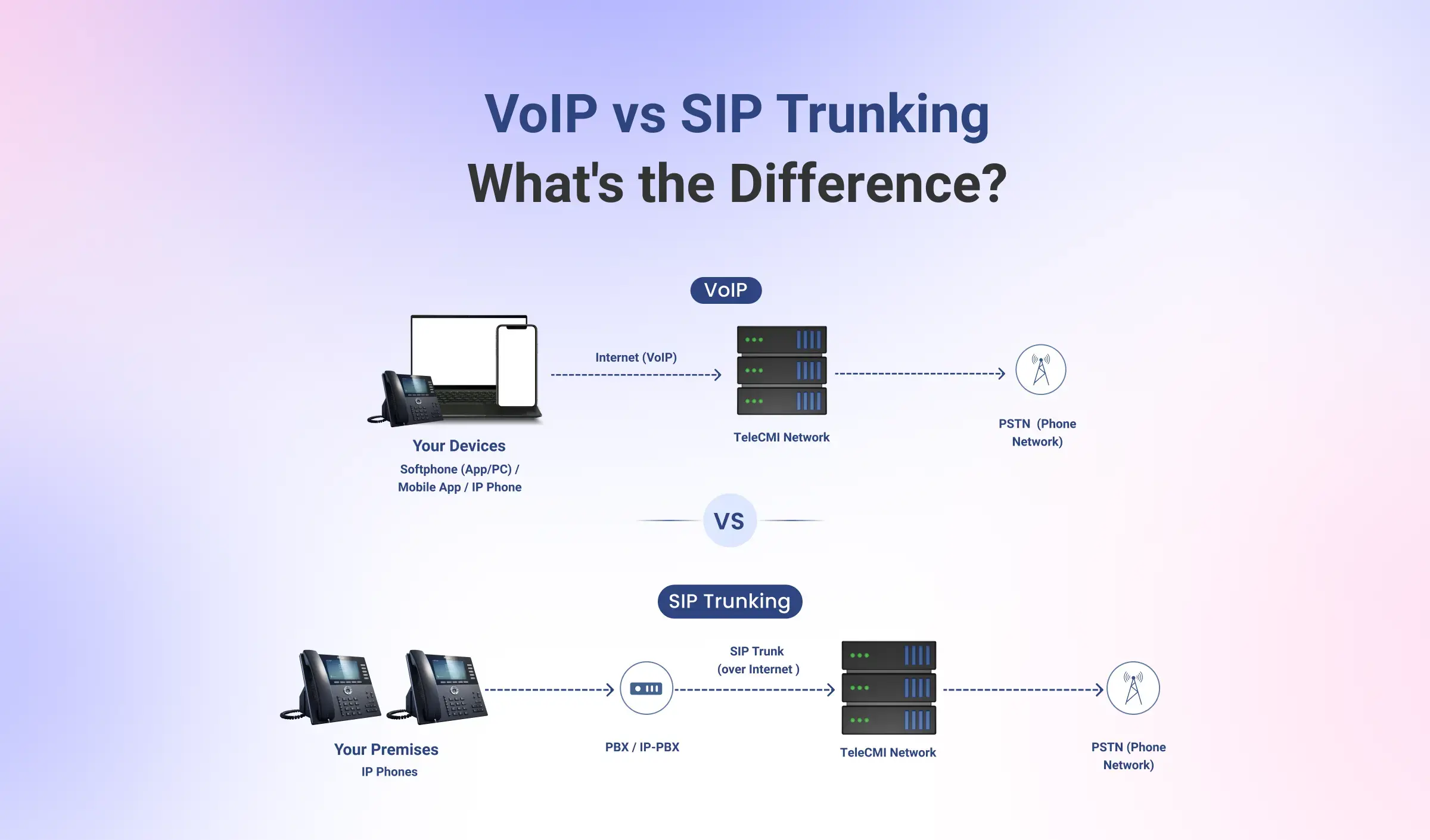
VoIP is the broader technology that turns voice into data and sends it over the internet. SIP trunking is one specific method of delivering that technology, used to connect an existing PBX system to the internet in place of traditional phone lines. That single distinction changes how a business should actually evaluate providers, and it’s the one most sales conversations skip right past.
Ask three vendors to explain the difference between VoIP and SIP trunking, and there’s a decent chance all three answers sound completely different, mostly because the two terms get used interchangeably in pitch decks even though they describe different layers of the same system. One is the technology itself. The other is a way of plugging that technology into hardware a business already owns.
This guide breaks down how VoIP and SIP trunking work, where they overlap, and which setup actually fits a business heading into 2026.

Key Takeaways
 VoIP is the umbrella technology for calling over the internet. SIP trunking is one method of delivering VoIP to an existing PBX system.
- Cloud VoIP needs no existing hardware. SIP trunking needs a PBX to connect to.
- SIP trunking usually costs less at scale for businesses that already own PBX infrastructure. Cloud VoIP is priced per user and easier to set up without an IT team.
- Many mid-size and large businesses run both together: cloud PBX for flexibility and SIP trunking for cost-efficient PSTN connectivity.
- Countries including the UK and Germany are actively switching off traditional PSTN networks, which is prompting many businesses to make the switch regardless of preference.
What Is VoIP?
VoIP stands for Voice over Internet Protocol. It’s the technology that takes a voice, converts it into digital data packets, and sends those packets over the internet instead of down a copper phone line. On the other end, the packets are reassembled into audio fast enough that neither person on the call notices it.
That’s the whole mechanism at a basic level: voice becomes data, the data travels over broadband, and it’s rebuilt as sound on arrival.
VoIP isn’t one product. It’s a category that covers a wide range of tools: cloud phone systems, softphone apps, mobile calling apps, video calling, and full UCaaS platforms that bundle calling with chat and video. Every one of these runs on VoIP underneath, whether the interface looks like a phone, a browser tab, or a mobile app. Nearly every modern enterprise communication tool has VoIP at its core, even those that never mention the term in their marketing.
What Is SIP Trunking?
SIP stands for Session Initiation Protocol, and SIP trunking is a method of delivering VoIP calls to a business’s existing IP-PBX system over the internet, replacing legacy T1/PRI circuit lines and traditional PSTN copper infrastructure.
Here’s the mechanism. A SIP trunk connects an on-premises or cloud PBX to the public phone network using the internet. On the technical side, a Session Border Controller (SBC) sits between your network and the provider to secure the connection, enforce Quality of Service (QoS) to secure clear voice quality, and manage media protocols such as RTP. The PBX still handles internal call routing and SIP trunking; simply modernizes the pipe carrying those calls in and out.
The name itself comes from a classic telecom analogy: a tree trunk supports multiple branches. A SIP trunk works the same way: a single virtual connection supports multiple concurrent channels (simultaneous calls), eliminating the requirement for separate physical lines for every employee.
SIP trunking makes the most sense for businesses that already run an established PBX setup and want to drop expensive, legacy PRI lines for internet-based calling, all without replacing the hardware they’ve already invested in and trained staff on.
Why this matters right now: the SIP trunking market is projected to reach $181.58 billion by 2031, largely due to major telecom carriers retiring copper PSTN infrastructure faster than expected. More background on how SIP trunking fits into the bigger VoIP picture is available from GetVoIP’s comparison guide and Tech.co’s rundown of VoIP adoption statistics.
Is SIP Trunking the Same as VoIP?
No, and this is where most of the confusion in sales conversations actually starts. SIP trunking is a type of VoIP. It isn’t a competing alternative.
A simple way to think about it: VoIP is like “the internet,” the broad technology underneath everything. SIP trunking is like “fiber broadband,” one specific way of delivering that broader technology into a business. Fiber is still the internet. It’s just one particular method of getting it there.
Vendors muddy this because both are sold by roughly the same set of providers, even though they address different infrastructure needs. A business starting from zero, with no phone hardware at all, generally needs VoIP broadly, most likely a cloud phone system. A business that already owns a PBX and just wants to modernize the connectivity layer beneath it, without replacing the whole system, is actually shopping specifically for SIP trunking.
VoIP vs SIP Trunking: Head to Head
Infrastructure is the real difference. VoIP doesn't ask for any existing hardware, no PBX, nothing. SIP trunking is the opposite case. It needs a PBX or another call-control system already in place to plug into, which is exactly why it fits businesses that already have telephony infrastructure and have no interest in moving out.
Cloud VoIP tends to be quick to deploy and light on maintenance, which is a big part of why teams without a dedicated IT person gravitate toward it. SIP trunking asks more of whoever sets it up, but in exchange, the IT team gains real control over call routing, codecs, bandwidth, and quality-of-service settings rather than leaving it to a provider's defaults.
Scaling looks similar on the surface but works differently. Adding a user to cloud VoIP is a dashboard change. Adding capacity to SIP trunking means adding channels to the existing setup.
Reliability, in both cases, comes down to the provider and how the network is set up. Cloud VoIP platforms tend to build in more redundancy out of the box. SIP trunking reliability depends more on the PBX itself and on how well the local setup handles failover.
Portability is worth a mention too. Cloud VoIP travels with the user, any device, any location since nothing physical ties it down. SIP trunking remains tied to the physical location of the PBX, though newer cloud PBX setups have begun chipping away at that limitation.
By 2028, Gartner projects that 90 percent of organizations will rely on cloud office platforms for enterprise telephony by 2028, up from just 30 percent in 2025, a shift covered in detail by UC Today's breakdown of Gartner's 2025 UCaaS Magic Quadrant is a solid place to look further.
VoIP vs SIP Trunking: Real-World Cost Comparison
Understanding how pricing scales depends on whether you buy per user or per concurrent call channel:
- Cloud VoIP Pricing (Per User): You pay a fixed monthly fee per employee (e.g., $20/user/month). A team of 50 users costs approximately $1,000/month. This model includes software features, maintenance, and phone lines in one predictable subscription.
- SIP Trunking Pricing (Per Channel): You pay for the maximum number of simultaneous calls your business makes at peak hours, not total employees. If that same 50-person company rarely has more than 10 people on the phone at once, they only need 10 SIP channels (at ~$15–$25 per channel) plus DID (Direct Inward Dialing) phone numbers. Total cost: roughly $200–$250/month.
Cloud VoIP is cheaper and lower-risk for smaller or distributed teams without IT staff. SIP trunking delivers significant ROI for larger teams or call centers that already own PBX hardware and want to optimize channel utilization.
VoIP vs SIP Trunking: Which Should You Choose?
Selecting the right business VoIP solution or SIP trunk provider comes down to your current hardware footprint and internal technical capacity:
Choose a Cloud VoIP Solution if:
- You are starting fresh with no existing phone hardware or legacy PBX.
- Your team has under 50 users, making per-user cloud pricing simple and cost-effective.
- You manage remote or hybrid teams who need to make calls on mobile apps, laptops, or web browsers from anywhere.
- You want an all-in-one cloud communication platform with built-in IVR, call recording, CRM integration, and analytics, without having to manage firewalls or SBC configuration.
Choose a SIP Trunk Provider if:
- You have significant capital tied up in an on-premises IP-PBX that is not ready for retirement.
- You run a large organization (50-500+ users) where paying per concurrent SIP channel is significantly cheaper than buying individual cloud seats for every employee.
- You have a dedicated IT team capable of managing PBX routing, Session Border Controllers (SBCs), and Quality of Service (QoS) parameters.
- You are executing a phased PSTN migration, using SIP trunking as the immediate bridge off legacy copper lines before eventually transitioning to full cloud PBX.
Can You Use Both VoIP and SIP Trunking Together?
Yes, and quite a lot of mid-size to large businesses already run it exactly this way.
The setup usually looks like this: a cloud PBX, which is VoIP at its core, connects out to the PSTN through a SIP trunk for inbound and outbound calling, while internal calls between employees stay entirely on the internet without touching the PSTN at all. It’s a hybrid that combines the flexibility of a cloud PBX with the cost efficiency of SIP trunking as call volume scales up.
Cloud phone system works this way in practice. It connects to SIP trunks for PSTN connectivity while handling IVR, call routing, recording, and CRM integration entirely at the cloud layer, giving a business the modern features of cloud telephony without giving up the cost advantages SIP trunking brings at scale.
TeleCMI currently holds a 4.8 out of 5 rating across 291 reviews on G2, which lines up with the kind of reliability businesses look for when running a hybrid setup like this in production. For a wider look at how business phone systems stack up against each other, G2’s Business Phone Systems category and TeleCMI’s own G2 review page are both useful starting points.
The Future of VoIP and SIP Trunking in 2026 and Beyond
PSTN switch-offs are no no longer a remote plan. The UK, Germany, and a growing list of other countries are actively decommissioning their traditional PSTN networks on fixed timelines, which means businesses in those markets are migrating to VoIP or SIP trunking whether it was on this year’s roadmap or not.
AI is showing up across cloud communications, too, from call transcripts and summaries to IVR systems that route callers to the right person without a long list of button presses.
WebRTC is also gaining ground, enabling calls to happen directly in a browser without a dedicated SIP client or a traditional VoIP app installed at all. It won’t replace either technology outright, but it’s quietly reducing how often either one requires a separate piece of client software just to make a call.
Bringing Everything Together
VoIP and SIP trunking aren’t competing against each other. They’re different layers of the same modern-day communication infrastructure, one the broad technology, the other a specific way of connecting it to hardware a business already owns. Which one actually fits depends entirely on what that business already has in place and where its phone system is headed next.
Build a Smarter Business Communication System with TeleCMI Today.

Cloud VoIP & SIP Trunking
AI-Powered Call Management
Enterprise-Grade Reliability
Trusted by 3,500+ Businesses
Frequently asked questions (FAQ)
Vignesh N

With deep expertise in cloud telecommunications, I help readers explore the latest trends in VoIP and modern business communication. At TeleCMI, I focus on educating businesses with clear, practical insights, making complex telecom concepts easy to understand. I’m passionate about helping organizations improve efficiency, enhance customer engagement, and adopt smarter communication strategies.


.webp)