What is Call Monitoring? A Complete Guide for Business Leaders

9 mins read

Posted on Feb 03, 2026

Vignesh N
SEO


Vignesh N
SEO






Every customer phone call tells a story. Some reveal what your company does well. Others quietly expose problems that reports never capture. Yet in many organizations, these conversations disappear as soon as the call ends.
Call monitoring gives leaders a way to stay connected to what is actually happening on the front lines. Rather than relying solely on scores and summaries, managers can hear real interactions, understand customer concerns, and guide teams with facts rather than guesswork. When used well, call monitoring becomes less about oversight and more about improving service and strengthening relationships.
In this blog, we’ll delve into what is call monitoring, how it works, the benefits, and choosing the right one for your business.

Key Takeaways:
 Leaders are allowed to see the real customer experience and agent performance, rather than reports and metrics.
- Team members provide service that is accurate, professional, and reliable in every contact.
- Managers can give very specific and useful feedback based on real conversations.
- Monitoring puts a spotlight on workflow inefficiencies, knowledge gaps, and recurring problems.
- Early intervention prevents escalations and fosters trust.The recording and analytics are stored for review.
- Managers can replay the call, search by topic, and analyze patterns across multiple calls.
What is Call Monitoring?
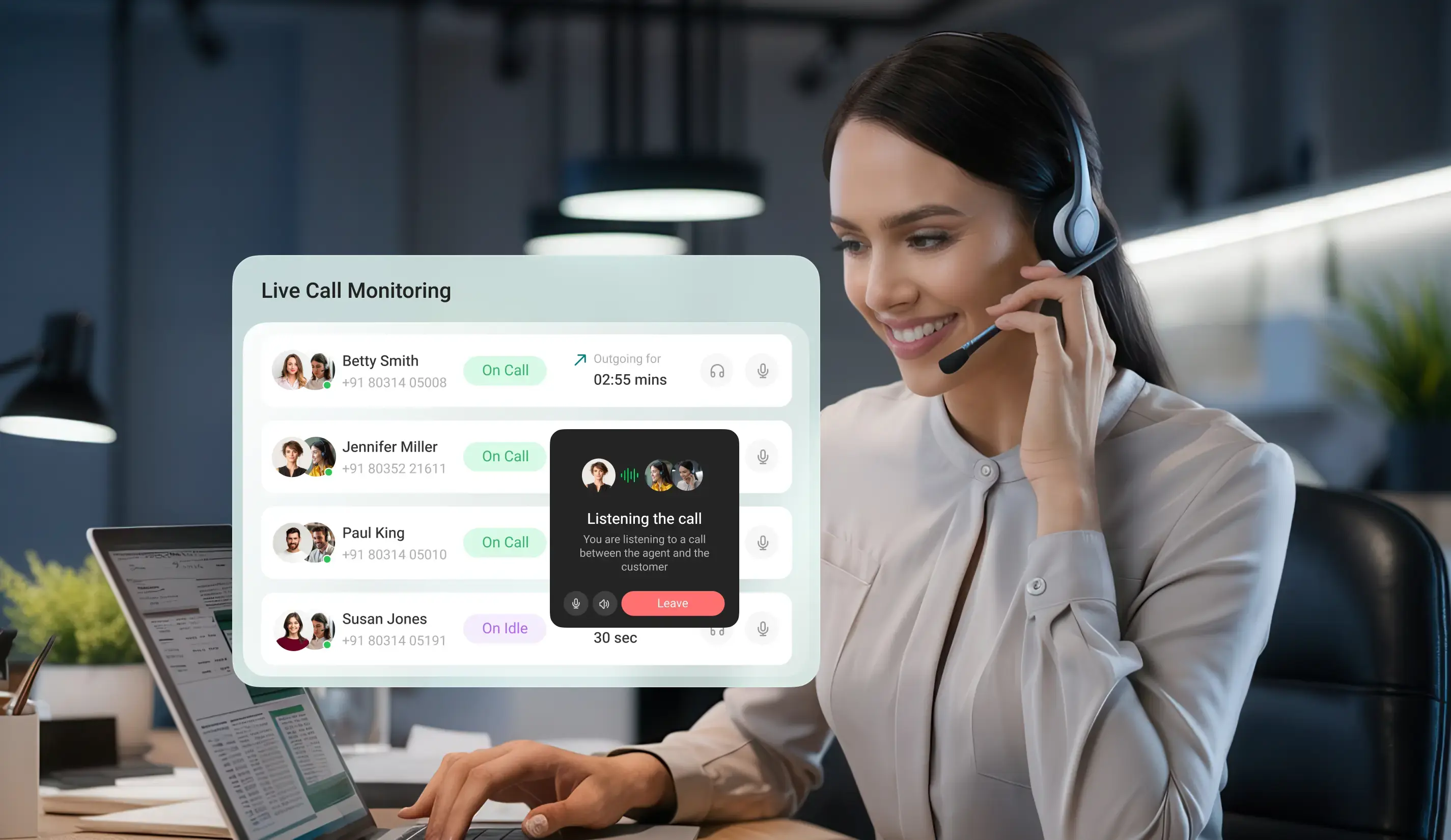
Call monitoring is the practice of listening to live or recorded phone conversations between employees and customers to evaluate performance, improve service quality, and protect the business from risk. In a contact center, it allows supervisors and managers to hear how agents communicate, how problems are handled, and where conversations succeed or break down. Calls may be reviewed after they end, or listened to in real time using call whispering and barbing tools.
Features of Call Monitoring
Call monitoring offers more than the ability to listen to calls. Below are the essential features that make call monitoring a critical system for modern contact centers.
1. Silent Live Call Listening: Supervisors can listen to calls in real time to understand how the conversation is going, require assistance, or assess communication quality without interrupting the flow.
2. Contextual Whisper Coaching: A Supervisor speaks to an agent during a live call without the customer hearing. It is useful when the agent needs guidance on how to respond, explain a policy, or calm a frustrated caller, making the agent stay confident and ensuring the customer receives a clear and helpful reply.
3. Dynamic Call Intervention: Supervisors can join a call when additional support is needed during a live call. By stepping in at the right time, leaders can steady the conversation, provide accurate information, and prevent the issue from growing into a complaint.
4. AI-Driven Sentiment and Behaviour Analysis: The system evaluates tone, language, and pacing to understand customer emotion and agent behavior. This makes it easier to detect frustration, uncertainty, or satisfaction without manually reviewing every conversation.
5. Automated Call Recording and Tagging: Calls are captured and sorted by topic, outcome, or keyword. This facilitates the retrieval of discussions for training, quality assessments, or regulatory audits.
6. Post-Call Performance Analytics: Once the call ends, the system highlights response times, speaking patterns, and resolution outcomes. These insights help leaders refine coaching, strengthen team performance, and understand customer satisfaction.
Benefits of Your Contact Center Implementing Call Monitoring
1. Enhancing Customer Experience:
Call monitoring reveals what customers actually go through, not what reports suggest. It allows managers to correct service breakdowns early and build a smoother, more reliable experience across every interaction.
- Identifies recurring service issues before they grow into customer complaints.
- Improves tone, clarity, and response accuracy across teams.
- Creates consistency so customers receive the same quality of support every time.
2. Optimizing Sales Performance:
Sales conversations become more effective when coaching is based on real customer interactions. Call monitoring shows managers how successful agents handle objections, guide prospects, and close deals, allowing these practices to be taught across the team—an approach similar to how Writepaper homework experts analyze real examples to improve performance and outcomes.
- Reveals the techniques used by high performers that lead to stronger results.
- Highlights common objections and effective responses.
- Helps new sales staff ramp up quickly using real call examples.
3. Driving Operational Efficiency:
Inefficient processes become visible when call patterns are reviewed closely. Call monitoring helps leaders fix operational issues that slow down teams and frustrate customers.
- Reduces average call handling time without lowering service quality.
- Exposes confusing workflows or outdated procedures.
- Helps prioritize process improvements based on real demand.
Example:
A logistics team often faces issues on delivery-related calls; while analyzing, call monitoring highlights that agents switch between systems and tools to find order details. While combining information into a single screen, calls become faster, and customers receive answers without delay.
4. Minimizing Escalations:
Call monitoring allows supervisors to join a live call to solve the issues before minor problems become complex issues.
- Allows real-time support during sensitive conversations.
- Less number of calls are passed to senior management.
- Protects customer relationships before trust is damaged.
5. Improving Coaching and Training:
Training becomes stronger when it is built on feedback rather than being generic. Call monitoring gives managers real material to coach with precision.
- Turns feedback into clear, measurable improvement steps.
- Helps identify where individual agents struggle.
- Builds confidence through targeted, call-based coaching.
How Does Call Monitoring Work in a Contact Center?
It connects your phone platform, customer records, and supervisor tools so that managers can review calls in real-time or after the fact.
The process generally includes only a few simple steps:
- On each call received at the contact center, the system recognizes the caller and puts the call through to an agent, linking it with the customer's profile.
- Depending on how the system is set up, calls can be recorded automatically. Supervisors can monitor in silence, provide cues to the agent, or break into the call when necessary to offer additional support.
- It gathers information on the duration of a call, keywords, sentiment cues of a call, and precisely how an agent worked through an issue.
- For instance, it will allow managers to replay the call, find any topic being discussed, or review trends that appear across multiple conversations.
- These insights are then used to coach, develop the training material further, and maintain the quality of service throughout the team.
Who Uses the Call Monitoring Feature of Contact Center Software?
Call monitoring is used across several teams, each for different reasons. Here are the three main departments that highly utilize contact center software.
1. Marketing Teams: Marketing teams can hear calls to understand customer preferences, uncover common questions, and capture the language customers would naturally use. All these help in refining messaging, having better campaigns, and matching up their strategies to what customers actually care about.
2. Sales Teams: Sales teams then put call monitoring into place to analyze real conversations and train from the top performers on how to fine-tune their objection handling and closing. Managers also use recorded calls as a way to coach new representatives with real-world, applicable examples. Incorporating product training for sales teams ensures that representatives have a deep understanding of offerings, enabling them to communicate value more effectively and improve overall sales performance.
3. Technical and customer service teams: Call monitoring is a way for the support teams to deliver accuracy and consistency in solving issues. The supervisors will listen to calls to identify the knowledge gaps, guide through complex cases, and ensure customers consistently receive clear and reliable assistance.
How to Choose the Right Call Monitoring Solution
Choosing the right call monitoring system is easier when you focus on how your teams actually work each day. A good tool like TeleCMI will make life simpler for supervisors, support agents during tough moments, and give leaders a clear view of what customers experience.
1. Ease of use: A system should be simple for supervisors to navigate, especially during busy hours. Quick access to live calls, recordings, and coaching tools helps teams respond without delay.
2. CRM integration: When the platform syncs directly with your CRM, every call automatically finds its place. This keeps records accurate and gives teams a complete picture of each customer without extra steps.
3. AI capabilities: Modern contact centers gain significant benefits from built-in intelligence. Tools that read sentiment, identify patterns, or produce automatic summaries help leaders understand conversations at scale.
4. Scalability: The platform should grow with your teams, support additional users, and handle higher call traffic without reducing quality.
5. Security compliance: Recordings often contain sensitive information. Choose software that complies with regulations such as HIPAA or GDPR and provides robust access controls to protect both your customers and your business.
Conclusion
Call monitoring helps teams learn from real conversations, not just numbers on a report. The process records factors such as talk time, key phrases, sentiment analysis, and issue resolution, allowing executives to have a better insight into the actual experience customers go through. Supervisors can listen in, offer support when it matters, and use recordings to coach agents with context and care. Repeated issues will reduce, and customer service will remain consistent, culminating in a sense of satisfaction on both ends of the call-a typical call will then be a learning experience, influencing training and streamlining processes.
See how call monitoring helps supervisors guide agents

Live call listening, whisper coaching, and call intervention
AI-driven sentiment insights to catch issues early
Confident agents, smoother conversations, and consistent customer experiences
Frequently asked questions (FAQ)
Vignesh N

With deep expertise in cloud telecommunications, I help readers explore the latest trends in VoIP and modern business communication. At TeleCMI, I focus on educating businesses with clear, practical insights, making complex telecom concepts easy to understand. I’m passionate about helping organizations improve efficiency, enhance customer engagement, and adopt smarter communication strategies.

 for your Call Center and Enhance Efficiency_.webp)