What Is the Public Switched Telephone Network?

8 mins read

Posted on Jan 27, 2025


Saravana Kumar
SEO


Saravana Kumar
SEO






The telephone system was commercialized many decades ago and constantly evolves with technological advancements. It began by connecting through telephone lines, and the telecommunication system moved to underground copper wires, undersea telephone cables, communication satellites, and now even a digital network into PSTN.
With the internet dominating the digital world recently, PSTN is trying to stay relevant to other technologies. In this guide to PSTN, let's see their benefits, features, how they impact businesses, their cost, and how you can stay competitive in the market with business communication optimization.
What is PSTN?
The Public Switched Telephone Network (PSTN) has existed since the 1800s and allows callers to communicate with each other globally. To connect calls, PSTN networks use underground copper wires, switches, and other infrastructures.
They are also known as fixed lines, landlines, or analog. The PSTN network is regulated by government bodies even though some parts of the legacy system have been digitally upgraded.
How does PSTN Calling Work?
PSTN calling works via a network of interconnected circuits and switches. When the call is made, the phone converts voice into electrical signals sent to the local exchange. In the exchange, leveraging a system of routing protocols, it determines the right path for the call to take through a series of switches and trunk lines that are high-capacity transmission lines.
PSTN for Businesses
For any business, a PSTN system can be set up using an individual line for each employee. This works well for many employees, but adding more lines can be costlier. This is why larger businesses prefer to use the PBX system, as it transforms the business phone system into a central office; the incoming calls made to your business will reach the PBX system and then be routed to the specific extension of employees. This system uses features like auto-attendants to get callers to the right destination.
Key Features of PSTN Services
PSTN is a popular communication system that offers a comprehensive set of features, such as
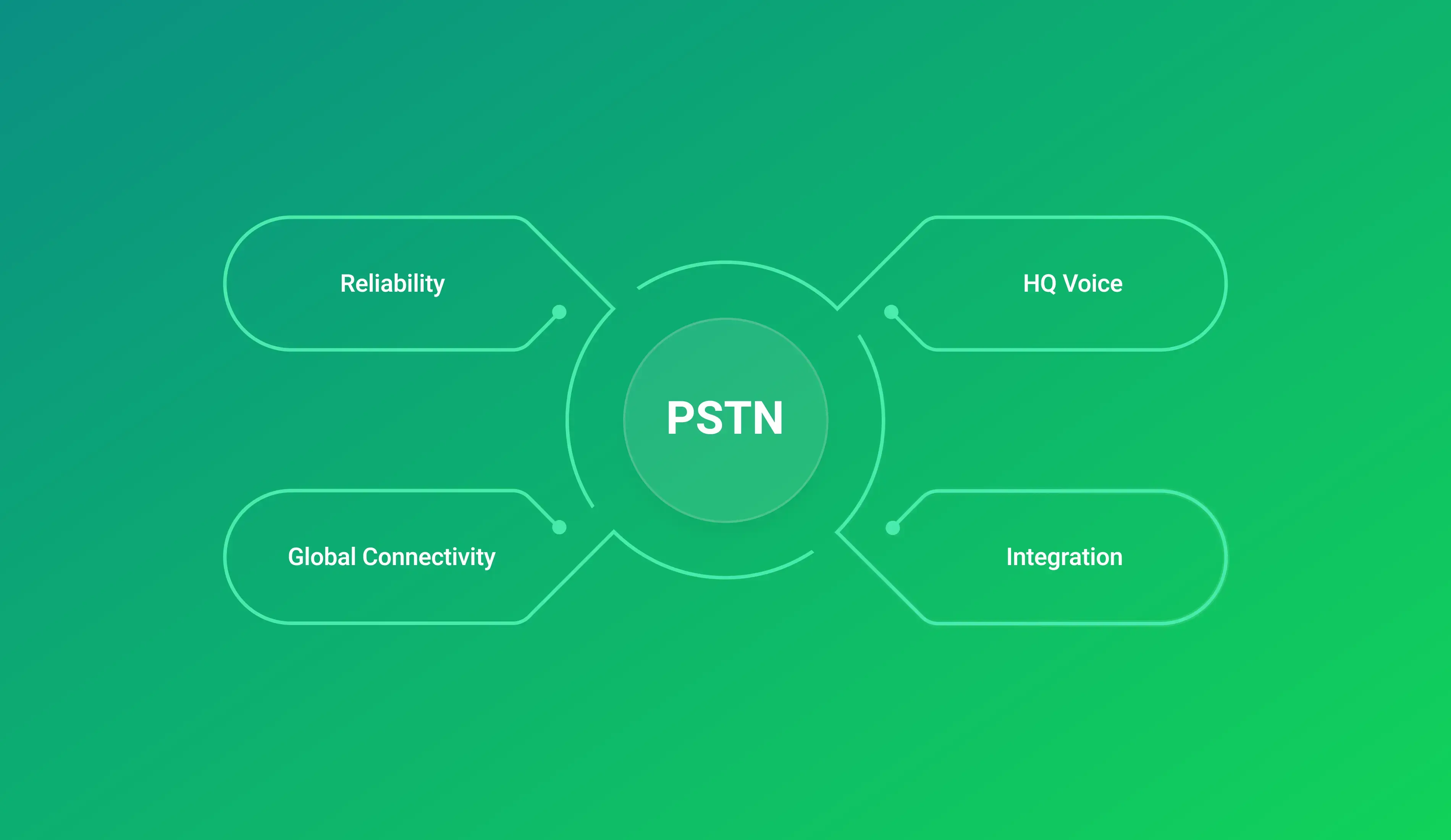
- Reliability - Guaranteed 99.999% operational time with redundant infrastructure and solid backup routes, ensuring consistent and seamless service during emergencies.
- HQ Voice - Delivers high-quality voice support with clear and uninterrupted communication for personal and professional purposes.
- Global Connectivity - Make calls to any network globally, and international businesses can connect with customers to stay connected. Businesses looking to expand their outreach can also use G Map Extractor to find location-based business leads and support more targeted communication efforts
- Integration - Users can seamlessly communicate with easier accessibility without any barriers with compatibility and integrations to existing systems.
Benefits of PSTN Services
With many businesses switching to VoIP service, PSTN remains a popular choice for most companies for a few crucial reasons. Listed below are the reasons,
1. Robust Infrastructure - PSTN services have a robust in-built infrastructure that has been improved constantly over the years. It has several networks of local exchanges, trunk lines, switches, and international gateways that spread worldwide coverage.
2. Consistent Call Quality - These networks use circuits for every call, ensuring reliable and consistent voice communication with zero latency. Businesses depend on PSTN for all emergency communications due to its consistency in delivery.
3. Increased Security and Privacy - PSTN works on a network with tight security measures, and the PSTN line providers ensure compliance with regulatory and encryption standards to protect user data and prevent unauthorized access. This level of robust security makes PSTN the best choice for businesses that depend on sensitive communications for data protection.
How Much Does PSTN Access Cost?
Let's understand the cost incurred during the installation and use a PSTN phone system in the home or office.
- Cost for Consumers - To set up a PSTN connection at home, you will need a telephone set and the right PSTN provider. Imagine buying a decent phone from any shop for $60 and a basic phone service with unlimited calls costing around $30 monthly. There are many plans with unlimited local and national calls at affordable costs and monthly plans.
- Cost for Businesses - Businesses will require separate lines for each employee while getting a PSTN phone system. For some reason, businesses prefer VoIP over other traditional phone systems. If cases involving small businesses within ten employees can choose a monthly plan for around $30 per month per connection. For connecting with more than forty employees to the PSTN service, a key system unit will be the right choice as it offers an array of features, and KSU costs approximately $800 or more for each line.
Boost Your Business Communication to New Heights with an AI-Powered Solution System!
Start Free TrialFuture of PSTN Network
There has been a slow decline in PSTN usage as other digital communication technologies, such as mobile networks, VoIP, and others, have become more dominant and cost-effective. Most businesses are moving away from PSTN to choose modern alternatives for flexibility, advanced features, and reduced costs.
Some countries, like the Netherlands and Estonia, have shut off their PSTN networks, while others, like the UK, New Zealand, and Denmark, plan to terminate the network in six years. However, some transition strategies are being adopted in hybrid systems that integrate PSTN and VoIP for a hassle-free migration process. As 5G and IoT technologies emerge, more rampant innovations and superior communication solutions will emerge.
How does TeleCMI Help Business Owners with Effective Communication?
With a comprehensive cloud communication platform, TeleCMI optimizes businesses with AI-driven calling functionalities to streamline and enhance communication processes.
- AI-Driven Capabilities - Leverage AI-enabled call routing, IVR, call analytics, and 100+ AI tools to offer customizable customer experiences.
- Centralized Communication Platform - Use a single platform to manage every local and global call for seamless channel connectivity.
- Omni-Channel Experience - Integrate text, voice, and other communication channels to engage with customers in any medium quickly.
- Real-Time Insights - Offers real-time dashboards and analytics to monitor call data, agent productivity, and customer conversations for efficient call management.
- Quicker Integrations - Integrate seamlessly with over 150+ popular CRMs and advanced platforms for more effortless information flow and increased productivity.
- Robust Security - Provides tightened security. End-to-end encryption in adherence to industry regulations and standards to protect sensitive data.
How to Get Started with TeleCMI’s PSTN Phone System?

Businesses can set up TeleCMI’s PSTN phone system in easy and simple steps.
1. Sign Up - Access the dashboard in TeleCMI to create an account by entering the details of your business,
2. Choose India Region - Select the India region to set up your phone system.
3. Get a Virtual Phone Number - Choose a virtual phone number by choosing from the given options.
4. Select a Plan - Pick a subscription plan that will suit the individual business requirements.
5. Complete Payment Setup - Compare and review the payment process to quickly activate the account.
6. Install App - Download the TeleCMI app, and agents can use it to make business calls from their phones.
Following these steps, you can quickly set up TeleCMI’s PSTN phone system and manage your business calls effectively.
Transform Business Communication with TeleCMI
PSTN services have been a foundation of global communication since the 1800s. They have a well-established infrastructure and a good reputation for reliability. There is a decline in PSTN usage due to the emergence of other technologies. Still, businesses are finding ways to get alternatives to infuse these advancements with PSTN services as they offer significant benefits at all levels of business communication.
With advanced capabilities like virtual phone numbers, multiple deployment options, and integrations, TeleCMI promises uninterrupted communication for businesses across all sectors. TeleCMI 's PSTN services are designed to drive maximized business growth and improve conversations.
Contact us to see TeleCMI in action and experience advanced calling solutions.
The Future of Communication is Here—Switch to AI-Powered Phones!

Customizable Solutions
Connect From Anywhere
Improve Team Productivity
Frequently asked questions (FAQ)
Saravana Kumar

I’m passionate about exploring and sharing insights on modern cloud communication technologies. At TeleCMI, I focus on helping readers understand the evolving world of cloud telephony and IVR solutions in a simple yet in-depth way. My goal is to deliver genuine value by turning complex telecom concepts into clear, actionable knowledge that builds trust and drives innovation.