Contact Center Analytics: The Complete Guide to Data-Driven Customer Experience

10 mins read

Posted on Aug 13, 2024

Vignesh N
SEO


Vignesh N
SEO






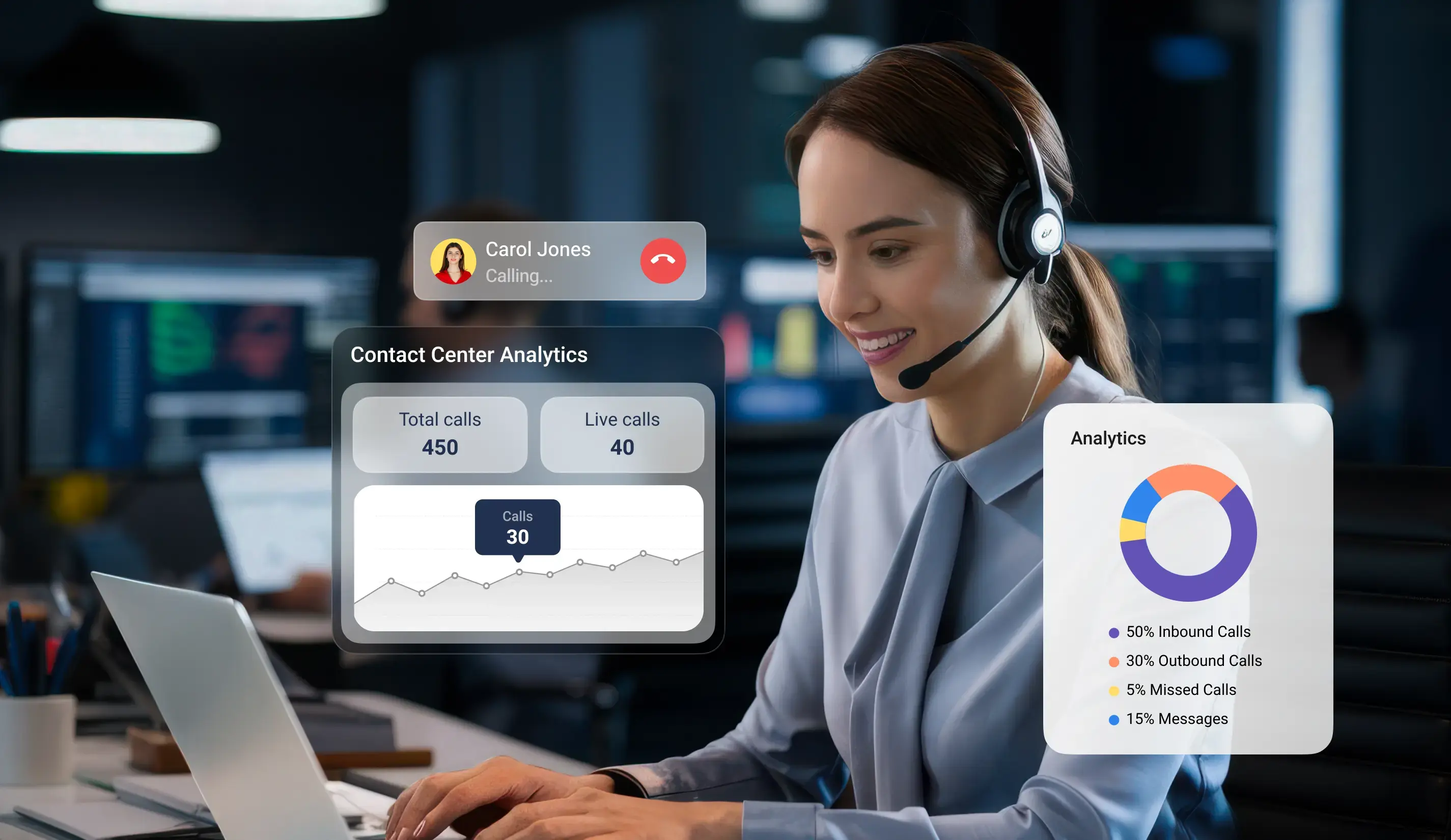
Contact Center analytics is the process of transforming raw data into actionable insights for an organization that handles a large volume of incoming and outgoing calls. By collecting information, including calls, chats, texts, and videos, the system analyzes this data by incorporating advanced tools and technologies to extract insights and provide meaningful metrics for observation, optimization, and productivity.
It provides answers to questions like:
- What's happening?
- Why is it happening?
- What might happen next?
- What should we do about it?
In short, call center analytics is all about:
Analytics = Data + Context + Action.
How much of your contact center data drives decisions?
If your answer isn't "almost all of it," you're definitely not alone.
Contact centers generate a wealth of interaction data, including customer conversations, agent activities, and operational signals. But the absence of right analytics means that data is often limited to numbers and metrics, which often leads to inconsistent service quality, poor customer experience, and agent burnout.
Modern customers expect fast resolutions, consistent experiences across channels, and empathy at every touchpoint. At the same time, leaders face pressure to reduce costs, manage hybrid teams, and meet demanding service benchmarks. A cloud PBX phone system helps address these challenges by enabling seamless communication, improving customer service efficiency, and supporting flexible team management.
That's where Contact Center Analytics comes in. It transforms noise data into intelligent graphs and charts, helping you to monitor performance, identify customer emotions, and optimize every interaction.
In this blog, we'll explore how contact center analytics works, the types you need to know, and how platforms like TeleCMI offer smarter, data-driven CX decisions.
What is Contact Center Analytics?
Contact center analytics is the process of collecting, extracting and analysing raw data into useful metrics. By incorporating AI and machine learning techniques, these systems provide meaningful insights. By transforming data into visual metrics, you gain in-depth insights into average time handling, first-call resolution, agent productivity, and overall business performance, and enhance the customer experience.
Types of Contact Center Analytics
The system offers a range of contact center analytics to provide comprehensive data, detailed reports, and valuable insights. Here's the list of analytics that are focused explicitly on contact center solutions:
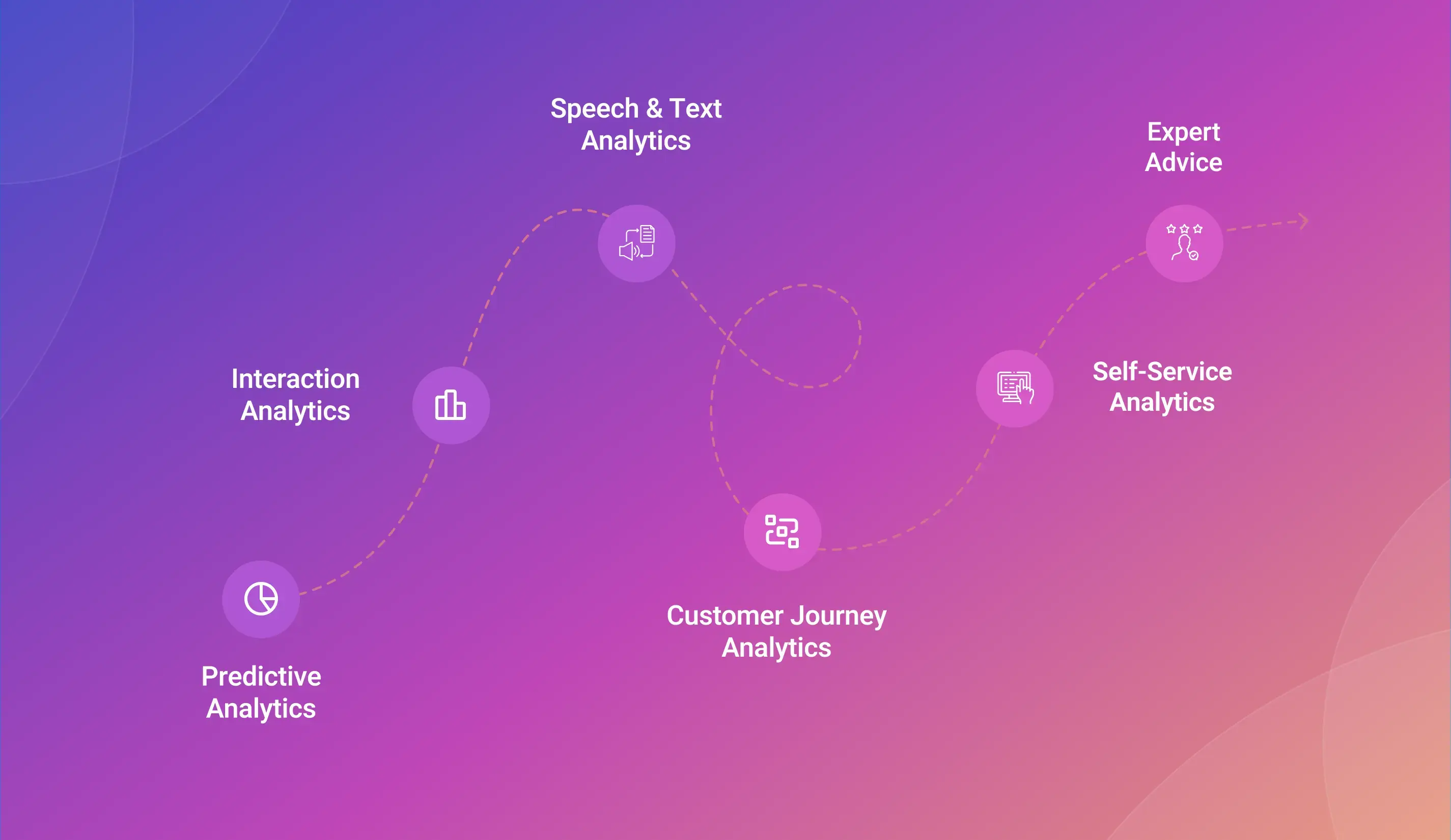
Predictive Analytics
As the name suggests, predictive analytics predicts future trends and behaviors by analyzing existing data and other statistics. With this, brands can prioritize and address customer needs, configure business operations, and make decisions instantly. Businesses can leverage this function for promotions, discounts, and other launches for the upcoming months.
Interaction Analytics
Interaction analytics refers to the process of analyzing agent-client communication across various platforms, including calls, messages, audio, video, and social media. This can thereby provide deep insight into patterns, perform sentiment analysis, and help companies quickly identify and address customer issues.
Speech & Text Analytics
Speech and text analytics collect information in the form of spoken and written customer communication. It examines various factors, including tone, content, voice recordings, and written exchanges.
Customer Journey Analytics
This type of analytics tracks how customers migrate towards various support channels available on the platform. These can include live support, self-service options, and more. Businesses can identify where customers find it challenging and require support. Thus, based on this, brands can customize the call flow.
Self-Service Analytics
Self-service analytics refers to focusing on customer-initiated conversations and evaluating the effectiveness of automated platforms, such as chatbots and FAQs. By analyzing this with deep insights, businesses can provide faster resolutions and eliminate the workload for agents.
Smart leaders do more than track metrics; they turn trends into tactics and insights into impact.
Why Contact Center Analytics Matters
Detailed call analytics are crucial for a contact center to enhance the customer experience, boost agent performance, and make informed strategic decisions.
1. Elevating Customer Experience:
Analytics empowers you to move beyond guesswork and deliver experiences that truly resonate with your audience.
- Decode customer sentiment, preferences, and behavior in real time.
- Identify pain points across touchpoints and take proactive steps.
- Consolidate and unify all reports in a single channel to deliver faster and personalized support.
2. Improving Agent Performance
Agents are the face of your brand, and analytics gives you the tools to coach, support, and recognize them effectively.
- Pinpoint the strengths and areas for improvement by analyzing metrics like average handling time, call quality and sentiment score.
- Prevent agent burnout and create a positive environment by offering personalized training, leveraging data quality tools, and supporting continuous improvement.
- Managers can provide clear feedback and celebrate high-performing agents based on detailed metrics.
3. Enhancing Operational Efficiency
Analytics helps streamline workflows, optimize resource allocation, and reduce unnecessary costs.
- Fine-tune scheduling, automate low-impact tasks, and intelligently route calls with comprehensive reports and insights.
- Offer customer-centric and operational agile solutions with strategic analysis of call center metrics.
- Insights from business phone systems on call volume trends, peak hours, missed call rates, and abandonment patterns enable you to automate processes, customize workflows, and optimize operations for sustained business growth.
Key Metrics and KPIs in Contact Center Analytics
There are various key performance indicators (KPIs) calculated in a contact center to track performance, customer satisfaction, and optimize operations.
Customer-Focused Metrics
- CSAT (Customer Satisfaction Score): Typically gathered after post-interaction, to understand the satisfaction level and customer emotion.
- NPS (Net Promoter Score): The score, often measured using an NPS tool , provides a clear picture of customers' loyalty. It is about asking how likely they are to recommend your service or product to their friends and family.
- First Contact Resolution (FCR): Track whether the queries were addressed in the first interaction. High FCR enhances the customer experience and increases the likelihood of repeat business with you.
- Sentiment analysis: Uses natural language processing to analyze the tone and emotional cues within customer interactions.
For every 1% increase in First Contact Resolution (FCR), customer satisfaction rises by approximately 1%, and Net Promoter Score gains 1.4 points. Wikepedia
Agent and Performance Metrics
- Average Handle Time (AHT): This metric measures the total time spent handling a call, including talk, hold, and wrap-up time, helping agents avoid rushing and maintain quality calls.
- Occupancy rate: Indicates the percentage of time spent actively engaging on calls, which allows supervisors to analyze the overloads and underutilized resources.
- Quality scores: Based on internal QA reviews or automated assessments, quality scores reflect how well agents adhere to scripts, processes, and customer engagement best practices.
- Call Disposition: Refers to the outcome or classification of each call (e.g., resolved, escalated, follow-up required). Understanding disposition trends helps refine routing and agent workflows.
Operational Metrics
- Call abandonment rate: The percentage of callers who hang up before connecting with an agent due to long wait times or a poor IVR experience.
- Service level: Tracks the percentage of calls answered within a predefined threshold. It's a key indicator of accessibility and the effectiveness of resource allocation.
- Contact volume trends: Clear visibility on incoming calls, outgoing calls, missed calls, over time. These trends help with staffing models, marketing impact analysis, and workload forecasting.
- Self-service success rate: Evaluates how many customers resolve their queries through self-service tools (IVR, chatbots, knowledge base) without needing agent assistance.
Best Practices for Implementing Contact Center Analytics
To effectively implement contact center analytics for your business, define your goals, select the right software, integrate it with existing tools, measure the outcomes and make improvements.
Align Analytics with Business Goals
Specify your business objectives, such as improving customer satisfaction, reducing churn, enhancing agent performance, or generating revenue. However, these goals should be specific, measurable, achievable, relevant, and time-bound (SMART) for your analytics implementation. Map these goals to the Key Performance Indicators (KPIs) and measure them over a specific period, then start implementing improvement measures.
Integrate Across Channels and Systems
In a contact center, customers not only interact via call, they contact the teams through chats, emails, video conferencing, and even social media. To gain complete visibility on every platform, the contact center software should integrate with those channels, supported by data integration consulting services. This unified approach provides a clear picture of every interaction, metrics, and analytics, and automatically synchronizes and updates all metrics consistently across the channels.
Empower Teams with Actionable Insights
With an intuitive dashboard and comprehensive analytics, managers, supervisors, and agents can gain valuable insights into customer satisfaction, agent performance, and overall business growth. It helps you to provide real-time coaching and training, make informed predictions, and make informed decisions.
How TeleCMI Delivers Smarter Contact Center Analytics
TeleCMI is one of the best contact center analytics providers, offering over 400 calling and advanced analytics tools. This enables businesses to recognize customer emotions, automate repetitive tasks, enhance accuracy in interactions, and more.
Major metrics to track using TeleCMI:
- Live Call Volume Trends and Missed Call Patterns
- Agent Occupancy and Performance Dashboards
- Cloud IVR Flow and Pathway Analytics
- Peak Time Insights and Hang-up Reason Reports
- Channel-Based Metrics and Campaign Tracking
- On-Demand, Scheduled, and Custom Reports
The goal of call analytics is to foster a culture of continuous improvement, understand the "why" behind the numbers, and feel accountable for outcomes.
Conclusion
Contact center analytics is one of the powerful ways to understand customers, evaluate agents' performance, and predict future business growth. We all know that customer expectations evolve, and businesses must incorporate data-driven intelligence to offer meaningful interactions and stay aligned with their goals. From consolidating all information across systems to improving customer satisfaction and optimizing operations, these metrics enable you to act with clarity, agility, and precision. With TeleCMI, you can gain a unified view of customer journey, agents' performance, and business opportunities.
See how TeleCMI’s Contact Center Analytics can transform your business

Sentiment & Speech Analysis in Action
Customizable KPI Tracking & Reporting
Secure, Compliant, Scalable Platform
Frequently asked questions (FAQ)
Vignesh N

With deep expertise in cloud telecommunications, I help readers explore the latest trends in VoIP and modern business communication. At TeleCMI, I focus on educating businesses with clear, practical insights, making complex telecom concepts easy to understand. I’m passionate about helping organizations improve efficiency, enhance customer engagement, and adopt smarter communication strategies.


 for your Call Center and Enhance Efficiency_.webp)