What Are Internal Calls and How Do They Benefit Your Business?

10 mins read

Posted on Oct 29, 2025

Vignesh N
SEO


Vignesh N
SEO






Every business starts with a shared purpose, but as teams grow, communication can become a barrier instead of a bridge.
How?
Marketing used one calling app, support relied on another, and sales often used personal numbers to reach colleagues. Messages got lost. Calls went untracked. And what should have been quick, five-minute decisions usually turned into day-long delays.
This is the silent friction that costs businesses time, money, and momentum. As hybrid work expands and operations spread across geographies, seamless internal communication isn't just convenient; it's critical.
That's where internal calling or app-to-app calling comes in. It unifies every conversation within a single, secure platform, enabling teams to connect instantly, collaborate smarter, and eliminate telecom costs entirely.
In this guide, we'll uncover how internal calling helps modern businesses streamline communication, improve accountability, and drive measurable ROI.

Overview:
Internal calls are more than just making calls between departments, teams, or locations within a company. It's more about creating a communication culture that fosters collaboration and business success. Through omnichannel communication, real-time analytics, and automation, teams can connect effortlessly, communicate in context, and collaborate efficiently.
What is Internal Calling (App-to-App Calling)?
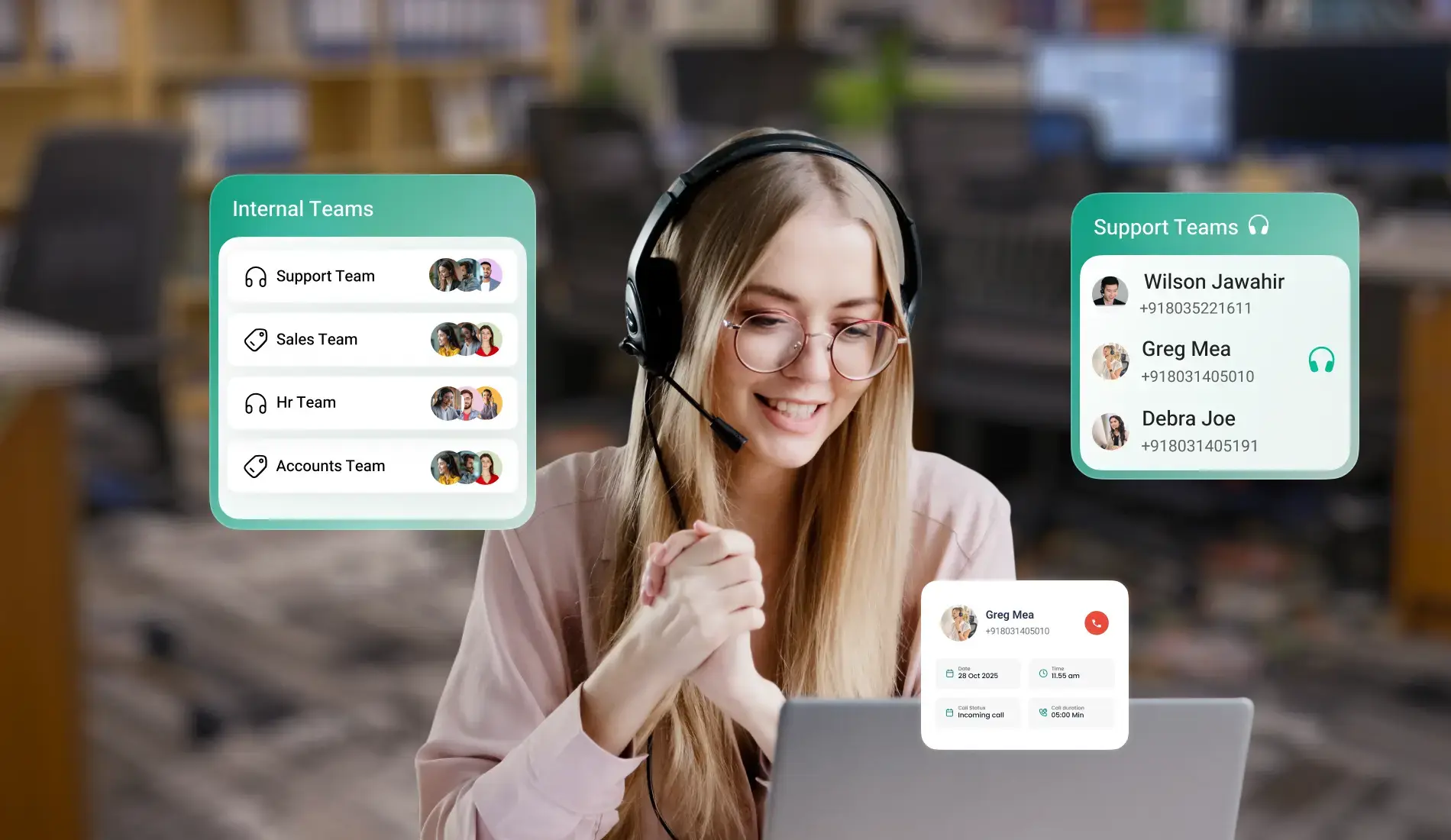
Internal calls are voice and video calls made between two departments, employees, or teams within the organization using a unified business communication platform. These app-to-app or in-app calls utilize technologies like Voice over Internet Protocol (VoIP), a virtual extension, and a distinctive caller ID to reach out to peers securely, irrespective of location or device, without telecom expenses.
Why Are Businesses Shifting to Internal Calling?
Businesses are adopting an app-to-app calling system to unify communication, simplify workflows, and enhance team productivity through transparency, agility, and scalability.
Here's a list of reasons why organizations are implementing internal calling features into their operations:
- Reduced Operational Costs: Teams usually use diverse communication tools to stay connected and in sync. But a business communication system makes it easier by consolidating all platforms on one dashboard and offering contextual engagement between teams, locations, and channels.
- Enhanced Security & Control: Internal calling requires each employee to call from their unique ID, ensuring encrypted communication and preventing unauthorized access and data leaks. Also, admins can audit call logs and recordings and monitor activities, gaining complete control over internal communications.
- Better Visibility & Analytics for Management: With in-depth insights, predictive analysis, post-call details, and department-level performance metrics, supervisors can gain actionable insights on internal calls, team collaboration, and resource optimization across departments — all of which contribute to enhancing operational efficiency and supporting technical SEO services strategies. These analytics can help identify which content and keywords are driving traffic, allowing SEO strategies to be refined for better search rankings. Plus, a link building agency can use these insights to prioritize outreach efforts, secure niche relevant backlinks from authoritative websites, and measure the impact of backlinks on overall site performance.
- Full Integration with Business Tools: Internal calling with zoho crm telephony integration, Helpdesk, and Sales tools, keeping your teams connected within a single digital environment.
- Scalable for Remote and Hybrid Teams: Most internal calling platforms, like TeleCMI, evolve as your business grows. As one of the leading VoIP solutions for remote and hybrid teams, it can adapt to your organization's needs, from onboarding new users to supporting distributed workforces efficiently.
Expert Insight:
Every internal conversation becomes cost-free, efficient, and entirely managed within your organization's ecosystem.
Key Benefits of Using Internal Calling in Your Business
Beyond just making voice or video calls, it strengthens collaboration, builds accountability, and enables organizations to operate faster and with greater precision. Here is a list of key benefits that make internal calling an essential feature for your organization.
- Faster Decision-Making: Employees can receive instant, clear answers without delays, frustration, or downtime through a unified system. Teams can link instantly across departments, make rapid decisions, and answer customer or project questions in real time. With real-time collaboration and faster access to data, teams can prospect like a big team while improving response times and coordination.
- Stronger Team Collaboration: Internal calling enables employees to get connected instantly with peers or managers through secure in-app calls, enhancing project coordination and team synergy.
- Secure, Encrypted Communication: Since employees use company-issued IDs or extensions, every internal call is encrypted end-to-end, ensuring conversations remain private and protected.
- Works Seamlessly Across Locations and Devices: No matter whether your team works from an office, remotely, or across the world, internal calling provides seamless and trustworthy connectivity.
- Zero Cost for Internal Calls: Unlike traditional communication setups that incur per-call charges or telecom costs, internal calls are free within your organization. There is no dependency on external carriers, offering unlimited app-to-app calls across teams and reducing overall communication expenses.
- Built-in Logs, Recordings, and Analytics: Internal calling systems provide detailed analytics that go beyond call duration and volume. With insights into team responsiveness, department activity, and usage trends, managers can make data-driven decisions.
When Should You Consider an Internal Calling Feature in Your Business Communication Platform?
Internal calling (app-to-app calling) is particularly worth it if your business requires speed, security, and ease in everyday collaboration. The following are the situations where implementing internal calling can provide instant and quantifiable value:
- Remote or Hybrid Teams: If your workforce operates from multiple locations or follows a hybrid model, internal calling ensures consistent communication without dependency on personal numbers or third-party apps.
- High Internal Call Volume: When teams frequently interact for quick clarifications, approvals, or project updates, the number of internal calls can be significant. Internal calling systems streamline this process, allowing unlimited in-app communication at zero cost, all within your organization's secure network.
- Need for Faster Communication: In dynamic environments such as operations, customer support, or sales, time-sensitive decisions are routine. Internal calling enables instant voice or video connections, reducing delays and improving responsiveness across departments.
- Multiple Departments or Branches: Organizations with multiple departments, branches, or field offices often struggle with disconnected communication systems. Internal calling unifies everyone under one communication network, ensuring that every employee, from head office to remote site, stays connected and informed.
- Cross-Functional Collaboration: When departments like marketing, finance, and customer service work together extensively, internal calling streamlines cross-functional coordination. It allows teams to connect in the moment, share insights, and arrive at decisions sooner, without using third-party platforms.
Measuring the Real Business Impact of Internal Calling: Calculating ROI
Any investment in communication technology must deliver quantifiable value in terms of cost savings, productivity gains, and better control of operations.
Let's break down what that looks like in numbers.
Example Scenario: Measuring Cost Efficiency
Team Size: 30 employees
Average Internal Calls per Day: 300
By switching to internal calling, your business could save ₹4,500 per month (₹54,000+ annually) while gaining complete control, compliance, and data visibility.
Best Practices for Rolling Out Internal Calling in Your Organization
Implementing internal calling is a shift in how your organization communicates, collaborates, and securely shares information. Here are the best practices for successfully introducing internal calling across your teams:
Assess Team Needs and Communication Workflows:
Prior to deployment, spend time understanding how your teams currently work together. Learn:
- Which departments communicate the most
- What kind of communication (voice, video, or quick updates) do they depend on
- How current workflows can be optimized by internal calling
Train Teams on Internal Calling Tools:
The success of any new system depends on how well employees understand it. Conduct short, role-specific training classes that include:
- How to place and receive calls
- Utilizing functions such as call transfers, recordings, and analytics
- Best practices for safe and effective use
Ensure Cross-Device Accessibility:
Modern workplaces demand flexibility. Enable internal calling across mobile devices, desktops, and browsers to support both in-office and remote teams.
Monitor Usage with Analytics:
After going live with internal calling, leverage integrated analytics to monitor usage habits and performance. Review:
- Call volume and response times
- Department-level activity trends
- User adoption and engagement metrics
Integrate with CRM, Helpdesk, or Sales Tools:
Smooth integration is the essence of long-term effectiveness. Integrate your internal calling system with core business applications like CRM, Helpdesk, or Sales tools.
- Auto-log call information for visibility
- Allow click-to-call from business apps
- Unify customer and internal communication data
Start Small, Then Scale Gradually:
Begin your rollout with high-communication departments such as sales, customer support, or operations. Collect feedback, tune configurations, and scale steadily throughout the organization.
How to Set Up Internal Calls with TeleCMI
It is easy, quick, and scalable to get started with TeleCMI Internal Calling. Within a few steps, your teams can transition from disjointed communication to an integrated, secure, and free internal calling solution.
Set Up Your Account: Register and Log in to your TeleCMI dashboard and create users or departments. Every member of your team is assigned a unique internal extension for effortless in-app calling.
Configure Internal Extensions: Assign virtual extensions to employees or teams. These are their virtual IDs for voice or video calls within the company, without the need for phone numbers.
Enable Cross-Device Access: Install the TeleCMI app on desktop and mobile devices so employees can stay connected anywhere, across offices or remote locations.
Integrate with Business Tools: Connect TeleCMI with your CRM, Helpdesk, or Sales platforms for click-to-call and automatic call logging.
Monitor and Optimize: Utilize advanced analytics to monitor usage, call effectiveness, and team collaboration metrics, allowing ongoing improvement.
Key Takeaways:
The impact of Internal Calling goes beyond convenience. Businesses adopting internal calling experience:
 Lower operational expenses with zero telecom costs for internal calls.
- Enhanced productivity and quicker decisions from an immediate app-to-app connection.
- Greater transparency and control through call analytics, logs, and performance insights.
- Smooth scalability for remote, hybrid, or multi-site teams.
- Stronger data security through encrypted, organization-managed communication.
Conclusion
Internal calling has emerged as the foundation of contemporary business communications, bridging people, processes, and technology. What used to be a simple phone call has become the backbone of organizational agility. Through the consolidation of communication within one ecosystem, internal calling turns everyday interactions into strategic assets.
Teams communicate quickly, decisions are made in real time, and all conversations become measurable, secure, and traceable. Internal calling on platforms like TeleCMI is easy to implement, from initial setup and user adoption to integrating the CRM and Helpdesk systems. It creates a connected culture where decisions are quicker, teams work openly, and communication is an asset that can be measured instead of a repeated expense.
As organizations continue to evolve, the question is no longer why adopt internal calling but how soon. Get Started!
See How Internal Calling Transforms Team Communication

Unlimited App-to-App Calling
Cross-Device Connectivity
Smart Analytics & Insights
Frequently asked questions (FAQ)
Vignesh N

With deep expertise in cloud telecommunications, I help readers explore the latest trends in VoIP and modern business communication. At TeleCMI, I focus on educating businesses with clear, practical insights, making complex telecom concepts easy to understand. I’m passionate about helping organizations improve efficiency, enhance customer engagement, and adopt smarter communication strategies.


 for your Call Center and Enhance Efficiency_.webp)