Best 7 VoIP Solutions for Remote teams and Hybrid workplaces in 2026

28 mins read

Posted on Apr 30, 2026


Vignesh N
SEO


Vignesh N
SEO





With the rise of hybrid and remote work, businesses of all sizes are moving from traditional telephony to cloud communication platforms that combine voice, video, and other channels for effective collaboration. While providing voice data transmission over the internet, it also removes the limitations of traditional telephony like high setup cost, lack of flexibility, and minimal features, and enhances the scalability of businesses.
These advantages have made VoIP solutions a strong option for remote teams, providing the flexibility, reliability, and performance for modern communication. Additionally, features like IVR, and intelligent call routing will further increase the overall efficiency and customer experience of a business.
Understanding what VoIP solutions are will help businesses increase efficiency and make them communicate in a more smarter and faster way. In this blog, we will explore deeper about VoIP solutions and the 7 best providers creating an impact in this space.

Key Takeaways
 Modern VoIP systems offer smarter and more efficient communication through advanced features like IVR, CRM integrations, Analytics, and AI automation
- Businesses can work from anywhere without a physical infrastructure, ensuring effective collaboration across distributed teams
- Choosing the right provider for a business depends on the overall team size, use case, and budget, with differing needs
VoIP: The Future of Business Communication
Voice over Internet Protocol (VoIP) is a modern communication technology that utilizes the Internet to transmit and receive calls instead of relying on traditional telephone lines. It transforms the voice signals from the speaker into digital data packets, which travel through IP networks. The data packets are again converted to voice signals while reaching the receiver.
This results in a high-quality call, enhancing user experience without the need of any expensive hardware or cable installation.
How VoIP Solutions benefit Remote and Hybrid Teams
The modern workplace has undergone a major shift, where teams are spread across cities, countries, and time zones. As a result, effective collaboration has become crucial, which has led to a need for a more reliable, flexible, and cost-effective communication system.
VoIP phone systems address this by replacing the traditional telephone infrastructure with a cloud-based alternative, allowing voice, video, and messaging over the internet. Whether an employee is working from a particular state or a country, they can make and receive calls effortlessly right from their place.
Benefits of VoIP solutions for Remote teams:
- VoIP uses internet-based call transfers, which eliminates the need for expensive infrastructure and technology
- Simplifies installation using network where users can easily remove or add extensions, unlike traditional telephone systems which require wires and cables
- Provides quality audio and video calls for distant workers, which is crucial for communication and team collaboration
Key Features of VoIP Solutions for Remote Teams in 2026
Hybrid and remote working has become a standard for many small and medium-sized businesses. Knowing the features of VoIP and how they directly enhance remote work productivity is essential for any business that wants to manage a distributed team.
- Intelligent routing: This feature directs the call to the right agent or department based on the customer intent, reducing the reliability on manual agents.
- Call Back: Allows customers to request a return call from an agent instead of waiting on hold and automatically connects the customer again to the available agent.
- Call Recording and Transcription: Call Recording records inbound and outbound calls for quality assurance and training purposes. AI Call transcription converts the audio to text format, to analyze conversations more efficiently.
- Auto attendant and Interactive Voice Response (IVR): It is a significant VoIP feature that allows self service and around-the-clock availability for businesses. Attends the call automatically and provides customers with multiple options to receive information regarding a query, leave messages without waiting, or navigate to an agent.
- CRM Integrations: Integrating VoIP systems with leading CRM platforms like Zoho, Salesforce, or Hubspot provides agents with customer history, preferences, and purchase data within a single interface.
- Call Reporting and Analytics: It comprises a dashboard that provides insights regarding call volumes, duration, wait times, and overall performance. These insights help businesses make informed decisions and refine customer experience.
- Click to Call: With just a single click, agents can connect with customers directly from CRM or website interfaces. This increases the conversion rate by eliminating the need for dialing and improving customer engagement.
- Video Conferencing: Integrated video calling improves the collaboration of multiple teams by eliminating the need for separate platforms and reducing costs.
- Voicemail to Email: Sends a customer query as a recorded voicemail directly to email inboxes. This allows agents to never miss critical customer queries and manage interactions more efficiently.
- Multi-device compatibility: Allows employees to manage business calls from their desktop or mobiles while still showing the official business number.
Together, these features eliminate the communication gap between remote and hybrid teams and help them work smarter and faster, providing a unified experience.
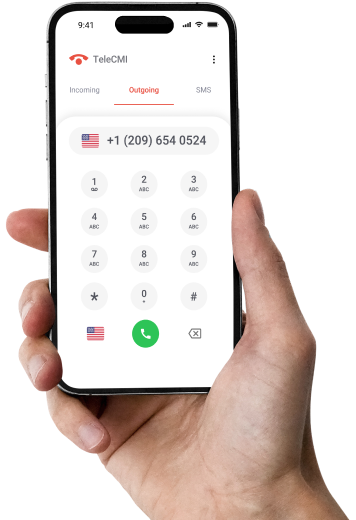
Give your remote team the tools to call, connect, and collaborate from anywhere with VoIP.
Get StartedVoIP vs Traditional Phone Systems for Remote Work
For decades, traditional phone systems were the primary means of business communication, which required a physical hardware installation and cable setup. However, the arrival of cloud-hosted VoIP systems has changed the scenario, serving as a cost-effective alternative for businesses with an advanced suite of communication tools.
Employees can now communicate from anywhere through a single interface without the need for a physical infrastructure.
Key differences between VoIP and Traditional Phone Systems
Which is better for Remote Work
For almost all remote and hybrid work environments, VoIP is the superior choice. It eliminates the need for a physical office, allowing businesses to make and receive calls on their personal devices without compromising the quality and features, making it reliable for modern teams.
However, traditional phone systems can still be used in cases like areas with poor internet connectivity or organizations with strict compliance requirements, but they don't meet the real-time needs of modern remote teams.
How to Choose the Best VoIP Solution for Remote Teams
While the right VoIP solution can help businesses enhance call quality with advanced features and reduced costs, a wrong solution can do the opposite, which can be a struggle for remote teams. According to Gartner, 70% of organizations that switch communication platforms report poor fit of their specific needs as the primary reason for switching.
Hence it is important for businesses to consider the following factors before selecting a VoIP service provider to make confident and informed decisions for long-term growth.
Understanding your team's communication needs
The first and foremost step is to identify why your team actually needs a communication system. Each business needs are different, so one can start by asking:
- Size of a remote team and how quickly businesses want their teams to grow
- Location of the team members: Same city, different countries, or across multiple time zones
- Types of primary communication: Voice or video calls, team chats, or a combination
- Approach to inbound and outbound calls: The volume of calls, number of agents and channels
1. Scalability and Flexibility
Remote teams consist of a dynamic work environment, where new employees join a company, roles evolve, and workloads keep changing. The right solution must be able to grow with your business without requiring major infrastructure changes.
A scalable solution should allow you to:
- Add or remove users instantly
- Assign virtual numbers across various regions
- Compatible with multiple devices like smartphones, laptops, and tablets
Cloud-based VoIP systems are the go-to option here, as they don't require a physical infrastructure and can scale easily and cost-effectively with businesses.
2. Integration Capabilities
Integration plays a major role for a business in reducing the manual workload and enhancing the workflows.
Find out which tools your company already uses and check for compatibility:
- CRM software like Zoho, Salesforce, or Hubspot
- Collaboration tools like Slack or Microsoft teams
- Helpdesk like Zendesk or Freshdesk
Key integration questions to ask:
1. Is the CRM integration native or does it need a third party integrator like Zapier?
2. Does the integration support two way data sync or only one way logging?
3. Are there additional charges for premium integrations?
3. Reliability and Call Quality
For remote teams, reliability is an important factor, as their communication entirely depends on the technology used. Poor call quality, dropped calls, or latency issues can negatively impact the overall customer experience.
Consider the following elements to select an effective VoIP system:
- 99.99% uptime SLA: A service level agreement that guarantees less than one hour of downtime for the entire year.
- Global Network Infrastructure: Providers with data centers in multiple regions deliver consistent call quality for internationally distributed teams.
- Automatic Failover: If the primary server goes down, calls are instantly directed to a backup server, to ensure continuity.
- Quality of Service (QoS) support: Manages traffic to ensure applications like VoIP and video streaming receives the required bandwidth for performance, reducing latency and data packet loss.
4. Security and Compliance
For remote teams handling sensitive customer conversations, business data, or regulated information, security is crucial. A VoIP solution should include the following security measures to protect business and customer data.
- End-to-End encryption: Data is encrypted on the sender's device and is decrypted only by the recipient, remaining unreadable to the intermediates
- Multi-factor Authentication: Asks users to provide two or more verification factors like password or biometrics, preventing credentials from theft.
- SOC 2 Type II certification: Verifying if an organization's security controls are designed correctly and their effective functioning period (eg - 6 to 12 months).
- HIPAA Compliance: Implements policies and technical controls to prevent unauthorized access to patient data.
- Regular Security Audits: VoIP Service Providers should conduct and publish the results of independent security assessments
5. Pricing and Total Cost
While most providers recommend a low per user cost/month, the ideal cost for a business depends on several factors that are easy to overlook.
- Per user monthly cost: The base subscription fee for a team member per month
- Feature Tier Limitations: Businesses should check if the required features are available within the base plan or locked in professional plans
- International Calling Rates: Some providers charge per minute rates for international calls, even on paid plans
- Add on Costs: Additional charges for call recording storage, extra numbers, and premium features
- Setup and Onboarding fees: Some VoIP providers charge for initial setup, which is a one-time upfront cost for configuring a new cloud telecom service.
Comparison Table: Top VoIP Solutions for Remote Teams
The below table offers an overall idea for businesses to choose a VoIP system:
TeleCMI
.webp)
TeleCMI is a leading AI-powered unified communications platform (UCaaS) that helps businesses effectively manage customer interactions, across voice and digital channels. It improves inbound customer experience through smart automation, intelligent routing, and analytics, and supports outbound engagement.
Key Features:
- Automation and Routing: Advanced IVRs and intelligent routing quickly connects the call to the right agent.
- Artificial Intelligence: Features like AI Voice agents, AI coaching, and AI assist reduce the workload of human agents and guide them properly.
- Advanced Call Management Suite: Includes features such as call recording, forwarding, monitoring, conferencing, whispering, barging, and queuing for call control and quality assurance.
- Numbers: Provides local, toll-free, virtual, and international numbers to expand reach and establish stronger connections across various regions.
- Reporting and Analytics Dashboards: Tracks call performance, agent activity, and customer insights with live dashboards and detailed reporting.
- CRM, API Integrations, and Web Extensions: Integrates with 170+ business tools, which allows automated workflows and easy access to calling tools directly from your browser.
- Auto Dialer and Outbound Automation: Enhances agent productivity with predictive/progressive auto dialing and automated followups
Best For:
Businesses that largely depend on inbound customer communication, such as support teams, service providers like e-commerce brands and finance, and growing enterprises.
Pricing Plans:
Pros:
- It is consistently seen as a cost-effective solution, especially VoIP for startups and growing businesses
- According to SaaSworthy, users have mentioned TeleCMI as a reliable customer support, which is a major strength
- Helps businesses simplify communication and improve productivity without heavy infrastructure
- A flexible and remote- friendly option that works well for distributed teams and modern business setups
Cons:
- Initial setup may be slightly complex due to the dependence of telecom operators on call termination and connectivity
- Some users report that customization options are limited
- Mobile app is still under development
G2 Rating: 4.8/5
Work from anywhere without communication gaps using a TeleCMI VoIP solution built for modern remote teams.
Start 14 Days Free TrialExotel
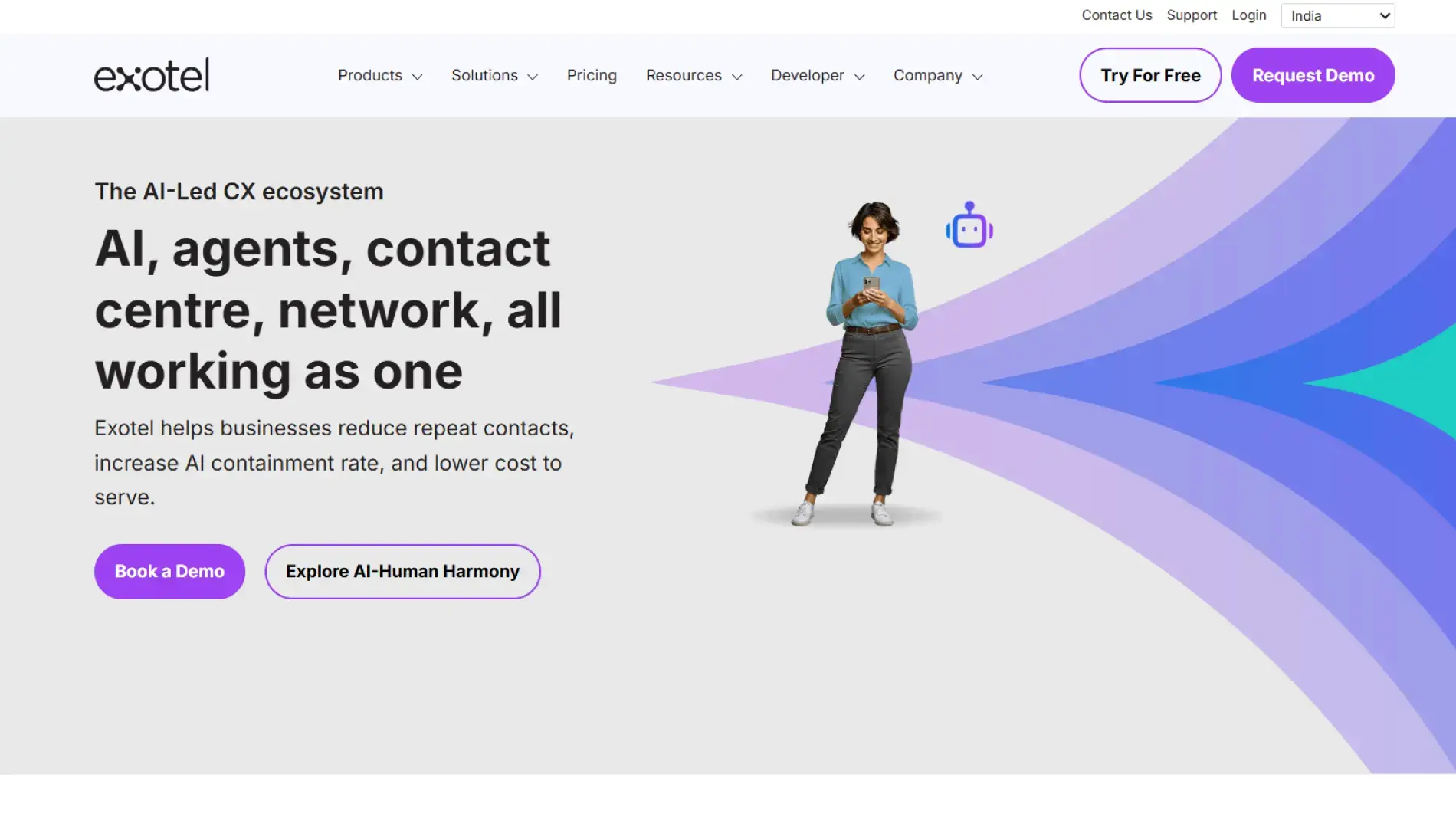
Exotel is an enterprise-grade cloud telephony and customer experience platform that helps businesses reduce repeat contacts, lower implementation cost, and increase AI containment rate. It combines human intelligence with AI and automation, offering a strong infrastructure and omnichannel communication in a single platform.
Key Features:
- Intelligent Voice agents: Uses Natural Language Processing to understand a caller's intent and sentiment, and performs functions like call answering, scheduling appointments, and qualifying leads.
- Conversation Quality Analysis (CQA): Analyzes all the interactions completely across voice and chat for quality and performance check.
- Bot designer: A low-code canvas-based tool that tests and builds AI-powered conversational bots for both voice and chat to handle customer queries
- No-code Connectors: Connects CRMs, helpdesk platforms and business tools through a single click, without writing code
- Patented Call Monitoring: Ensures high-quality and reliable voice communication by constantly monitoring the calls
- Voice Streaming: Transmits the voice data to AI engines or supervisors during a live call for guidance and performance monitoring
Best for:
Exotel is suitable for startups, SMBs, and enterprises in Indian markets that handles large volumes of calls. It specializes in compliant and API-driven communication solutions.
Pricing & Plans:
Exotel uses a credit-based model, where pricing depends on usage.
Pros:
- Handles high call volumes, making it more suitable for B2C operations
- Supports voice, SMS, and whatsApp in a single platform, eliminating the need for multiple tools
- Tech teams can build custom workflows and integrations due to high flexibility
- With its strong compliance, supports businesses that operate in regulated environment with strict telecom rules
Cons:
- Inconsistent call quality can lead to issues like latency or call drops, affecting reliability
- AI capabilities are limited and still evolving compared to its competitors
- Strong in India, but has limited exposure in international markets
G2 Rating: 4.4/5
MyOperator
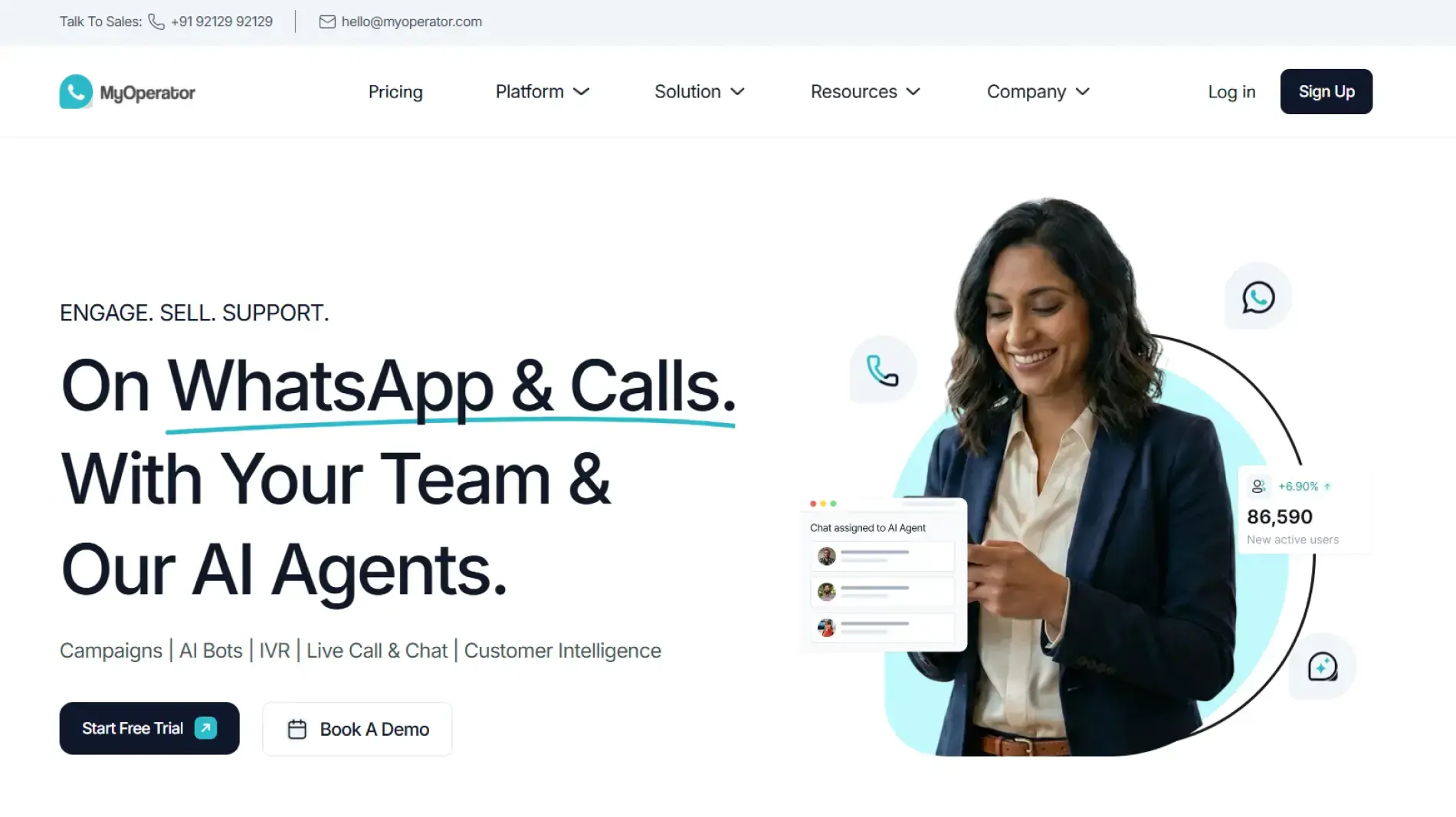
MyOperator is a Business AI Operator, a platform that unifies Whatsapp and Cloud calling into a single AI-powered system. They help businesses eliminate tool fragmentation, function 24/7, and provide intelligent customer experiences.
Key Features:
- Virtual Numbers: Helps businesses establish presence across multiple regions without installing a physical hardware
- Toll-free Numbers: Customers can make calls free of cost, increasing the engagement
- CTWA Integration: (Click-To-Whatsapp-Ads) integration helps businesses connect instagram and facebook ads directly to their Whatsapp Business API, converting ad clicks to immediate and high-intent leads
- Whatsapp Broadcast Messaging: Allows businesses to send thousands of messages to customers simultaneously without creating groups, ensuring privacy
- Multi-agent Live Chat: Allows multiple team members to respond and track whatsapp conversations from a shared inbox
- Multi-Language IVR: Offers IVR menus in multiple languages for global audiences
- Live Dashboard: Helps businesses to monitor ongoing calls and agent activity, supporting features like live call tracking, agent status visibility, and performance metrics
Best for:
Startups and enterprises that need a unified platform to manage calls, whatsapp, and AI workflows. It helps businesses automate sales, support, and marketing, increasing customer engagement across various channels.
Pricing and Plans:
MyOperator uses a subscription based, tiered pricing model which depends on business size and usage.
Pros:
- Simplifies workflows by combining whatsapp, call and AI tools into a single dashboard
- Small teams report easy access due to simple interface and quick onboarding
- Starting prices are generally lower for small-scale businesses compared to its alternatives
Cons
- Users report post-sales support are sometimes unresponsive
- Additional features may increase overall cost
- Limited CRM integrations and API flexibility
G2 Rating: 3.8/5

Tired of using MyOperator?
See why MyOperator is unsuitable for managing Your business communication and why you need a MyOperator Alternative.
Acefone
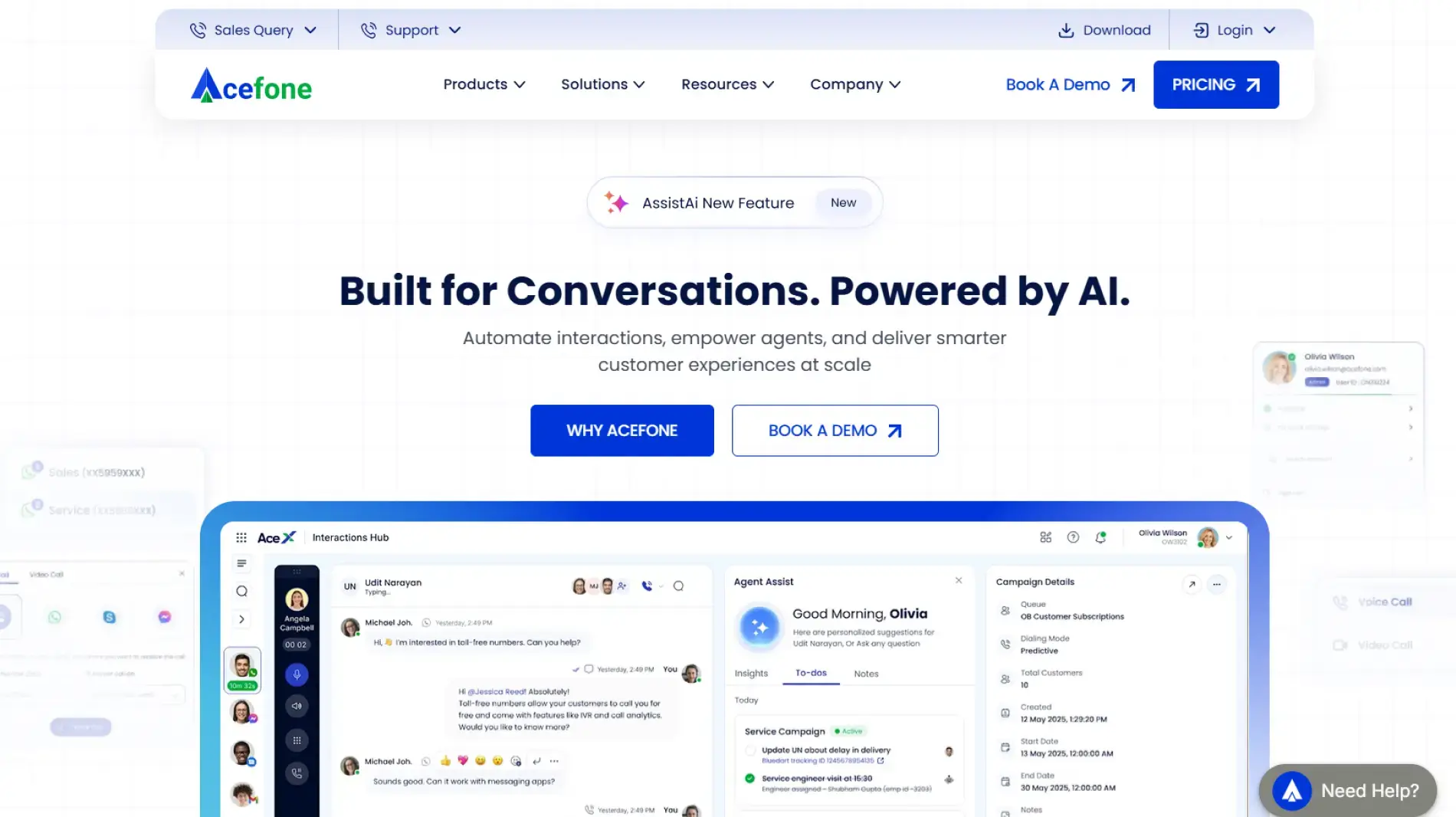
Acefone is a cloud communications provider that offers tools like VoIP, IVR, Call Recording, and CRM integrations for businesses to enable remote work, helping automate interactions, empower agents, and deliver smarter customer experiences.
Key features:
- Custom Call Flows: Helps businesses to design the complete structure of a phone call, like choosing an agent or IVR, from the moment the call starts and until it ends.
- Whatsapp Business Calling: Allows agents to make and receive calls through whatsapp API by integrating whatsapp voice calling into their unified communication system.
- Auto Dialer: Dials numbers automatically from a list and connects the answered call to agents, reducing idle time and enhancing efficiency.
- Blended Call Handling: Allows agents to manage both inbound support calls and outbound sales and followup calls from a single interface.
- Dynamic Scripting: Provides agents with scripts about specific lead information, which allows personalized conversations during live calls.
- Click-to-call: Helps agents initiate an instant and automated voice call with a single click from a browser, website widget, or CRM.
Best for:
Small to mid-sized businesses looking for a flexible cloud communication solution without heavy investment in complex hardware or infrastructure.
Its especially suitable for remote or dispersed teams that need a scalable and omnichannel communication accessible from any internet-enabled device.
Pricing and Plans:
Acefone utilizes a usage-based pricing strategy that relies on flexibility.
Pros:
- Eliminates the need for multiple tools by combining voice calls, whatsapp messaging, video conferencing and campaign tools in a single unified platform
- Ideal for remote and hybrid work environments, helping teams operate anywhere through softphone apps and cloud access
- Improves scalability for growing teams by allowing businesses to scale users, calls, and operations without infrastructure changes
- CRM integrations like Zoho, Salesforce, and Hubspot, enhances customer experience with personalized interactions and eliminates manual switching by syncing customer data with telephone system
Cons:
- Add-ons and additional features can increase costs, which requires careful monitoring
- For some beginners and non-technical teams, user interface may not be very intuitive
- Not suitable for very small teams or freelancers as there is a minimum number of users criteria
G2 Rating: 4.8/5
CallHippo
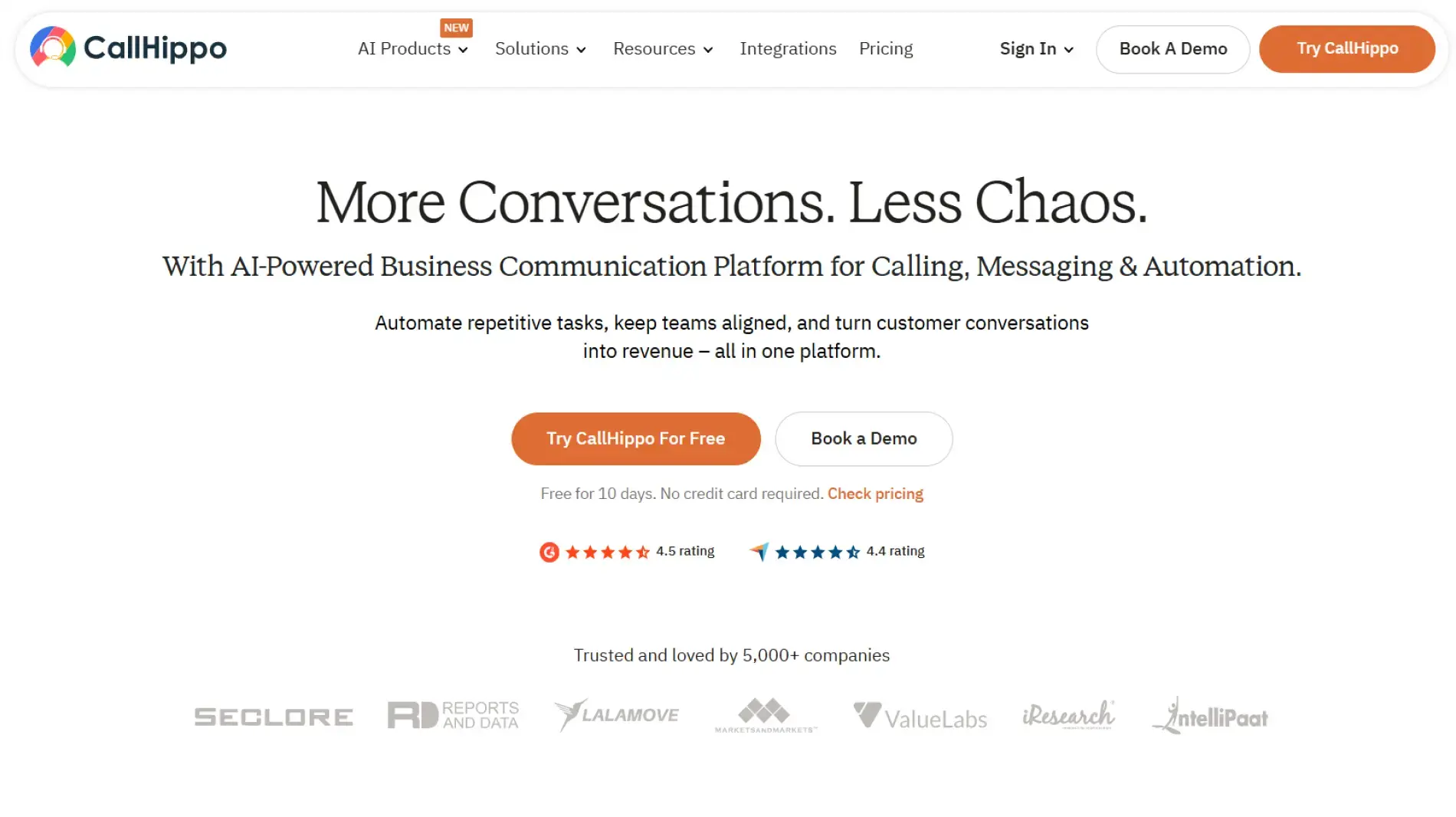
CallHippo is a cloud-based virtual phone system and a VoIP solution primarily used by sales and support teams to manage inbound and outbound calls globally. It helps companies improve remote team productivity and enhance customer engagement while keeping the costs low.
Key features:
- Auto Rotate Number: Displays different number for each call by changing automatically from the CallHippo dialer. This prevents agents from being marked as spam, increasing credibility
- Gamification: Includes game-like elements such as points, batches, and leaderboards in the customer support dashboard to boost agent engagement and performance
- Answering Machine Detection: Helps distinguish between live leads and answering machines like voicemails, increasing productivity and the probability for successful conversations
- Global Connect: Allows users to identify the right time, day, and zone and effortlessly connect with the clients and teams all over the world, improving customer relationships.
- Sticky Agent: A routing method that connects the returning customers to the same agent with whom they have previously spoken. It ensures continuity by directing the customers to specific agents
- Smart Switch: Improves call quality by allowing users to automatically switch between telephony providers. It helps businesses address connectivity issues by reducing drop calls and agent downtime
Best for:
Startups, small-to-medium businesses, and remote teams looking for an easy-to-deploy VoIP solution.
Particularly effective for sales-driven teams needing international numbers and advanced call analytics to connect with a global audience, support remote teams, and improve productivity.
Pricing and Plans:
CallHippo uses a per user, subscription-based pricing model
Pros:
- Offers virtual numbers for more than 150 countries globally, allowing effortless expansion
- Suitable for fast moving teams, due to its easy setup and minimal technical effort
- Advanced call tracking and automation features improve outbound efficiency
- CRM integrations like Hubspot, Salesforce, and Zendesk enhance productivity and simplifies workflows
Cons:
- Users have to purchase higher price plans to access advanced features
- Due to limited customization, it may not be suitable for highly tailored workflows
- Fewer third party integrations compared to its competitors
G2 Rating: 4.5/5
Tired of using CallHippo?
See why CallHippo is unsuitable for managing Your business communication and why you need a CallHippo Alternative.
Ozonetel
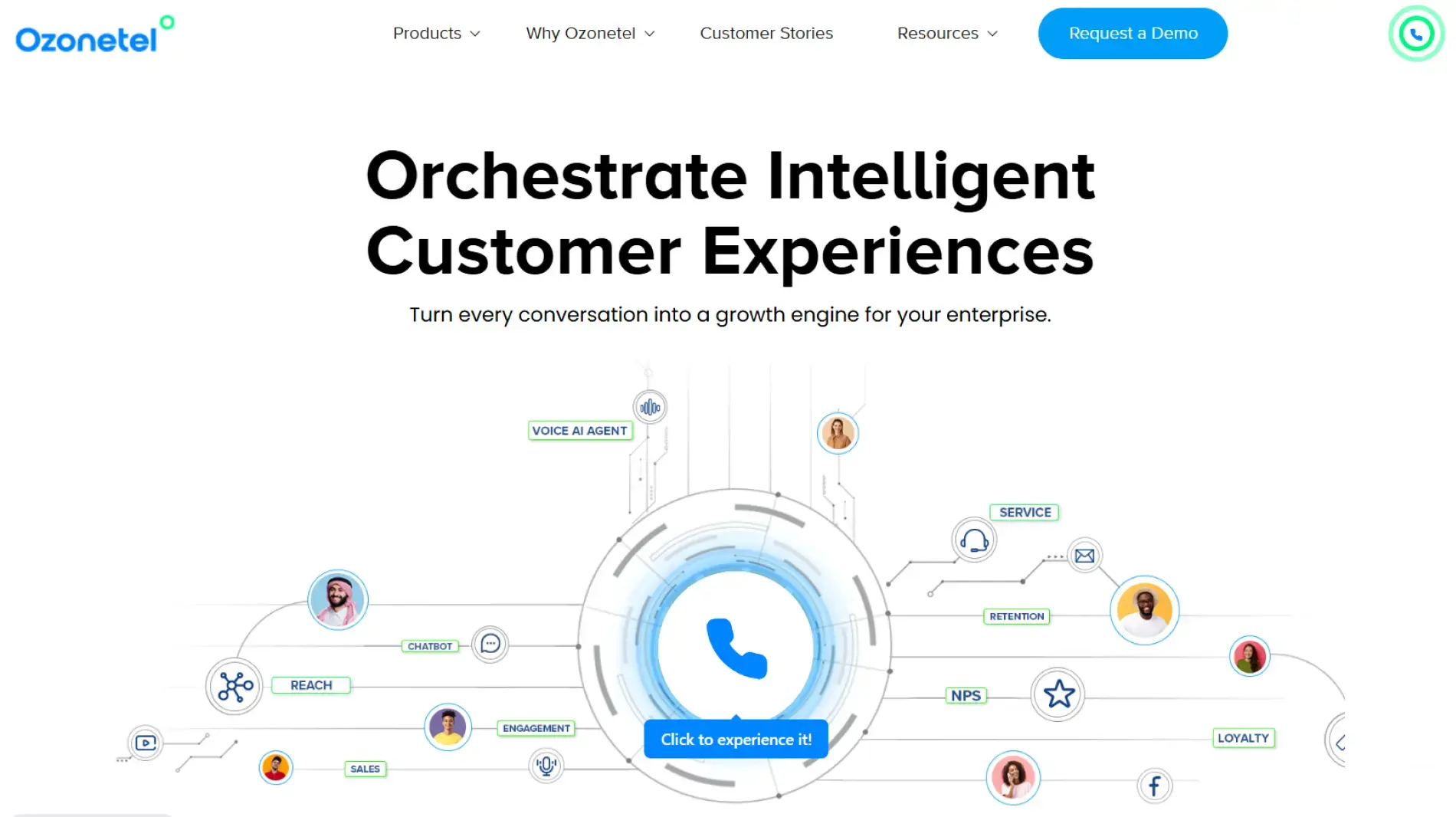
Ozonetel is a leading cloud-based customer experience platform for contact centers. Through its CCaaS (Contact Center as a Service) platform, it integrates voice, SMS, whatsapp and social media channels, helping businesses manage customer interactions through a single unified dashboard.
Key Features:
- Offline Agents: Allows agents to handle inbound or outbound calls through mobile or other devices without logging in to a desktop
- Self-service IVR: An automated phone system that solves customer queries through voice commands and keypad inputs without any agent assistance
- Priority Routing: Enables businesses to prioritize inbound calls based on urgency, ensuring important clients are connected to agents faster
- Consolidated desktop: Agents can view customer details and add notes in the same window where they receive calls. This eliminates the need to toggle between applications and increases productivity
- Radio Integrations: Allows radio stations and advertisers to run interactive marketing campaigns. It allows customers to participate in contests or receive information when they give a missed call
Best for:
Mid to large organizations looking to combine voice, whatsapp, and other communication channels into a single platform.
Ideal for startups and growing businesses where customer support teams need flexible deployment of inbound and outbound campaigns.
Pricing and plans:
Ozonetel uses a tiered, subscription-based model based on customization and flexibility for businesses of different sizes.
Pros:
- Highly intuitive user interface and simple onboarding allows teams to start immediately without heavy technical effort
- Effectively covers both inbound and outbound operations by providing core features like IVR, Call routing, Analytics and AI tools
- Allows better workflow efficiency by supporting major integrations like Salesforce, Zoho, and Hubspot
- Complete cloud-based setup allows businesses to add agents, channels or campaigns without major infrastructure changes
Cons:
- Since it is completely cloud-based, poor network conditions can affect call quality and latency
- Limited global positioning with more focus on Indian and Asian markets, which may affect companies with global communication needs
- Businesses should contact sales for price quotes, as pricing is not transparent
G2 Rating: 4.6/5
FreJun
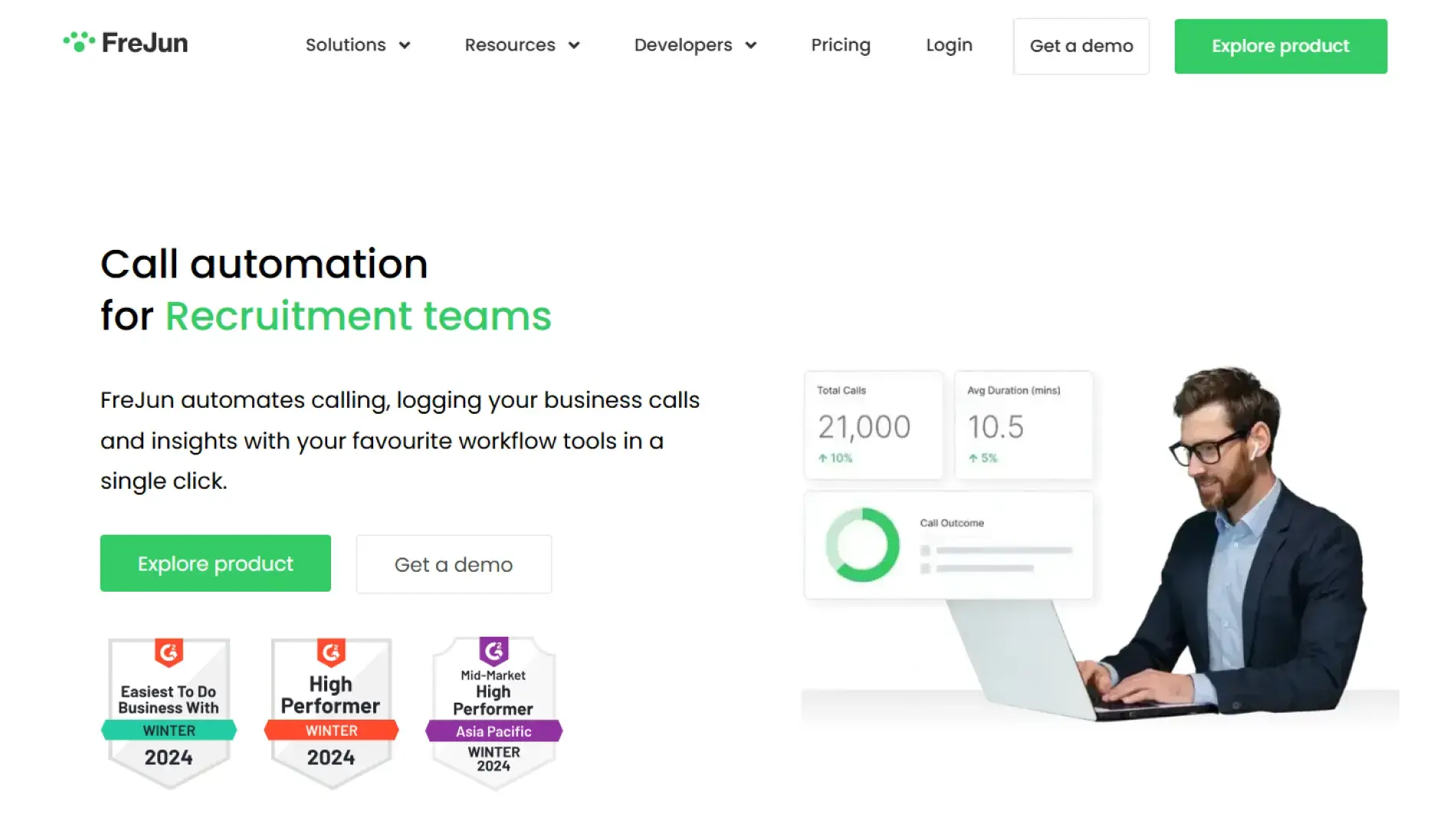
Frejun is an AI-powered cloud telephony and call automation platform that helps businesses manage and record inbound and outbound calls using virtual numbers. It simplifies communication by providing integrations and advanced analytics for managing calls and enhances the productivity of business teams.
Key Features:
- Virtual Number: Provides internet-based, cloud hosted phone numbers that helps remote teams manage calls without SIM cards or hardware.
- Call Transcription: It is an AI-powered automation feature that converts voice conversations into text in real-time. It helps sales and support teams to gain insights about a customer call.
- CRM/ATS Integration: Connects directly with Application Tracking Systems (ATS) and CRM tools to automate call recording and analytics, eliminating manual data entry.
- Voice Broadcast: Helps businesses send pre-recorded voice messages to hundreds of people with just a single click.
- AI Insights: Analyzes call conversations and provides real time response using automatic transcription, call summaries, and sentiment analysis. It helps businesses improve sales performance and enhance customer satisfaction.
- Reports & Analytics: Helps businesses monitor KPIs like First Call Resolution (FCR), and Average Handle Time (AHT), through actionable insights of call data, agent performance, and communication trends.
Best For:
Sales, recruitment, and customer success teams require a reliable, cost-effective, and fully integrated VoIP solution to handle a large number of calls.
Especially suitable for small to medium sized businesses that want to simplify workflows and convert conversations into actionable insights.
Pricing and plans:
Pros:
- It supports remote teams and hybrid work environments well due to its cloud-based communication method
- Teams can handle interactions more efficiently through an organized approach with features like click-to-call and call tracking
- Analysis of call conversations is simplified through features like call transcription, summaries, and insights
- Simple user interface and fast onboarding makes it accessible for growing teams
Cons:
- Not suitable for complex call center operations or large-scale inbound support
- Focuses more on calling and AI insights, with limited support for broader omnichannel communication
- May take time for some teams to adapt and fully leverage advanced features
G2 Rating: 4.9/5
What makes TeleCMI stand out:
- With enterprise-level features like AI-powered voice agents, Auto dialing, and advanced call management suite, it provides a balanced solution for teams to manage both inbound and outbound calls.
- TeleCMI is the most cost-effective option in this list covering top features, at a starting price of Rs. 734 per month.
- It provides deeper integration tools (170+) and a broader communication ecosystem compared to its competitors.
- Its overall combination of affordability, scalability, and in-depth features makes it a strong contender for companies approaching growing businesses and remote teams.
Conclusion:
Choosing the right VoIP solution is more than just making calls; it's about keeping your teams connected, your customers heard, and your workflow steady, regardless of the location. As remote and hybrid work environments become the future, businesses need smarter platforms to stay competitive and keep communication consistent.
By adopting platforms like TeleCMI, Exotel, or CallHippo, functions like calling, messaging, and monitoring can be managed through a single, unified platform, reducing manual workload. However, the best fit ultimately depends on your team size, budget, and the level of flexibility needed for your work.
Investing in the right VoIP system isn't just a technical decision, but a strategic business move that directly impacts how your team connects, collaborates, and performs in a modern work environment. Evaluate your priorities, utilize the available trials, and choose a platform that not only meets your needs today but aligns with your goals tomorrow.
Upgrade Your Business Communication for Remote & Hybrid Success

Trusted by 2500+ Businesses
Virtual Numbers in 150+ Countries
AI Call Automation
Affordable Plans
Frequently asked questions (FAQ)
Vignesh N

With deep expertise in cloud telecommunications, I help readers explore the latest trends in VoIP and modern business communication. At TeleCMI, I focus on educating businesses with clear, practical insights, making complex telecom concepts easy to understand. I’m passionate about helping organizations improve efficiency, enhance customer engagement, and adopt smarter communication strategies.