How to start a virtual call center business in 2026?

7 mins read

Posted on May 23, 2024

Saravana Kumar
SEO


Saravana Kumar
SEO






The expectations of customers are increasing at a rate that is much higher than most support teams can manage. Modern consumers need immediate, one-on-one service across channels right now, and they want it their way, not yours.
However, a lot of businesses are failing to keep up, trapped in legacy workflows or isolated tools that restrict their capacity to react rapidly and reliably.
As per Salesforce, 73% of customers wanted to receive a higher quality of service compared to the previous year.
Under the pressure, support leaders are reconsidering how their teams work and where. As 87 percent of organizations adopt the hybrid and remote model, the virtual call center has become smarter, scalable, and more resilient than its static and legacy counterparts.
This guide will explain all you need to know to develop and scale a virtual call center in 2026, including tools, hiring, and performance optimization, among others.

Key Takeaways
 Technology Integration is Critical: The ability of cloud software, VoIP systems, and CRM integrations to work together is the key to your success.
- Remote Agent Management Requires Structure: Implement transparent onboarding, performance tracking, and assistance systems.
- Design for Scalability from Day One: Construct infrastructure that is flexible enough to allow growth and seasonal fluctuations
What is a Virtual Call Center?
A virtual call center is a cloud-based customer service operation that enables agents to work remotely from any place with an internet connection. It is based on software and VoIP technology and operates all the communication workflows without a centralized office and physical infrastructure.
The agents use laptops, smartphones, or tablets to access the platform and communicate with the customers through various channels: voice, email, live chat, WhatsApp, or even video conferencing.
The virtual call centers retain the complete functionality of the traditional setup and provide enhanced flexibility, reduced operational expenses, scalability, and access to a global talent pool.
How Does a Virtual Call Center Work?
A virtual call center is made possible through a stack of integrated technologies:
- Cloud-Based Call Center Software: Hosts all activities remotely, gives real-time access to call tools, dashboards, and analytics.
- Voice over Internet Protocol (VoIP): Sends the calls through the internet, which does not require any landlines, and allows the communication to be of high quality through digital devices.
- CRM Integration: Allows the agents to access customer data and history of interactions in real time, and provide faster and more personalized service.
- Call Routing and IVR: Smart systems route the calls to the correct agents depending on skills, intent, or language. IVR phone system gives the customers the option to do a self-guided navigation on frequently asked questions.
How to Set Up a Virtual Call Center?
1. Choosing the Right Legal Structure for Your Call Center
Beyond tools and staffing, launching a virtual call center also involves setting up the business itself. As client work begins and revenue comes in, many founders look to formalize operations with a legal structure that supports growth and limits personal risk.
An LLC is a common choice for call center businesses because it separates personal assets from the company while offering flexibility as operations scale. Location also plays a role in how the business is set up.
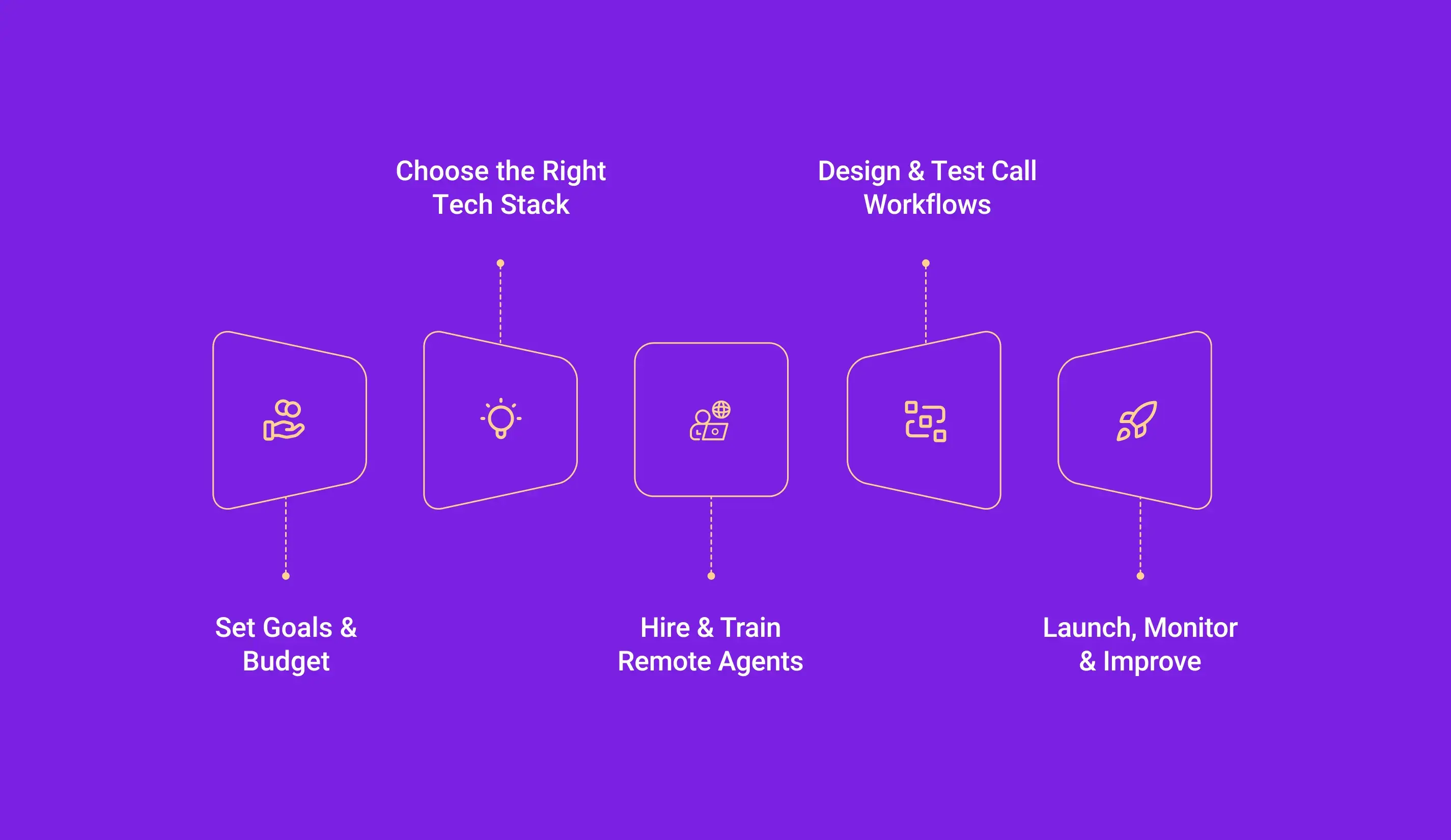
2. Define Your Requirements
- Identify the type: inbound, outbound, or blended.
For example, an inbound call center is ideal for handling support queries and incoming leads, while an outbound call center works best for cold calling, appointment setting, or follow-up campaigns
3. Plan Your Budget
- Factor in platform costs, agent salaries, software licenses, training, and IT support.
- Although virtual setups are 60-70 percent cheaper to start with, the ability to forecast in detail is important to scale sustainably.
4. Choose the Right Technology
- Compare the platforms in terms of reliability, scalability, features (IVR, ACD, call recording ), ease of use, integrations, and 24/7 support.
- Ensure compliance with industry standards like ISO, PCI DSS, or GDPR.
5. Hire and Train Remote Agents
- Focus on candidates with strong communication skills and self-discipline.
- Implement virtual onboarding solutions and offer training on systems, CX best practices, and data privacy by role.
- Encourage continuous learning through performance feedback and regular coaching.
6. Create Call Scripts and Escalation Paths
- Standardize common workflows but allow agents to personalize.
- Develop clear hand-off protocols and escalation hierarchies.
7. Test Call Flows and Systems
- Validate IVR service paths, CRM syncing, and routing logic with test users.
- Conduct pre-launch dry runs with small agent groups.
8. Launch Operations
- Start with a soft launch. Monitor traffic and response quality.
- Gradually ramp up based on performance indicators.
9. Monitor and Optimize
- Use dashboards to track metrics: AHT, CSAT, FCR, agent utilization.
- Collect customer feedback. Regularly review call recordings.
- Make iterative improvements to workflows and training.

What surveys say?
According to a Deloitte survey, 81% of companies plan to adopt or have already adopted cloud-based contact center technologies by 2025, supporting remote-agent models
What Are The Benefits Of Starting A Virtual Call Center?
1. Cost Savings
- No office rent, maintenance, or hardware investments.
- Reduced IT overhead and faster implementation timelines.
According to the Deloitte Global Outsourcing Survey, there is a 35% average cost saving within the initial year of using virtual contact centers.
2. Boosted Agent Productivity
- Agents work in personalized environments, reducing stress and improving focus.
- Fewer workplace distractions and no commuting time.
3. Flexibility & Scalability
- Add or remove agents as needed without logistical complexity.
- Serve new markets without geographic limitations.
4. 24/7 Global Coverage
- Distribute agents across time zones to offer uninterrupted support.
- Meet international customer needs without extending local shifts.
5. Improved CX Outcomes
- Smarter routing, CRM context, and omnichannel options lead to faster resolutions.
According to Forbes, customer satisfaction scores improved by 23% in just 6 months after adopting a virtual model.
Conclusion
Having a virtual call center in 2026 is not just about a digital transformation, but rather a step towards sustainable, scalable, and customer-oriented operations. With the evolution of cloud communications and the new trend of remote work, companies need to move past the constraints of physical infrastructure.
Organizations can achieve high levels of consistency in service delivery, minimize operational overheads, and provide better service than customers anticipate by selecting the right platform. TeleCMI is a leading virtual call center solution provider, and offers personalized solution to enable businesses to attain a robust remote culture, and attain the desired goals.
Frequently asked questions (FAQ)
Start Your Virtual Call Center with TeleCMI Today!

Effortless Cloud Integration
Cost-Effective and Scalable
Powerful Communication Tools
Saravana Kumar

I’m passionate about exploring and sharing insights on modern cloud communication technologies. At TeleCMI, I focus on helping readers understand the evolving world of cloud telephony and IVR solutions in a simple yet in-depth way. My goal is to deliver genuine value by turning complex telecom concepts into clear, actionable knowledge that builds trust and drives innovation.