What Is an IVR Contact Center? Complete Business Guide 2026

7 mins read

Posted on Oct 25, 2025

Vignesh N
SEO


Vignesh N
SEO






Let's imagine you're running a successful business with thousands of employees working in multiple departments across the globe. A customer facing a payment issue tries to reach your support. With various escalation and self-service alternatives, the customer can finally get in touch with your support team and get the query solved.
Is this approach nurturing a good client-agent relationship and improving the client experience?
No right.
The alternate solution? Cloud contact center software featuring advanced Interactive Voice Response (IVR).
An IVR cloud contact center allows the client to connect with the right agent, team, or location through automation, intelligence, and self-service options like keypad or voice inputs. This enhances customer service quality, reduces delays or confusion, and supports operations.
In this blog, we'll explore IVR contact centers, including how they work, the business benefits they provide, what to look for in a product, and how to choose the correct solution for your organization's requirements.

Overview:
As business expands its origin, the customer expectations evolve to a more personalized, quick, and accurate response, which results in the requirement of a smarter, efficient, and intelligent system for the handling of inbound and outbound interactions. This is where an IVR Contact Center (Interactive Voice Response Contact Center) comes into play. It utilizes automation and intelligence to handle a large volume of calls to the right department and offers 24/7 self-service options while improving operational efficiency, reducing costs, and enhancing customer satisfaction.
What Is an IVR Contact Center?
An IVR, also known as Interactive Voice Response, is an automated phone system that allows callers to reach the right agent via keypad inputs, query line, or voice response to the pre-recorded audio/greetings. It reduces long wait times, misrouting, and frustration, resulting in improved customer experience, agent productivity, and overall business performance.
How Does it Work?
- Caller Initiates Contact: The client calls your business number.
- Automated Greeting: The IVR welcomes them with a pre-recorded or AI-sounding greeting.
- Input Collection: Callers enter data through key presses or voice.
- Call Routing: Based on the caller's input, IVR routes the caller to the most suitable agent or department.
- Optional Self-Service: Callers can solve queries like checking account balances, scheduling appointments, or tracking shipments independently without agent support.
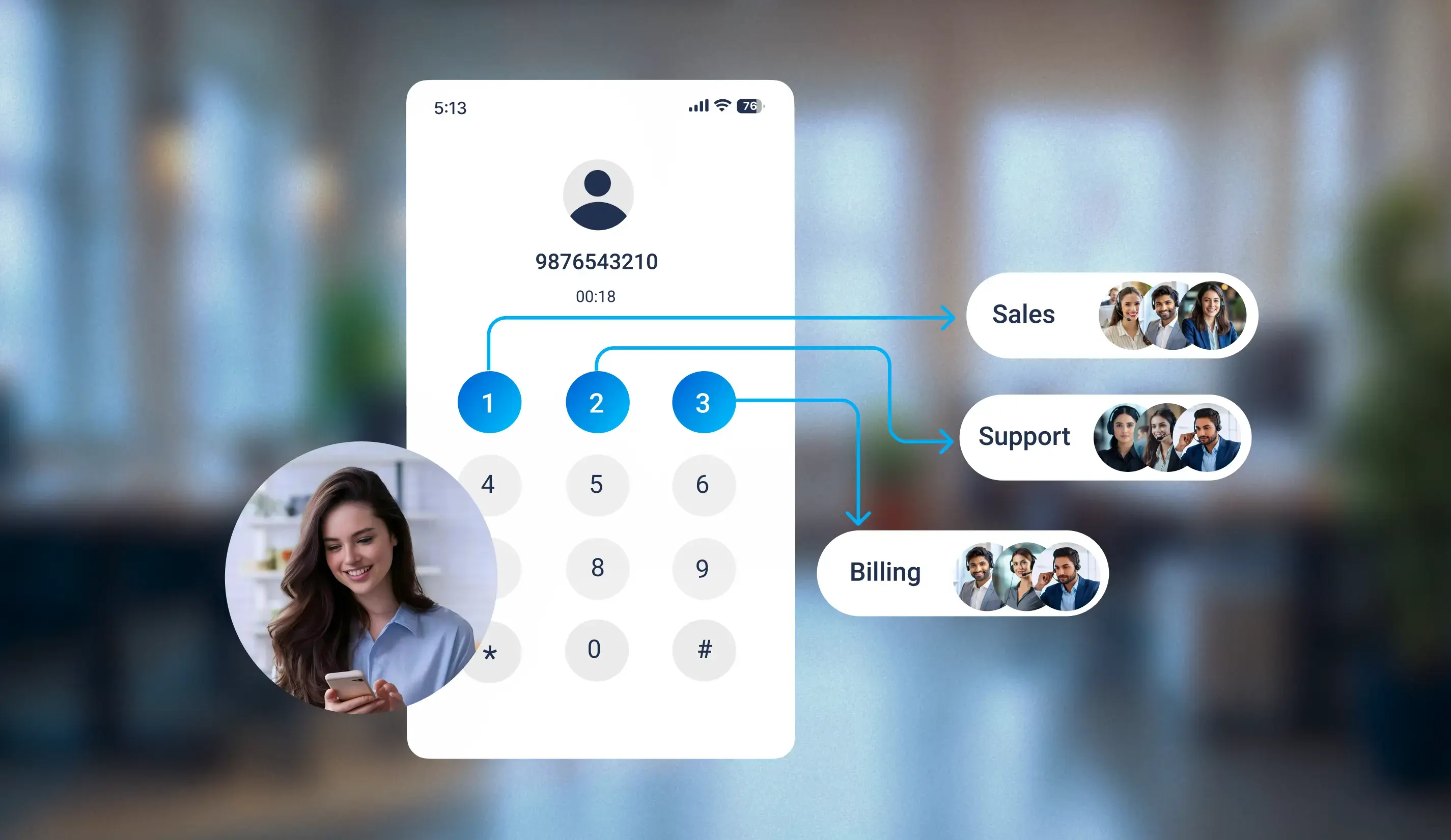
Example of IVR:
Welcome to XYZ,
Press 1 for Sales, Press 2 for Support, or Press 3 for Billing.
Connecting Sales.
The live agent interaction starts here.
Why Your Business Needs an IVR Contact Center?
An IVR contact center not only optimizes business but also makes customers feel heard, valued, and cared for, and your agents are allowed to focus on high-impact activities. Having an IVR contact center has numerous benefits that have a direct impact on your bottom line and customer satisfaction.
- Improve Customer Experience: A well-designed IVR allows customers to quickly find answers or connect with the right agent without waiting in long queues.
- Cut Operational Costs: By automating regular questions, your business can save on having a large support staff performing repetitive work.
- Boost Agent Efficiency: Increase agent performance, reducing call transfers, increasing First Call Resolution (FCR) and enhance overall business productivity by Intelligently route calls to the right agent.
- Scalability: As your business expands, an IVR system can accommodate increased call volumes, new service lines, and more languages.
- Consistency: Automated responses provide a consistent experience for every customer interaction, regardless of the time of day or the agent handling the conversation.
Key Features to Look for in a Contact Center IVR
Selecting the right IVR Contact Center software requires a clear understanding of the capabilities that drive efficiency and customer satisfaction. Here are the key features to look for when evaluating a Contact Center IVR solution:
Customizable Call Flows and Menus:
Every business has unique customer service flows. Your IVR should allow you to build and modify call flows according to your organizational setup and communication needs. Look for platforms that offer drag-and-drop visual editors to build and adjust menu options, greetings, and call routes without technical expertise.
Speech Recognition and Natural Language Processing (NLP):
Next-generation IVR systems go beyond "Press 1" options. With speech recognition and Natural Language Processing (NLP), callers can speak naturally. For example, saying "Check my order status" or "Talk to billing." This AI-driven capability enhances accessibility, shortens navigation time, and creates a more conversational, human-like experience for customers.
CRM and Helpdesk Integration:
The robust IVR solution should interface easily with your current CRM (Customer Relationship Management) and helpdesk applications. Integration allows your agents to view customer history, preferences, and past interactions the instant a call is connected, which means personalized and effective service.
Multilingual Support for Global and Regional Customers:
A multilingual IVR system lets you serve customers in their preferred language, making interactions smoother and more inclusive. This option is especially critical for global businesses or regionally distributed audiences, where language access directly translates to customer satisfaction and loyalty.
Advanced Call Routing Options:
Optimized call routing is the foundation of a top-performing IVR Contact Center. Seek advanced routing features that route calls on the basis of:
- Agent skill set (Skills-based routing)
- Time of day (Time-based routing)
- Customer location (Geo-routing)
- Priority level or customer value
These allow each customer to be directed to the most suitable agent in the shortest time possible, reducing the queue time and improving the first-call resolution rate.
How to Choose the Right IVR Contact Center for Your Business
Choosing the right IVR contact center solution is a strategic business decision that has the potential to enhance customer experience, agent performance, and overall operations efficiency. Below is a step-by-step guide to assist you in making the correct choice:
Assess Your Business Needs and Call Volume: Start by analyzing your organization's communication patterns, including average call volumes, peak hours, and types of customer interactions. Understanding these metrics will enable you to assess the extent of automation, routing logic, and infrastructure your company will require.
Understand Your Customer Demographics and Languages: Consider key factors such as geographical regions, languages spoken, and customer behavior patterns to evaluate multilingual support and localized voice prompts for a personalized experience.
Check Integration Capabilities with Existing Systems: The effectiveness of an IVR solution also relies on how seamlessly it can integrate with your current tools, whether CRM systems, helpdesk, or marketing automation platforms.
Evaluate Vendor Support and SLAs: Even the most sophisticated IVR systems will fail without good vendor support. Before committing, review the provider's Service Level Agreements (SLAs) and support models.
Check for:
- 24/7 customer support availability
- Implementation and onboarding assistance
- Technical documentation and training resources
- Guaranteed uptime and performance benchmarks
Review Pricing Models and Total Cost of Ownership: Pricing plans can differ considerably between IVR vendors, ranging from subscription plans to pay-per-minute usage models. Assess what best fits your call patterns and financial goals.
Scalability and Future-Proof: The ideal platform must be compatible with future enhancements, such as AI-driven analytics, chatbot support, or omnichannel support. Cloud-based IVR service are flexible and easily scalable, positioning them to be the preferred choice for companies with changing operational requirements or growing customer bases.
Request Demos and Trials to Test Usability: Make sure not to finalise any purchase without a hands-on evaluation. Request a demo or trial period to experience the platform's usability, configuration options, and reporting tools.
Conclusion
If your team handles a high volume of calls daily, implementing an IVR Contact Center can make a significant difference. It streamlines call routing, reduces wait times, and ensures customers reach the right department quickly. With TeleCMI’s IVR Contact Center Solution, you can customize intelligent call flows tailored to your business needs whether for support, billing, or new inquiries our contact center solution improves efficiency and customer satisfaction simultaneously.
Ready to Transform Your Call Handling?

Automate Routine Queries & Reduce Wait Times
Personalize Every Interaction with Smart Routing
Scale Effortlessly as Your Business Grows
Frequently asked questions (FAQ)
Vignesh N

With deep expertise in cloud telecommunications, I help readers explore the latest trends in VoIP and modern business communication. At TeleCMI, I focus on educating businesses with clear, practical insights, making complex telecom concepts easy to understand. I’m passionate about helping organizations improve efficiency, enhance customer engagement, and adopt smarter communication strategies.


 for your Call Center and Enhance Efficiency_.webp)