How to Handle High Call Volumes During Peak Seasons Without Hiring More Staff

7 mins read

Posted on Dec 05, 2025


Saravana Kumar
SEO


Saravana Kumar
SEO





The busiest month of the year should lift a business; often, it exposes its weakness. During peak hours, admission periods, discount campaigns, and festive periods, customers call to check details, but instead, they hear a busy tone and no callbacks. They often lose patience and decide to look elsewhere, and you have no idea how many customers or leads you lost.
Hiring or outsourcing a team doesn't make a big difference. Hiring or outsourcing a team doesn't make a big difference. Instead, you can invest in a cloud contact center embedded with AI techniques, IVR, real-time analytics, and integration to handle conversations, optimize resource allocation, and grow your revenue during peak seasons. This blog guides you on how automation and intelligence help you manage high-volume calls without missing critical customer interactions.

Key Takeaways
 High call volume becomes a problem only when your system cannot scale with demand.
- Hiring more people does not fix routing confusion, long wait times, or missed calls, but a right system with self-service options, IVR, and regional language call routing does.
- Call queues and callback systems prevent callers from dropping off during busy hours.
- Real-time reports provide clarity on missed opportunities and team performance.
- A structured call system allows small teams to handle peak demand efficiently.
Why High Call Volume Becomes a Problem
High call volume places pressure on every part of a business. During peak seasons, even small delays create ripple effects. Customers wait longer. Agents rush through conversations. Managers lose sight of performance. Revenue slips without warning. A strong call system functions like infrastructure. When designed correctly, it absorbs pressure without visible cracks. IVR service, call queues, and analytics work together to create a controlled flow rather than a flood of missed calls.
High-volume calls are not the real issue; the challenge begins when incoming calls rise faster than a team can respond. When this happens, customers wait longer, agents become overloaded, and even small delays can create a ripple effect across thousands of interactions—especially during peak seasons.
Here are the Top 5 related issues:
1. One agent can handle one call at a time
If all lines are busy during the peak hours, every new caller hears a busy tone or waits too long. Even a capable team cannot address multiple conversations simultaneously.
2. Lack of structured routing
Many businesses offer a single number for all services, whether it's sales, billing, or support, which leads to misrouting, slows call responses, increases handling time, and often leads to frustration.
3. Customers do not prefer waiting
When wait times exceed a limit, callers often hang up. Lengthy lines give the sense that the company lacks staff or is not ready.
4. No clear view of missed opportunities
Every unresolved question, unattended inquiry, or callback request may represent lost revenue. Without data, the business cannot understand the scale of the loss until the season ends.
5. Stress on employees during peak hours
Teams switch between calls, follow-ups, and manual updates. This overload leads to slower responses, inconsistent service, and low morale.

A study published by Harvard Business Review found that most callers begin to disconnect once wait time crosses 80 seconds. This drop-off happens quietly but directly impacts revenue, because the customers who hang up rarely return or complain—they simply move on.
Traditional Solution vs Smart Solution
A rise in call volume often prompts businesses to hire more staff. It appears practical, but it does not resolve the core limitations.
Solution 1: Strengthen Self-Service Option
Before customers dial in, offer other channels for resolving routine issues. It includes an FAQ page, a searchable knowledge base, technical documentation, a user manual, and video tutorials to address common and simple inquiries such as order tracking, business hours, refund policy, cancellations, and more.
Solution 2: Use IVR to Auto-Answer and Direct Calls
Interactive voice response (IVR) lets callers choose from a menu: "Press 1 for sales, 2 for support, 3 for billing," and so on. This simple routing ensures that calls reach the right department immediately.
Benefits:
- Incoming calls get answered instantly, even if agents are temporarily unavailable.
- Callers are directed to the right team, reducing misroutes and repeated transfers.
- Common requests can be resolved without any live voice interaction, saving agent effort.

Never Drop Calls
Transform peak-hour chaos into organised flow and ensure every customer reaches you, even when demand spikes.
Solution 3: Use Call Queue with Estimated Wait Time and Callback Option
Call queues and callback abandonment rates enhance customer satisfaction and relieve staff from managing hold calls.
- A callback option lets customers keep their spot in line without waiting on hold.
- When the number of calls surpasses the agents' capacity, a waiting line offering estimated wait times aids in setting expectations.
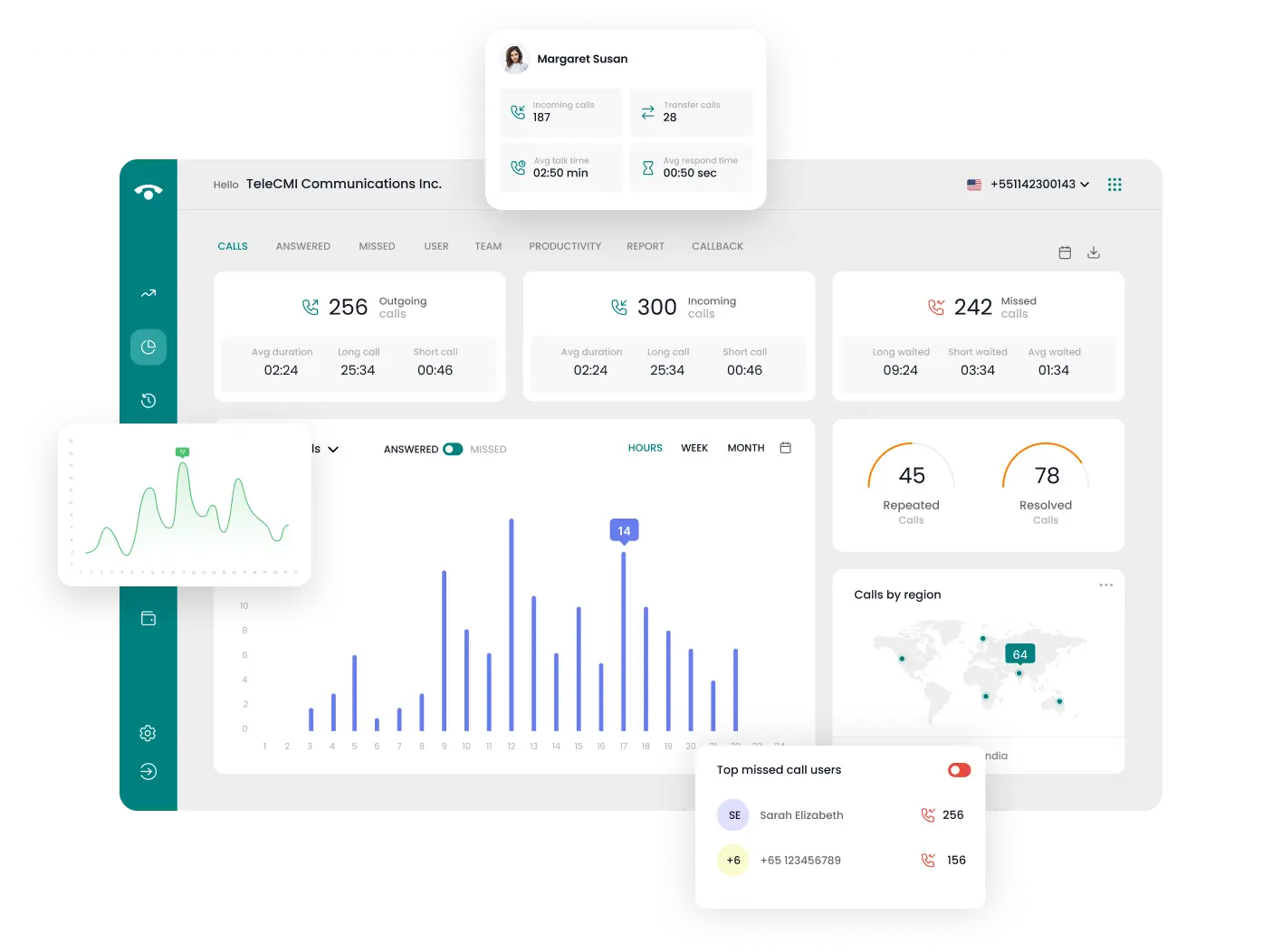
Solution 4: Real-Time Call Monitoring & Call Reports

Real-time analytics offer insights that enable you to understand what is effective and what is not. Using call analytics, you can monitor:
- Overall count of calls (received, unanswered, disconnected)
- Average wait times
- Call durations
- Agent performance metrics
These data help spot bottlenecks, peak calling hours, and common issues. With such visibility, you can plan, shift agents, adjust IVR options, or add FAQs.

McKinsey’s findings show that companies using data-driven methods to manage customer calls can improve performance by up to 30 percent. This reinforces how powerful real-time analytics can be when it comes to strengthening call operations.
Solution 5: Regional Language Routing
Clients frequently favor assistance in their language, particularly in India. Introducing language routing, such as Tamil, Hindi, Telugu, and Kannada, enables customers to select their preferred language via the IVR system, directing them to the most suitable agent. This minimizes miscommunication and enhances first-call resolution rates. Delivers an improved customer experience. It also prevents lost time caused by language mismatches that require transfers.
Expert Advice: The goal is not to answer more calls randomly. The goal is to direct the right calls to the right people at the right time. That clarity is what protects both service quality and revenue.
Checklist: What to Use Based on Your Business Stage
Different growth phases require different call-handling systems. This checklist offers a simple path based on your business stage:
1–5 employees
- A single business number to centralise all inquiries.
- A basic IVR to answer and guide callers automatically.
- Call forwarding to ensure no call is missed when one person is busy.
Growing team
- Department-wise call routing for faster resolution.
- Call recording for quality checks and training.
- Call analytics to monitor missed calls, volumes, and agent performance.
Pan-India audience
- Language-based routing for regional clarity.
- A structured IVR flow for different customer needs.
- Real-time reports to track performance across locations.
Hyundai Mobis Case Summary

Hyundai Mobis faced rising customer calls that often went unanswered due to limited tracking and inconsistent routing. After adopting TeleCMI's cloud telephony system, calls were routed correctly, recorded, and monitored through real-time analytics. This improved response quality, reduced missed calls, and strengthened customer experience without requiring additional staff.
Conclusion
High call volume is not a business growth challenge; it's a sign of healthy demand. But when calls go unanswered or are routed incorrectly, it costs secretly. Because customers don't complain, they just move.
Many businesses think that hiring more people during peak hours, festive times, or seasonal demands is a great choice. It's not; instead, you can implement a well-designed call system with self-service tools, IVR, call queues, analytics, and language routing in place. Even a small team can manage heavy call traffic without losing control.
With the right call-handling structure, businesses can serve more customers, retain confidence, and grow without increasing overhead.
Smarter Call Handling Starts Here
Let smart workflows absorb the call pressure so your team can focus on delivering a better experience.
Frequently asked questions (FAQ)
Saravana Kumar

I’m passionate about exploring and sharing insights on modern cloud communication technologies. At TeleCMI, I focus on helping readers understand the evolving world of cloud telephony and IVR solutions in a simple yet in-depth way. My goal is to deliver genuine value by turning complex telecom concepts into clear, actionable knowledge that builds trust and drives innovation.