How Post-Call Analytics Helps Improve Agent Performance and Customer Experience

14 mins read

Posted on Jul 13, 2026

Vignesh N
SEO


Vignesh N
SEO






Contact centers are having a real debate right now. Real-time AI coaching gets most of the attention, but it only works well once a team already knows what good and bad calls actually look like. That knowledge comes from post-call analytics.
For years, that knowledge stayed locked away the moment a rep hung up. Call quality depended on luck. A QA lead picks a few random recordings each week, scores them by hand, and hopes those calls represent everything happening across the floor. That works fine when there's no better option. But it leaves plenty of room for patterns to go unnoticed.
Post-call analytics closes that gap with AI and speech recognition that processes every call the moment it ends, turning raw conversations into searchable transcripts, sentiment trends, and topic tags. No sampling is needed, and no guessing which calls actually matter. Here is the complete guide on how post-call analytics helps Agent performance and customer experience

Key Takeaways
 Post-call analytics turns every conversation into assessable insight.
- Sentiment, resolution, silence, and keywords, all tracked automatically, on every call.
- Managers get a fast, clear way to spot the coaching moments that actually matter.
- Customers notice quicker follow-ups and smoother resolutions, even without ever hearing the word “analytics.”
- Real research backs this up: faster insight generation, lower costs, stronger CSAT.
What Is Post-Call Analytics?
Post-call analytics uses AI and natural language processing (NLP) to analyze conversations after a call ends. This allows businesses to analyze every interaction across different languages, tones, and contexts.
Here's how it works conceptually:
- AI listens to customer and agent interactions.
- Speech recognition converts conversations into text.
- Tone, intent, and emotion are interpreted by language models and sentiment engines.
- Dashboards visualize patterns that show risk, opportunity, and performance indicators.
- Insights flow into operations for coaching, product decisions, and proactive customer engagement.
It helps businesses identify trends, improve performance, and make better decisions using conversation data.
Why Post-Call Analytics Matters for Modern Contact Centers
We are seeing a massive shift in how support teams define a "good day." Forward-thinking brands are moving away from purely watching the clock—such as obsessing over minutes logged or total calls handled—and focusing heavily on genuine business outcomes. They want to see real resolution, positive customer sentiment, and authentic follow-through that actually solves the customer's problem.
This is why many organizations are investing in the best post-call analytics software for contact centers to turn every customer conversation into actionable insights that improve service quality and agent performance.
This is exactly where post-call tracking proves its worth. By pulling concrete data on everything from awkward dead silence and holding patterns to explicit keyword triggers like "refund" or "manager," you get a highly scannable snapshot of your floor's health in seconds.
The operational payoff lands straight in your metrics. For instance, Average Handle Time (AHT) naturally decreases because agents no longer have to spend hours typing tedious summaries by hand after every interaction. Furthermore, when your system automatically tags recurring issues, agents catch repeat-call patterns early, allowing them to solve complex problems on the very first try.
"According to research from McKinsey & Company, companies applying advanced analytics in their contact centers have reduced average handle time by up to 40 percent while also improving customer satisfaction and employee engagement."
What Metrics Does Post-Call Analytics Track?
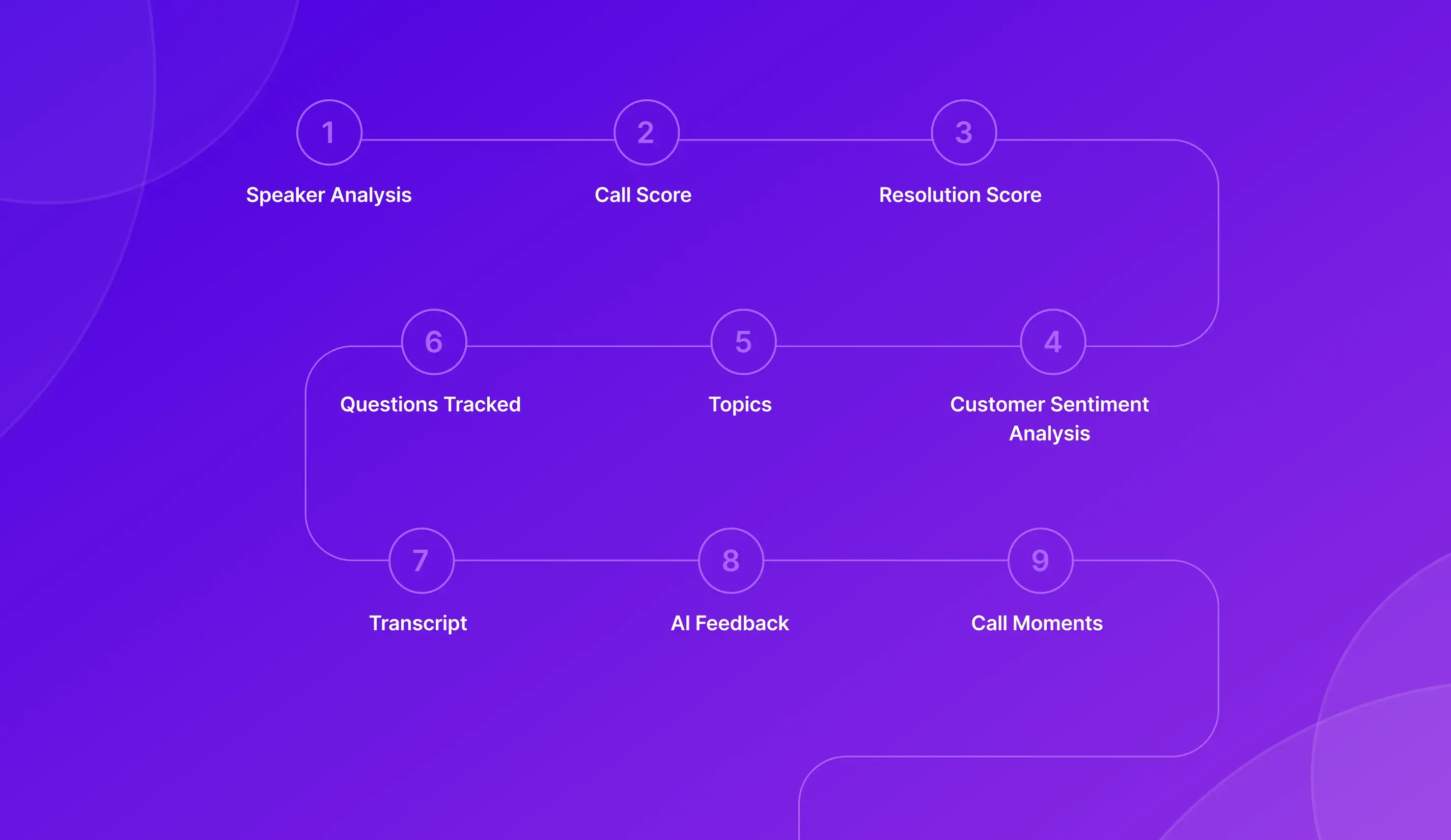
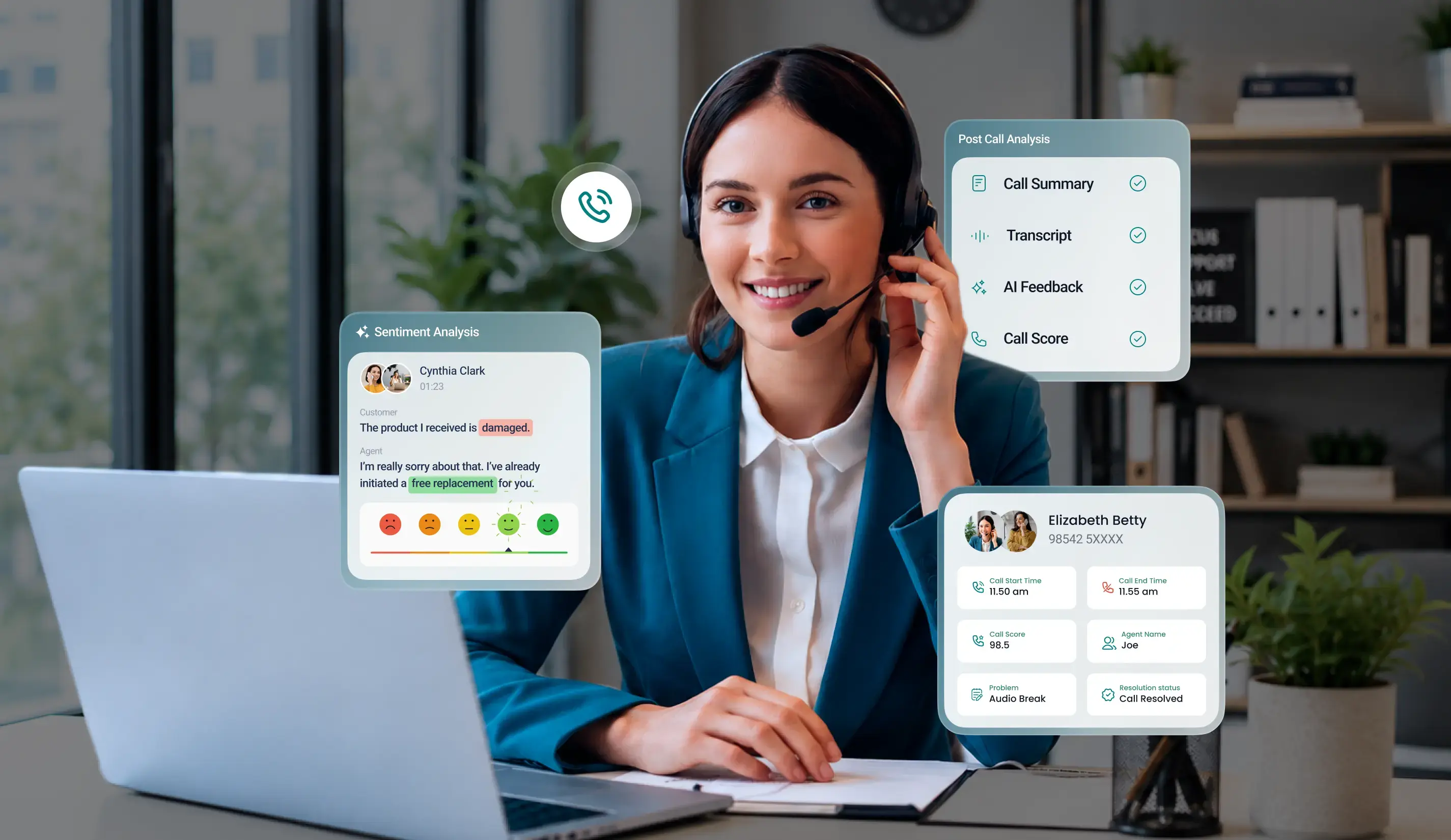
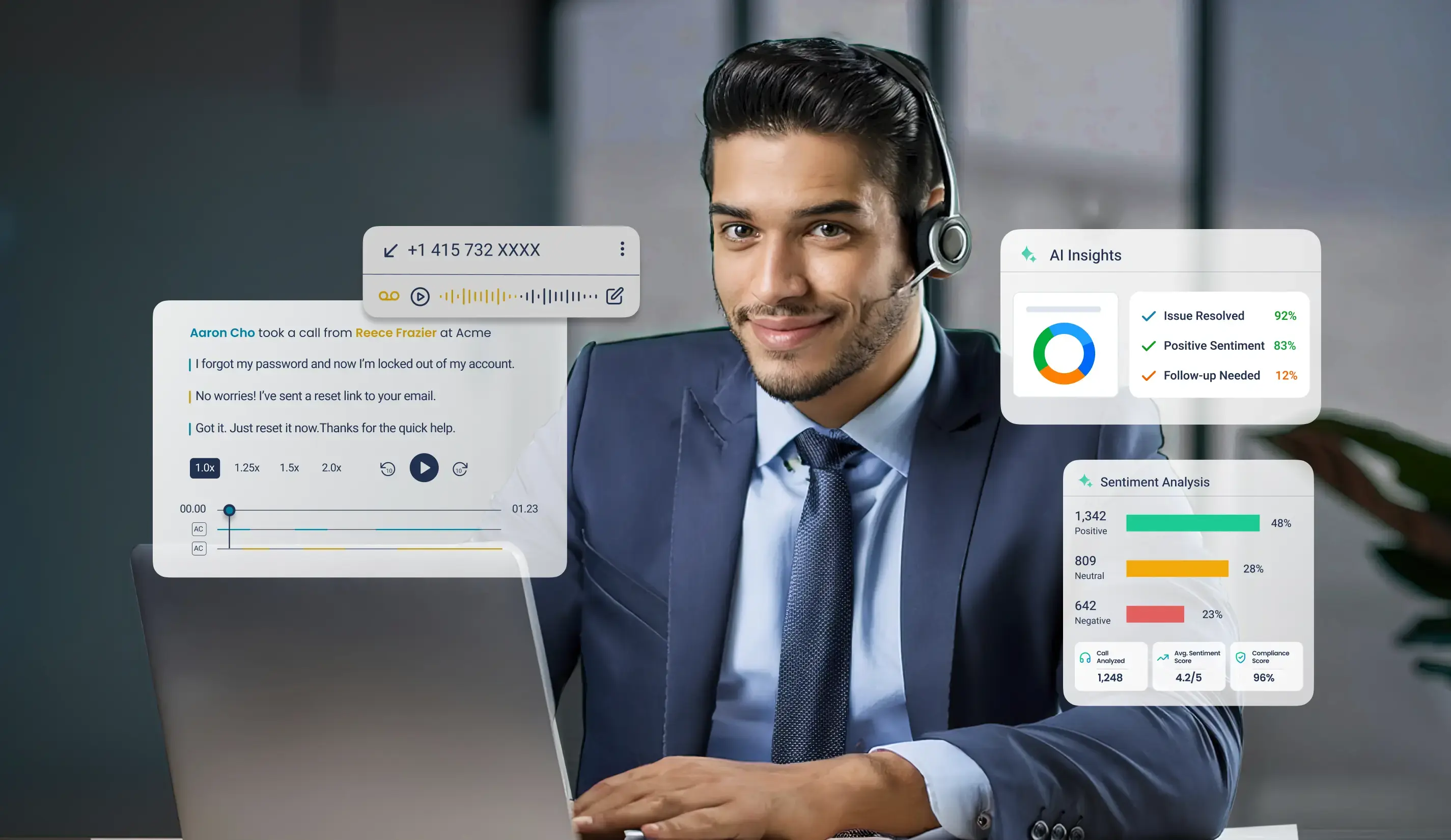
Every call, summed up at a glance. Agent, customer, duration, outcome, sentiment. Nothing to dig for.
- Speaker Analysis
Who talked, and how much. A quick read on whether the agent was actually listening or just dominating the conversation.
- Call Score
Actual performance against the audit template, not just how fast the call wrapped up.
- Resolution Score
Did the problem actually get solved, or is this customer calling back next week?
- Customer Sentiment Analysis
Did the customer leave happy, neutral, or frustrated? Tracked across the whole call, not just guessed at the end.
- Topics
What the call was actually about, tagged straight from the transcript. Billing, delivery, a product issue, whatever it was.
- Questions Tracked
How many relevant questions did the agent actually ask? A strong signal for whether they were diagnosing the issue or just guessing.
- Transcript
See exactly what was said, word for word, searchable and time-stamped.
- AI Feedback
The specific moment the agent could have done better. Not a vague score, an actual point in the call worth reviewing.
- Call Moments
The critical points in the conversation. Where the tone changed, where a challenge came in, and where it mattered most.
Improve Every Customer Conversation with AI-Powered Post-Call Analytics and Actionable Insights.
Start 14 Days Free TrialHow Does Post-Call Analytics Improve Agent Performance?
- Identifies Coaching Opportunities
Instead of a supervisor listening through hours of on-hold music to find one coachable moment, the system signals the exact timestamp that matters. Fifteen seconds where a customer’s tone changed sharply. A moment an agent handled a challenge with real grace.
Bring actual data into a one-on-one, instead of a supervisor’s fuzzy memory of a call from last Tuesday, and coaching turns into a strategy session instead of a critique.
- Reduces After-Call Work
Auto-generated summaries free agents from typing notes after every call. Across a full shift, that’s hours handed back to actual conversations.
- Improves Call Handling Skills
Agents who see their own real patterns tend to improve faster than agents relying on a supervisor’s memory. Data remembers the good calls too, not just the rough ones.
- Increases Agent Productivity
Less documentation, faster wrap-up, and more calls handled well without cutting corners to get there.
- Enhances First Call Resolution (FCR)
Spot which topics come back as repeat calls, and agents get sharper at solving the root issue the first time.
How Post-Call Analytics Improves Customer Experience
- Faster Issue Resolution
The next agent already has context, thanks to topic detection and auto call summaries. Customers reach a solution instead of having to repeat themselves from scratch.
- Highly Personalized Customer Engagements
An agent opening a call already knows the mood of recent conversations, which shapes the whole approach from the first line.
- Better Follow-Up Accuracy
The “Advance” flag automatically catches promised callbacks. What got promised on a call actually gets delivered.
- Improved Customer Satisfaction (CSAT)
When you resolve issues faster and make conversations feel effortless, your CSAT scores naturally climb. It is a direct, unbreakable connection that holds true across every industry benchmark.
- Consistent Service Quality
Customers expect the same standard of care whether they talk to a veteran agent or a brand-new hire. True quality means maintaining steady service levels across your entire workforce every single day, not just when your top performers happen to be on the clock.
"According to IBM, one telecom company that directly addressed customer complaints saw its CSAT scores jump to the top of the industry, cutting churn by 75 percent and nearly doubling revenue within three years."
Real-World Example: How Post-Call Analytics Helped Improve Contact Center Performance
Picture a standard support team, about 40 agents, managing deliveries for a growing retail brand.
Before Using Analytics
Quality checks leaned heavily on guesswork. A small weekly sample stood in for thousands of calls, and coaching relied on whatever a manager happened to catch along the way.
After Implementing Post-Call Analytics
The moment you turn on post-call tracking, hidden patterns surface almost instantly. Take a look at a real-world example: within the first seven days of deployment, one team noticed an awkward, recurring stretch of dead air every time an agent tried to look up an order status.
Instead of guessing what was wrong, leadership rolled out a fast, highly practical fix. They pulled live delivery tracking data directly into the agent’s primary dashboard view. The result? That frustrating dead silence vanished, handle times plummeted, and customer satisfaction scores climbed right alongside it.
This is the exact pattern we see whenever support floors make the shift. This technology is never about replacing a manager's human judgment or intuition. Instead, it acts as a compass—pointing that judgment toward the exact five seconds of a call that actually matter, rather than leaving them to hunt through hours of audio on a random guess.
Post-Call Analytics vs Traditional Call Reporting
Key Business Metrics Improved by Post-Call Analytics
- Average Handle Time (AHT): Improves when agents spend less time hunting for information mid-call and less time writing notes afterward.
- Boosting First Call Resolution (FCR): Instead of just patching over a customer's issue to get them off the phone, your team can catch repeat-call patterns early and fix the root problem right then and there.
- Lifting Customer Satisfaction (CSAT): Scores naturally climb when you resolve issues faster and make sure agents actually follow through on what they promised.
- Improving Net Promoter Score (NPS): When customer service is consistently great, it builds deep trust. That trust is what transforms standard customers into loyal fans who actively refer your brand to others.
- Maximizing Agent Productivity: Agents spend less time on tedious manual documentation and summary tasks, freeing them to focus entirely on helping the next person.
- Making Quality Assurance (QA) Matter: Your QA scores finally mean something because they are based on every single conversation across the floor, rather than a tiny, random sample of calls from the week.
- Driving Up Overall Resolution Rates: As the system flags recurring bottlenecks, leadership can roll out real process fixes rather than just talking about problems in meetings without follow-up.
Post-Call Analytics Use Cases Across Industries
- E-Commerce & D2C: Brands use post-call tracking to instantly spot and smooth out friction points during tricky delivery or refund conversations.
- Healthcare: Providers rely on it to ensure agents use the exact regulatory and compliance language required on every single call without exception.
- Banking & Fintech: Teams can flag high-risk keywords the exact second a customer says them, allowing managers to monitor sensitive security or fraud issues.
- Logistics & Shipping: Companies use it to track hold times meticulously and dead air. When a customer calls about a missing shipment, they want a fast, direct answer above everything else.
- SaaS Support Desks: Technical teams leverage automatic topic detection to catch recurring software bugs or product questions before they pile up into a massive backlog.
Common Challenges When Implementing Post-Call Analytics
Transcription Accuracy: While transcription tech is incredibly sharp nowadays, it still works best when you have clean audio quality and take the time to set it up properly from day one.
Navigating AI Limitations: AI is smart, but it can still struggle with heavy sarcasm, unique cultural phrasing, or subtle shifts in tone. The best approach is to pair automated AI scoring with occasional human reviews to capture the full picture.
Connecting Disconnected Tools: The real business payoff only happens when your analytics platform plugs directly into the CRM and helpdesk systems your team already lives in every day.
Keeping Data Private: You need to bake data privacy and security rules right into your system setup from the very start, rather than trying to bolt them on as an afterthought. This keeps you compliant and protects customer trust.
Getting Agents On Board: If agents think you are just using this to spy on them, they will resist it. Frame the tool as a supportive assistant. Once they see it eliminates their post-call typing, they usually embrace it completely.
Best Practices for Using Post-Call Analytics
Start Small and Focus: Do not try to track every single metric all at once. Pick two or three key areas—like dead silence or specific keyword triggers—and nail those first before expanding.
Share Data with Your Agents: Do not just hoard these insights at the managerial level. Pass the data directly to your agents so they can track their own progress. This makes the tool feel like a supportive coach rather than a rigid report card.
Keep Humans in the Loop: Always pair your automated AI scoring with human spot-checks. AI is fantastic at processing massive amounts of data, but humans are still the undisputed experts at understanding nuance and context.
Set a Weekly Review Cadence: Carve out a little time every single week to dig into the patterns flagged by the system. This keeps your team's momentum going and ensures small issues do not snowball into massive problems.
Plug It Into Your Daily Tools: Connect your analytics layer straight into your CRM or helpdesk platform. Insights are only useful if they are easy to access—if they live in a separate browser tab that nobody ever opens, they will just go to waste.
The Future of AI-Powered Post-Call Analytics
The next big chapter in this space is all about moving from post-call analysis to real-time action. Imagine getting live sentiment alerts right in the middle of a difficult call rather than finding out about it after the customer hangs up.
We are moving toward predictive systems that can spot a great coaching moment or a compliance risk exactly as it happens. The system will be able to pop up helpful suggestions or knowledge-base articles on an agent's screen right when they need them most. Post-call analytics laid the foundation, but the future is about bringing those incredibly sharp insights directly into the live conversation as it unfolds.
How TeleCMI Helps Companies Gain Useful Insights with Post-Call Analytics
This is exactly where TeleCMI shines. Instead of forcing you to bolt a third-party analytics tool onto an entirely different system, TeleCMI’s post-call analytics is built directly into its cloud telephony and CX platform.
This means your call scoring, AI-generated summaries, and compliance tracking all draw from one single, unified data stream. Whether your team relies on Cloud CX or our Business Phone System, these insights are layered seamlessly onto your existing call flows from day one. For high-volume teams handling support, sales, or collections, this simple integration transforms your call history into a continuous improvement engine—making your customer experience measurably better with every single
Final Thoughts
At the end of the day, post-call analytics gives customer service teams something they have never really had before: complete visibility into every single conversation, not just the rare few a manager happened to catch. Teams adopting this technology early are doing much more than just tightening up their QA process. They are building a smarter, more responsive customer experience that naturally gets better over time, call after call.
Ready to Unlock Smarter Contact Center Performance with TeleCMI?

AI Call Analytics
Automated QA & Call Scoring
Customer Sentiment Tracking
Boost Agent Productivity & CSAT
Frequently asked questions (FAQ)
Vignesh N

With deep expertise in cloud telecommunications, I help readers explore the latest trends in VoIP and modern business communication. At TeleCMI, I focus on educating businesses with clear, practical insights, making complex telecom concepts easy to understand. I’m passionate about helping organizations improve efficiency, enhance customer engagement, and adopt smarter communication strategies.


.png)