Single-Level vs Multi-Level IVR: Which One Fits Your Business?

10 mins read

Posted on May 18, 2026

Saravana Kumar
SEO


Saravana Kumar
SEO






When customers contact a business, they usually expect one thing. “Reaching the right agent”.
Many have had the typical experience, where the person calling hears something like this: “Press number one for Sales. Press number two for Support.” There would be some waiting time before you are directed to another menu, then finally to an agent. Sometimes, the call could go on forever without end, and nothing makes sense anymore.
By the time the caller ends up speaking to an agent, he or she must have gotten frustrated. This is where IVR can play a significant part in ensuring customer experience.
What IVR means is an Interactive Voice Response. It is a phone system that allows callers to be greeted automatically and respond by giving information (through keypad or voice) to direct them appropriately before connecting to a human being. Some are clean and direct. Others are elaborate, branching, multi-layered setups. The question isn’t which is better; it’s which one is right for your business.
This article walks you through exactly that. You’ll understand how single-level and multi-level IVR systems work, when to use each, and how to make the decision without overcomplicating it.
What Is an IVR System and Why Does It Matter?
The moment your customer contacts you determines the nature of the entire conversation. This is where the IVR system comes into play and helps set the right pace.
- The first few seconds before an agent gets on the line are always managed by the IVR itself.
- Finding out the reason why the caller is calling you and routing them to the right department.
- Available around the clock, never takes a lunch break, and can handle.
Here’s what most people overlook: the structure of your IVR isn’t just a technical decision. It’s a customer experience decision.

As per the Salesforce State of the Connected Customer Survey, about 73 percent of today’s customers want brands to see them as individuals and not statistics, which was only 39 percent in 2023.
What Is a Single-Level IVR?
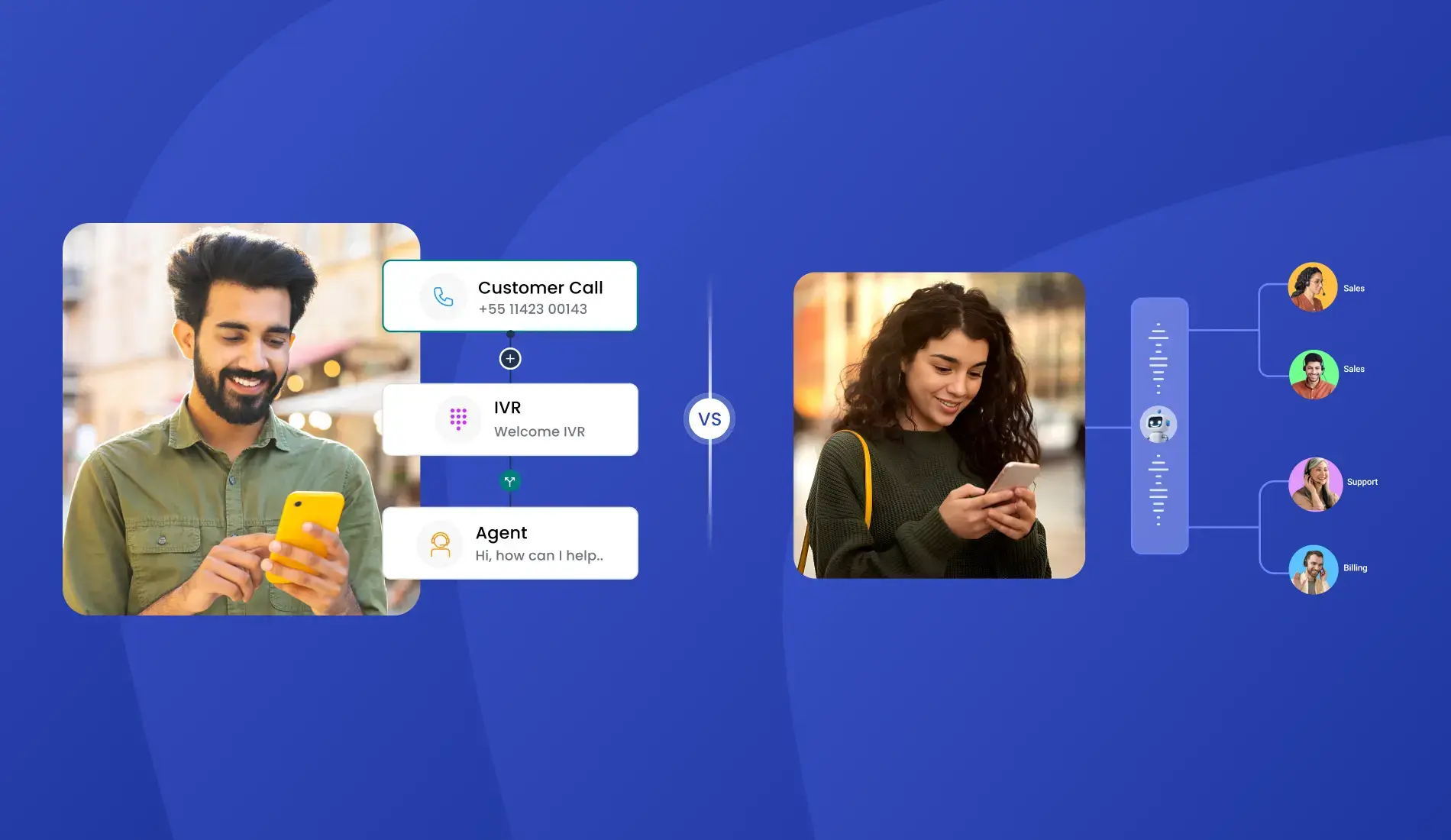
A single level IVR has only one menu hierarchy; the customer selects an option, and it routes to the agent based on their choice. A generic single-level IVR setup includes:
- A formal greeting, like a welcome message.
- Followed by a list of options to choose from.
- Finally, the caller was routed to their destination.
A real-world example:
"Thank you for contacting TeleCMI. For Sales, press 1, for Customer Support, press 2, for Billing, press 3, and for Front Desk, press 0."
What Is a Multi-Level IVR?
A multi-level IVR takes things further. Instead of a single menu with a few options, callers move through a series of menus that narrow down their need before they reach an agent.
Level one will have broad options, and you will be filtered to the next set of options until you reach your destination.
- The first will be a formal greeting, such as a welcome message.
- Second, there will be a menu of available options for selection.
- Third, you will filter into another set of options and so forth.
- Fourth, the caller is directed to their destination.
A real-world example:
“Thank you for calling TeleCMI. Press 1 for Sales, Press 2 for Support, Press 3 for Billing."
For a caller opting for 1 for sales: "If you're a new customer interested in a package, press 1; but if you want help regarding your existing order, press 2."
Single-Level vs Multi-Level IVR: Head-to-Head
The decision lies in finding the solution that fits your business rather than what it could be in the future. This is where their strengths lie when compared on relevant parameters.
Setup Complexity
A single-level IVR can be up and running in a day. Define your choice list, record your prompts, allocate each prompt to its proper queue, and you are done. Multi-tier IVRs demand more time for designing the menu flow chart, understanding how customers would view their issues at each point, and verifying that there is nothing dead in any route.
Caller Experience
Single-level is fast and frictionless; most callers can navigate it on autopilot. Multi-level can be just as smooth, provided the menus reflect how callers actually think, not how your internal org chart is structured. The failure mode for multi-level isn't complexity; it's complexity that doesn't serve the caller.
Team Size
Single-level works well for teams with 2–4 departments where the differences are clear-cut. When you have five or more queues, or when one department needs to process multiple kinds of requests, multilevel routing becomes worthwhile in terms of complexity.
Cost
A single-level system is inexpensive to develop and operate. The cost of developing and running a multilevel system is relatively higher. In cases of high-volume calls, the multilevel IVR system becomes cost-effective through avoiding redirections and reducing wasted time on agent re-routing.
Scalability
Single-level IVR eventually hits a ceiling; there are only so many options you can fit in one menu before it becomes unworkable. Multi-level grows more gracefully. New products, teams, regions, or services become new branches without requiring a full restructure.
Maintenance
Single-level is easy to update, swap a prompt, change an extension, and is done. Multi-level requires more careful stewardship because one change can ripple through multiple paths. Without a clear owner and regular audits, menus go stale quickly.
Deliver better call experiences with the right IVR setup. Simplify call handling and improve customer experience today
ExploreWhen Single-Level IVR Is the Right Choice
Single-level IVR earns its place when simplicity genuinely serves your callers better than precision would. Here's when to choose it:
- Your business has 2–4 departments with clear, non-overlapping responsibilities.
- Call volumes are low to moderate, a few dozen to around 100 calls per day.
- You want quick deployment with minimal IT involvement.
- Your incoming calls are consistently straightforward, and callers are reliably reaching out for one of three or four clear reasons.
- You're a lean team where the person managing the system wears multiple hats.
For these businesses, adding a second menu layer doesn't improve the experience; it just adds friction. Keep it simple, and your callers will thank you. TeleCMI's single-level IVR is built for exactly this kind of scenario: fast to configure, easy to adjust, and manageable without a dedicated IT team.
When Multi-Level IVR Is the Right Choice
At a certain scale, a single-level IVR stops being a convenience and starts being a bottleneck. Here's when to move to multi-level:
- If you are an organization with several products or services offered, and the current menu is getting overly long or too broad for use.
- When you deal with high call volumes, and any small percentage of misdials results in agent rework.
- Your customer base is located in more than one region or speaks more than one language, which means you need an extra menu to route calls effectively by language or region.
- If your customer support consists of different departments that take care of completely different kinds of requests.
- You have an employee responsible for updating the IVR system on a regular basis.
For call centers and enterprise support teams, multi-level IVR isn't a luxury; it's the structure that makes high-volume operations manageable. TeleCMI's multi-level IVR supports complex routing logic, regional customization, and the hierarchical structures that large teams rely on.
Common IVR Mistakes to Avoid - Regardless of Level
Whether you go single-level or multi-level, a few mistakes will undermine even the best-designed system.
- Too many menu options: Research consistently shows that callers start dropping off after four or five choices. If your menu has seven options, the person who needs option seven has already zoned out. Trim ruthlessly. If you need more than five options, that’s a sign you might need a second level rather than a longer first menu.
- No way to reach a live agent: Some callers will always need a human, whether their situation is complex, their patience is short, or they’re not comfortable navigating automated menus. A system with no escape route doesn’t just frustrate those callers; it costs you the call entirely. Always include a zero-out option or a “speak to someone” prompt.
- Outdated recordings: If your IVR still mentions a department that was restructured two years ago, or routes to an extension that no longer exists, callers notice, and they lose confidence in your business before they’ve spoken to anyone. Menu recordings should be reviewed every time your team structure changes.
- No analytics on caller behavior: One of the most underused features of modern IVR systems is data. Which options do callers choose most? Where do they hang up? How long are they spending on the menu before making a selection? Without tracking this, you’re maintaining the system blind. With it, you can continuously improve the experience based on what callers are actually doing
How to Choose: A Simple Decision Framework
If you're still weighing which type fits your business, run through these four questions honestly:
Conclusion
Neither approach can be said to be definitively superior to the other because whether or not one should use single-level IVR or multi-level IVR largely comes down to the complexity of one’s routing needs. The former is likely more effective for smaller businesses, while the latter is more advantageous for larger businesses.
While small businesses can make good use of single-level IVR, large companies can benefit from multi-level IVR due to the increased complexity of their operations.
Ready to find the right IVR setup for your business? Stop overcomplicating your call routing
Try TeleCMI freeFrequently asked questions (FAQ)
Saravana Kumar

I’m passionate about exploring and sharing insights on modern cloud communication technologies. At TeleCMI, I focus on helping readers understand the evolving world of cloud telephony and IVR solutions in a simple yet in-depth way. My goal is to deliver genuine value by turning complex telecom concepts into clear, actionable knowledge that builds trust and drives innovation.