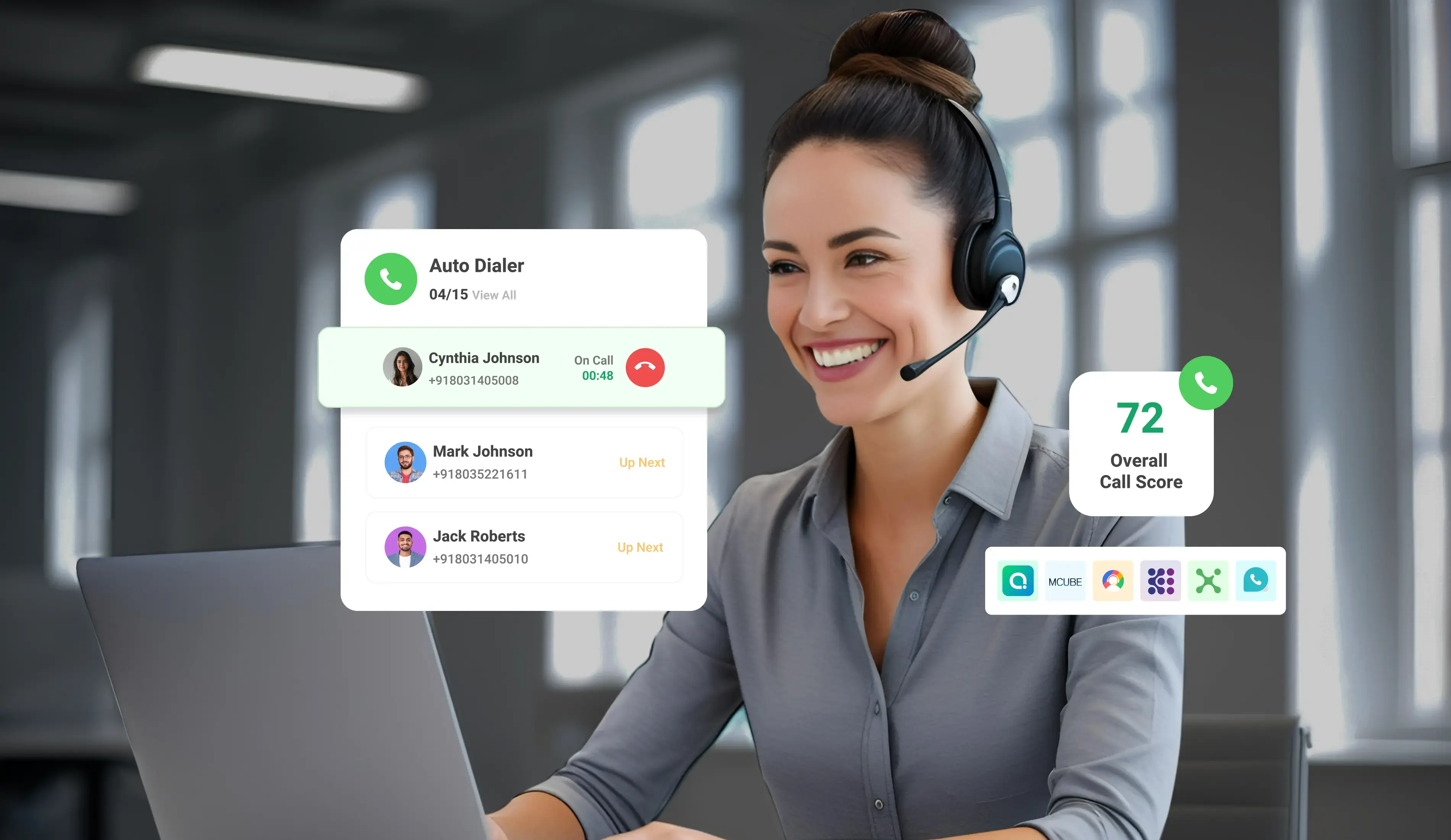
TeleCMI Auto Dialer vs Exotel: Feature-by-Feature Comparison

20 mins read

Posted on Aug 20, 2026


Saravana Kumar
SEO


Saravana Kumar
SEO






Picking an auto dialer isn't about buying software with the most features. For an outbound sales team, it comes down to a few basic questions: How fast can reps work through their lists? What dialing modes do you get? How do you manage campaigns? How well does it sync with your CRM? And what will scaling up actually cost down the line?
Both TeleCMI and Exotel support outbound cloud calling, but their product breadth, dialing options, pricing structures, and number allocation models differ. TeleCMI focuses heavily on cloud telephony, contact center features, and outbound sales workflows. Exotel treats auto dialing as just one part of a larger, all-in-one communications stack.
This comparison looks at the parts that matter to an outbound team, such as dialing modes, campaign management, caller IDs, monitoring, pricing, integrations, setup, support, and compliance. If you are deciding between the two, these are the differences that can have the biggest impact on how your team calls, scales, and manages its day-to-day operations.

Key Takeaways
 TeleCMI supports Progressive and Predictive dialing, as well as broadcast dialing for outbound campaigns.
- Exotel currently offers Predictive, Power Dialer, PACE, and Voice Blaster as part of its auto-dialer offering.
- TeleCMI provides 170+ business tool integrations and supports caller ID assignment at the user level. (TeleCMI Integrations | Connect 200+ CRMs & Business Apps, 2026)
- Exotel's public Business Phone System plans use credits for calls, SMS, and WhatsApp, with different agent and ExoPhone allocations.
- The right fit depends on your main focus - whether you need a dedicated outbound sales dialer, an all-in-one messaging suite, clearer pricing, or specific dialing modes for your reps.
TeleCMI vs Exotel at a Glance
TeleCMI is a cloud communication platform covering business telephony, contact-center operations, outbound dialing, virtual numbers, call recording, live call monitoring, analytics, CRM integrations, and multichannel communication. TeleCMI auto dialer supports Progressive and Predictive campaigns, while its campaign tools let administrators upload leads, assign agents, set intervals, and monitor campaign activity. Teams can add and manage users as their calling operations grow, while handling voice and other communication channels from the same platform.
Exotel has a broader communications stack. Its current Business Phone System plans include an auto-dialer, live dashboards, recordings, analytics, dynamic call flows, call transfer, voice APIs, SMS and WhatsApp APIs, and campaigns. Its dedicated auto-dialer product adds Predictive, Power Dialer, PACE, and Voice Blaster capabilities.
Exotel brings a wide range of capabilities to the table. But features alone don't determine the right fit. For outbound teams, factors such as agent costs, number requirements, and call usage can be just as important when evaluating the overall value.
Which Auto Dialer Fits Your Sales Team ?
Compare your team's calling requirements with TeleCMI's dialing modes, integrations, campaign management, and number allocation.
TeleCMI Auto Dialer vs Exotel Auto Dialer Features: Head-to-Head
Dialing Modes
TeleCMI offers both predictive and progressive dialing depending on your workflow. Predictive dialing dials ahead using software logic so agents jump straight from one call to the next. Progressive dialing is more deliberate - it connects the agent first to make sure that the agent is on the line before the customer's phone even rings.
TeleCMI focuses on the core outbound dialing modes—predictive and progressive—which cover the primary dialing workflows required by many sales and calling teams. Exotel provides additional outbound capabilities such as Power Dialer, PACE, and Voice Blaster alongside its predictive dialing functionality.
For teams that primarily need predictive or progressive dialing, TeleCMI covers the core outbound workflows. Exotel provides a broader selection of dialing options, including Power Dialer, PACE, and Voice Blaster. The better choice depends on whether the team needs those additional dialing workflows or prefers a more focused outbound setup.
Call Pacing and Agent Utilization
Call pacing is the balance between dialing volume and agent bandwidth. Proper call pacing stops your agents from sitting idle between leads. This will make sure callers are not met with dead air. It continuously aligns outbound dial speed with live agent availability to keep your floor moving without burning through leads.
TeleCMI provides controls to configure dialing behavior and campaign execution based on the selected dialing mode. Predictive dialing places multiple calls based on anticipated agent availability, while progressive dialing connects to a single contact when an agent is ready. Campaigns can be managed through lead lists, scheduling, and day-based routing. It supports retries, pausing, and resuming the campaign.
Exotel uses dynamic pacing based on factors like average handle time, connect rates, and live agent occupancy. Its predictive mode can dial multiple numbers ahead of agent availability, and progressive mode places a call when an agent is ready. Managing large lists is also flexible. You can throttle dial speeds, automate retries, and pause campaigns whenever you need.
Avoiding dropped calls and keeping prospects off the dead air is a priority for both TeleCMI and Exotel. Exotel provides configurable controls for managing pacing and call-drop ratios, giving supervisors greater control over predictive dialing behavior. TeleCMI takes a hands-on approach by letting you set custom calling intervals. Getting these settings right keeps your agents busy while protecting customer experience and compliance.
Call List Management
Both platforms support the core workflows needed to organize outbound call lists, but their approaches differ.
TeleCMI allows teams to upload lead lists through CSV files, assign contacts to users, and organize campaigns based on their calling requirements. Teams can also manage calling lists through available integrations.
Exotel supports campaign-based contact management with options for list uploads, segmentation, filtering, and CRM-linked calling workflows. Its APIs also allow businesses to manage campaign and contact data programmatically.
For DNC handling, the level of suppression depends on how lists and configurations are maintained. So it shouldn't be treated as an absolute guarantee. How well it works depends on how clean your lists are, so you'll still need to maintain your own opt-out records and compliance checks.
Retry Logic
Most leads won't answer on the first attempt. You’re going to run into busy lines, unanswered dials, and follow-up requests all day. Automated retry rules handle that redialing in the background so agents can stay focused on live conversations.
When a call drops or goes to voicemail, TeleCMI handles the follow-up for you. You can customize how many times the system retries a lead and how long to wait between attempts, keeping your reps focused on talking rather than rebuilding call lists.
Exotel also supports retry logic for unsuccessful calls, with campaign-level settings to determine how and when contacts should be called again. This gives teams control over repeated attempts across outbound campaigns.
Both tools handle redialing busy lines and missed calls automatically. Just keep in mind that retry controls can look different depending on how you configure your campaigns. So it is good to double-check that the platform gives you the exact parameters your team needs.
Real-Time Campaign Monitoring
Post-campaign reporting only tells you what already went wrong. To run an efficient sales floor, supervisors need to see what's happening right now, like who is available, which calls are live, and whether campaigns are actually hitting their stride.
TeleCMI provides agent-status information, live call feeds, campaign performance data, reports, analytics, recordings, call monitoring, and call whispering. It also supports real-time supervisor actions through its broader communication dashboard.
Exotel offers a comprehensive monitoring toolkit, complete with live dashboards, recordings, and advanced analytics. TeleCMI also provides real-time visibility for managers through live dashboards, analytics, recordings, and active campaigns.

These differences are also reflected in user feedback. On G2, TeleCMI currently has a 4.8/5 rating from 306 reviews, compared with Exotel's 4.3/5 from 342 reviews. G2 reviewers also rate TeleCMI higher for ease of use, setup, support, and meeting business requirements.
The Hidden Cost of Outbound Calling: Agent-to-Number Ratio
When evaluating an auto dialer, businesses often compare how many agents a plan supports. But there's another question that can directly impact outbound operations: how many virtual numbers are included?
An outbound team needs three things to keep calling at scale:
- Agents – The people handling connected calls.
- Calling capacity – The ability to place enough calls for the team's workload.
- Caller IDs/numbers – The outbound numbers customers see when calls are placed.
A plan may support a large number of agents but offer only a small pool of virtual numbers. That can limit how teams distribute caller IDs across agents, campaigns, regions, or use cases.
This is why the agent-to-number ratio deserves attention when comparing the actual cost and capacity of an outbound dialer. A lower number allocation can mean that teams need to purchase additional numbers as their calling operations grow.
TeleCMI's Number-per-User Advantage
TeleCMI takes a different approach to number allocation by allowing businesses to provision one business number per user. Instead of multiple agents relying on a limited pool of outbound numbers, each user can have an individual number for business calls.
This gives outbound teams more flexibility in how they manage their calling operations:
- Individual outbound identity: Each agent can have a dedicated business number for customer calls.
- Simpler number management: Teams can associate numbers directly with users.
- Campaign flexibility: Different numbers can be assigned across teams, campaigns, or use cases.
- Less dependence on a single caller ID: Teams has a broader pool of outbound identities to work with.
- Easier scaling: New numbers can be provisioned as additional users are added.
- Greater continuity: If a number develops deliverability or reputation issues, teams have more flexibility to manage their outbound identities.
A larger pool of individual outbound numbers gives teams greater flexibility when managing caller identities, campaign continuity, and outbound operations as they scale.
TeleCMI vs Exotel Pricing Comparison
Price is another important difference between the two platforms, particularly for teams that expect their outbound operations to grow. TeleCMI uses a per-user pricing structure, while Exotel combines plan pricing with credits. Below is a TeleCMI vs Exotel pricing comparison.
TeleCMI may offer a more predictable pricing structure for teams that primarily need core outbound calling capabilities. Its pricing options include per-user plans and an unlimited-user plan, depending on the selected package. Exotel uses a plan-based model that combines agent capacity, ExoPhones, and communication credits.

Note
Pricing reviewed in August 2026. Plan prices, credits, number allocations, validity periods, and included features may change. Confirm the current pricing and plan terms with the provider before purchasing.
The Credit Model vs Predictable Pricing
Exotel's pricing includes a credit-based model. The credits provided with its plans can be used across calls, SMS, and WhatsApp, with Exotel stating that 1 credit = ₹1.
Base plan prices only tell half the story. Your actual bill will depend on how quickly you burn through your included call credits and whether you need to buy extra numbers or add-on resources down the line.
For an outbound operation, businesses may need to account for:
- Subscription or plan cost
- Calling usage
- Credits consumed
- Additional usage beyond the plan
- Number requirements
- Costs associated with scaling the team
So when comparing TeleCMI and Exotel, the advertised plan price should not be viewed in isolation. The more useful comparison is the total cost of running the required calling operation at the team's expected volume and size.
TeleCMI's Pricing Model
TeleCMI's unlimited-user plan uses a different pricing approach for growing teams, with a fixed monthly subscription rather than pricing that increases based on the number of users:
- Unlimited users
- Unlimited calling, with no prepaid credit bucket
- Cloud contact center features such as call recording, analytics, CDR, call monitoring, and reporting.
For teams adding agents or increasing calling activity, this can make budgeting more straightforward. The subscription isn't built around a fixed pool of prepaid credits that teams need to track as call volume grows.
This pricing structure can make budgeting more predictable for growing outbound teams, particularly when the number of users and calling activity increase over time. TeleCMI also offers a 14-day trial, giving teams time to test the actual calling workflow before committing.
Compare the Difference on Your Own
Test the features that matter to your team and see how TeleCMI performs
Pricing by Team Size
The better value depends on team size and dialer usage. Looking at a few typical team sizes makes the cost difference much easier to spot.
- 3-Agent Team
For a small setup with 3 agents, Exotel’s entry Dabbler plan gives you 3 seats, a single ExoPhone, and 5,000 call credits. With TeleCMI, don't just look at the headline sticker price. You should make sure you calculate total costs based on user count, phone line add-ons, calling minutes, and required features.
- 6-Agent Team
At six agents, Exotel's Believer plan provides six agents, two ExoPhones, and 9,500 credits. That results in a smaller pool of outbound numbers than agents, while TeleCMI's per-user approach gives teams more flexibility in allocating numbers as users are added.
- 20–50 Agents
Once your team reaches 20 to 50, how a provider charges matters as much as what they charge. Instead of focusing only on headline prices, factor in user limits, extra phone lines, and call volume. TeleCMI's unlimited-user plan may be particularly relevant for larger outbound teams because adding users does not require moving to a higher user-capacity tier, subject to the applicable plan terms.
- High-Volume Calling Team
For teams making a large number of calls, credit consumption becomes an important budgeting factor. A credit-based model requires teams to track usage as call volume increases, while TeleCMI's unlimited-user and unlimited-calling model can offer more predictable costs, provided the applicable plan terms cover the team's required usage.
CRM and Third-Party Integrations
An outbound dialer becomes much more useful when agents do not have to maintain the call system and CRM as separate records.
TeleCMI currently lists 170+ business tool integrations, including Zoho, HubSpot, LeadSquared, Freshworks, and Pipedrive. It also provides APIs and webhooks for custom workflows.
For the TeleCMI auto dialer, the relevant questions are whether your CRM is supported, whether calls can be logged automatically, whether recording links can be associated with contacts, and whether click-to-call or other workflows are available.
Exotel also supports CRM and business-tool integrations and provides APIs for custom communication workflows. Its current Business Phone System plans include voice, SMS, and WhatsApp APIs.
Setup and Ease of Use
Both platforms are cloud-based, so teams do not need to deploy an on-premises PBX to start using cloud calling.
TeleCMI's setup flow includes selecting a virtual number, configuring call flows, adding team members, and starting calls. Its auto-dialer workflow then lets teams upload leads, create campaigns, select dialing modes, assign agents, and monitor activity.
Exotel is also a mature cloud platform with extensive configuration and API capabilities. That broader flexibility can be useful for organizations with custom communication workflows, though businesses should weigh the implementation effort against their actual needs.
The best setup is the one your operations team can maintain without constantly relying on developers.
Support: What Happens When Your Dialer Stops Working?
For an outbound sales team, a dialer issue is more than a technical problem. When agents cannot place calls, leads go untouched, campaigns slow down, and sales productivity suffers.
TeleCMI Support
TeleCMI provides support via chat, email, and phone (where applicable), along with dedicated account manager support. Having direct support channels gives teams a way to get assistance when they are dealing with issues that affect live calling, campaign setup, or day-to-day operations.
Exotel Support
Exotel currently provides support through dashboard chat, WhatsApp, and email. These channels cover the common support needs. But teams dealing with time-sensitive outbound issues may value having direct assistance through multiple channels.
Compliance and Indian Outbound Calling
Compliance is an important consideration for any business running outbound campaigns in India. Both TeleCMI and Exotel are TRAI-compliant. But businesses still need to configure and operate their campaigns in accordance with the rules that apply to their specific use case.
Key areas to consider include:
- DND and consent: Make sure you are only calling people who actually gave consent or aren't on active DND registries.
- Caller identification: Use provisioned business numbers and appropriate caller IDs.
- Calling regulations: Follow applicable telecom requirements for outbound campaigns.
- Abandoned calls: Configure dialing and pacing to reduce unwanted dropped or silent calls.
- Number provisioning: Use numbers provisioned for the intended business calling purpose.
- Call recording: Follow applicable requirements around recording and customer notification.
- Disclosure requirements: Provide any disclosures required for the nature of the call.
The platforms can provide the telephony infrastructure and relevant controls, but businesses remain responsible for configuring their campaigns in line with applicable telecom regulations and their specific calling use case.
Who Should Choose TeleCMI?
TeleCMI may be a suitable option for businesses looking for an outbound setup that is straightforward to scale and easier to budget. It may be particularly suitable for teams that:
- Have growing outbound sales teams
- Prefer predictable monthly costs.
- Prefer a pricing model that does not rely on a fixed prepaid calling-credit pool.
- Need predictive or progressive dialing.
- Want greater flexibility in outbound number allocation.
- Want one number per user where supported by the selected plan.
- Need CRM integrations
- Want voice and other channels in one platform.
- Value multiple support channels.
- Want faster deployment
- Prioritize overall value and essential functionality over having the widest possible feature set.
Who Should Choose Exotel?
Exotel may be more suitable for businesses whose requirements extend beyond core auto-dialer workflows or who already use its broader communication ecosystem. It may be a better fit for teams that:
- Prioritize a broader range of features and dialing options.
- Need advanced enterprise capabilities for specific use cases.
- Have complex integration requirements
- Need functionality beyond TeleCMI's current dialer offering.
- Already use Exotel across their communication stack.
- Have technical resources available for more involved deployments
- Prefer a credit-based model for managing communication usage.
TeleCMI vs Exotel: Which Auto Dialer Is Right for You?
TeleCMI may be a better fit for teams that prioritize predictable subscription costs and core outbound dialing capabilities. Exotel may be more suitable for businesses that need a broader range of dialing options and communication features.
Instead of just tallying up feature lists, focus on what your team actually needs right now. These include headcount, call volume, phone lines, and integration support. Matching those requirements against each platform's features, pricing model, and scalability can help you determine which auto-dialer is better suited to your operations. You can also scale the platform with you as you go down the road.
Wrapping Up
Exotel is a strong option for businesses that need broad outbound dialing capabilities and a wider communications ecosystem. Its range of dialer engines - including Predictive, Power, PACE, and Voice Blaster -gives managers maximum flexibility to tailor dialing modes to specific campaign goals.
TeleCMI takes a more focused approach to the core outbound workflows that many sales teams need, with Progressive and Predictive dialing, campaign controls, monitoring, caller ID management, and 170+ business tool integrations.
The best way to choose between TeleCMI and Exotel is to put them to work on your actual sales floor. TeleCMI offers a 14-day trial so you can test the dialer engine, run a few test campaigns, try out the integrations, and see how the reporting holds up.
Ready to Choose Your Auto Dialer?
The right platform depends on your team size, calling volume, dialing requirements, integrations, and pricing model
Frequently asked questions (FAQ)
Saravana Kumar

I’m passionate about exploring and sharing insights on modern cloud communication technologies. At TeleCMI, I focus on helping readers understand the evolving world of cloud telephony and IVR solutions in a simple yet in-depth way. My goal is to deliver genuine value by turning complex telecom concepts into clear, actionable knowledge that builds trust and drives innovation.


 for your Call Center and Enhance Efficiency_.webp)