Is VoIP Secure? The Ultimate Guide to VoIP Security & Call Encryption

15 mins read

Posted on Jun 23, 2026

Vignesh N
SEO


Vignesh N
SEO






Every call made by any business organization includes sensitive information:
Client calls. Business deals. Confidential information.
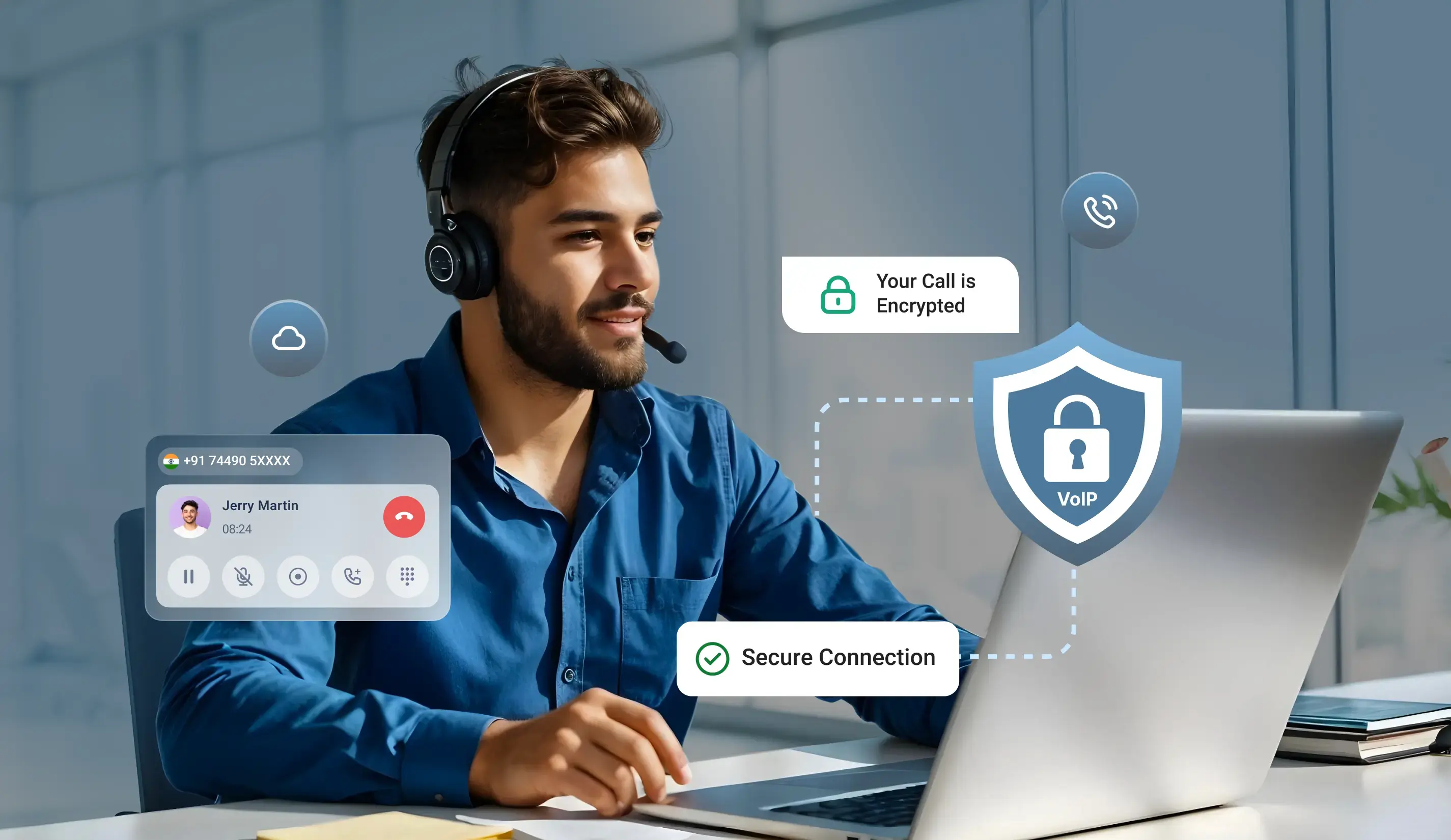
Once it is made over the internet using VoIP services, concerns about its security arise. However, just like any other form of technology, VoIP can demonstrate its advantages to users if certain steps are taken to secure it. The security of a VoIP system depends on encryption, authentication, and network policies.
Is it a safe place or a dangerous one?
This article provides an overview of all aspects of VoIP security, from the basics to ways to encrypt the connection to evaluating the security level of your cloud phone provider.

Key Takeaways
 VoIP is absolutely safe to use as long as the encryption and access control measures are properly performed.
- The most common VoIP technologies for securing the connection are SRTP and TLS.
- The major threats involve toll fraud, vishing, DDoS attacks, and wiretapping.
- Multi-factor authentication and network segmentation must be implemented.
- Remote and hybrid teams face elevated VoIP security risks without additional controls.
- Cloud-based VoIP systems often exceed the security capabilities of traditional PBX infrastructure.
What is VoIP Security?
VoIP security refers to measures implemented to protect voice communication carried out over the Internet Protocol from any form of unauthorized access, listening, deception, and disturbance.
While normal telephony is dependent on dedicated circuit-switched networks, voice over IP is digitized into packets and transmitted using IP networks. The same networks can be used for making web transactions, sending emails, transferring files, and many other functions.
While such VoIP phone systems offer flexible and cost-effective services, they pose security risks like other internet systems. VoIP security is the intersection of three types of security:
- Network security
- Application security
- Communications compliance.
Some of the security offered by VoIP includes:
- The content of calls (what is said)
- Call metadata (who called whom, when, and from where)
- Signaling data (the handshake information that sets up each call)
- User credentials and account access
- The availability of the phone system itself
Is VoIP Secure?
VoIP technology is safe when it is correctly configured and protected. It is not a matter of technology but of the way that it is implemented. If it uses proper encryption and MFA and has secure access to the network, it will be more robust than a legacy system.
How VoIP Calls Work
Understanding VoIP security starts with understanding the call lifecycle. When a user makes a VoIP call:
1. The caller's device captures audio and converts it into digital data.
2. That data is compressed and broken into small packets.
3. The packets are transmitted over the Internet using IP protocols.
4. The packets are reconstructed into audio at the recipient’s terminal almost instantly.
5. Signaling for calls (including setup, routing, and disconnection) is provided by protocols such as SIP.
There are two streams of data for every VoIP call:
- Signaling Stream: The signaling stream handles the call setup and routing process. SIP is the most widely used protocol in this category.
- Media Stream: The media stream is responsible for voice data. RTP is the most widely used protocol in this case.
Both streams require separate security. A system that encrypts media but leaves signaling unprotected still exposes call metadata to interception.
Understanding VoIP Call Encryption
What is Call Encryption?
Call encryption is the process of converting voice data into an unreadable format during transmission so that only authorized endpoints, the caller, and the recipient can decode and listen to it.
Types of VoIP Encryption
Common VoIP Security Threats
- Eavesdropping: Unencrypted calls can be intercepted, just like unprotected Wi-Fi traffic.
- Toll fraud: Hackers get access to the system and make costly international calls through the system, mostly overnight. When people notice, thousands of dollars' worth of calls will have been made. The reason is weak passwords or open extensions.
- DoS Attacks: Overwhelming the system with useless traffic and making it impossible for real calls to be made. It does not involve theft but disruption.
- Caller ID spoofing: Faking the caller ID to look like a trusted number (a bank, even your own company). Common scam tactic, also a risk to brand damage.
- Vishing: Phishing, but by phone. Someone impersonates IT or a vendor to obtain passwords or OTPs from an employee. Works because voice feels more trustworthy than email.
- Man-in-the-middle attacks: Rare, but an attacker sits between two parties on a call, intercepting it unnoticed. Encryption is the main defense.
- Weak passwords / default settings: The most common cause of breaches. Not clever attacks, just unlocked front doors.
Top Security Features Every VoIP System Should Have
When evaluating a business VoIP system, these are the security features that should be non-negotiable:
VoIP Security Best Practices for Businesses
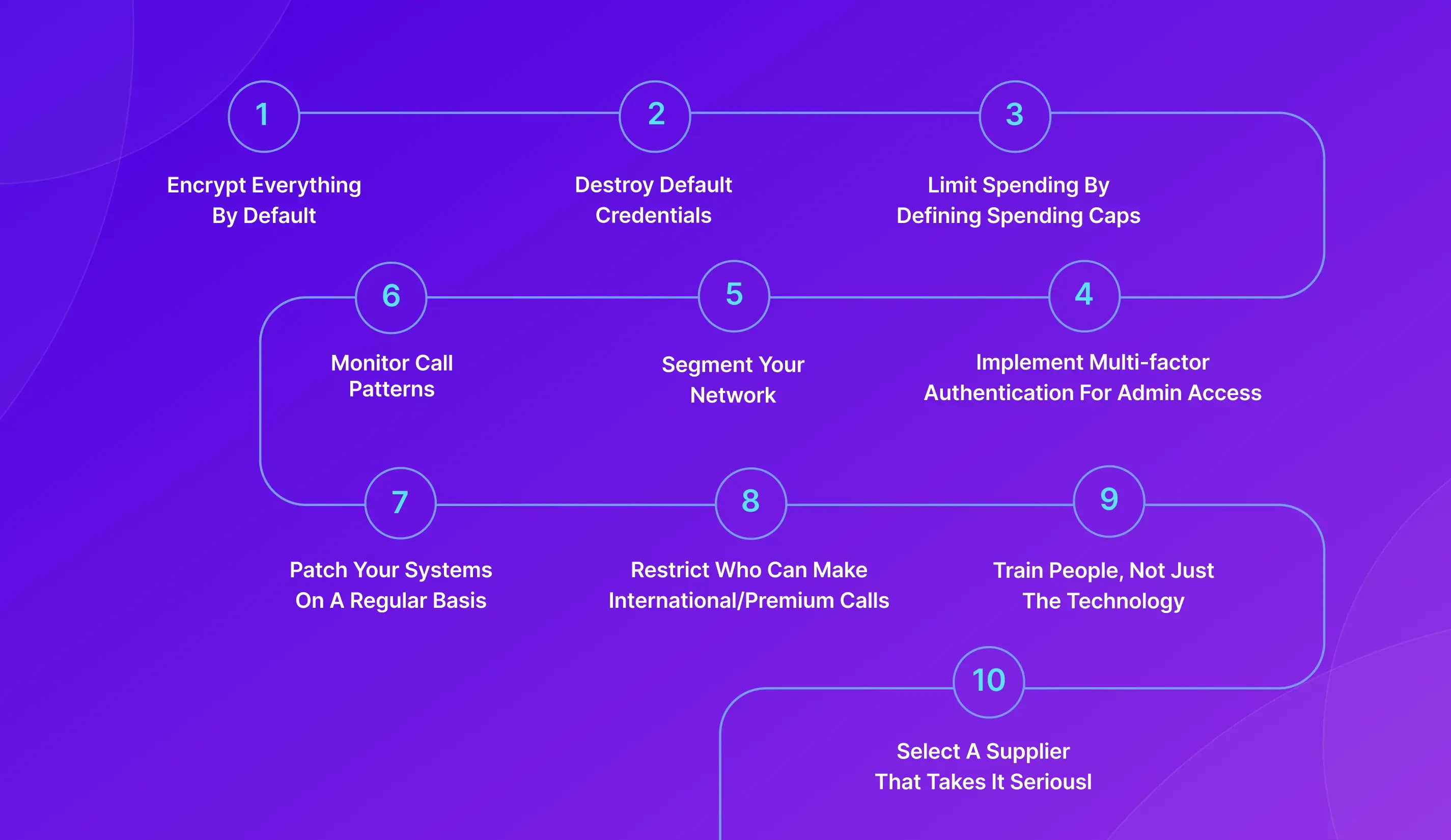
1. Encrypt everything by default: Everything must be encrypted by default: The phone calls must be end-to-end encrypted out-of-the-box and not be set up as an option.
2. Destroy default credentials: Every single extension and every admin account must have unique passwords from Day 1. Default credentials are the #1 method for hackers to access the network.
3. Limit spending by defining spending caps: International and premium rate calls must be limited automatically in order to prevent a fraud attempt in minutes instead of weeks.
4. Implement multi-factor authentication for admin access: Multi-factor authentication, in addition to a password, is necessary for accessing the portal. This is the most valuable resource to steal.
5. Segment your network: Keep voice traffic on a different VLAN than the office network traffic. This makes an attack harder, even in case an individual endpoint becomes compromised.
6. Monitor call patterns: Unusual call patterns (international late-night calls, spike in volume, etc.) need to be detected and not seen only when reviewing the billing report.
7. Patch your systems on a regular basis: Old software/firmware of IP phones, gateways, and PBX systems are among the favorite methods to breach the system.
8. Restrict who can make international/premium calls: Most employees never need to call overseas. Lock that down to the people who actually do.
9. Train people, not just the technology: A simple tip about the "IT department" or "bank" calling and asking for your password/OTP is always useful. Remember, most threats begin with the individual, not with a flaw in the firewall.
10. Select a supplier that takes it seriously: Encryption, reliability, and security need to be one of the first questions you raise, not one that comes to light through incidents.
Secure Your Business Communications with TeleCMI
SRTP and TLS encryption. Multi-factor authentication. Detailed audit logs.
VoIP Security for Remote and Hybrid Teams
Remote and hybrid work environments introduce distinct VoIP security challenges. Employees working from home or in public spaces often use devices and networks that fall outside the IT team's direct control.
Best practices for securing remote VoIP access:
- Require VPN access before any VoIP connection for remote workers
- Enforce MFA on all user accounts, especially for admin-level roles
- Issue managed devices or enforce minimum security standards on personal devices via mobile device management (MDM)
- Disable guest network access and ensure home routers use WPA3 where supported
- Provide employees with a vetted softphone app rather than allowing third-party alternatives
- Conduct security awareness training specific to remote work risks
HIPAA Compliance Checklist for VoIP
Healthcare organizations and their communication vendors must ensure that VoIP systems meet HIPAA requirements for protecting Protected Health Information (PHI) transmitted over voice.
- End-to-end encryption for all calls involving PHI
- Encrypted voicemail storage
- Access controls with role-based permissions
- MFA for all accounts accessing PHI
- Call logging and retention for an audit trail
- Business Associate Agreement (BAA) with VoIP provider
- Automatic session timeout for idle accounts
- User authentication before accessing voicemail
- Breach notification procedures documented
- Regular risk assessments on VoIP infrastructure
How Secure Is VoIP Compared to Other Communication Systems?
VoIP Security vs Traditional Phone Systems
Traditional PSTN lines are widely assumed to be more secure because they are physical circuits. In reality, they are not encrypted and are vulnerable to physical tapping, social engineering of telecom providers, and SS7 protocol exploits. A well-secured cloud VoIP solution provides significantly better technical security assurances compared to an old PBX-based solution.
How to Choose a Secure VoIP Provider
Security must be the main consideration when choosing a business VoIP provider. This is how you can tell the difference between companies that are serious about security and ones that only make promises in their marketing material:
- Does the company offer SRTP and TLS encryption as built-in security capabilities or is it necessary to purchase extra security packages?
- Is there an ability to use end-to-end encryption (ZRTP)?
- Does the company offer SLA with uptime and infrastructure redundancy as its backbone?
- Does the company have any certifications concerning security (SOC 2, ISO 27001, GDPR, HIPAA BAA)?
- Does the company offer logging, auditing, and anomaly detection services?
- How does the company disclose security vulnerabilities and respond to security incidents?
- Is multi-factor authentication available for all types of users?Is the infrastructure hosted in data centers with physical security controls?
- Are software and firmware updates handled automatically by the provider?
- What data residency options are available for businesses with data localization requirements?
Future of VoIP Security
The VoIP security landscape is evolving alongside the broader threat environment. Several trends are shaping what effective VoIP security will look like in the coming years:
AI-Powered Threat Detection
Increasingly, machine learning algorithms are employed to detect anomalous call behavior, fraud call patterns in real time, and compromised accounts even before an attack takes place. AI-powered detection has transitioned from being enterprise-specific to being the norm for cloud VoIP systems.
AI-Enabled Attack Sophistication
While the same technology helps in defending against attacks, it is also used by hackers to conduct more sophisticated operations. AI is being used to create deepfake voices, target vishing attacks, and automate scanning of VoIP systems. Companies should train their employees to approach voice instructions received on the phone with the same level of scrutiny as any malicious emails.
Post-Quantum Cryptography
The post-quantum cryptographic standards are already available at NIST, and soon-to-be innovative companies offering VoIP solutions will integrate this form of encryption in their new protocols.
Zero Trust Architecture
Per-session authentication, continuous verification, and least-privilege access will be increasingly needed in VoIP implementations instead of network-level trust.
Regulatory Expansion
The Digital Personal Data Protection Act (DPDPA) in India introduces new legal obligations for the collection, storage, and processing of voice data. Businesses in Southeast Asia and South Asia can anticipate new VoIP regulatory requirements over the coming years.
How TeleCMI Helps Businesses Build Secure Communication Workflows
TeleCMI's cloud phone system is built with enterprise-grade security at its core, designed for businesses that cannot afford communication downtime, data leakage, or compliance gaps.
- Compatible with SRTP and TLS encryption protocols for all types of calls.
- Role-based permissions enable admins to assign each member a specific level of access to configuration and data exports.
- MFA is enabled for all accounts, lowering the chances of credentials theft and subsequent account takeover.
- Full call records and audit trails are available for compliance, quality assurance, and incident investigation.
- TeleCMI's AI Voice Agent capabilities operate within the same secure infrastructure.
- Business Phone System includes ring groups, priority routing, and IVR, all running on secure, redundant cloud infrastructure.
- The contact center solution comes with monitoring, access control, and reporting to ensure security at scale.
TeleCMI is designed to meet the needs of small and medium-sized enterprises as well as mid-market firms based in India and Southeast Asia. For those dealing with a dispersed workforce or operating under compliance requirements, TeleCMI offers a platform for secure communications.
VoIP Security Checklist
- Enable SRTP and TLS encryption on all call paths
- Change all default SIP credentials at setup
- Enable MFA for every user and admin account
- Segment VoIP traffic on a dedicated VLAN
- Restrict international calling to necessary users only
- Set up call anomaly alerts (volume, destination, time)
- Require VPN for all remote VoIP connections
- Review and update user account access quarterly
- Keep VoIP firmware and softphone apps updated
- Train staff on vishing recognition and response protocols
- Confirm the provider holds relevant compliance certifications
- Conduct a VoIP-specific security audit annually
- Review call logs and audit trails monthly
- Evaluate the provider's incident response procedures
Final Thoughts
VoIP is a widely implemented technology that can be trusted by companies ranging from one-person operations to large multinationals. The problem with VoIP is not whether it can be secured; the real question is whether or not it has been secured.
The use of encryption, authentication, network segmentation, and trustworthy VoIP service providers is the basis for a secure VoIP implementation. The risks may be great, but the protective measures that counteract them are also easy to implement.
For businesses in India and Southeast Asia, where regulatory requirements are tightening and remote workforces are expanding, getting VoIP security right is no longer optional. It is the baseline expectation for any professional communication infrastructure.
Secure Every Business Call with Enterprise-Grade VoIP Security, Reliable Infrastructure, and Advanced Communication Tools.

SRTP & TLS Call Encryption
Trusted by 3,500+ Businesses Worldwide
Multi-Factor Authentication & Access Controls
Frequently asked questions (FAQ)
Vignesh N

With deep expertise in cloud telecommunications, I help readers explore the latest trends in VoIP and modern business communication. At TeleCMI, I focus on educating businesses with clear, practical insights, making complex telecom concepts easy to understand. I’m passionate about helping organizations improve efficiency, enhance customer engagement, and adopt smarter communication strategies.

.webp)