What is Call Masking? How It Works, Benefits, and Business Use Cases

14 mins read

Posted on Apr 28, 2026

Vignesh N
SEO


Vignesh N
SEO






Your customers share their phone numbers with your business because they trust you. Every unmasked call you make risks breaking that trust — permanently.
Think about the last time a food delivery arrived and the driver called from a personal number. That number is now saved in the customer's phone forever. The driver's privacy is gone. The customer's trust is a coin flip away from a complaint. And your brand? Sitting squarely in the middle of a problem you never needed to create.
This is exactly the problem call masking solves, and in 2026, with India's DPDP Act 2023 now in force and consumer privacy expectations at an all-time high, it's no longer optional infrastructure. It's a baseline expectation.
In this guide, you'll understand what call masking is, how it works under the hood, which industries depend on it, and how to evaluate a solution that actually protects your customers and your business.

Key Takeaways
 Masking routes your call to the virtual proxy number and keeps both the caller's and the recipient’s original phone numbers anonymous.
- It ensures confidentiality for the customers and employees, providing complete tracking to businesses.
- Deliveries, ride-sharing, property transactions, healthcare, and marketplaces use call masking more frequently.
- The perfect solution should be compatible with your CRM, scalable, and track all interactions.
- TeleCMI offers encrypted, API-ready call masking built for Indian and global businesses.
What is Call Masking?
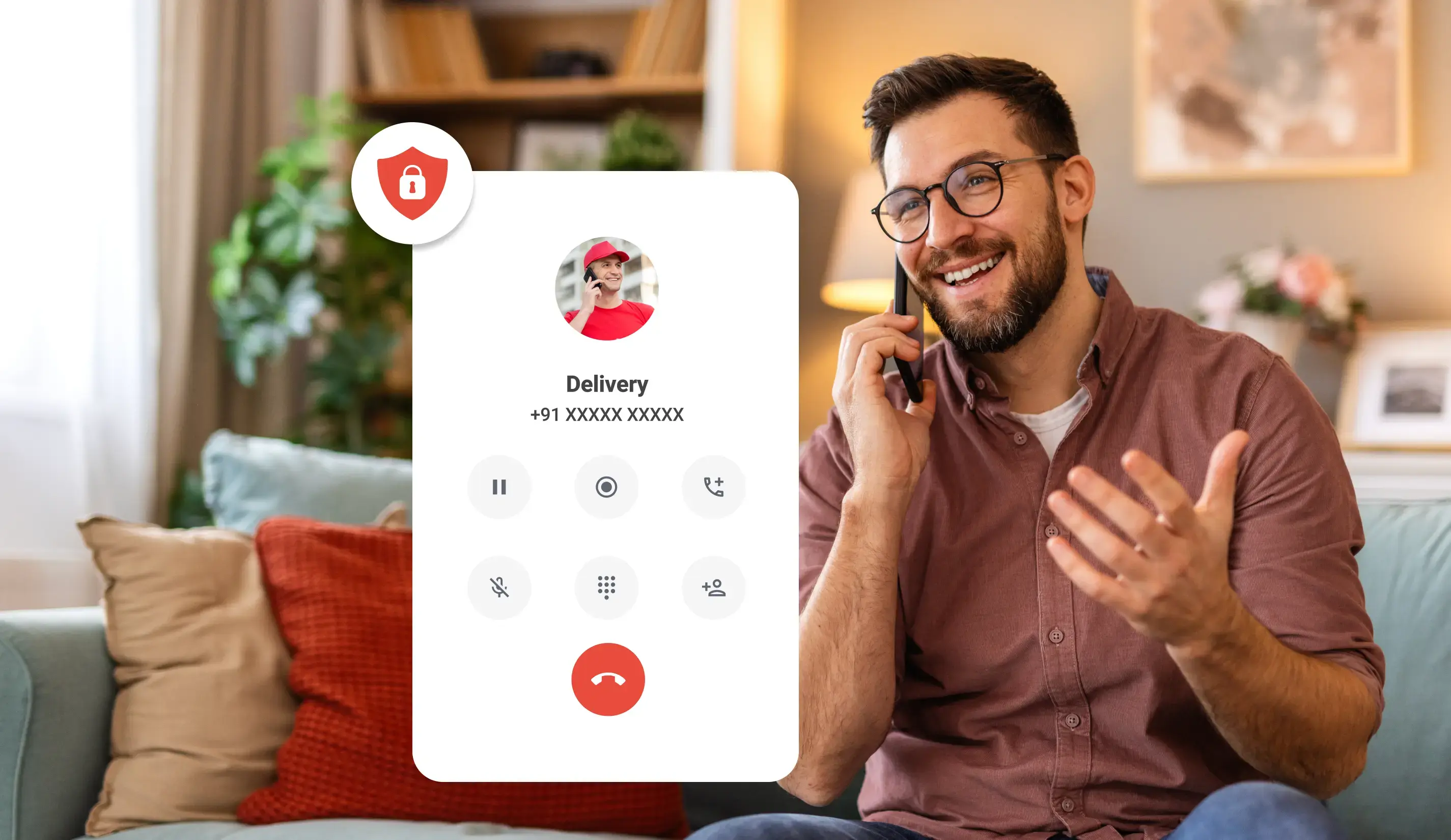
Call masking is a privacy technology that connects two parties through a temporary virtual (proxy) number instead of their real phone numbers. Neither side sees the other's actual digits.
To the customer, calls appear from a branded business number. To the driver or agent, the customer appears through the same proxy. Real numbers never leave the system. This is fundamentally different from call masking vs call forwarding (which still exposes the forwarded number) or caller ID spoofing (which is illegal).
In simple terms, call masking is a two-way privacy shield applied to every call your business makes or receives.
Types of Call Masking
1. Direct Call Masking: A proxy phone number masking is assigned per transaction or session. When a customer books a cab or places a delivery order, the system instantly assigns a virtual number for that interaction. The number typically expires when the session ends.
2. Permanent Number Masking: One proxy number is permanently allocated to the agent or representative, ensuring a long-lasting business engagement like real estate or recruitment where regular communication is anticipated, yet actual numbers need to stay confidential.
3. Variable Number Masking: Numbers change depending on call traffic, time, and location. Frequently applied in call tracking and attribution to learn which campaigns drive inbound calls.
Why Call Masking Matters for Your Business in 2026
The Digital Personal Data Protection (DPDP) Act 2023 was enacted in India, placing binding requirements on enterprises regarding the collection, use, and sharing of personal data, including telephone numbers. Worldwide, GDPR set a precedent for data management practices for any business dealing with EU clients.
Call masking addresses three core needs:
- Control: Businesses own the communication layer
- Security: Sensitive data stays protected
- Insight: Every interaction becomes measurable
Beyond compliance, customer expectations have hardened. Research consistently shows that users abandon apps and platforms that make them feel unsafe. According to Thales Group, 82% have abandoned a brand over data privacy concerns.
How Call Masking Works: Step-by-Step
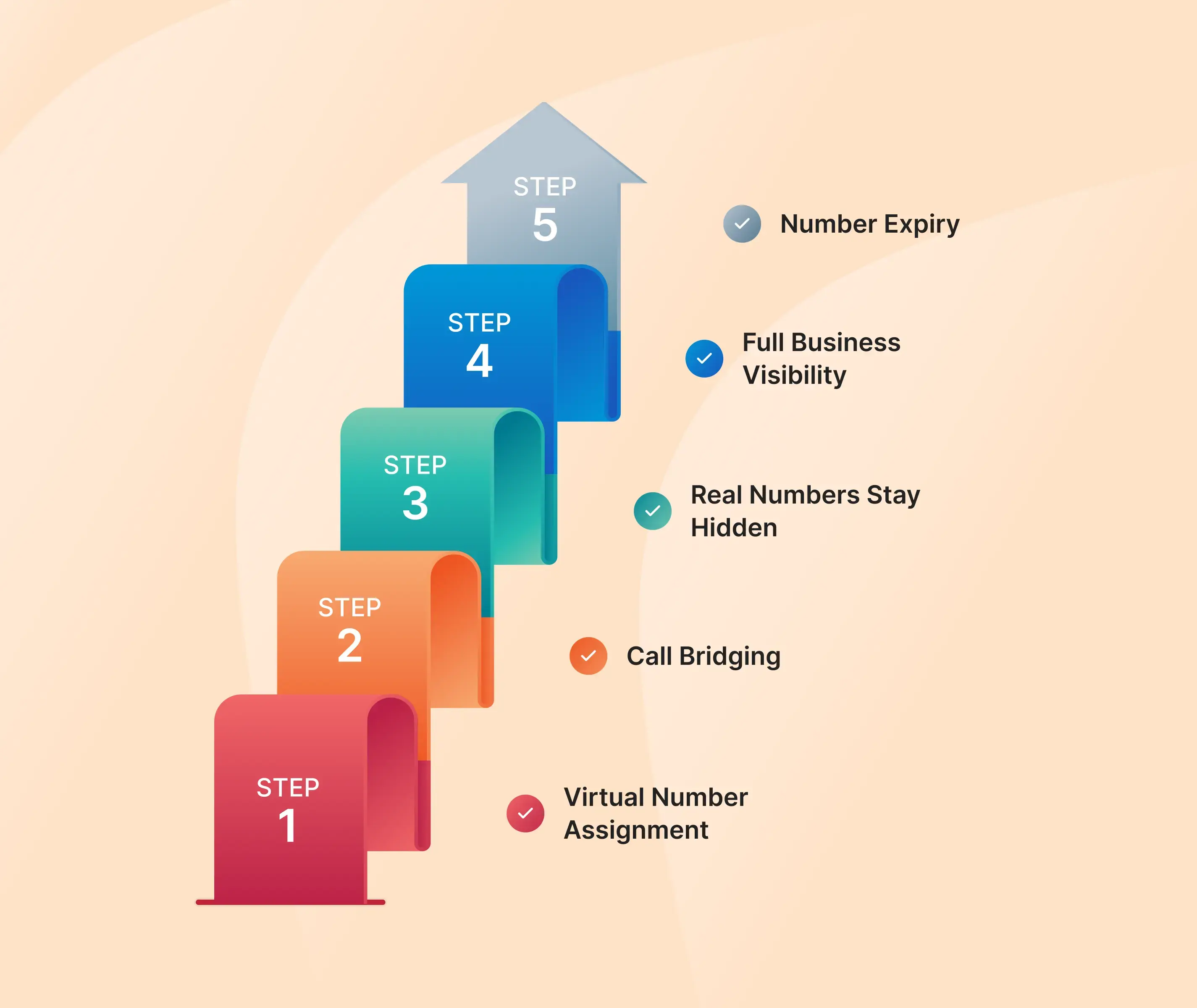
Step 1: Virtual Number Assignment
When a trigger event occurs, such as an order, booking, or support request, the system automatically assigns a proxy number via the API within milliseconds.
Step 2: Call Bridging
When either party calls, the platform silently bridges the connection to the correct agent or customer. Both parties hear each other in real time. It feels like a direct call.
Step 3: Real Numbers Stay Hidden
Neither party's actual number is ever exposed. Even if someone tries to capture the number from a call log, they only find the temporary proxy, which has already expired.
Step 4: Full Business Visibility
Behind the scenes, you get complete logs: call duration, timestamp, outcome, recording, and agent ID, synced to your CRM.
Step 5: Number Expiry
Once the session is complete, the proxy is retired. It can be recycled for a completely different pairing with no residual connection. This eliminates the biggest vector for post-transaction harassment and data misuse.
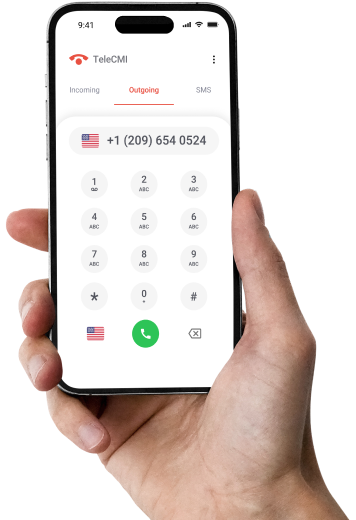
Protect customer privacy with TeleCMI call masking that hides real numbers, prevents misuse, and builds trust on every call.
Start 14 Days Free TrialCall Masking in Real Life: Three Scenarios
- Food Delivery — A customer orders from a restaurant app. The system assigns the proxy number +91-80-XXXX-0041 to the session. When delivery is marked complete, the proxy expires. Neither party can contact the other again through that number.
- Marketplace — A buyer on a classified platform wants to discuss a listing. A session proxy is assigned. Once the item is sold, the proxy closes. Post-sale harassment becomes structurally impossible.
- Ride-Hailing — A driver coordinates pickup through a temporary proxy for the trip duration. Once the ride ends, neither party can call the other directly — protecting both driver and passenger by default.
Top Benefits of Call Masking for Businesses
Features are what a product does. Benefits are what your business gains. Here's the real-world value of getting call masking right:
1. Protects Customer Privacy and Your Reputation
When a customer's number is exposed and misused, they don't blame the driver or the agent; they blame your brand. Call masking removes that risk entirely. You become the company that proactively protects its data without them having to ask.
2. Keeps Employee Numbers Private
Sales reps, delivery drivers, field agents, and healthcare workers don't sign up to have their personal mobile numbers permanently in customers' contact lists. Call masking protects your team and keeps communication secure with a click to call solution
3. Gives You Full Business Visibility
Privacy for customers and employees does not mean opacity for you. With call masking, every interaction is logged and auditable. Businesses can also use post call analytics to monitor conversations, agent performance, and call outcomes while keeping real numbers protected
4. Supports Legal Compliance
India's DPDP Act 2023, GDPR for international operations, and TRAI regulations all require businesses to handle personal data, including phone numbers, with appropriate safeguards. Call masking is one of the cleanest technical controls you can implement to demonstrate compliance.
5. Eliminates Spam and Post-Transaction Misuse
Temporary proxy numbers are the most effective technical control against phone number harvesting. Once the transaction ends, the proxy is no longer valid. There's nothing to save, sell, or misuse.
6. Centralizes Communication Control
All calls flow through a single, manageable infrastructure. You can apply routing rules, business hours logic, recording policies, and escalation paths, giving operations teams the control they need without restricting field staff.
Protect customer privacy with TeleCMI call masking that hides real numbers and keeps every conversation secure.
Get Started FreeIndustries That Need Call Masking
Call masking is not an optional feature; it is an absolute necessity in multiple sectors dealing with large volumes of private conversations:
- eCommerce/Direct-to-Consumer: Call coordination between fulfillment teams and customers regarding cash-on-delivery and return orders.
- Logistics/Last Mile Delivery: Driver-to-customer calls are frequent, time-critical, and carry significant risks should phone numbers be leaked.
- Ride Hailing/Last Mile Transport: Passengers and drivers coordinate rides automatically ending at the end of the trip.
- Real Estate: Private communication between brokers and agents on calls with potential home-buyers and tenants.
- Recruitment: Private calls between candidates and recruitment consultants without saving each other's phone numbers.
- Healthcare & Teleconsultation: Patient calls to practitioners with full data confidentiality and compliance.
- Classified Marketplaces: Buyer-seller interactions that must close the loop without exposing either party's identity.
- BFSI & Fintech: Customer outreach and collections with number privacy supporting both agent and customer interests.

Real-World Case Study: TeleCMI & Bitdefender
Global market leader in cybersecurity technologies, Bitdefender used TeleCMI to transform its customer service strategy by implementing masked outbound calls. In addition to enhancing data privacy and compliance, this resulted in a self-running 24/7 support center devoid of human intervention outside working hours.
Call Masking vs Normal Calling
Important Features to Look for in a Call Masking Solution
Not all call masking service providers are built the same. Here's what separates a capable solution from one that will create problems at scale:
Operational Features
- Virtual number pool depth: Enough numbers to handle peak demand without recycling collisions
- Real-time session management: Immediate assignment and expiry with no manual intervention
- API-first architecture: Clean integration with your app, CRM, or logistics platform
- Call recording with access controls: Recordings are available to authorized managers only.
- Detailed call logs: Duration, outcome, session ID, and agent mapping
- CRM and helpdesk sync: Data flows directly into your tools without manual export
- Mobile SDK support: Businesses running driver or field agent apps
Security and Compliance Features
- End-to-end encrypted call routing: No interception risk between the proxy and either party
- Data residency options: Store call records in-country for DPDP Act compliance
- Role-based access to logs and recordings: Only authorized personnel can review sensitive interactions.
- Audit logs: An immutable record of who accessed what and when
- TRAI-compliant number infrastructure: Especially relevant for Indian operations
- Session token expiry controls: Define how long a proxy remains active post-transaction
How Businesses Can Implement Call Masking
Implementation is typically a week or less for teams with API experience. Here's the practical path:
- Determine your use case: Define your call flow and plan to work with the API. The delivery, marketplace, and healthcare industries all have unique call lifetimes.
- Select your carrier: Consider the depth of phone number pools, available documentation, reach in India, compliance strategy, and support responsiveness.
- Integrate: Most providers will support REST APIs, webhooks, and SDKs. It takes one day to integrate your system (creation of sessions, call bridging, logging).
- Setup route parameters: Define the lifetime for sessions, enable business hours routing, add a backup routing rule, and define a consent prompt.
- Test and monitor: Observe calls per minute, percentage of failed calls, average call duration, and any other relevant metrics. Adjust routing based on results.
Call masking isn't just a feature - it's the smart way to protect privacy, build trust, and secure every business conversation.
Get Free TrialCall Masking Pricing: What Affects the Cost?
Pricing varies by provider and usage model. The primary cost drivers are:
- Virtual number pool size — more concurrent sessions require a larger pool
- Call minutes volume — per-minute rates for routed calls
- Geographic coverage — international numbers typically cost more than domestic
- Add-ons — call recording storage, advanced analytics, CRM integration fees
- Contract structure — monthly vs annual commitment, with volume discounts for annual
How to Choose the Right Call Masking Provider
The decision comes down to five questions:
1. Can their API handle your peak call volume without latency or errors?
2. Do they have Indian number coverage with TRAI-compliant infrastructure?
3. How quickly does their support team respond when something breaks at 2am during a delivery surge?
4. Does their compliance posture match your obligations under the DPDP Act 2023 and any sector-specific regulations?
5. Can you extend the same platform to handle call recording, IVR, CRM sync, and analytics — or will you need to stitch together five different tools?
The last question matters more than most buyers realize. Choosing a point solution for call masking that doesn't integrate with your broader communication stack creates operational debt that compounds quickly as you scale.
Why TeleCMI for Call Masking
TeleCMI is not just a call masking vendor. It's a full communication platform, and call masking is one of its most battle-tested capabilities.
Here's what that means in practice:
- Encrypted virtual number infrastructure with automatic expiry post-session.
- API first solution with web and mobile APIs; integrated in hours, not days.
- Real-time analytics for managing every session from one dashboard.
- Scales from 100 to 100,000 calls a day without re-negotiation or degradation.
- Multi-use case where the same solution is used for IVR, call forwarding, CRM integration, and intelligent routing.
- Bitdefender is using TeleCMI for the protection of agent and customer data privacy in addition to improved data security and better support efficiency.
- Free 14-day trial; all features unlocked; ready in under 10 minutes.
The Future of Call Masking in 2026 and Beyond
Masking is transitioning from a protective measure into an intelligent layer for communication. The three major developments driving future advancements are as follows:
Augmented AI Calls
AI technology is currently being embedded in masked call sessions for automatic transcription, emotion analysis, compliance detection, and post-call session summary generation.
Regulatory Tightening
As DPDP Act 2023 enforcement matures and sector regulators (RBI, IRDAI, SEBI) issue data handling guidelines, the question won't be whether to implement call masking; it'll be whether your implementation meets the specific standard your regulator expects.
Cross-Channel Privacy
Number masking will extend into messaging, masked WhatsApp sessions, masked SMS threads, and a unified privacy infrastructure across every channel. Businesses that build this now will have a structural advantage as the regulatory environment tightens.
Conclusion
Call masking is one of those rare technologies where doing the right thing for your customers also happens to be the right business decision. It protects privacy, reduces compliance risk, gives your operations team full visibility, and, done well, makes every customer interaction feel like it came from a company that genuinely cares.
In 2026, the question is not whether your business should implement call masking. The question is whether you're implementing it correctly — with the right infrastructure, the right compliance posture, and the right integration into your existing stack.
Protect Real Numbers. Keep Conversations Safe

Protects Customer & Agent Privacy
Tracks Every Call in Real Time
Stops Spam, Misuse & Unwanted Follow-Ups
Frequently asked questions (FAQ)
Vignesh N

With deep expertise in cloud telecommunications, I help readers explore the latest trends in VoIP and modern business communication. At TeleCMI, I focus on educating businesses with clear, practical insights, making complex telecom concepts easy to understand. I’m passionate about helping organizations improve efficiency, enhance customer engagement, and adopt smarter communication strategies.