AI Voice Agents vs Human Agents: Which Should Handle Calls?

17 mins read

Posted on Aug 21, 2026

Vignesh N
SEO


Vignesh N
SEO






The question is no longer whether businesses can automate phone conversations. They can. The harder question is deciding which calls should be handled by AI and which still need a human agent.
AI voice agents can handle routine, high-volume interactions such as answering FAQs, qualifying leads, scheduling appointments, and managing after-hours calls. Human agents, however, remain important for conversations that require empathy, judgment, negotiation, or complex problem-solving.
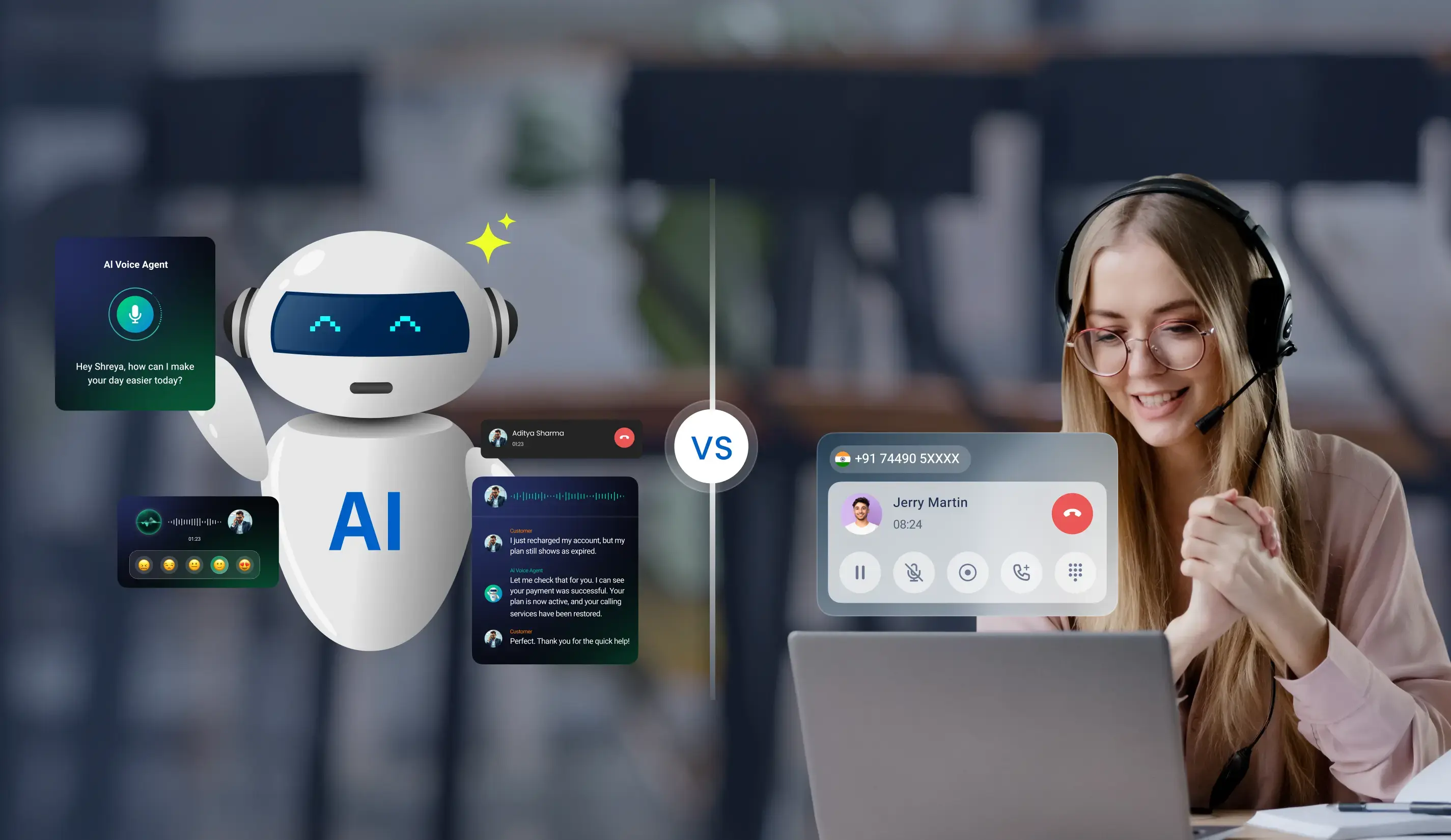
That is the real question behind AI Voice Agents vs Human Agents: not which one is better, but which type of interaction each is best suited to handle.
This guide compares AI voice agents and human agents across cost, resolution, customer satisfaction, consistency, scalability, and practical use cases. It also explains how businesses can combine both through a hybrid approach to improve customer experience while using human-agent time more effectively.

Key Takeaways
 AI voice agents are perfect for handling high-volume, repetitive calls.
- Human agents are still very much essential for interactions that need empathy, human judgment, negotiation, or special handling.
- The two work best together when the AI passes along all the relevant customer context during a handoff.
- Automation should be based on call type and business risk, not an arbitrary percentage.
- The right AI-powered customer service model reduces routine workload while keeping people available for conversations that need them.
What Is an AI Voice Agent and How Does It Work?
An AI voice agent is a software system that can handle phone conversations without a human agent on the other end. It listens to what the caller says, understands the intent, responds in natural language, and can follow a defined workflow to answer questions or complete a task.
The biggest difference from a traditional IVR is how callers interact with it. Instead of choosing from the fixed options such as “Press 1 for sales,” callers can simply explain what they need. The AI interprets the request and responds accordingly.
AI voice agents can handle both inbound and outbound calls, from answering FAQs and qualifying leads to collecting information, scheduling appointments, and routing calls. They do this by combining speech recognition to understand what the caller says, AI models and intent recognition to determine what the caller needs, and text-to-speech to respond naturally. Together, these technologies allow the agent to understand a caller, respond in real time, and take the next step in the conversation without relying on a fixed IVR menu.
Businesses can build AI-powered voice applications around their existing telephony setup, rather than treating the AI agent and phone system as separate layers. AI Agent Development makes it possible to create intelligent voice workflows that integrate directly with existing communication infrastructure. TeleCMI, for example, provides voice APIs and real-time AI streaming capabilities that allow businesses to connect calls with AI applications, process live call audio, and build custom voice workflows.
This also makes it possible to connect AI-driven conversations with other parts of the calling workflow, such as call transfers, recordings, and human-agent handling when a conversation needs escalation.
What Is a Human Agent and How Do They Work?
A human agent is a real person / trained employee who speaks directly with customers or prospects to answer questions, solve problems, provide support, or move a sales conversation forward. They can listen to what the customer is saying, understand the situation, and respond to them based on their specific needs.
Human agents are especially useful when a call involves a complaint, a complicated issue, a negotiation, or a high-value customer. They can pick up on frustration, ask follow-up questions, think through situations that do not have a straightforward answer, and decide what to do when the usual process does not apply.
That flexibility is their biggest strength. The trade-off is that businesses need to hire, train, schedule, and manage enough people to handle demand, which makes it important to use human-agent time where it adds the most value.
AI Voice Agents vs Human Agents Head-to-Head Comparison
Because AI voice agent performance on accents, background noise, and call quality varies so much by system, businesses evaluating vendors should ask how audio quality is tested across real-world conditions before rolling out at scale.
What AI Voice Agents Do Better - The Honest Assessment
The biggest advantage of AI phone agents is not that they are better at everything. It is that they can take on work that does not need a person.
- 24/7 availability
A human agent costs the business whether they handle 10 calls or 100 calls in a shift. An AI voice agent can handle the 3 AM call, the Sunday afternoon query, or a holiday weekend spike without overtime, shift changes, or additional staffing. The ability to stay available without increasing staffing costs for every additional interaction is one of the clearest advantages of AI voice agents.
- Consistency across every interaction
Human agents can naturally vary in how they handle the same conversation. After a difficult call, during a long shift, or simply from one agent to another, the tone and information shared may differ. AI voice agents follow the same workflow, approved responses, and required disclosures every time. This is particularly useful when businesses need certain information communicated accurately and consistently across a large number of calls.
- Handling high volume without queue buildup
A product launch, service outage, or major sale can push call volumes 5–10x above the usual level. A human team can only handle as many calls as the available agents allow, which can quickly lead to long queues and abandoned calls. With conversational AI, you can handle multiple conversations simultaneously, so 500 calls at once is a disparate challenge from handling 5.
- Routine query resolution at scale
Some customer calls are simple and predictable. Like checking an order status, confirming an appointment, sharing an account balance, or answering a common question. When the answer and process are already defined, an AI voice agent can handle the conversation without involving a human agent. This way, human agents can focus their time on calls that need judgment, empathy, or problem-solving rather than spending their shifts answering the same routine questions.
- Data capture and CRM sync
AI can capture information during a call, create transcripts and summaries, and sync relevant details with connected CRM or business systems. The information is recorded consistently without depending on an agent's memory or whether they have enough time between calls to update the record. Human agents can then start with the relevant customer information already available rather than spending time documenting routine interactions manually.

Trust Factor #1:
Gartner's forecast illustrates how quickly AI agents are becoming part of sales organizations, but adoption alone does not determine which customer conversations should be automated.
What Human Agents Still Do Better - The Honest Assessment
Human agents remain especially valuable when the conversation has consequences that go beyond retrieving information.
- Emotional intelligence and empathy
A caller dealing with a failed delivery, billing dispute, service failure, or sensitive personal issue may need reassurance as much as information. A human agent can listen to the customer's frustration, adjust the tone, and decide how much explanation is needed.
- Complex problem solving
Not every customer issue fits neatly into one process. A caller might have a billing problem, a previous complaint, and a service issue at the same time. A human agent can look at the full situation, connect the different pieces, speak with the relevant teams, and work out what needs to happen next.
- Relationship building
AI call agents for sales teams can handle qualification and early-stage conversations effectively when the process is structured. But those high-value B2B sales often involve negotiation, objections, trust, and several stakeholders. A human salesperson can read the situation and change the conversation accordingly.
- Unexpected situations
Customers do not always follow the process a business has designed. They may ask for something unusual, provide incomplete information, or bring up a problem that does not have a standard solution. When the right response depends on judgment rather than a defined workflow, having a human agent take over gives the business more flexibility to handle the situation.
This does not make AI incapable of complex conversations. It means businesses should decide how much risk and ambiguity they are comfortable assigning to automation.
Let AI Handle Routine Calls and Route Complex Conversations to the Right Human Agent.
Start 14 Days Free TrialThe Real-World Use Cases: Who Should Handle What?
Routine Inbound Queries — AI
AI can quickly handle FAQs, order status, business hours, and other structured requests.
Lead Qualification — AI + Human
AI can collect basic lead details and qualify prospects before handing them to a salesperson.
Complaint Resolution — Human
Sensitive complaints need empathy, judgment, and personalized support, making human agents a better fit.
Appointment Scheduling — AI
AI can check availability, book appointments, and confirm details through a defined workflow.
Enterprise & High-Value Sales — Human
Complex sales require negotiation, relationship building, and human judgment.
After-Hours & Overflow Calls — AI
AI can handle calls outside business hours or during peak demand, reducing missed calls and wait times.
Trust Factor #2:
Customer acceptance of AI agents varies considerably by use case. Salesforce reports that 46% of business buyers would work with an AI agent for faster service, while only 17% of customers are comfortable with an AI agent making financial decisions. That difference reinforces an important point for human vs AI customer service: the right level of automation depends on what the customer is asking the system to do.
The Hybrid Model - How Leading Businesses Use Both in 2026
A hybrid AI contact center and human contact center starts with a simple principle: let AI handle the interactions it can resolve and involve people when the conversation crosses a defined threshold.
An AI voice agent picks up the incoming call first. It figures out why the caller is reaching out, gathers all the basic details, answers simple questions, and checks if a real person needs to step in. If the call needs a human touch, it will route straight to the right team.
TeleCMI supports this hybrid setup as both a telephony platform and a foundation for AI-powered calling. Businesses can connect an AI voice agent they already use, or build their own AI calling workflows using TeleCMI's APIs and real-time voice capabilities. Calls can then move between the AI and human agents as the conversation requires.
The same principle applies to the internal team. If AI removes routine conversations from the queue, human agents can actually spend more of their shift on cases that need experience and judgment. That can change the role of the team without making the team smaller by default.
For businesses considering how AI voice agents reduce agent workload, this is often the more useful question: which tasks are consuming human time without requiring human judgment?
How to Decide How Much of Your Call Volume to Automate
Do not start by deciding that 30%, 50%, or 80% of your calls should be automated. Start by looking at the calls themselves.
First, review your recent call volume and group conversations by type. Separate routine questions from complaints, exceptions, negotiations, and calls that require specialist knowledge. Also look at when calls come in. After-hours demand and predictable volume spikes can be good starting points for automation.
Then look at what happens when calls go unanswered. A customer may call back if they cannot get help, but a prospect who cannot reach your agent will most probably move on. It makes sense to begin with simpler calls such as FAQs, appointment scheduling, after-hours queries, and lead qualification before taking on more complicated conversations.
Once AI is handling these calls, measure what actually happens. Look at resolution rate, transfer rate, the reasons for escalations, customer satisfaction, abandonment rates, average handling time, and also the agent workload. If AI performs well on a particular call type, you can expand its role. If customers frequently ask for a human or the AI struggles with a workflow, that is a signal to keep it human-led.
The goal is not to automate a fixed percentage of calls. It is to automate the calls where AI can reliably do the job while keeping humans involved where they add more value.
Trust Factor #3: ROI depends on the workflow
IBM found that 47% of surveyed IT decision-makers were already seeing positive ROI from their AI investments. For businesses evaluating AI-powered calling, customer feedback can add another layer of context, so it is worth looking at how users rate and review platforms. G2 reviews of TeleCMI provide another practical reference point, with users highlighting easier call management, time savings, reporting, and CRM integration.
AI Voice Agents vs Human Agents: Cost and ROI Considerations
The cost comparison is not just about how much an AI call costs vs. paying a human agent.
With a human team, the overall cost includes salaries, benefits, training period, scheduling, overtime, management, recruitment, and the expense of adding more people when call volumes increase. AI has its own costs, including setup, integrations, usage, maintenance, monitoring, and developing the workflows it needs to handle calls properly.
There is also the cost of calls that never get answered. A customer who gives up after waiting in a queue may call again or leave frustrated. But a prospect who calls outside business hours may move on if nobody responds. Those missed conversations should be part of the ROI calculation too.
The ROI of AI customer service improves when automation is applied to enough repetitive volume to offset its implementation and usage costs. It is less compelling when the call volume is low or most conversations require human judgment.
McKinsey's research on contact-center AI also shows why the business case should include agent productivity, not only direct automation. In a recent study, an AI assistant increased issue resolution by 14% per hour and reduced time spent handling an issue by 9%.
The Future of AI Voice Agents and Human Agents
The next stage is likely to be less about making AI sound human and more about The future of customer interaction is a hybrid model where AI and human agents work together:
- AI handles volume: Manages routine calls 24/7 and scales during demand spikes without needing to add any extra staff.
- AI connects with business systems: Pulls customer information, schedules appointments, and completes defined tasks.
- Humans handle complexity: Focus on sensitive complaints, complex problems, negotiations, and situations requiring judgment.
- Smart routing: AI identifies intent and sentiment, then routes complex calls to the right human agent.
- Seamless handoffs: Agents will receive the conversation context and transcripts instead of making customers repeat themselves.
- AI assists agents: Live suggestions, call summaries, and customer insights help human agents resolve calls faster.
How TeleCMI Helps Businesses Combine AI Voice Agents and Human Agents
TeleCMI provides the telephony platform businesses need to bring AI and human calling together. Businesses can connect an AI voice agent they already use, or build their own AI-powered calling solution using TeleCMI’s APIs and real-time AI streaming capabilities.
Once connected, AI can handle routine conversations, collect information, or process calls before routing them to human agents when needed. TeleCMI supports the human side with call recording, live monitoring, transcription, automated summaries, sentiment analysis, AI Assist, and 170+ CRM integrations. Its contact-center capabilities also include call transfer, barging, whispering, monitoring, and recording.
This creates one connected workflow where businesses can use the AI solution of their choice while TeleCMI provides the telephony, call management, and human-agent infrastructure around it.
The Bottom Line
The better question in AI voice agent vs human agent is not which one wins. It is which one should handle each type of call. AI voice agents should not be treated as a complete replacement for human agents.
AI is well suited to routine, repetitive, high-volume interactions. Human agents remain essential when calls require judgment, empathy, negotiation, or complex problem solving. TeleCMI provides the telephony layer that businesses can connect to an AI voice agent they have built or already use, while its contact-center capabilities support the human side with call routing, recording, monitoring, transcription, summaries, sentiment analysis, AI Assist, and CRM integrations.
Ready to Combine AI Voice Agents and Human Agents?

AI Voice Agent Integration
Smart Call Routing & Transfers
Call Recording & AI Summaries
170+ CRM Integrations
Frequently asked questions (FAQ)
Vignesh N

With deep expertise in cloud telecommunications, I help readers explore the latest trends in VoIP and modern business communication. At TeleCMI, I focus on educating businesses with clear, practical insights, making complex telecom concepts easy to understand. I’m passionate about helping organizations improve efficiency, enhance customer engagement, and adopt smarter communication strategies.