How Does Call Masking Work? A Complete Technical Guide to Secure Business Communication

16 mins read

Posted on Jul 24, 2026

Vignesh N
SEO


Vignesh N
SEO






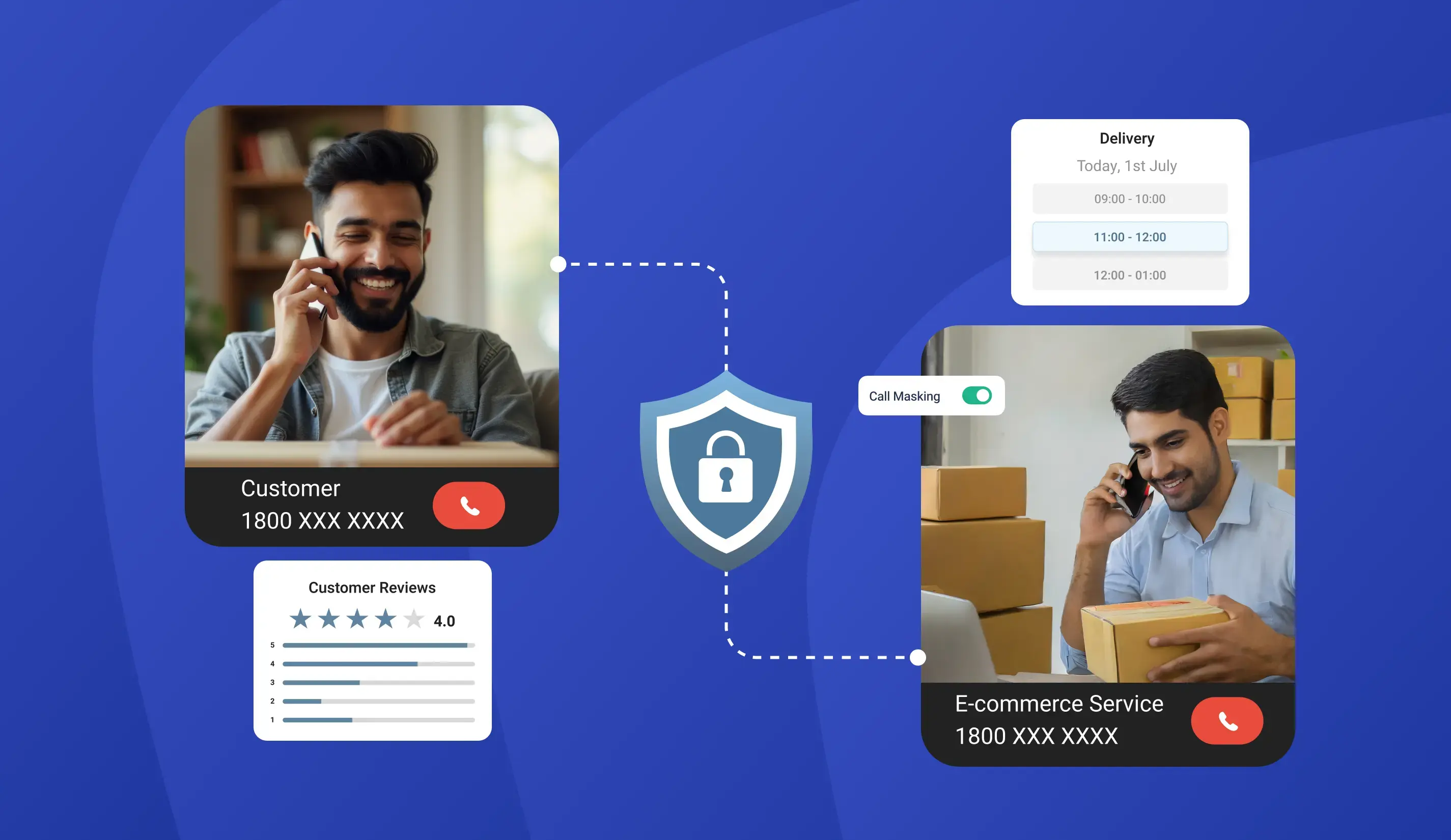
A delivery rider calls a customer to confirm the address before completing an order. The call lasts less than a minute, the package is delivered, and the job is done. But the conversation leaves behind something neither party intended to share - their personal mobile numbers.
That means customers can still call the driver after the order is dropped off, and drivers can contact customers off the app. What should just be a quick delivery ends up leaving both sides' personal details exposed.
Call masking prevents this by replacing real phone numbers with temporary virtual proxy numbers. The call normally connects, but neither the customer nor the delivery rider sees the other's actual number.
In this guide, you'll learn how call masking software works behind the scenes, how virtual proxy numbers route calls, the different types of call masking, where businesses use it, its role in privacy and regulation, and what to look for when implementing a call masking solution.

Key Takeaways
 Call masking uses temporary virtual numbers to protect the real phone numbers of callers and recipients.
- Calls are routed through a cloud telephony platform that securely connects both parties.
- Call masking keeps personal numbers private and automatically tracks call records. This way, it prevents off-platform communication.
- Unlike deceptive caller ID spoofing, masking operates through authorized virtual phone numbers. This keeps all call activity fully traceable.
- Modern solutions integrate with CRMs and business applications to automate number assignment and session management.
What Is Call Masking?
Call masking is a cloud telephony technology that replaces the real phone number of the caller or recipient with a temporary virtual proxy number during a phone call. This allows both parties to communicate without revealing their personal phone numbers.
From the user’s end, nothing changes. They just make or receive a call as usual. In the background, the telephony platform assigns a virtual number to hide the actual phone numbers. Once the call ends, that proxy number is turned off automatically.
Spoofing is about tricking people with fake numbers, which is illegal. Call masking is a legitimate privacy feature that protects personal numbers. It keeps complete call records so you always have proof if an issue comes up down the road.
It’s the industry standard for gig apps, delivery services, and healthcare providers, letting teams talk to customers safely by personal phone number masking.
Call Masking How It Works – The Technical Mechanics
Although the experience feels like a regular phone call, several automated processes happen within seconds inside the cloud telephony platform.
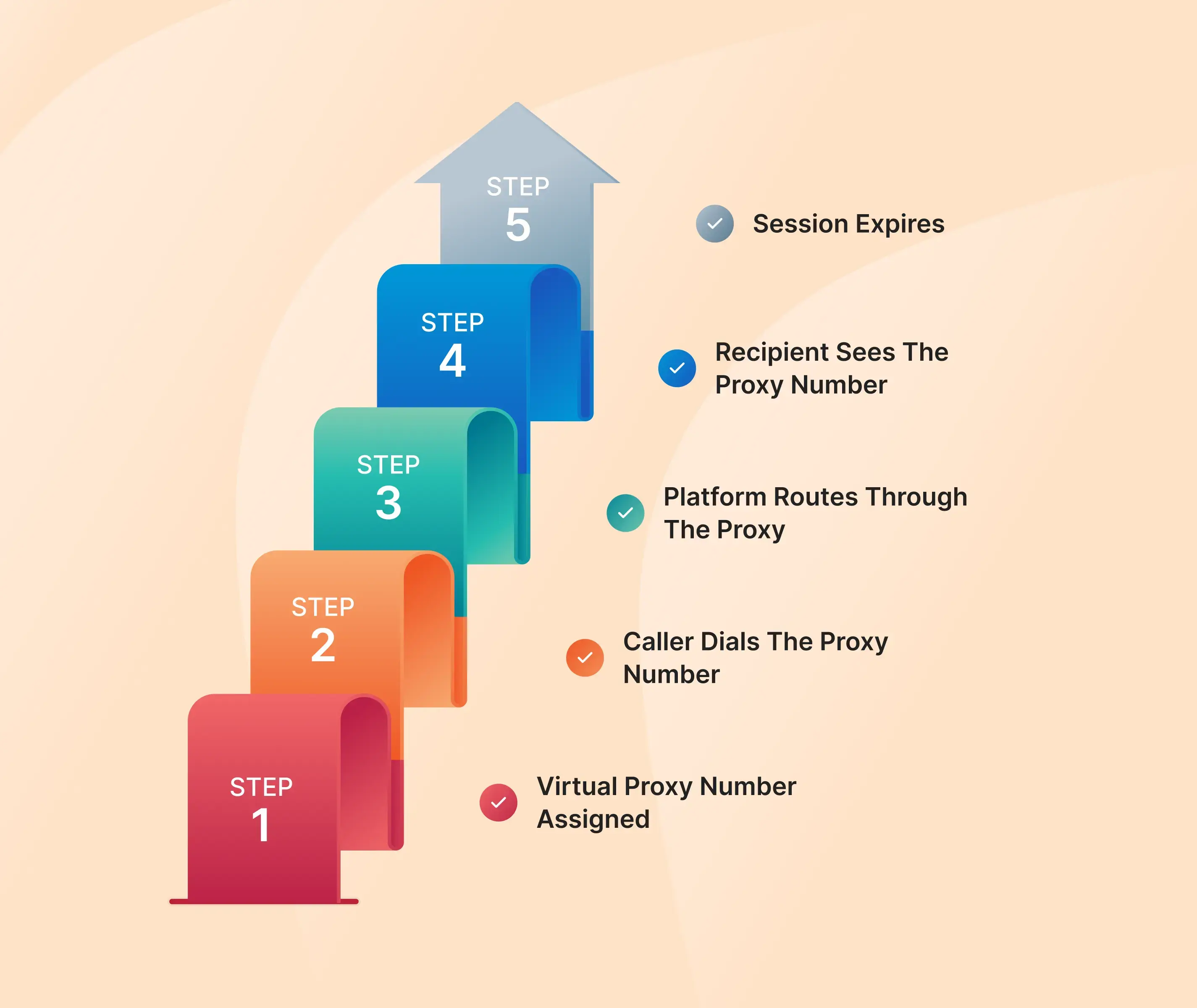
Step 1: A virtual proxy number is assigned
The process begins when a business event triggers communication. For example, when an order is placed, a ride is accepted, an appointment is booked, or a support ticket is created.
Rather than sharing actual phone numbers, the platform assigns a temporary virtual number from its system. It routes the call just for that specific order or trip, and then disconnects. So there’s no permanent link between both sides.
Step 2: The caller dials the proxy number
When an agent starts the call, it is automatically routed through the cloud telephony platform rather than directly to the recipient.
Using APIs or application integrations, the platform associates the call with details such as the customer, agent, transaction, assigned proxy number, and session duration before connecting the call.
Step 3: The platform routes through the proxy
First, the platform verifies the active session and swaps in a virtual proxy number. From there, it hides both caller IDs and bridges the call instantly.
Because the routing happens through the platform, firms can also enable features such as call recording, analytics, reporting, and quality monitoring without affecting the calling experience.
Step 4: The recipient sees the proxy number
When the recipient gets a call, only the proxy number appears on screen. If the customer calls back while the session is active, the system automatically recognizes the number and routes the call right back to the agent. So neither side ever needs to share their real phone number.
Step 5: The session expires
Call masking is only meant for temporary interactions. The proxy number automatically deactivates once an order or appointment ends. It will also deactivate if a pre-configured timeout kicks in.
The number may become inactive, return to the available pool, or be reassigned to another transaction. This ensures personal phone numbers remain protected after the interaction has finished.
IBM’s Cost of a Data Breach Report shows that the global average breach cost was $4.44 million. That kind of number is a strong signal of why businesses are careful about exposing customer contact details in communications.
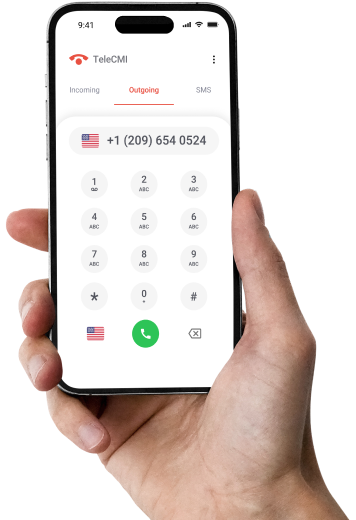
Protect Customer Privacy with Secure Call Masking and Virtual Phone Numbers.
Start 14 Days Free TrialTypes of Call Masking
Businesses have different communication requirements, so call masking can be configured in several ways depending on how long interactions last and who's privacy needs to be protected.
- One-way masking
One-way masking keeps one person's number hidden while leaving the other visible. It’s widely used for outbound calls from personal devices. A sales rep can call leads from their personal phone, but the recipient sees the official office number. This ensures return calls land back with the business, not the employee.
- Two-way masking
Two-way masking shields contact details for everyone on the call. Both parties talk through a middleman proxy number, so personal phone numbers stay 100% private.
This is the standard approach call masking used by delivery platforms, ride-hailing services, healthcare marketplaces, and similar businesses where customer and agent privacy are equally important.
- Session-based masking
Session-based masking gives you a temporary number strictly for a single task. This can be a delivery, ride, appointment, or support request.
As soon as the interaction finishes or times out, the platform releases the proxy - stopping unsolicited call-backs and keeping private info safe.
- Permanent number masking
Permanent masking assigns the same virtual number to an employee, department, or customer relationship for an extended period.
This approach is useful for industries such as real estate, recruitment, and account management, where customers expect ongoing communication with the same business contact while employees' personal numbers remain private.
Phone Number Masking vs Caller ID Spoofing – Why the Distinction Matters
Phone number Call masking and caller ID spoofing both display a number different from a person's actual mobile number, but they serve entirely different purposes.
First, let’s cover the question ‘what is call masking?’. Call Masking is a secure privacy feature that uses temporary virtual numbers to route calls. The platform securely stores the actual call logs for safety and dispute resolution.
Call spoofing, on the other hand, uses fake or unauthorized caller IDs to deceive the receiver about who is calling. Unlike call masking, spoofing is commonly associated with scams and is illegal or heavily restricted in many countries, including India and the US.
For businesses, this distinction is critical. A legitimate phone number masking solution should always use authorized virtual numbers, maintain complete call records, support audits, and operate within an approved business workflow.
TRAI encourages call masking to keep customer data safe - as long as it’s done legally through licensed telecom networks.
Permitted:
- Using authorized proxy numbers from licensed cloud telephony providers to shield customer privacy.
- Retaining detailed call logs and audit trails for legal and verification purposes.
Not Permitted:
- Displaying fake / misleading caller IDs to deceive people.
- Impersonating individuals or brands.
- Using virtual numbers to dodge telecom laws or facilitate scams.
TRAI strictly regulates caller ID in India to fight misuse of caller identification
Business Use Cases for Call Masking
Any business that needs to contact their customers without revealing their personal number can benefit from call masking. It safeguards privacy, keeps interactions on-platform, and guarantees each call remains fully traceable.
- Gig Economy and On-Demand Delivery
Delivery drivers frequently contact customers to verify addresses. With two-way masking, both parties communicate through a temporary virtual number instead of exchanging personal phone numbers. The moment the package is at the door, the line disconnects. So no one gets after-hours calls. But all interaction records stay safely saved.
- Ride-Hailing and Transportation
Finding a passenger on a busy street takes a fast call - but neither side needs to trade real cell numbers to do it. Call masking lets them communicate through a proxy number for the trip. This protects both parties from uninvited contact after the ride ends while keeping every call linked to the trip recorded.
- Healthcare and Telemedicine
Doctors, nurses, and coordinators constantly contact patients. Through call masking, only the hospital's business number is displayed to the patients, keeping healthcare professionals' private numbers off-limits while guaranteeing patient callbacks reach the main desk.
- Real Estate
Real estate agents spend all day on the phone with buyers, tenants, and property owners. Showing a central business number instead of a personal cell helps maintain a professional image. This also stops clients from blowing up an agent's personal phone after hours.
- E-commerce Customer Support
Support reps often call customers about deliveries, returns, or payment checks. Call masking ensures customers always see the official company number, even if reps work from home. Simultaneously, supervisors can easily track all call activity using centralized reports.
- Financial Services
Banks, lenders, and insurance companies use call masking to display official business numbers during verification, collections, and service calls. This improves customer confidence whilst keeping auditable communication records for compliance purposes.
- Recruitment and HR
Recruiters often call job candidates using their personal mobile phones. With call masking, displaying the company's official HR number maintains professional communication. It also stops candidates from reaching the recruiter's personal phone after the hiring process is completed.
Privacy Compliance and Secure Communication
How call masking supports GDPR compliance: Call masking keeps personal contact details hidden by routing calls through temporary virtual numbers. This limits unnecessary exposure of customer phone numbers to third-party agents. It corresponds directly with GDPR’s data limitation principle, ensuring teams only share the data required to complete a call.
How it supports India’s DPDP Act: India’s Digital Personal Data Protection Act, 2023, classifies phone numbers as protected personal data. This means businesses should treat customer numbers as protected personal data and use call masking to limit who can see them.
Call logs and records: Even when the live call is masked, the platform can still retain the real caller and recipient numbers. These logs are important for audits, fraud checks, or handling any upcoming disputes. It is important to understand that privacy protection doesn't necessarily require deleting all the operational records immediately. It simply means restricting access to them.
Data retention policies: Proxy call logs should only stick around as long as you actually need them for business or legal reasons. After that, they need to be permanently removed or de-identified according to a documented retention policy. A good policy defines retention windows by use case, such as shorter retention for routine logs and longer retention only where law, disputes, and compliance require it.
When evaluating a call masking solution, it's important to look beyond number masking itself. TeleCMI’s call masking solution routes calls through virtual proxy numbers to keep personal details completely hidden. Combined with secure call logs, call recordings, API integrations, CRM connectivity, and centralized reporting, it enables organizations to maintain traceable communication records while lowering unnecessary exposure of personal contact information.
How to Set Up Call Masking for Your Business
Implementing call masking requires configuring your communication workflow rather than deploying new hardware.
Step 1: Choose a cloud telephony provider
Select a call masking service provider that offers call masking, virtual numbers, session management, and the integrations your business requires.
Step 2: Define your use case
First, decide if you need one-way or two-way call masking for your business. Then, decide how long those temporary numbers should be in use - like, should they expire right after a transaction, after a set time, or stay active for long-term clients?
Step 3: Configure proxy number pools
Virtual numbers are assigned dynamically from a shared number pool. Calculating your ideal pool size comes down to two main factors: your expected concurrent call volume and target regions.
Step 4: Set session duration and expiry rules
Configure specific expiration rules for your temporary virtual numbers. Choose to disconnect numbers as soon as a task finishes - like a completed ride / closed ticket- or you can even set them to expire on a fixed timer.
Step 5: Integrate with your CRM or Order Management Platform
Your team shouldn't have to assign virtual numbers by hand. Proxy numbers are assigned automatically whenever a new order, booking, or ticket is created through integrating with your CRM.
Step 6: Test the communication flow
Before going live, verify the following:
- The recipient sees the proxy number and not the real number
- Return calls are routed correctly
- Test if the call recording features are enabled
- Check system analytics to record call details correctly
- Verify proxy numbers disconnect once sessions expire
Step 7: Train your team
Trust is built not only through strong privacy practices as well as through the reliability of the communication platform businesses choose. In one global privacy study, 64% of consumers said clear information with respect to privacy practices would increase their trust.
This highlights why organizations should choose providers that combine privacy-focused features with dependable implementation and support. TeleCMI's reviews on G2 reflect this, with customers frequently featuring its ease of implementation, responsive support, and reliable cloud telephony capabilities for enterprise communication.
What to Look for in a Call Masking Solution
Not every call masking platform offers the same level of functionality. Consider the following before making a decision.
- Does it support both one-way and two-way masking? Choose a solution that offers both, so you can match different business use cases and privacy requirements.
- Are proxy numbers available in your target countries? Check that your provider offers virtual numbers wherever your business operates. You don't want coverage gaps in major markets.
- Does it support session-based expiry or only permanent assignment? Session-based expiry automatically drops numbers as soon as a transaction ends. This creates a much stronger privacy buffer than keeping static numbers assigned indefinitely.
- Is the system integration API-based? Look for APIs and CRM integrations that automatically assign proxy numbers based on orders, bookings, or support tickets.
- Are call recordings retained for dispute resolution? Secure call recordings and logs help with quality monitoring, compliance, and customer dispute resolution.
- Is the system TRAI and GDPR Compliant? Make sure the platform handles data safely and conforms to local telecom rules. Proper data governance keeps your communication compliant across every market.
Businesses looking for a long-term call masking solution should choose a platform that combines these capabilities in a single, easy-to-manage system. TeleCMI combines call masking with virtual numbers, REST APIs, CRM integrations, webhook support, encrypted call recordings, real-time analytics, and centralized number management, permitting businesses to implement secure communication workflows devoid of disrupting existing operations.
Wrapping Up
Every business has situations where people need to talk without disclosing personal phone numbers. Whether it is a delivery driver at the door, a recruiter calling a prospective candidate, or a support agent checking in on an open ticket - people need to talk. Call masking makes those connections happen naturally without leaving personal phone numbers out in the open.
Beyond protecting privacy, it also gives businesses better control over customer communication. Teams can track calls, maintain conversation records, integrate with their CRM, and guarantee all interaction happens through an approved business channel.
TeleCMI brings these capabilities together in a single cloud platform. Along with call masking, businesses get virtual numbers, CRM integrations, APIs, analytics, and call management features that make it easier to build secure, scalable, and well-managed communication workflows.
Ready to Build Secure Communication Workflows with TeleCMI?

Privacy-First Call Masking
REST APIs & Webhooks
Real-Time Analytics
Cloud Telephony Platform
Frequently asked questions (FAQ)
Vignesh N

With deep expertise in cloud telecommunications, I help readers explore the latest trends in VoIP and modern business communication. At TeleCMI, I focus on educating businesses with clear, practical insights, making complex telecom concepts easy to understand. I’m passionate about helping organizations improve efficiency, enhance customer engagement, and adopt smarter communication strategies.

.png)