IVR vs AI Voice Agent: What Is the Difference in 2026

11 mins read

Posted on May 22, 2026

Saravana Kumar
SEO


Saravana Kumar
SEO






Picture this.
A customer has a billing question. They call your support line at 8 PM on a Friday night.
What greets them?
A flat robotic voice.
“Press 1 for sales. Press 2 for support. Press 3 for billing.”
They press 2.
Then another menu appears.
“Press 1 for account issues. Press 2 for technical problems.”
One wrong choice later, they are back where they started.
By now, frustration has replaced patience. The customer hangs up. Maybe they'll try your competitor instead. This continues to occur daily across banks, hospitals, e-commerce sites, telecommunications companies, and airlines. But, in 2026, clients will be looking for something completely different.
Clients will prefer talking with real humans rather than getting pre-recorded responses. And here comes the role of AI voice agents.
Instead of guiding customers through IVR menus, AI voice agents enable customers to communicate freely. The system listens, comprehends intent, answers instantly, and most likely solves the problem without human assistance.
The contrast between a standard IVR system and an advanced AI voice agent is not merely technological but has ramifications for customer satisfaction, operational efficiency, retention, and profits.
Companies that continue to use traditional IVR flows are beginning to realize the difference.
In this article, you will learn about how the two systems operate and specialize, along with the alternatives that business owners can explore in 2026 while making decisions between IVR and AI voice agents.

Key Takeaways
 IVR systems are based on static menus and buttons, while AI voice agents offer natural-language interaction.
- The ability to analyze context and detect user intent makes AI voice agents significantly better at solving people's problems directly.
- Businesses implementing AI voice agents in 2026 benefit by providing superior customer service, increasing retention, and minimizing support costs.
- IVR is valuable for simple applications, including call routing, announcement of office operating hours, and data management.
- Today's businesses often use both IVR and AI voice agents together.
IVR vs AI Voice Agent: Understanding the Difference
Companies have been relying on IVR technologies for many years to handle inbound customer calls. It allowed for reducing the load on support specialists and managing calls properly. However, customer preferences have evolved, and now everyone wants to conduct fast, smooth, and easy conversations.
This is where AI voice agents will replace IVR systems and bring a new level of service.
Traditional IVR Systems: Structured but Limited
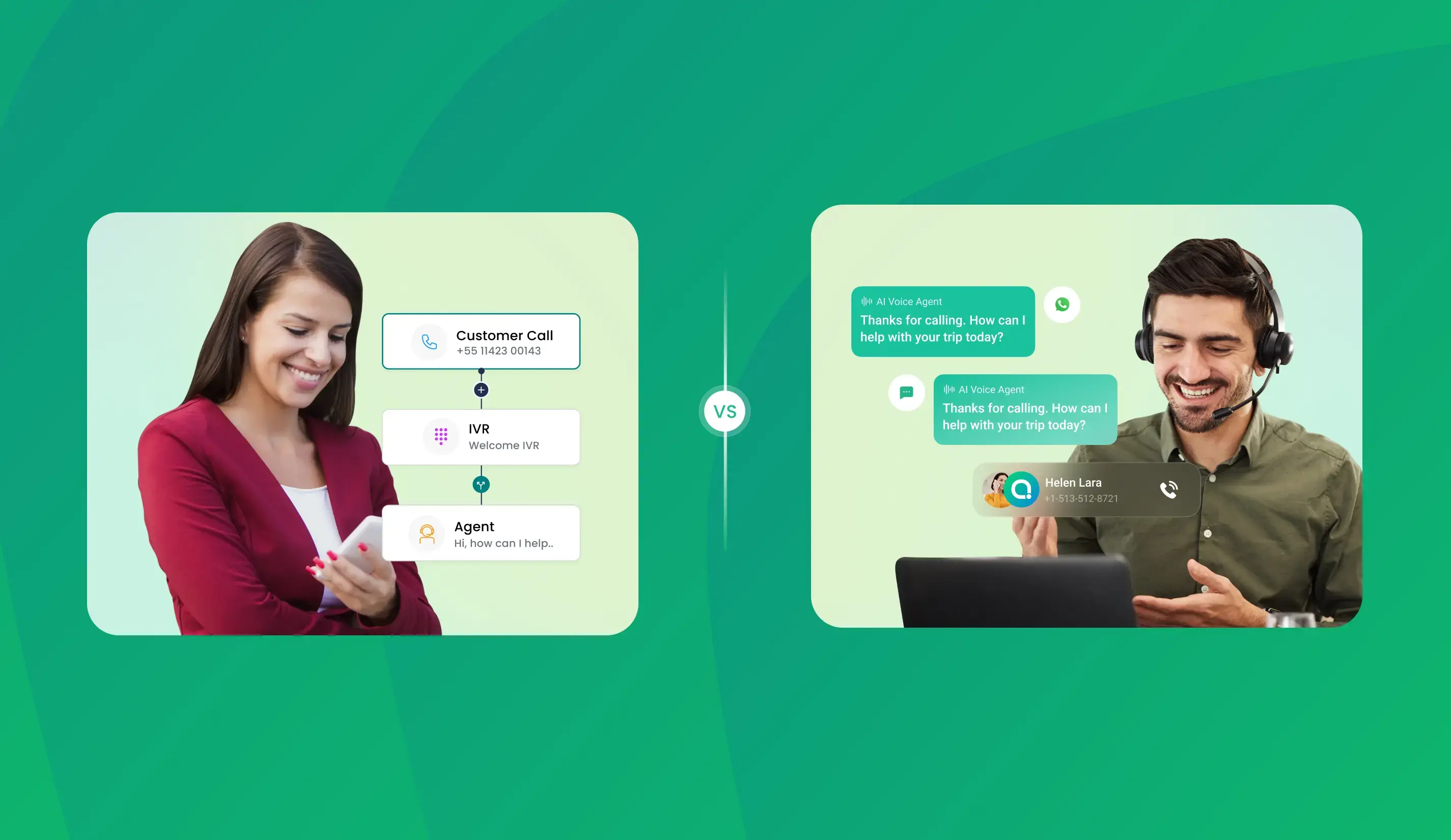
The Interactive Voice Response (IVR) system runs using predefined call flows. The customer responds to various menus with key presses or utterances. Based on their response, the call will be routed.
A common interaction looks like this: Press 1 for Sales. Press 2 for Customer Support. Press 3 for Billing. Press 0 to talk with an agent.
This model works well for straightforward tasks such as:
- Routing calls to departments.
- Sharing business hours
- Providing account status updates
- Handling high call volumes efficiently
For businesses managing thousands of calls daily, IVRs have long been a practical solution. But rigidity is one of the major reasons why organizations are adopting AI-based voice technology.
AI Voice Agents: Conversational and Context-Aware
Compared with rigid menus, AI voice agents offer entirely different functionality. Unlike traditional menus that force callers to make difficult choices, AI agents give callers the opportunity to express themselves as they would in a conversation with a human agent.
The following technologies are utilized by AI voice agents:Natural Language Processing (NLP)
- Speech recognition
- Large Language Models (LLMs)
- Real-time voice synthesis
Rather than selecting options, the customer simply explains the issue.
For example:
“I was charged twice for my subscription, and I need a refund.”
The AI assistant recognizes the user's statement through voice recognition technology and responds in natural language to process the issue.
No keypad navigation. No repeating menus. No guessing which department to choose.
Modern AI voice agents in 2026 can:
- Manage full customer conversations.
- Understand context and intent.
- Handle interruptions naturally.
- Support multiple languages.
- Integrate with CRMs and support platforms.
- Escalate calls to human agents when needed.
- Improve responses through continuous learning.
The result feels far more human and far less transactional. Instead of navigating a system, customers feel like they are having an actual conversation.
What Is the Difference Between IVR and AI Voice Agents?
The Business Cases Where IVR Still Wins
Even with the rise of conversational AI, traditional IVR systems still solve a few business problems extremely well.
- Simple, predictable call flows like “Press 1 for billing” or “Press 2 for technical support”
- Businesses operating with very limited support budgets
- High-volume environments where routing matters more than conversation quality
- Compliance-heavy industries that require scripted, auditable responses
- After-hours routing and basic self-service requests

HubSpot also reports that 75% of customer service teams recently saw record ticket volumes, which explains why automated routing remains necessary for many operations.
Why Businesses Are Moving Toward AI Voice Agents
AI voice agents are designed for conversations that do not follow a rigid script. Instead of forcing callers through layered menus, they can understand intent, respond naturally, and guide customers toward resolution in real time.
They are especially effective in situations like:
- Complex, multi-step customer conversations
- Businesses handling large volumes of repetitive support queries
- 24/7 customer support without expanding agent headcount
- Multilingual support environments
- Teams are trying to reduce hold times and call abandonment
Can IVR and AI Voice Agents Work Together?
Yes. Instead of completely replacing each other, many businesses tend to use both technologies at the same time. Under this hybrid model, the voice agent handles the customer's dialogue. The technology recognizes intent using natural language processing and extracts all critical data from the interaction. Then it routes requests to IVR, where all the necessary procedures, such as routing, transfer, compliance prompts, or queues, happen.
This combination gives businesses the flexibility of conversational AI without abandoning the reliability of traditional routing systems.
By 2026, this hybrid arrangement will become a common practice among medium-sized and large support operations. Although automation is preferred in terms of efficiency, companies require predictable workflows, audit logs, and overall controllability.
This is the reason why TeleCMI sees a growing trend towards using IVR and AI voice agents as two complementary technologies rather than competitors.
Explore how AI voice automation and IVR can work together inside a single platform
Talk with an ExpertHow to Decide Whether Your Business Needs IVR or an AI Voice Agent
The decision between IVR and AI voice assistants is not merely a technological one. This is about the experience your customers will have, the system's cost efficiency, its response time, and the scalability of your support team. Instead of trying to figure out which technology works better, the right question is which type of technology will best suit the way your company communicates with customers.
Here are 10 practical questions that can help you decide.
How Complex Are Your Customer Conversations?
If your callers usually need to take simple steps, such as choosing a department, checking their account balances, or paying their bills, then IVR systems are often the right solution. But when customers explain their issues in different ways or need further clarification, AI voice assistants will be a better fit.
Best fit:
- Simple and straightforward communication → IVR
- Dynamic and complicated communication → AI voice agent
What Is Your Daily Call Volume?
Companies with less call volume might not require sophisticated conversational automation technology. As call volume escalates, repetitive calls are causing delays and increasing hold time. An AI voice agent will address these issues while keeping costs from skyrocketing.
Best fit:
- Low to moderate call volume → IVR
- High-volume support operations → AI voice agent
How Important Is Reducing Hold Time?
Customers get frustrated with long wait times, which increases their likelihood of abandoning the conversation. While an IVR system can alleviate such pressures through routing, an AI voice agent handles customer inquiries without human intervention.
Best fit:
- Basic routing needs → IVR
- Faster resolutions and lower abandonment → AI voice agent
Do Your Customers Speak Multiple Languages?
IVR systems can support multiple languages, but only in a limited way, using strict menu options. AI-powered voice bots offer greater flexibility for handling different languages, as customers don't need to use layered menus to place their orders.
Best fit:
- Limited language requirements → IVR
- Diverse or multilingual customer base → AI voice agent
Are Most Calls Repetitive?
Your customer service might be repetitive, with your agents handling routine billing, scheduling, order updates, and similar queries. In such cases, you can rely on an AI voice agent, which would automate all such tasks.
Best fit:
- Mostly routing-based support → IVR
- Repetitive support automation → AI voice agent
What Is Your Budget?
IVR solutions tend to cost less to deploy and manage than AI voice agents. AI voice agents entail a higher initial cost but may lower future costs due to their ability to handle repetitive tasks.
Best fit:
- Tight infrastructure budget → IVR
- Long-term efficiency investment → AI voice agent
How Important Is Customer Experience?
Customers expect that support systems be fast and conversational in nature. Although traditional IVR menu systems have been helpful in guiding customers to where they need to go, there is usually frustration in going through various routing options.
Best fit:
- Functional call routing → IVR
- Experience-focused support → AI voice agent
Do You Need 24/7 Customer Support?
IVR systems can route calls outside business hours, but they usually cannot handle detailed customer conversations. AI voice agents can answer questions, collect information, schedule appointments, and assist customers even when human teams are offline.
Best fit:
- Basic after-hours routing → IVR
- Full-time automated assistance → AI voice agent
Are You Operating in a Compliance-Heavy Industry?
Industries such as banking, insurance, and health care sometimes demand scripted workflows and proper documentation. The role of IVR technology is still useful since it guarantees consistent and controlled calls. AI voice agents will be ideal in these scenarios too, but most probably alongside structured workflows.
Best fit:
- Strict scripted workflows → IVR
- Flexible support with structured controls → Hybrid setup
Are You Planning for Scale Over the Next Few Years?
Some firms need a simple system to route calls at present. Meanwhile, other companies are expecting growth in the coming years and will be scaling up their customer support operations. AI voice agents can prove to be a good choice for such cases.
Best fit:
- Stable support operations → IVR
- Growth-focused automation strategy → AI voice agent
Conclusion
IVR and AI voice agents have different applications depending on the type of customer contact. IVRs continue to be very useful when it comes to structured routing, standardized workflows, and cost-effective processes. The AI voice agent is ideal for conversational purposes, repetitive queries, multilingual conversations, and customer interaction at scale.
For companies operating in 2026, the optimal strategy would be to use both. This would involve combining conversational AI with structured IVR workflows.
A good example of how to do this effectively would be TeleCMI, which offers both IVR and AI voice agent functionalities in its communication platform.
Frequently asked questions (FAQ)
Saravana Kumar

I’m passionate about exploring and sharing insights on modern cloud communication technologies. At TeleCMI, I focus on helping readers understand the evolving world of cloud telephony and IVR solutions in a simple yet in-depth way. My goal is to deliver genuine value by turning complex telecom concepts into clear, actionable knowledge that builds trust and drives innovation.