Predictive Dialer vs Progressive Dialer: Which One Fits Your Team?

13 mins read

Posted on Jul 03, 2026

Saravana Kumar
SEO


Saravana Kumar
SEO






Choosing between a predictive dialer and a progressive dialer comes down to one question: Do you want to maximize call volume or prioritize every customer interaction?
Choosing the wrong dialer can slow your team down instead of helping them work more efficiently. A predictive dialer can push too many calls through if it isn't set up properly, while a progressive dialer may not deliver the call volume your team needs for fast-paced campaigns. The right choice depends on your team's size, outbound goals, and any compliance requirements you need to meet.
In this guide, we'll break down how predictive and progressive dialers work, the key differences between them, when each one makes the most sense, and how to choose the best fit for your outbound team.

Key takeaways
 A predictive dialer dials ahead of when an agent is available based on historical data of call volume; a progressive dialer dials only when the agent is already available.
- Predictive dialing pushes more calls per agent per hour, but carries a higher risk of abandoned calls when the prediction overshoots.
- A progressive dialing system virtually wipes out abandoned calls, which is crucial in collection, insurance, and other heavily regulated industries.
- A predictive dialing system works best for large-volume telemarketing and lead-generation groups, whereas a progressive dialing system works best for small teams and regulated businesses.
- Your choice should be determined by call volumes and the number of agents that you have, not which dialing system sounds more sophisticated.
What Is an Auto Dialer? A Quick Recap
Before comparing the two dialing methods, it helps to understand the technology they belong to.
An auto dialer is software used to make outbound calls automatically. With its help, there is no need for agents to dial all phone numbers, as the system makes calls automatically. After that, it automatically sorts out unanswered or voicemail calls and routes only those in which there are live people to the agents.
Some of the key benefits include higher efficiency of employees, as they spend more time speaking with leads and customers and do less repetitive work. Modern outbound systems offer many dialing methods that vary from each other by some characteristics. Predictive and progressive dialers are two of the most commonly used outbound dialing methods.
These may be called two approaches based on the same technology. They both automate outbound calls but choose the moment for making them differently.
Quick Summary
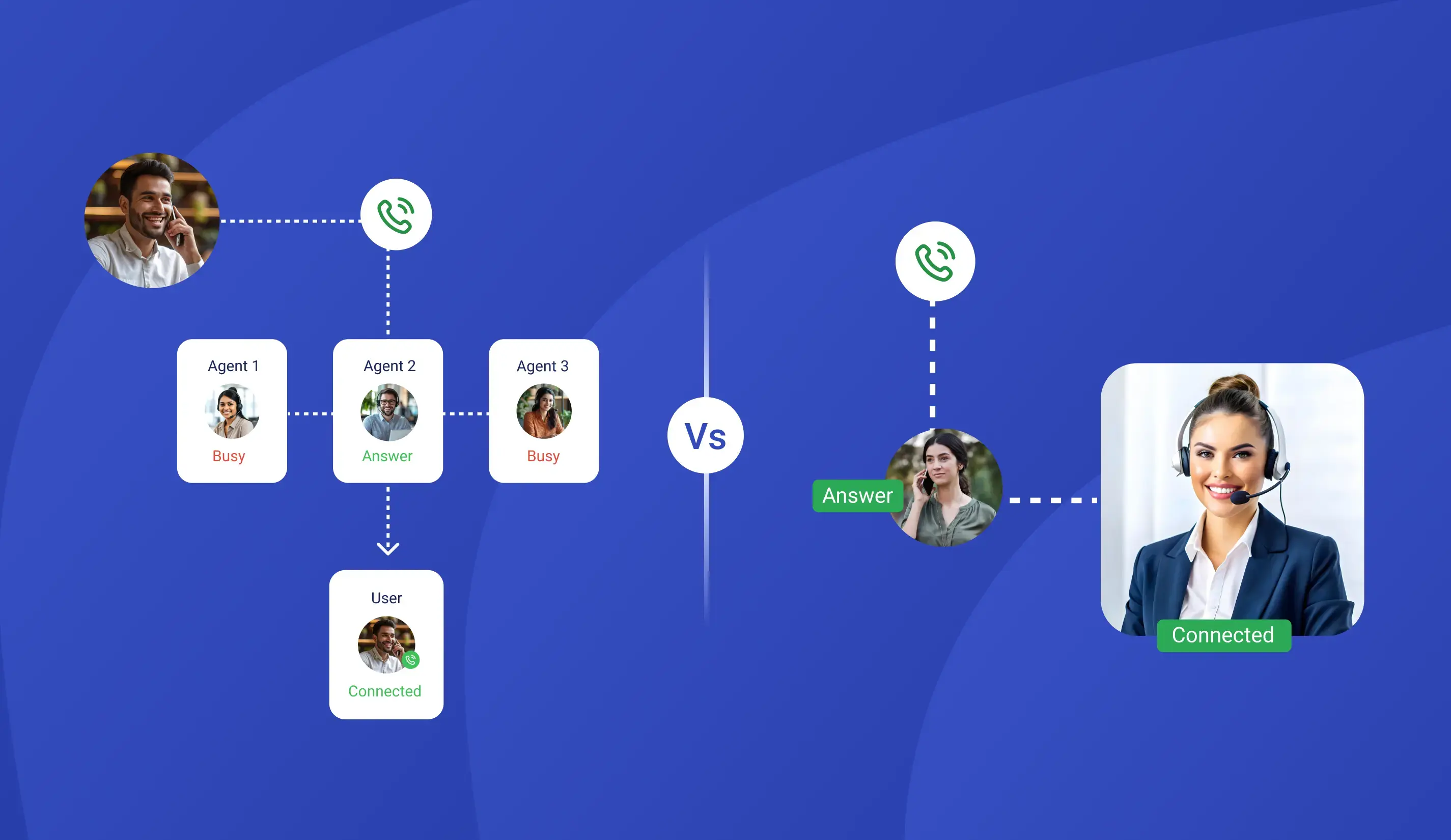
Predictive dialers use advanced algorithms to reach out to many numbers even before the availability of agents to make full use of their available talk time and increase the amount of contact during the day. However, progressive dialers make phone calls only when the representative is available.
In short,
- Predictive dialing is the best choice when dealing with heavy-volume campaigns for sales, telemarketing, and lead generation purposes, when the productivity of agents is the top priority.
- A progressive dialer is preferable for industries with a high regulatory burden and if all answered calls should be forwarded to an available agent.
- For a variety of campaigns in your company, go for a platform such as TeleCMI, which offers two options for you to choose from.
Predictive vs Progressive Dialer at a Glance
Not sure which dialer fits your team?
Explore TeleCMI's auto dialer and see how predictive and progressive dialing can improve your outbound campaigns.
What Is a Predictive Dialer?
A predictive dialer is an outbound dialer that uses algorithms to predict when agents will become available. Instead of waiting for one call to end before placing the next, it dials multiple numbers simultaneously to increase the chances of having a live customer ready when an agent finishes their current conversation.
The goal is simple: keep agents talking instead of waiting.

According to Genesys, predictive dialers use real-time algorithms to minimize idle time and maximize agent productivity by connecting agents to live calls more efficiently.
How a Predictive Dialer Makes Decisions
The term predictive in the name of this system stems from its ability to predict when an agent is available as well as when the customer is available. The dialer uses various parameters, including:
- Average call duration
- Historical answer rates
- Agent availability
- Wrap-up time after each call
- Time of day
- Campaign performance trends
Based on this information, the dialer controls its pace throughout the day. If there are more callers than expected, it slows down dialing to prevent flooding agents. When answer rates fall, it speeds up outbound dialing to ensure agents' productivity.
Why Businesses Choose Predictive Dialers
The biggest advantage of a predictive dialer is improved agent utilization.
With a traditional way of making outbound calls, agents waste lots of time waiting until a call connects, reaches voicemail, or goes unanswered. With the help of predictive dialing, much of this time is eliminated, and representatives get more time for conversation with customers.
Predictive dialing is commonly used for:
- High-volume outbound sales
- Telemarketing campaigns
- Lead generation
- Fundraising campaigns
- Large collections teams
Consider a sales force of 40 people engaged in lead generation activity. Historical information shows that the average call duration is four minutes, and only one in four calls makes contact with a live client.
The predictive dialer begins dialing multiple numbers even while the conversation with the previous client is going on. When the agent is free, another customer is already on the line waiting to communicate.
From the agent’s point of view, the process is almost invisible. There is no need to listen to ringing or dial numbers.
When a Predictive Dialer Isn't the Best Choice
Even though the predictive dialer is very efficient, it may not be suitable for all marketing campaigns. A predictive dialer system dials ahead of agent availability; there is always a possibility that more customers answer than expected. When this happens, a customer may experience a brief delay before being connected, or, in some cases, the call may be abandoned if no agent becomes available in time.
For businesses operating in industries with strict telemarketing regulations or those where every customer interaction is highly valuable, this trade-off may outweigh the productivity benefits.
In these situations, a progressive dialer often provides a better balance between efficiency, compliance, and customer experience.
What Is a Progressive Dialer?
A progressive dialer is an automated outbound dialing tool that makes one outbound call only when it confirms that the agent is ready to take the call. Progressive dialer does not predict the agent's availability and make calls simultaneously. The call always starts with the agent who is ready for it. The aim of the progressive dialer is not the high quantity of calls but their quality.
How Does a Progressive Dialer Work?
It follows a straightforward sequence:
1. An agent completes the current conversation.
2. The system confirms the agent is available.
3. The next number in the campaign is dialed.
4. If the customer answers, the call is immediately connected to the waiting agent.
5. After the conversation ends, the process repeats.
Because there is no overlap between calls, businesses have greater control over the customer experience and outbound pacing.
Why Businesses Choose Progressive Dialers
Progressive dialers work best when there is a high importance on conversation over the number of calls made. With every phone call that is picked up, there is always an agent ready to speak on the phone.
These dialers are therefore useful for firms where trust and accuracy are crucial factors.
Common use cases include:
- Financial services
- Insurance providers
- Debt collection agencies
- Healthcare outreach
- B2B sales teams
- Customer renewal and retention campaigns
In these industries, representatives often need time to review customer information before each call. A steady dialing pace allows agents to prepare properly, resulting in more personalized conversations and better outcomes.
Imagine a financial services team helping customers renew insurance policies. Each conversation requires the agent to review account details, understand previous interactions, and prepare personalized recommendations before speaking with the customer.
When a Progressive Dialer Isn't the Best Choice
Despite the advantages that progressive dialing offers, it’s not necessarily the most effective method for every outbound campaign.
With the fact that just a single call can be placed at any particular time, the employees may end up spending more time waiting for the phone to ring or be picked up. In situations where there are high-volume lead generation or telemarketing campaigns, the number of conversations per day will be limited.
In cases where your focus is on agent productivity and maximizing the contacts reached, predictive dialing would work best.
Predictive Dialer vs Progressive Dialer: What's the Difference?
While both dialers are aimed at making automated outbound calls, they use completely different strategies to assist the agents in reaching out to customers. The first one is designed to make as many conversations as possible; the second aims at ensuring that all answered calls will go through to the agents.
Calling Pace and Agent Experience
- With the help of a predictive dialer, calls are made before the moment when agents are available, which allows increasing their productivity and the number of conversations.
- On the contrary, a progressive dialer calls customers only after agents become available, providing them with the opportunity to get prepared to the conversation.
Call Abandonment Risk
- Since a predictive dialer dials numbers in advance, sometimes the number of answering customers may exceed the number of available agents, causing call abandonment.
- Progressive dialers do not face such problems since they only contact customers when agents become available.
Compliance
- Businesses operating under strict telemarketing regulations often prefer progressive dialers because they naturally reduce abandoned calls.
- Though predictive dialers can also comply with the regulations, they need to be properly monitored.
Productivity
- If you want maximum outbound calls, then you will need a predictive outbound dialer.
- Progressive dialers move at a much slower pace compared to predictive dialers, but they give agents time to prepare better.
Setup and Complexity
- The predictive dialer uses algorithms and historical data to calculate the optimum dialing rate and is therefore harder to set up.
- The progressive dialer uses a one-to-one dialing approach and is hence relatively easy to set up.
When to Choose a Predictive Dialer
- High-volume outbound teams making hundreds of calls a day across a campaign.
- Telemarketing and lead generation campaigns where speed and contact volume drive results.
- Teams with enough agents on the floor to absorb the occasional call overlap comfortably.
When to Choose a Progressive Dialer
- Compliance-sensitive industries such as collections, insurance, and financial services.
- Smaller teams where every single customer interaction needs to land well.
- Businesses that prioritize customer experience and call quality over raw call volume.
Why TeleCMI Supports Both Predictive and Progressive Dialing
Every outbound campaign has different goals. While a predictive dialer would be best for mass campaigns, a progressive dialer would be more effective where customer satisfaction and compliance are important. With TeleCMI, you don't have to choose just one. It offers the possibility of switching from a predictive to a progressive dialing system according to the requirements of your campaign.
How to Decide: A Simple Framework
Four questions, in order - the first one you answer “no” to usually settles it.
1. What's your daily outbound call volume? Hundreds of calls a day per agent point to predictive; lower, focused volumes don't need it.
2. How costly is an abandoned call in your industry? A missed connection in sales is an inconvenience; in regulated collections or insurance, it can be a compliance incident.
3. Are you under strict telemarketing or compliance rules? Abandonment-rate caps or consent requirements usually settle the decision in favor of progressive.
4. Do you have enough agents to absorb overlap? Predictive only works well with enough agents on a campaign to absorb its occasional over-prediction; a thin team feels every miscalculation.
Want to see how either mode performs against your own call lists and agent counts? TeleCMI's auto dialer supports both modes on the same plan, so you can test predictive and progressive pacing on real campaigns before committing to one.
Conclusion
Selecting between a predictive dialer and progressive dialer is not an attempt to find the one that is better in every way, but it means choosing the type of dialer that will suit your purposes.
If you care about call volume and agent productivity, a predictive dialer suits your needs. And if you care about a lower abandonment rate and compliance, then a progressive dialer is a better solution for you. For those companies that conduct various outbound campaigns, the TeleCMI dialer with its support of both dialing technologies will do well.
Ready to Optimize Your Outbound Calling?
Prioritize call volume, compliance, or customer experience
Frequently asked questions (FAQ)
Saravana Kumar

I’m passionate about exploring and sharing insights on modern cloud communication technologies. At TeleCMI, I focus on helping readers understand the evolving world of cloud telephony and IVR solutions in a simple yet in-depth way. My goal is to deliver genuine value by turning complex telecom concepts into clear, actionable knowledge that builds trust and drives innovation.