6 Signs It's Time to Switch to a Cloud Phone System

10 mins read

Posted on Mar 16, 2026


Saravana Kumar
SEO


Saravana Kumar
SEO






Imagine you’re speaking with a customer when the call drops. Or when a prospect tries to reach your sales team several times, only to hear a busy tone or receive no response.
Do you think that the customer feels satisfied, or will they simply move on to another business?
Most small and medium businesses face this problem every week. Yet many assume that a small team can manage these issues. These moments feel small, but when they add up every day, they cost you business reputation, revenue, and retention.
To avoid these problems, a cloud phone system allows for intelligent routing, maintenance, and customer communication. In this blog post, we will discuss the need for and the benefits of investing in a cloud phone system.

Key Takeaways
 The traditional phone system is often not efficient for remote teams, business growth, or a hybrid work culture.
- Missed calls and delayed responses quietly affect your business revenue, reputation, and customer trust.
- Relying on an on-premises system increases operational costs in terms of maintenance, hardware upgrades, and manual setup.
- Limited features, integration, and real-time analytics make it take teams hours to make decisions and reduce efficiency.
- Cloud telephony systems simplify business communication with intelligence, integration, and automation.
What is a cloud phone system?
A cloud phone system is a business phone system that lets users make phone calls over the internet rather than a traditional phone line. In addition to traditional phone call features, modern business phone systems often include automated features that assist in handling high call volumes for businesses.
Why Many SMBs Ignore Communication Problems for Too Long
- At the beginning, the communication issues occur occasionally, which may seem like a minor inconvenience.
- Most businesses still rely on traditional phone systems to handle inbound and outbound calls.
- Some owners believe that upgrading a modern communication system will require expensive equipment and complicated installments.
- Unfamiliar with how modern communication systems work and comfortable with the traditional systems.
- Employees often develop informal ways to cope with communication limitations rather than switching.
Over time, however, these small issues begin to affect customer experience and business growth. Recognizing the signs early can help businesses avoid larger communication challenges later.

According to Gartner
Organizations are increasingly moving toward cloud-based communication platforms as they replace traditional PBX systems to support hybrid work, scalability, and lower infrastructure costs.
6 Practical Signs Your Business Should Switch to a Cloud Phone System
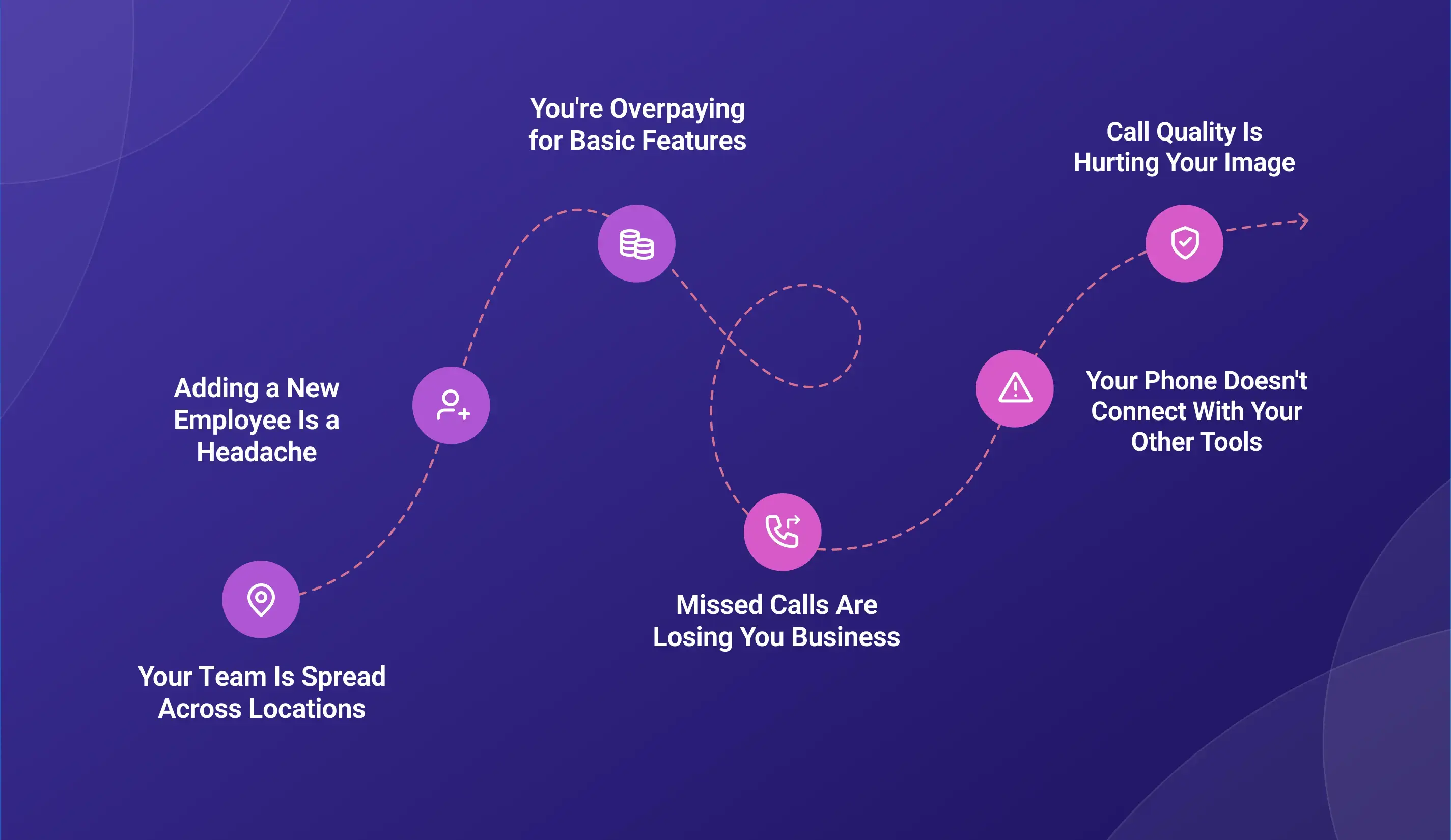
Here are the signs that it may be time to rethink your phone setup. If you face any of these within your communication system, it's time for a change.
- #Sign 1: Teams Work Across Multiple Locations
- #Sign 2: Adding a New Employee Takes Too Much Effort
- #Sign 3: Phone System Costs Keep Increasing
- #Sign 4: Missed Calls Are Turning Into Missed Opportunities
- #Sign 5: The Phone System Does Not Integrate With Other Tools
- #Sign 6: Poor Call Quality Is Affecting Customer Experience
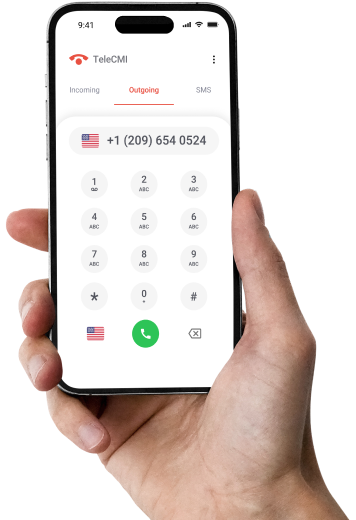
Never Miss an Important Business Call
Use intelligent call routing and automation to ensure every customer call reaches the right team
#Sign 1: Teams Work Across Multiple Locations
Problem Statement
Most businesses adapt to a hybrid work culture, operate remote teams with VoIP PBX, and operate in multiple locations. Communicating with each other over a personal phone number or a chat system for internal and external communication seems comfortable.
The Impact
It can create confusion during busy periods, shift changes, or urgent situations. Calls may be routed incorrectly, customer information may be missing, and teams may struggle to stay aligned.
The Solution
With a unified system, the teams can use a common communication platform. They can access the customer information and can easily transfer calls if support from another team member is required, ensuring smoother coordination and consistent customer experience.
#Sign 2: Adding a New Employee Takes Too Much Effort
Problem Statement
A traditional phone system often requires manual setup, including purchasing new hardware, configuring extensions, or assigning a new number when adding a new team member.
The Impact
This slows onboarding and makes it difficult for the new joinee to start communicating with the customer. Also, it's fine when adding one agent, but when your team expands, or you're looking for a new location, it costs more and limits your business communication.
The Solution
A cloud business phone system lets businesses add a virtual phone number in minutes, set up extensions, and manage teams in a single dashboard, so agents can make and receive business calls from day one without delays.
#Sign 3: Phone System Costs Keep Increasing
Problem Statement
Most businesses think that implementing a traditional phone system is a one-time investment. Unfortunately not. It often requires maintenance, repair bills, hardware replacement, and adding new lines or extensions, which costs more.
Impact
In many cases, companies pay high costs to maintain basic calling features. Also, when you're expanding to a new location or planning to implement a remote work culture, it's critical to manage teams and customers efficiently. VoIP solutions for remote and hybrid teams make this easier by enabling communication from anywhere.
Solution
The cloud-based phone system reduces the need for physical hardware, allowing businesses to manage communication costs more transparently. Whether adding a new user, extension, or location, you can estimate the overall cost before making an investment.
#Sign 4: Missed Calls Are Turning Into Missed Opportunities
Problem Statement
Every missed call represents a lost opportunity. Why?
With the absence of features such as automated call routing, voicemail management, or after-hours handling, the majority of the important calls are not being answered with a legacy system.
The Impact
What happens when a prospect tries to call your sales team after business hours, only to not get a response? The prospect ends up calling the competition. Similarly, what happens when a customer tries to call your customer service after a serious escalation, only to not get a response or a callback after a while? The customer definitely won't stick around for too long with your business.
The Solution
With modern phone systems, all the calls are being routed to the right teams, callbacks are instant, and the majority of the business already employs AI agents to handle after-hours calls, level 1 calls, and multilingual support 24/7.
McKinsey & Company" class="text-lg sm:text-2xl text-[#fff] font-bold font-heebo">Research from McKinsey & Company
Shows that companies that improve customer communication and engagement can significantly increase customer satisfaction and loyalty.
#Sign 5: The Phone System Does Not Integrate With Other Tools
Problem Statement
Customers expect prompt responses, personalized interactions, and relevant communications when dealing with the business over the phone. However, the phone system not integrating with other business tools does not allow the business agents to access the relevant customer information during the course of phone communications with the customers.
The Impact
Without integration between communication tools and business platforms, teams spend more time switching between systems. Agents may ask customers to repeat the same information or rely on colleagues to locate previous records. In complex scenarios, the situation can become even more complicated, resulting in a frustrating experience for both customers and agents.
The Solution
In modern business organizations, different digital tools are used for customer interactions. For instance, customer relationship management systems, help desk management systems, and communication systems are used for customer interactions. A cloud phone system helps in integrating all these digital tools.
#Sign 6: Poor Call Quality Is Affecting Customer Experience
Problem Statement
With traditional phone systems, call quality is often difficult to maintain. Calls are often cut off, or there is too much background noise, static, or echo during a phone call.
The Impact
Poor call quality can negatively impact the customer experience. When the quality of a phone call is poor, the customer can get annoyed, which can reflect poorly on the business. The employees are not able to understand the customers' problems due to poor call quality. This can result in longer phone calls, as the customers are not able to get their problems resolved properly.
The Solution
A cloud phone system can solve the problem of poor call quality, as the internet provides the best communication infrastructure for phone calls. With a cloud phone system, the call quality is better, which allows employees to communicate more effectively with customers.
Cloud Phone System vs Traditional Phone System
Why SMBs Choose TeleCMI to Fix These Exact Problems
Many small and medium businesses recognize the communication challenges but struggle to find a solution that is simple and easy to adopt. TeleCMI is a cloud phone system that enables businesses to manage communication across locations, improve call handling, integrate with business tools, and access deep analytics to make informed decisions.
- One business number to connect mobile, desktop, and desk phones so your team can stay connected no matter where they are.
- Fully cloud-based solution with zero hardware needs to get started with a business phone system.
- Predictable monthly cost with no extra fees on maintenance, hardware, or setup.
- An auto-attendant with smart call routing ensures the right person gets the call, while intelligent call queuing enables customer communication at any time.
- Integration with CRM systems and other business tools, as well as automatic call logging.
- High-definition voice, reliability, and disaster recovery features ensure business communication continues even in the face of the unexpected.
Conclusion
Communication problems rarely appear suddenly. They usually begin with small issues such as missed calls, delayed responses, or difficulty managing calls across teams. At first, these moments may seem minor. Over time, however, they can affect customer trust, team productivity, and business growth.
If you identify two or more of these signs that have been discussed in this article, it is perhaps time for you to rethink your existing phone system. A cloud phone system is a simpler solution for managing your business communications. It keeps you connected, makes your calls better, ensures consistency in customer interactions, and lets your business grow without the limitations of traditional phone systems.
Transform the way your business handles calls

Cloud-based business phone system
Integration with CRM tools
Scalable for growing teams
Frequently asked questions (FAQ)
Saravana Kumar

I’m passionate about exploring and sharing insights on modern cloud communication technologies. At TeleCMI, I focus on helping readers understand the evolving world of cloud telephony and IVR solutions in a simple yet in-depth way. My goal is to deliver genuine value by turning complex telecom concepts into clear, actionable knowledge that builds trust and drives innovation.


.webp)
.webp)