VoIP PBX System: Enabling Seamless Communication across Remote & Hybrid teams

10 mins read

Posted on Jan 19, 2026


Saravana Kumar
SEO


Saravana Kumar
SEO






Remote and hybrid work have become standard business practices. Employees now work from home, multiple offices, or different countries. Regardless of location, customers still expect fast and consistent support. Although this shift improves flexibility and access to talent, it also creates communication challenges for many organizations.
According to recent stats, nearly 49 percent of employees report that their communication platforms don’t work seamlessly across locations.
A VoIP PBX system solves this problem by centralizing business communication in one platform. Teams stay connected, conversation history remains accessible, and communication remains consistent across all locations.
In this blog, we’ll explore how a VoIP PBX system enables seamless communication for remote and hybrid teams.

Key Takeaways
 A VoIP PBX solution gives a single, integrated layer for all business telecommunication voice interactions.
- Centralized call handling enhances understanding, accountability, and response time across teams.
- Location-independent access enables employees to remain reachable without affecting business operations.
- Common conversation history enhances collaboration and team handoffs.
- Effective routing and greeting of calls improve customer trust and service delivery.
- Businesses reduce operational costs while gaining advanced communication capabilities.
What Is a VoIP PBX?
A VoIP PBX (Private Branch Exchange) is a business phone system that manages internal and external calls over the internet instead of traditional phone lines.
It helps businesses improve communication, support remote teams, and scale operations more efficiently. Modern VoIP PBX systems include cloud infrastructure, multi-level IVR, automation, and analytics to improve communication and customer service.
Difference between traditional & VoIP PBX systems
Communication Challenges Faced by Remote & Hybrid Teams
Remote and hybrid work offer flexibility, but they also introduce communication challenges. These issues can reduce collaboration, slow decision-making, and affect overall productivity.
Below is a deep dive into the major, often-overlooked issues that business owners and service providers should know
Asynchronous Communication and Time Zone Misalignment
Remote teams often work across different time zones, which can create communication delays. While asynchronous work provides flexibility, waiting for responses can slow planning and decision-making. As a result, projects may face delays and teams may respond more slowly.
Fragmented Information and Scattered Context
When teams use multiple tools, important updates often get lost in emails, chats, or personal notes. Without a centralized source of information, teams waste time searching for updates and lose visibility.
Loss of Informal Interaction and Relational Distance
Not all communication is task‑oriented. Spontaneous interactions, water‑cooler discussions, and quick side conversations contribute to team cohesion, trust, and shared context. Digital communication cannot fully replace casual in-person conversations that help build trust and teamwork.
Miscommunication and Lack of Context in Digital Conversations
Remote teams rely heavily on written and digital communication, which comes with trade-offs. Text-based communication lacks tone and body language, increasing the risk of misunderstandings. Excessive notifications can overwhelm employees and increase communication errors.
Technology and Tool Sprawl
Using too many communication tools can create confusion instead of improving collaboration. Conversations become scattered across different platforms, making information harder to find.

Interesting Insights
Nearly 80 percent of remote workers report experiencing communication challenges due to information scattered across platforms.
Trust, Visibility, and Monitoring Gaps
Trust issues and lack of visibility into work processes can easily affect remote teams: Less face-to-face interaction makes it harder to understand tone, intent, and context, which can affect trust and alignment.
Team Cohesion, Engagement, and Isolation
Hybrid workplaces can unintentionally exclude remote employees from important discussions and decisions. This can reduce engagement, collaboration, and overall team performance.
Cognitive Load and Meeting Fatigue
Remote teams often rely heavily on video meetings and conference calls. Too many meetings can lead to cognitive overload and meeting fatigue. Without clear norms, teams default to scheduling synchronous meetings instead of using efficient asynchronous updates.
Major Concern:
Having too many tools without integrating them creates silos rather than bridges. This is often an understated cause of inefficiencies.
How a VoIP PBX System Eliminates Communication Challenges Faced by Remote & Hybrid Teams ?
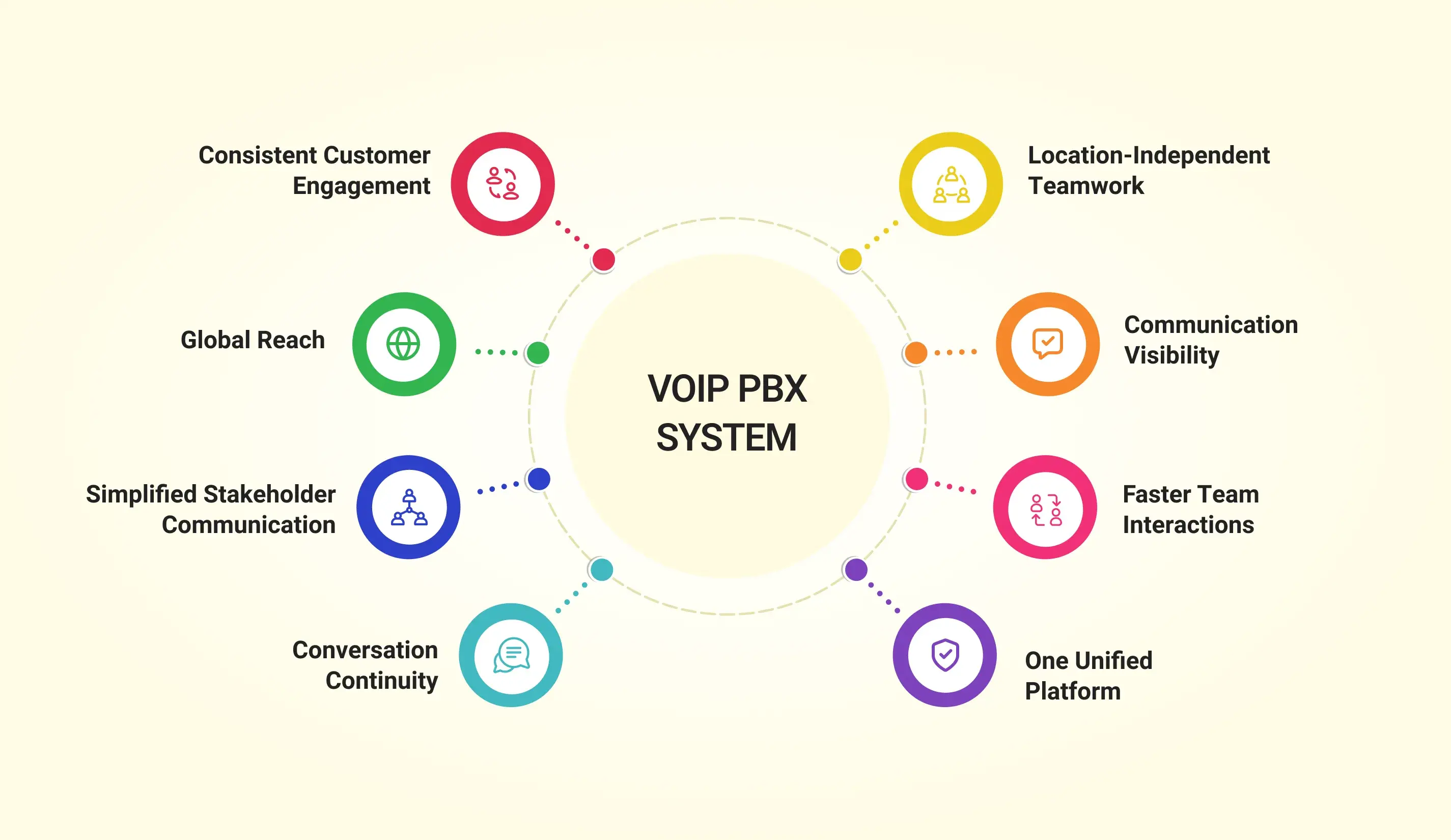
A modern VoIP PBX system unifies all channels and enables teams and customers to stay connected without friction. The benefits below explain how this works in practice and why businesses rely on these systems.
Location-Independent Teamwork
Employees can make and receive business calls from laptops, tablets, and smartphones using the same business number across all devices.
- No more “call the office line, then try my mobile” situations
- Remote employees stay as reachable as in-office staff
- Teams remain connected even during travel or office closures
Communication, Visibility, and Centralized Management
VoIP PBX systems provide dashboards and analytics that help managers monitor calls, response times, and team activity from one interface.
- Missed calls identification prior to turning into customer complaints
- Smooth workloads across teams and time zones
- Faster response times without requiring frequent check-ins
Faster Team Interactions and Collaboration
Remote teams often lose time switching between email, chat tools, and meetings just to resolve simple issues. Conversations slow down because people are unsure who is available or how to reach them quickly.
- Teams can switch from a message to a call in an instant
- Availability can be viewed by colleagues before making contact
- Questions are answered within minutes rather than hours
Centralized Communication Across the Business
Many hybrid teams use separate tools for calls, messages, and follow-ups, making collaboration less efficient. A unified communication platform brings all conversations into one place.
Reduced repetitive questions because of the common conversation history
- Quick access to decisions and previous discussions
- Integrated task handoffs between the team members
Consistent and Professional Customer Interactions
Customers demand prompt and professional feedback, irrespective of the work location of the employee. Sometimes, because all the communications are not channeled through a central platform, the services might become irregular
- Professional greetings across all teams and locations
- Fewer call transfers and dropped customer conversations
- Unified experience across sales, support, and service teams
Simplified Communication for Multi-Location Teams
With growth in organizations, whether it is an office or a geo, coordination and alignment face challenges. Alignment is made possible with an integrated communication solution.
- Local phone numbers without physical office presence
- Easier support across different time zones
- Centralized administration for distributed teams
Clear Communication With Partners and Stakeholders
- Shared context across internal and external discussions
- Reduced delays from misdirected communication
- Better coordination across departments and vendors
Preserved Conversation History and Business Knowledge
When distributed teams don't share conversation information that isn't recorded, their work can suffer due to the loss of important context.
- Record conversations to avoid loss of crucial information
- Faster onboarding using past communication records
- Fewer repeated explanations across teams
Business Benefits of Using a VoIP PBX for Remote & Hybrid Teams
A VoIP PBX system delivers measurable business value beyond basic calling. For distributed teams, it improves cost control, flexibility, and communication quality without adding operational complexity.
Cost Savings: VoIP PBX systems lower expenses related to physical hardware, maintenance, and long-distance calls. Companies pay for predictable subscription costs rather than making huge upfront investments.
Easy Scalability: The VoIP PBX system provides the flexibility to add and remove the number of employees, locations, or numbers without investing in any additional equipment.
Advanced Call Capabilities: VoIP PBX platforms offer features such as call forwarding, voicemail-to-email, auto attendants, and call analytics. Vonage highlights that these capabilities improve responsiveness while reducing manual call handling.
Business Continuity: Cloud-based PBX systems help businesses stay operational during outages, office closures, and unexpected disruptions.
Improved Team Productivity: Centralized communication reduces time spent searching for information or switching tools. Faster call resolution and clearer handovers help teams focus on core work.
Greater Communication Experience: High call quality, intelligent routing, and easy access improve communication for both employees and customers.
Essential Checklist Business Owners Should Know Before Adopting a VoIP PBX
Before implementing a VoIP PBX system, business leaders should evaluate the following essentials to ensure long-term success:
Reliable internet connectivity to support call quality
Checklist 1
- Cloud-based PBX infrastructure for flexibility and uptime
Checklist 2
- Remote and mobile access support for distributed teams
Checklist 3
- Easy scalability for growing or changing teams
Checklist 4
- Cost-effective pricing with transparent plans
Checklist 5
- Call routing and management features aligned with workflows
Checklist 6
- CRM and business tool integrations
Checklist 7
- Strong security standards and data encryption
Checklist 8
- High uptime guarantees and service reliability
Checklist 9
- Responsive provider support and ongoing maintenance
Conclusion
Remote work and the hybrid model have transformed how companies communicate, both within and outside the company. Traditional phone systems and fragmented tools struggle to support distributed teams, consistent customer experiences, and scalable operations.
A VoIP PBX system centralizes communication, improves visibility, and helps teams collaborate effectively from any location. It supports business growth by improving communication, reducing costs, and increasing operational efficiency. As remote and hybrid work continue to grow, adopting a VoIP PBX system is an effective way to build a flexible and scalable communication infrastructure.
Upgrade your communication and unlock the next level of growth

Cloud First Calling
Advanced Call Control
Flexible Team Calling
Frequently asked questions (FAQ)
Saravana Kumar

I’m passionate about exploring and sharing insights on modern cloud communication technologies. At TeleCMI, I focus on helping readers understand the evolving world of cloud telephony and IVR solutions in a simple yet in-depth way. My goal is to deliver genuine value by turning complex telecom concepts into clear, actionable knowledge that builds trust and drives innovation.