Top 10 VoIP Features That Improve Customer Experience

14 mins read

Posted on May 19, 2026


Vignesh N
SEO


Vignesh N
SEO






The way a business communicates has become just as important as what it actually sells. In 2026, customers aren't just evaluating your product or your price point. They're forming opinions based on how fast you pick up the phone, whether your support agent already knows who they are, and whether they had to repeat themselves three times just to get a simple answer resolved.
That's a tall order, especially for businesses still running on phone infrastructure that hasn't meaningfully changed in decades. Missed calls, hold music that plays forever, agents who have no context on the customer, these aren't minor inconveniences. There are reasons people quietly switch to your competitors.
Add to that the reality of modern teams: people working from home, from co-working spaces, across time zones. Legacy phone systems weren't designed for any of that.
VoIP has changed the equation. Not just by moving calls to the internet, but by building an entirely different kind of communication stack around them.

Key Takeaways
 Modern VoIP features like IVR, smart routing, and CRM integration help businesses deliver faster and more personalized customer support.
- Cloud-based VoIP systems reduce missed calls, long wait times, and communication gaps across voice, chat, WhatsApp, and email.
- Features such as AI call summaries, analytics, and callback options improve agent productivity and customer satisfaction together.
- Businesses using VoIP can support remote and hybrid teams efficiently while maintaining consistent call quality and collaboration.
- Choosing the right VoIP system helps businesses improve customer experience, reduce operational costs, and scale communication easily.
What is VoIP?
Voice over Internet Protocol (VoIP) is a modern communication technology that allows businesses to make and receive phone calls through the internet instead of traditional telephone lines. By replacing copper wires and physical phone exchanges, VoIP phone system converts voice signals into digital data, sends it through the internet, and converts it back into clear audio for the person on the other side. This makes business communication quicker, more flexible, and simpler to manage from anywhere.
Modern Communication Expectations of Customers
Modern customers want faster communication and support, which determines the quality of a service. Businesses that fail to meet these expectations often lose customers to competitors that provide better experiences.
Why Customer Experience Matters in Business Communication
Customer experience matters more than products and pricing in business communication. Every call a customer makes, every message they send, and every interaction they have reflects how they feel about your brand and whether they choose to opt for your brand or move to a competitor.
Communication is no longer only about sharing information. It is the main channel through which trust is built, problems are solved, and customer loyalty is earned. One frustrating interaction, including a missed call, a long hold time, or an agent who doesn't know the customer's history, can destroy months of customer trust within seconds.
How VoIP Features Improve Customer Experience
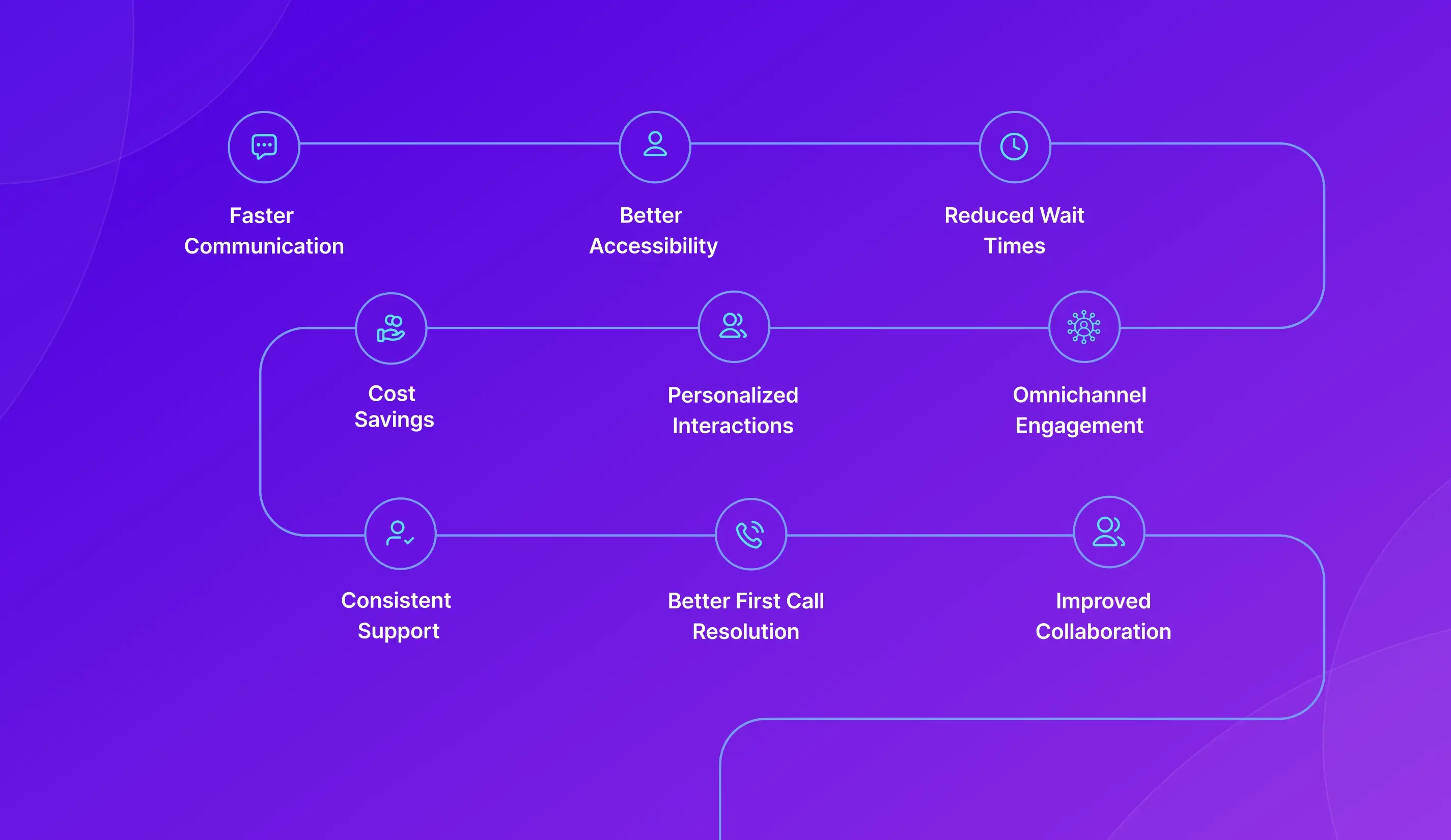
VoIP systems enhances user experience by providing businesses with intelligent features that directly improve the quality of every interaction.
- Faster Communication: VoIP enables effortless call setup and AI-powered routing, helping customers connect with agents within seconds instead of minutes.
- Better Accessibility: Agents can make and receive calls from any device or location, ensuring customers always connect with the right person, even when teams work remotely or across different locations.
- Reduced Wait Times: Features like Skill-based routing, smart queues, and AI bots help reduce hold times significantly, often by 40–70% according to industry benchmarks.
- Cost Savings: Businesses save 40–60% on communication costs compared to traditional phone systems, allowing them to invest more in staffing and customer service tools.
- Personalized Interactions: CRM integration provides agents with instant access to customer history, purchases, and preferences, making conversations more relevant and personalized.
- Omnichannel Engagement: VoIP combines voice, WhatsApp, SMS, and chat into one dashboard, allowing customers to switch channels smoothly without repeating themselves.
- Consistent Support: Cloud-based VoIP systems provide a high-quality calling experience regardless of the agent's device or location.
- Better First Call Resolution: Intelligent routing and real-time customer data help agents solve issues during the first call itself, improving FCR (First Call Resolution) rates by 15–30%.
- Improved Collaboration: Call whispering, conferencing, and live monitoring help teams collaborate in real time without disrupting the customer experience.
Why VoIP Features Matter for Customer Experience
How your business communicates is just as important as what you offer, especially in an era where customers can switch brands with a single click. That's why VoIP is not just a cost-saving tool; it's an important solution that shapes every customer interaction.
- Reduced Wait Times and Efficient Routing
Auto-attendants and intelligent call routing help customers reach the right person quickly without frustrating call transfers or long waiting times.
- Consistency Across Every Touchpoint
Modern customers expect a smooth experience whether they call, text, or join a video chat. With VoIP's unified communication platform, agents have complete customer information available instantly, and customers don't need to repeat themselves.
- Personalization and Professionalism
With CRM integrations and call analytics, VoIP provides customer history immediately after a call connects. Agents can greet customers by name, refer to previous issues, and solve problems faster, which turns regular calls into trust-building experiences.
- Reliability and Availability
Dropped calls and poor audio are not only frustrating; they can make customers lose confidence in a business's service. VoIP's cloud infrastructure delivers HD voice quality and uptime redundancy, ensuring your team stays reachable whenever it matters most.
Top 10 VoIP Features That Improve Customer Experience
Your phone system is more than a communication tool; it's a direct reflection of how much you value your customers. Here are the ten essential VoIP features that make the difference:
Businesses implementing these features typically witness higher FCR rates, improved CSAT scores, lower churn, and stronger customer loyalty.
Upgrade Customer Conversations With Smart VoIP Features Built for Modern Businesses
Start 14 Days Free TrialVoIP Features for Different Business Types
VoIP features are highly flexible and depend on how your team works and who they talk to, determining how success looks like for your business. Here’s how various teams and organizations benefit from key VoIP features:
- Small Businesses: Small businesses benefit the most from VoIP's low cost and easy setup. Features like Virtual phone numbers, auto-attendants, call forwarding, and pay-as-you-go plans eliminate expensive hardware, while Cloud voicemail, mobile apps, and CRM integration help businesses deliver reliable service without additional headcount.
- Sales Teams: Click-to-call, local presence dialing, call recording, auto dialers, and CRM integration provide agents with instant customer context and higher productivity on every call.
- Customer Support Teams: Support teams thrive on resolution speed and consistency. Intelligent call routing, advanced IVR, callback options, omnichannel support, and AI transcription help balance volume and quality.
- Remote and Hybrid Teams: VoIP ensures seamless calling from any device, through HD voice quality, presence indicators, and unified messaging. Cloud-based access ensures agents work from anywhere while maintaining service quality and team collaboration.
- Enterprises: Large enterprises require scalability, security, and advanced capabilities. VoIP provides multi-level IVR, global numbers, detailed analytics, workforce management tools, and enterprise-grade security supporting thousands of users across locations with high uptime and centralized control.
How to Choose the Right VoIP System
With multiple VoIP solutions available in the industry, choosing the right provider can be challenging. But the decision becomes clearer when this question is answered: which system will help my team deliver the best possible experience to every customer?
- Evaluate Your Business Needs: Consider call volume, team size, omnichannel requirements, and whether you have remote or hybrid teams. Small businesses may prioritize simplicity and low cost, while enterprises need advanced analytics and scalability.
- Identify Core Needs: Focus on features with the highest customer impact: call routing and IVR, CRM integration, analytics and reporting, callback and queue management, and omnichannel support. If a provider can't deliver these, extra add-ons won't compensate.
- Ease of Setup: Choose a provider that allows you to activate numbers, configure IVR, integrate with CRM, and go live within hours or days without requiring technical expertise.
- Call Quality and Reliability: Look for HD voice quality, uptime SLAs of 99.99% or higher, and redundant infrastructure to keep your team reachable during outages.
- Integration Compatibility: Your VoIP system should connect effortlessly with your existing CRM, helpdesk, ticketing platform, and collaboration tools. Poor integrations create data silos and slow down agents.
- Scalability: Choose a platform that grows with your business, adding users, locations, or channels without significant re-architecture or increased cost.
- Total Cost and Support: Compare pricing models (per-user, pay-as-you-go, or unlimited), factor in hidden costs, and evaluate the vendor's customer support quality and implementation assistance.
- Run a Real-World Trial: Test with real call resolution rates, wait times, and agent satisfaction metrics, and finalize your decision with these analytics.
Common Mistakes Businesses Make When Choosing VoIP
Many businesses rush into choosing a VoIP software without proper planning. Here are the most common mistakes to avoid:
- Not Knowing Your Budget: Look for hardware, installation, training, and ongoing maintenance beyond just the monthly subscription to make an informed decision.
- Focusing Only on Price: A low-cost provider with poor uptime or missing features is likely to result in lost productivity and frustrated customers than a reliable solution with higher price.
- Not Planning for Growth: Choose a system that supports additional users, locations, and features as your business expands to ensure long-term growth.
- Overlooking Remote and Mobile Teams: Evaluate mobile app quality, softphone capabilities, and remote access reliability, which is essential for distributed teams.
- Ignoring Integration Compatibility: Failing to check compatibility with your existing CRM, helpdesk, or collaboration tools creates workflow gaps and communication inefficiencies.
- Ignoring Compliance Requirements: Not looking for data security, encryption, and regulatory compliance such as the DPDP Act in India or GDPR can expose your business to serious legal and reputational risks.
A strategic approach to evaluating VoIP providers based on current needs, future goals, security standards, and total value, beyond just price, helps businesses avoid these mistakes.
Why Modern Businesses Prefer Cloud-Based VoIP
Cloud-based VoIP is no longer just a tech trend; it's the communication backbone of modern businesses. It has become the preferred communication solution for modern businesses due to its flexibility, cost-efficiency, and advanced capabilities.
Key reasons for its adoption:
- No Heavy Infrastructure: Unlike legacy telephony requiring expensive on-premise hardware, cloud telephony reduces major upfront investment and eliminates physical equipment maintenance.
- Work From Anywhere: Employees can make and receive calls from any device: desktop, laptop, or smartphone, regardless of location.
- Easy Scalability: Adding users, establishing connections, and integrating features takes just minutes, with no new hardware or technician required.
- Cost Efficiency: VoIP systems eliminate high costs that come with traditional landlines, long-distance charges, and hardware maintenance through predictable monthly pricing.
- Automatic Updates: The provider handles all software updates, security patches, and system maintenance, with high redundancy ensuring 99.9% uptime.
- Seamless Integrations: Cloud VoIP connects effortlessly with CRMs, collaboration platforms, and helpdesk software, creating a unified workflow that boosts productivity and customer experience.
Traditional Phone Systems vs. Modern VoIP
While traditional phone systems have helped businesses for decades, modern VoIP systems are the clear choice for those looking to communicate smarter in today's connected cloud space.
How TeleCMI Helps Businesses Improve Customer Experience with VoIP
By combining intelligent call routing, CRM integration, omnichannel communication, and real-time analytics into a single, reliable, cloud-based platform, TeleCMI empowers teams to respond faster, personalize every interaction, and deliver consistent, high-quality support across all channels and locations.
Conclusion
In 2026, exceptional customer experience is no longer optional; it is a must-have for a business. Modern VoIP technologies help businesses move beyond outdated communication limitations and deliver the instant, personalized, and seamless interactions that today's customers demand.
By adopting the right cloud-based VoIP system, businesses can reduce customer frustration, minimize lost leads, enhance team collaboration, and deliver high-quality support across every channel. The key is to choose a system that meets customers' needs, not just the budget.
Evaluate your current communication setup, identify the gaps, and choose a VoIP solution that transforms every call into an opportunity to build lasting customer relationships. Because customers don't remember the technology behind the call; they remember how it made them feel.
Improve Response Time, Reduce Missed Calls, and Delight Customers With TeleCMI

AI-Driven Performance Insights
Trusted by 3500+ Businesses Worldwide
Virtual Numbers in 150+ Countries
Affordable Pricing Plans
Frequently asked questions (FAQ)
Vignesh N

With deep expertise in cloud telecommunications, I help readers explore the latest trends in VoIP and modern business communication. At TeleCMI, I focus on educating businesses with clear, practical insights, making complex telecom concepts easy to understand. I’m passionate about helping organizations improve efficiency, enhance customer engagement, and adopt smarter communication strategies.



.webp)