How Does Sales Call Center Overcome calling Challenges & Win Deals

19 mins read

Posted on Jul 18, 2024
.webp)

Vignesh N
SEO


Vignesh N
SEO





Did you know? The average sales representative makes 52 calls per day. This indicates the significance of the outbound calling strategy. Hence, businesses have started targeting customers through outbound calls.
This blog discusses the importance of outbound calling in call centers and helps businesses attract more deals.
Outbound Sales Call Center: An Overview
An outbound sales call center is responsible for making calls to customers. These can be cold calling, lead generation, telesales, and more. These call centers will reach out to customers by managing high call volumes and ensuring that they reach a large audience worldwide.
For existing customers, it can be termed call centers with customer support executives to help them resolve queries about the product/service purchased from the business phone system. For new customers, it can be utilized to reach out and grab new audiences through sales and telemarketing.
Here is how an outbound call center works:
1. The call center manager has a list of customers/prospects to speak with. They are responsible for handling them through cold calling services or a lead generation approach.
2. The list will then be passed to call center agents and split among them. Their job is to engage with these customers proactively.
3. They will be provided with a script and a series of responses for the frequently asked and most challenging questions. This questionnaire script is offered to determine the customer’s likelihood of liking the brand or services.
4. Customers who show interest in the brand are added to the warmer leads category. They will be contacted again and pitched differently.
5. When speaking with customers, agents introduce themselves by stating their name and company and explaining why they are calling. This way, the customer will know about the brand and their agents.
6. Further, agents will continue explaining the product and providing customers with options to continue. Providing options will help customers remain engaged and choose one.
7. Finally, before the call is disconnected, the agent will discuss the upcoming steps to connect with the customer and convert them into a lead.
Difference between an Inbound and Outbound Call Center:
Here are the major differences between an inbound and outbound call center:
Inbound call centers are the ones that receive customer calls in the form of support requests, queries, complaints, and much more. They are responsible for answering customer queries and resolving them instantly.
On the other hand, Outbound call centers tend to make calls to customers. Their primary motive is to generate more customers, make sales, and market the brand. Agents perform warm and cold calls to generate leads.
Why can Outbound Call Centers be beneficial for your business?
Here are the primary reasons why setting up an outbound sales call center can be beneficial
.webp)
Brand reputation
With an outbound call center, businesses can build their brands effectively. They can reach out to their customers who can be a first-time user and help them to get knowledge about your brand.
Generate more leads
Outbound call centers work with the motto of proactive reaching out to customers. When your agents are well-trained to work on any challenging situation and aware of communicating with the customers, there are higher chances of converting them into leads.
Scale your business
As the business grows, so will the prospects. With an increased customer base, an outbound call center should also be able to cater to the growing needs. With outbound call center software, you can enhance the efficiency of calling your leads and also manage the present customers in the loop to engage them when needed.
Access to insights
Yet another reason for the need for outbound call center solutions is that they effectively give you complete access to business and customer data. With the extracted data, you can make data-driven decisions. The data can be in the form of call recordings, data collected from CRM, real-time data from the dashboard, etc.
Feedback mechanism
Businesses can also gather valuable feedback from customers by conducting surveys and feedback calls. These insights will provide a clear perspective of customer preferences, which can be used to improve brand services.
Customer retention
Loyal customers spend 67% more than new customers. Hence, retaining existing customers is crucial. Outbound call centers can offer higher customer retention rates by proactively engaging with present and existing customers. Businesses can frequently address customers' concerns or complaints and offer relevant solutions.
Improved productivity
Agents will spend more time on customer interactions as their major goal is lead conversion. An outbound call center makes it effective by automating repetitive tasks such as dialing and helping agents to connect with customers quickly and focus on lead generation.
Role of Outbound Call Center in Various Industry Verticals
1. Sales & Marketing
It enables quick contact with customers and helps them conduct surveys, promote new products/services, and upsell them to existing customers.
2. Real Estate
The real estate industry can boost its lead generation activity and client follow-ups. Agents can reach out to prospects (property buyers) and let them know about new listings, updates, schedule visits, etc.
3. Education
Educational sectors can use it to reach students, inform them about the courses, and help them with the admission process.
4. Automobile
The automobile industry can use them for regular follow-ups, service reminders, and promoting new brands or offers. As the market shifts toward electric mobility, manufacturers also use these channels to support drivers with charging network updates managed via a unified OCPP gateway solution.
Outbound Sales Call Center Challenges & Solutions
Let us unveil various challenges with the outbound sales call center and solutions to resolve them:
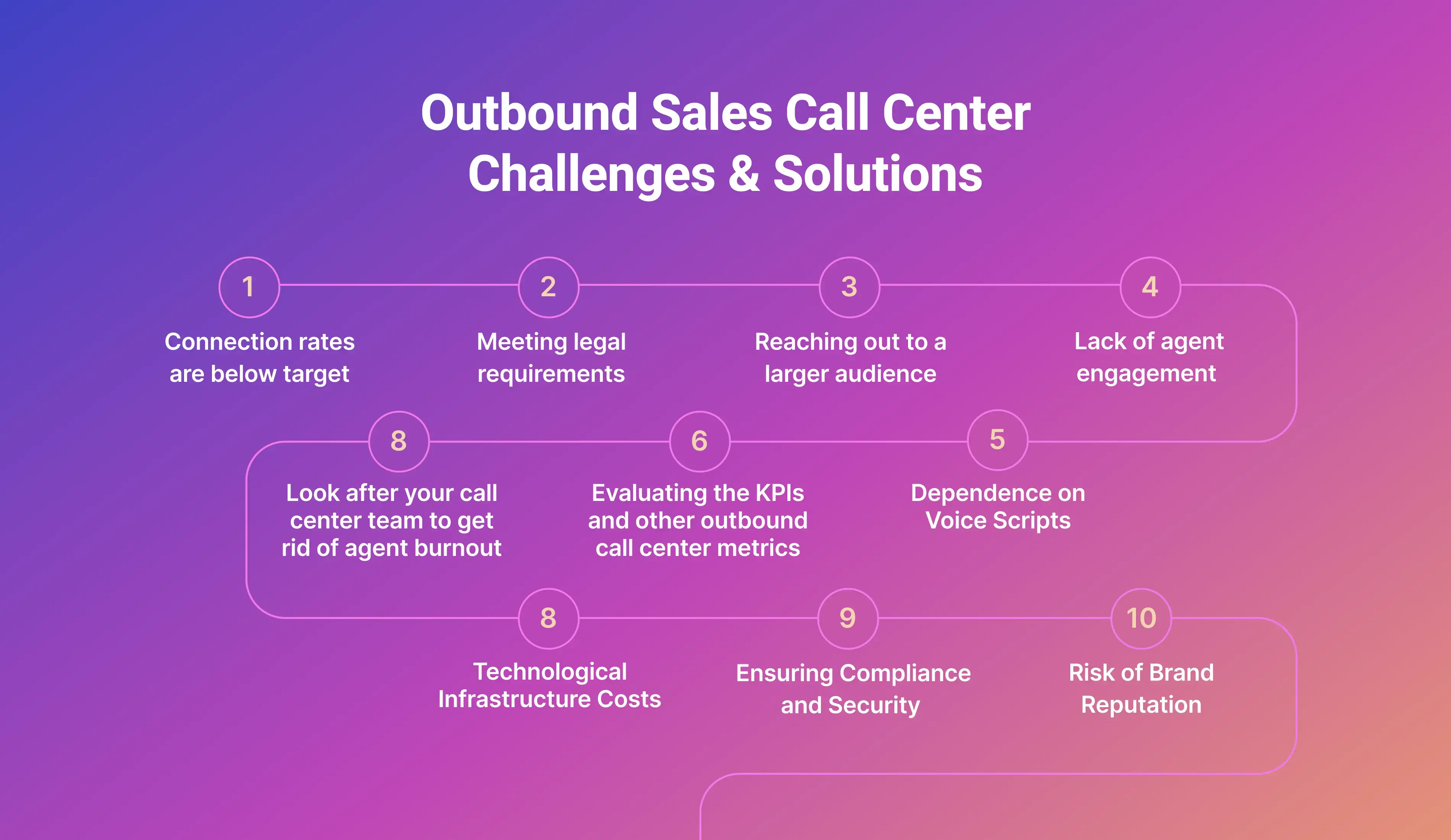
Challenge 1:
Connection rates are below target
Connection rate refers to the percentage of calls made when someone answers the call. While a few calls remain unanswered due to the following reasons
- Incorrect/invalid number
- Customers may fail to pick up your number, thinking it is an unknown call
- The call moves to voice mail
Solution:
- Predictive dialer can be an excellent option for increasing connection rates by optimizing and dialing calls to customers.
- Also, these dialer can simultaneously dial multiple customer numbers and help businesses connect with relevant people.
Challenge 2:
Meeting legal requirements
Outbound call centers should meet the required laws and regulations, such as Telephone Consumer Protection Act (TCPA) and Do Not Call (DNC) registries. If people list the phone numbers under the DNC list, then business may gain a bad reputation.
Solution:
- To resolve them, it is crucial to have tailored software that meets DNC compliance.
- Agents need to be trained in TCPA rules, including not calling them outside business hours.
Challenge 3:
Reaching out to a larger audience
Call centers are here to interact with and effectively engage a huge number of audiences. Let us consider an example: If there is a new discount or product update, it is the responsibility of the agents to share it with the customers. The challenge here is that the number of agents is limited while the customers are huge.
Solution:
- An Interactive Voice Response (IVR) can be an excellent option for handling numerous customers with pre-recorded messages.
- They also come with personalized options, where calls can be directed to live agents based on customer responses.
Challenge 4:
Lack of agent engagement
There can be situations when agents feel disengaged or demotivated when speaking with customers. This can be due to various reasons that can lead to poor customer service or experience and customer loss.
Solution:
- A good dialer and cloud IVR service can be the best fit which can handle customers effectively.
- On the other hand, managers should also reach out to the required agents and help them with performance enhancement, incentives, appreciation, and other things.
- Businesses can also create a work culture that empowers agents by offering a productive and happy work environment with training opportunities to enhance themselves.
Challenge 5:
Dependence on Voice Scripts
Sales scripts can be beneficial for agents, helping them brand themselves efficiently. However, when agents rely too much on the scripts, it sounds like a script reading to the customer and may frustrate them.
Solution:
- Businesses and heads can ensure that agents can interact with customers off-script when necessary.
Challenge 6:
Evaluating the KPIs and other outbound call center metrics
The next challenge is to keep track of outbound call center KPIs and other metrics. It is crucial to evaluate them and optimize them for enhanced performance. By tracking the real-time data on the dashboard, you can find areas for improvement, agents who need additional help or training, etc.
Solution:
- With an intuitive and informative dashboard, businesses can track different KPI metrics, such as Answer Success Rate (ASR), Dropped Call Rate (DCR), Conversion Rate, First Call Close (FCC), Occupancy Rate, and much more.
- Based on the data extracted from the KPIs, you can remodel your business activities and arrange training sessions for agents who need improvement.
Challenge 7:
Look after your call center team to get rid of agent burnout
Agents are the pillars of call centers. It is significant to look after them and take care of them to eliminate agent burnout rates. Make sure they are not stressed, and you maintain a happy working environment that helps them demonstrate exemplary performance
Solution:
- You can eliminate micromanagement activities and offer support when needed to create a good rapport.
- Businesses can also conduct regular 1 to 1 meetings to discuss the challenges and their feedback to be considered.
- You can try to maintain a flexible work schedule to help them maintain a better work-life balance.
Challenge 8:
Technological Infrastructure Costs
Implementing new technologies and programs can be expensive. Call centers need to manage the budget for agent training, infrastructure setup, implementation of the latest technology and tools, and day-to-day operational costs. Hence, every call center business will look for ways to reduce these expenses.
Solution:
- Businesses should carefully plan their budget by considering the operational and overall costs.
- Predictive dialers can be a good option to incorporate, as they can help cut costs and time by connecting with multiple customers simultaneously.
- Yet another option is integrating speech analytics tools, which can reduce the cost by lowering call volumes when speaking with customers.
Implementing these options is cost-effective and will not require a high-end budget.
Challenge 9:
Ensuring Compliance and Security
Businesses must stay aligned with evolving compliance requirements, including state-level regulations and data protection standards. Gaps in compliance can damage brand credibility and increase customer complaints, which often leads to business numbers being marked as spam.
Solution:
- Invest in compliance training sessions and automate compliance checks before proceeding with the software.
- You can also regularly attend webinars and frequently updated guides to know more about this.
Challenge 10:
Risk of Brand Reputation
Sometimes, customers or prospects may feel outbound call centers to be a nuisance or an irritating one when a business calls them. There can be issues with timing, personalization, relevancy, etc, which could lead to frustrated customers.
Solution:
- Make sure that your agents speak politely and give a professional welcome note to the customer. With a pleasing introduction, customers may look forward to further communication.
- You can also ask them if they are available to take it forward. This can bring a good rapport.
General Use Cases of Outbound Sales Call Center
- Helps in generating leads and nurturing them with regular follow-ups for feedback or complaints, if any.
- Helps in collecting unpaid debts on behalf of banks and financial institutions.
- Scheduling appointments and sending out notifications to the prospects on cancellations, new discounts, offers, etc.
Types of call center software:
Outbound call center software is categorized into two types: On-premises and cloud-based. Based on customers' needs, businesses can choose the one that is the best fit for their brand.
1. On-premises call center software
As the name suggests, this software requires a complete installation of equipment and infrastructure to facilitate the functioning of a call center in the workplace. It includes phone lines throughout the workplace, high-end servers, Private Branch Exchange (PBX) sets, and peripherals.
If you are dealing with sensitive business information and looking to safeguard it, on-premises can be the best option. It is difficult to intrude with the equipment unless someone has physical access to the system.
Cloud-based call center software" class="text-[#2b2e33] text-base sm:text-xl font-bold font-heebo pt-10">2. Cloud-based call center software
As the name suggests, the call center will function over the cloud rather than as a physical infrastructure. Hence, there is no need for equipment, physical hardware, or other infrastructure activities. They function over the internet.
The software provider will own the phone lines, servers, and platform. Businesses can purchase them on a subscription basis. This is a cost-effective option as you don’t need to invest in a dedicated IT support team and also take care of maintenance activities. Cloud telephony software has been the choice for most businesses today.
Interesting stats that can amaze you
- The average cost per call at call centers ranges between $2.70 and $5.60
- 66% of call center businesses are looking forward to invest in advanced analytics for enhanced customer satisfaction.
Best call center practices to consider:
Here are a few of the best call center techniques that a business should remember:
Campaign strategy
Right off the bat, it is crucial to plan and set the campaign to optimize your brand's outbound call center. Also, get your prospect list ready and determine if they are the right audience for your brand.
Create convincing scripts
Secondly, they craft convincing and compelling scripts for the agents, which can also attract customers. Ensure that they are pleasant, professional, and polite to grab the customer’s attention.
Perform regular agent training sessions
The next practice is to conduct frequent agent training and help them to equip their knowledge. They can also be provided with different situations to handle various customers with challenging questions.
Evaluate the KPI metrics
You should also keep track of various KPI metrics to ensure that they meet your business targets and check if you are on the right path. You can also determine your team’s performance instantly. It is crucially important to understand KPI indicators and make sure they are upto date, which can improve results.
You can check for KPI metrics such as:
- Connection rate
- Lead conversion rate
- Cost per lead
- Revenue per lead
- Speed to lead
Verify the compliance and security factors
Outbound sales call centers are highly regulated. Hence, it is important to remain compliant with Telephone Consumer Protection Act (TCPA) regulations and other important laws. Hence, create engaging script guidelines and procedures to ensure that agents get the proper consent before initiating a sales conversation.
Get Your Agents Onboard with Skills-Based Routing
Following this, you need to onboard highly experienced agents who can handle customer conversations. You also have to fight agent burnout rates and promote agent efficiency by providing an enhanced experience.
You can explain the vision, mission, aim, and other core values of the company to new employees. You can also set up learning goals and other things for them. Get them trained with the right skills to enable skill-based routing for your business.
Make use of AI
Artificial intelligence is an advanced technology used in every business and industry. Integrating AI can help outbound call centers enhance their efforts and work operations. You can utilize virtual agents to pre-qualify leads and set appointments. Moreover, the global AI market in the call center is expected to exceed $4 billion by 2027.
Cut down the chances of being marked under call blocking and flagging
Another crucial practice to remember is eliminating the chances of being marked as “Spam” or call blocking. This has a drastic impact on the business and the ROI. When a few customers mark your number as “spam,” it can eat away your business revenues.
Thus, work on caller ID reputation management to reduce the likelihood of being marked under call blocking and flagging.
Start using smarter dialing strategies
Utilizing smart dialing strategies can eliminate most outbound call center challenges. Although you have feature-rich DID management that helps your customers connect with the respective agent quickly and improve connection rates, it is also crucial to look to integrate smart dialing strategies, which can also improve lead efficiencies.
As we spoke earlier, predictive and auto dialers are a few options that can help businesses seamlessly connect with customers.
Utilize VoIP for long-distance calls
Leveraging VoIP (Voice over Internet Protocol) can be an excellent option if you have international and long-distance customers. You can quickly buy a virtual phone number to get started with customer interactions.
This can cut off additional and hefty costs, as well as the budget associated with infrastructure setup. VoIP phone system comes with intuitive dashboards that help agents retrieve end-to-end and live data in real-time.
Integrate call center technology with other tools
Businesses can integrate their call center technology with other major tools, which can enhance work efficiency. You can incorporate business tools such as CRM, which consists of customer and business data.
Agents can leverage CRM to personalize calls, track lead progress, and access relevant customer information in real time. Additionally, outbound dialing services to automate can increase call volume.
Make complete use of predictive dialing
Predictive dialing software can help automate the process of initiating customer calls in outbound call centers. Businesses can utilize intelligent algorithms and predictive dialing software, which can help them interact with numerous customers, check for the agent’s availability, and automatically increase the connection rate.
Rather than manual dialing, failed or ineffectual call routing, automation can make the process simple.
Value your customer’s time
Since customers play a significant role in every business, it is crucial to respect and understand their time. Your agents can keep the conversations short and sweet while considering politeness and professionalism.
Prepare everything beforehand
Finally, it is most crucial to make everything ready beforehand. Before placing a call to the customer, your sales agent should be prepared with all information, such as past conversations, active tickets, feedback/complaints, and other major queries, which can help in better interaction.
Technology for Outbound Call Centers:
An Outbound call center is incorporated with the following tech stack features to help businesses:
1. Dialer Systems
As we discussed, dialer systems can automate the customer dialing process and make operations stress-free. They also come with loaded features based on the dialer used. A progressive dialer will call customers when an agent is available.
A predictive dialer will predict when the agent is available for the call and place it when the agent becomes available. A preview dialer helps in delivering personalized interaction by displaying all the relevant information on the dashboard before initiating the call.
2. CRM Integration
CRM systems help businesses manage customer interactions. They are a platform that helps in handling contacts, sales, agent productivity, and much more. When planning to move towards a new platform, it is essential to integrate CRM to access existing and real-time customer data. Zoho CRM telephony integration can be beneficial for industries such as marketing, sales, e-commerce, hospitality, etc.
3. Call Recording
The call recording feature is crucial for every brand, as it can be used for future reference. When a business is evaluating an agent’s performance, it can simply review the call recordings and determine how the agent interacted with the customers.
Similarly, brands can also observe the call recordings to determine the feedback, suggestions, and complaints about their product stated by the customers. They can incorporate them for quality assurance and management.
4. Advanced Reporting & Analytics
As outbound call centers make data-driven decisions, it is important to have analytics and reporting tools. These tools can offer insight into real-time data, determine areas for improvement, and enable businesses to manage data in several ways. This functionality can help brands improve their efficiency and keep track of KPI metrics.
5. Integration with other Business tools
Apart from CRM, outbound call center software enables businesses to integrate other business tools. By integrating, one can collect, manage, and analyze the customer data, which is extracted through reporting strategies.
6. Call Monitoring
With the call monitoring feature, call center heads and businesses can monitor live and real-time conversations. This can also be used as a tracking feature to identify and train the agents based on their performance.
How outbound call center maximize sales efficiency with TeleCMI solution
TeleCMI can help you with an outbound call center solution that can streamline your work process and efficiency. Ensure you have skilled and trained agents onboard who can deliver seamless customer interactions.
Undoubtedly, a reliable and futuristic outbound call center can enable businesses to achieve their revenues and improve productivity. By using tools such as call recorders and auto-dialers, businesses can experience streamlined work operations.
Vignesh N

With deep expertise in cloud telecommunications, I help readers explore the latest trends in VoIP and modern business communication. At TeleCMI, I focus on educating businesses with clear, practical insights, making complex telecom concepts easy to understand. I’m passionate about helping organizations improve efficiency, enhance customer engagement, and adopt smarter communication strategies.

.webp)